The Mother of Monsters
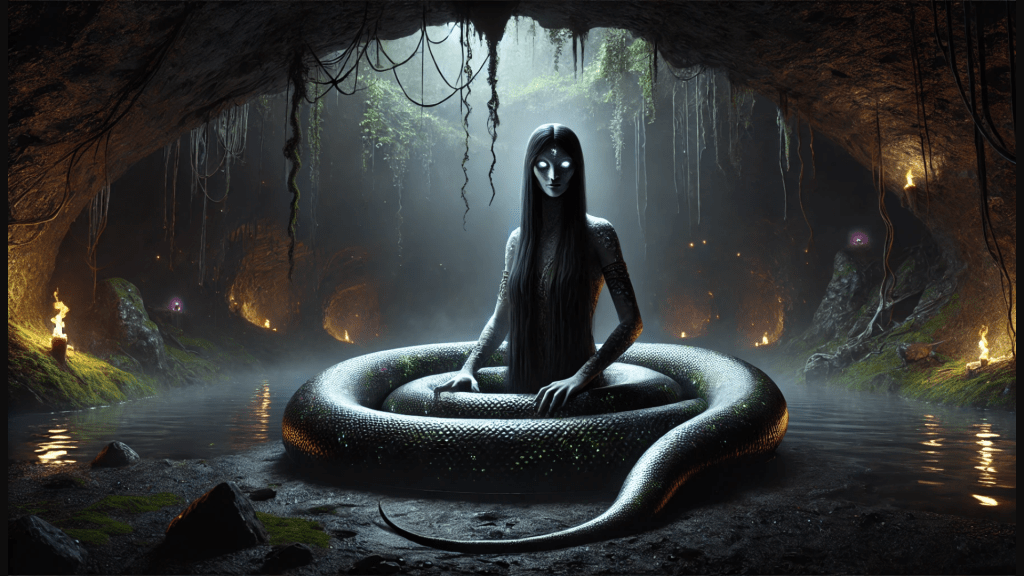
Echidna, known as the “Mother of All Monsters” in Greek mythology, was a fearsome creature with the upper body of a woman and the lower half of a serpent. She was said to dwell in deep, hidden caves, far from the reach of gods and mortals alike. Her origins vary in different myths, but she is often considered the daughter of primordial deities such as Gaia and Tartarus. Some accounts also name Phorcys and Ceto, ancient sea monsters, as her parents. Echidna embodied both beauty and terror, luring unsuspecting travelers into her lair before revealing her monstrous nature.
She was the mate of the fearsome giant Typhon, the most powerful of all monsters, who challenged Zeus for supremacy. Together, they gave birth to some of the most infamous beasts in Greek mythology, including Cerberus, the three-headed guard dog of the Underworld, and the Lernaean Hydra, a multi-headed serpent slain by Heracles. Other monstrous offspring included the Chimera, the Sphinx, the Nemean Lion, and the dragon Ladon. Each of these creatures played a role in the trials of Greek heroes, making Echidna a foundational figure in many legendary battles.
Despite her role in birthing terror, Echidna herself did not seek to overthrow the gods. Instead, she lived in the shadows, protecting her monstrous children and ensuring their survival. Some myths say that Zeus allowed her to live as a test for future heroes, ensuring that the world would always have formidable foes. Others suggest that she was slain by Argus Panoptes, the hundred-eyed giant, in service to the Olympians. Regardless of her fate, her legacy endured through her monstrous offspring, who continued to challenge heroes like Heracles, Perseus, and Oedipus.
“But she was monstrous, a nothing-like-nothing-perverse wonder,
Half a fair-cheeked nymph, but underneath a monstrous serpent,
Terrible, great, and glancing, and eating raw flesh underground,
In the secret place of the divine earth.”
– Hesiod, Theogony (translated by H.G. Evelyn-White)
Echidna’s unique nature made her a symbol of the balance between beauty and horror, life and destruction. She represented the chaotic forces of nature that could not be entirely tamed, only confronted and overcome. Her story intertwines with the themes of heroism, as many of her offspring served as obstacles for champions to prove their strength. While she is often overshadowed by her monstrous children, her influence on Greek mythology is undeniable. She was the mother of chaos, ensuring that heroes would always have battles to fight.
In later interpretations, Echidna has been reimagined in various ways, sometimes depicted as more tragic than terrifying. Some modern stories portray her as a misunderstood figure, protecting her children from a world that seeks to destroy them. Others emphasize her power and independence, making her a force beyond the control of gods and mortals alike. Regardless of the version, she remains an enduring symbol of primal strength and monstrous motherhood.
Though often overlooked in favor of her more famous offspring, Echidna’s mythic presence looms large in Greek lore. She serves as a reminder that monsters are not merely enemies but necessary forces that drive heroes to greatness. Without her, many of the most famous Greek legends would lack their most fearsome adversaries. She is both creator and destroyer, the mother of beasts and the silent architect of heroic trials. In this way, Echidna remains one of mythology’s most fascinating and complex figures.
 B. K. P. Carreon
Leave a comment