The Multi-headed Serpent
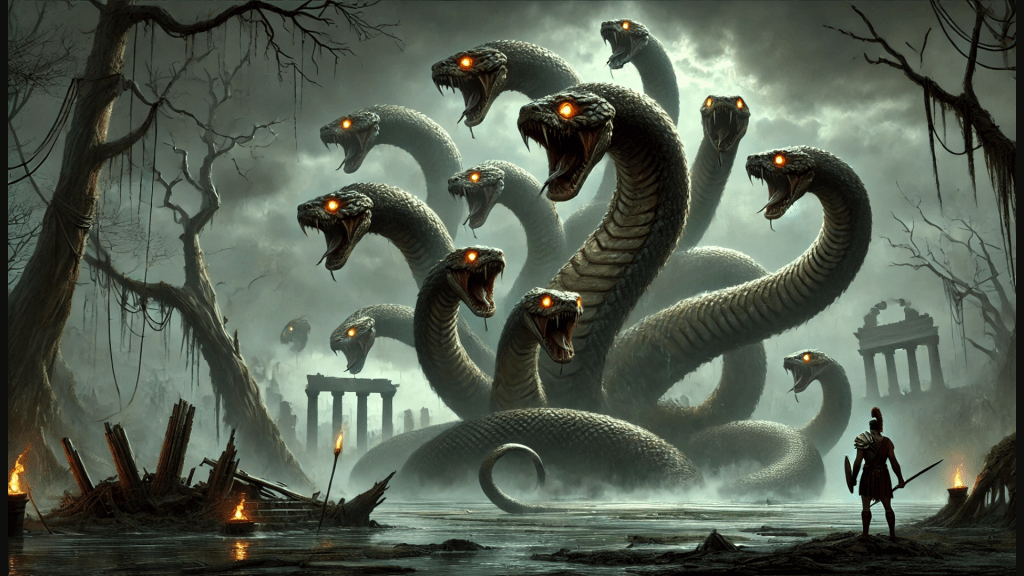
In the ancient Greek region of Lerna, a fearsome beast known as the Hydra terrorized the land. This monstrous serpent had multiple heads—most versions say nine—and for every head cut off, two more would grow in its place. Its blood and breath were poisonous, making it a deadly foe even from afar. The Hydra lived in a murky swamp, emerging only to attack livestock and villagers. None dared face it—until Heracles came.
Heracles, the mighty son of Zeus, was tasked with slaying the Hydra as one of his Twelve Labors. Knowing the creature’s regenerative power, he brought his nephew Iolaus to assist him. Heracles confronted the Hydra with his sword and club, chopping off heads with brute force. But as expected, two heads grew back for every one removed. The battle seemed endless, the swamp filled with steam and roars.
“Having gone to Lerna with Iolaus, he mounted a chariot and found the Hydra on a raised ground near the springs of Amymone, where it had its lair. Firing flaming arrows at it, he forced it to come out, and as it emerged, he seized it. But when he struck off one of its heads, two grew in its place…”
— Apollodorus, The Library, Book 1, Chapter 9, Section 7 (translated by Sir James George Frazer)
Iolaus came up with a brilliant idea: they would cauterize each stump after Heracles cut off a head. Using a torch, Iolaus burned the necks, preventing new heads from growing. One by one, they disabled the beast, slowing its regeneration. The immortal central head, however, proved nearly indestructible. Heracles eventually crushed it beneath a massive rock.
With the Hydra finally dead, Heracles dipped his arrows in the creature’s poisonous blood. This made his weapons lethal even with the slightest wound. However, the toxic blood would one day bring Heracles his own doom. For now, though, he had triumphed, completing the second of his Twelve Labors. The people of Lerna were safe at last.
The myth of the Hydra endures as a symbol of overwhelming challenges that grow stronger if not properly faced. It reflects the cunning and teamwork sometimes required to defeat monstrous problems. The tale also warns of the hidden costs of violence, as Heracles’ poisoned arrows led to future tragedies. In modern times, the Hydra represents problems that multiply—cut one down, and more arise. Still, like Heracles, persistence and cleverness can overcome even the deadliest threats.
 B. K. P. Carreon
Leave a comment