Father of Chaos
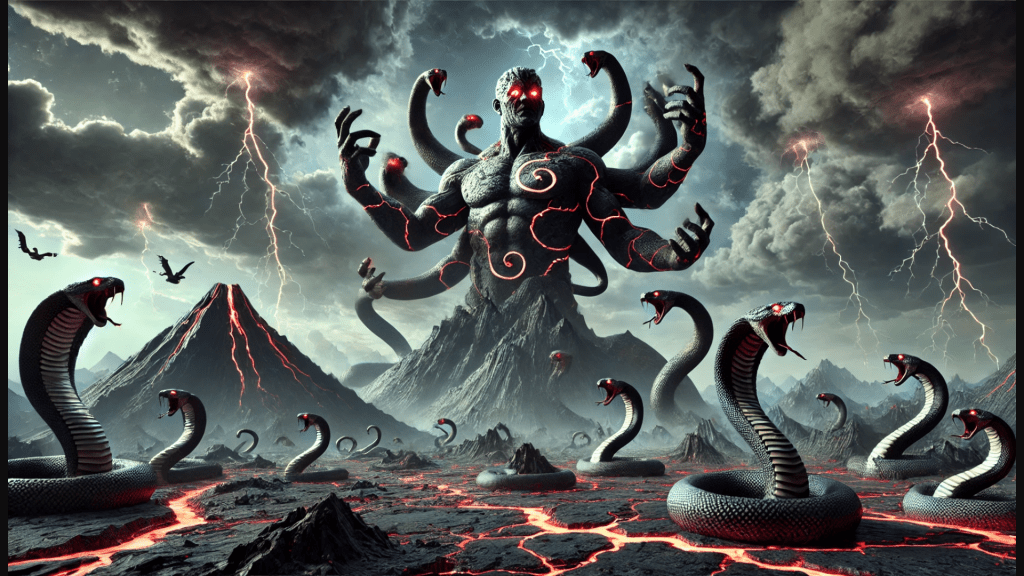
Typhon, in Greek mythology, was the last and most fearsome child of Gaia (Earth), born in revenge after the Titans were overthrown by the Olympians. Gaia, furious at Zeus for imprisoning her children, created Typhon with Tartarus as his father. Typhon was a monstrous giant, described as taller than mountains, with a hundred dragon heads, wings, and a lower body of writhing snakes. His voice could mimic animals and humans, and flames spewed from his eyes. He was the embodiment of chaos and destruction, feared by both mortals and gods alike.
Typhon rose against the Olympians in a cataclysmic battle for control of the cosmos. With his massive size and devastating powers, he struck fear into the gods of Olympus, who fled in terror. Most disguised themselves as animals to escape, while Zeus alone stood firm against the beast. The initial battle shook the heavens and the earth, as the two clashed with thunderbolts and storms. The skies burned as Zeus hurled lightning, but Typhon was not so easily subdued.
In their first confrontation, Typhon managed to overpower Zeus. He tore the sinews from Zeus’s hands and feet, rendering him powerless. The god was taken captive and hidden in a cave, guarded by a she-dragon named Delphyne. The rest of the Olympians were paralyzed with fear, their leader crippled and imprisoned. But Hermes and Pan, using cunning and stealth, eventually rescued Zeus and restored his strength.
“From his shoulders grew a hundred snaky heads of a fearful dragon, with dark, flickering tongues, and from under the brows of his eyes in his marvelous heads flashed fire, and fire burned from his heads as he glared. And there were voices in all his dreadful heads, which uttered every kind of sound unspeakable…”
— Hesiod, Theogony, translated by Hugh G. Evelyn-White
Once recovered, Zeus unleashed his full fury upon Typhon in a second, even more titanic battle. He chased the monster across the earth, from Mount Olympus to Mount Etna, striking him with thunderbolts as they raced. Typhon fought back with hurricanes, boulders, and fire, but even he could not match the king of the gods at full strength. Zeus finally gained the upper hand by hurling Mount Etna atop Typhon. Trapped beneath the mountain, Typhon was finally defeated.
Even in defeat, Typhon’s legacy endured. The Greeks believed that the volcanic eruptions and earthquakes of Mount Etna were caused by the imprisoned Typhon struggling beneath the earth. His children, such as Cerberus, the Hydra, and the Chimera, continued to trouble the world. Though he had been vanquished, his monstrous bloodline persisted through many more myths and legends. Typhon’s existence marked the final challenge to Zeus’s supremacy. His fall sealed the Olympian gods’ dominion over the cosmos.
The myth of Typhon symbolized the victory of order over chaos in Greek cosmology. Typhon represented the raw, untamed forces of nature—destructive and primal—opposing the structured rule of Zeus. His battle with the Olympians echoed earlier mythic cycles of divine struggle, such as the Titanomachy. But Typhon was unique in his overwhelming, elemental power. His defeat was not just a win for Zeus, but for the balance of the universe itself.
Through this myth, the Greeks explained natural disasters and reinforced the power of their gods. Typhon was a cautionary figure, a monstrous being who dared challenge divine authority and paid the price. His story served to highlight Zeus’s role as protector and enforcer of cosmic order. It was a tale of terror, bravery, and triumph told to awe and educate. And in the smoking craters of Sicily, his legend lived on.
 B. K. P. Carreon
Leave a comment