Overview:
| Back at the guesthouse, Greg shares suman with his parents, Al and Emily. Out on the veranda, Ellie notices storm clouds forming and points them out to her husband, Ansel, and her brother, Ronald. Elsewhere on the property, Thalia and Enrico scold Morissette for losing track of their daughter Allison at the pool. Meanwhile, Bill and his wife Selena discuss their options for a rest house in the Philippines when their butler, Carlisle, informs them that their son, Topher, is missing. Down in the cave, Topher leads his cousins and their friend Roanne to the cavern where he discovered the board—and where the star remains trapped. |
The_suman_incident.sav
Look, I’m not gonna sugarcoat this—watching Tito Greg demolish that suman is basically watching a man experience transcendence through glutinous rice. It’s like that scene in Ratatouille where Anton Ego gets hit by childhood nostalgia, except Filipino-style and way less pretentious.
The Pangilinan guesthouse dining room has that classic provincial vibe going on—wooden furniture that’s probably older than myself, walls painted in that specific shade of cream that screams “Lola chose this in 1987,” and the afternoon light slanting through capiz shell windows like some low-budget Instagram filter. The grandfather clock in the corner ticks away, measuring time in the most analog way possible.
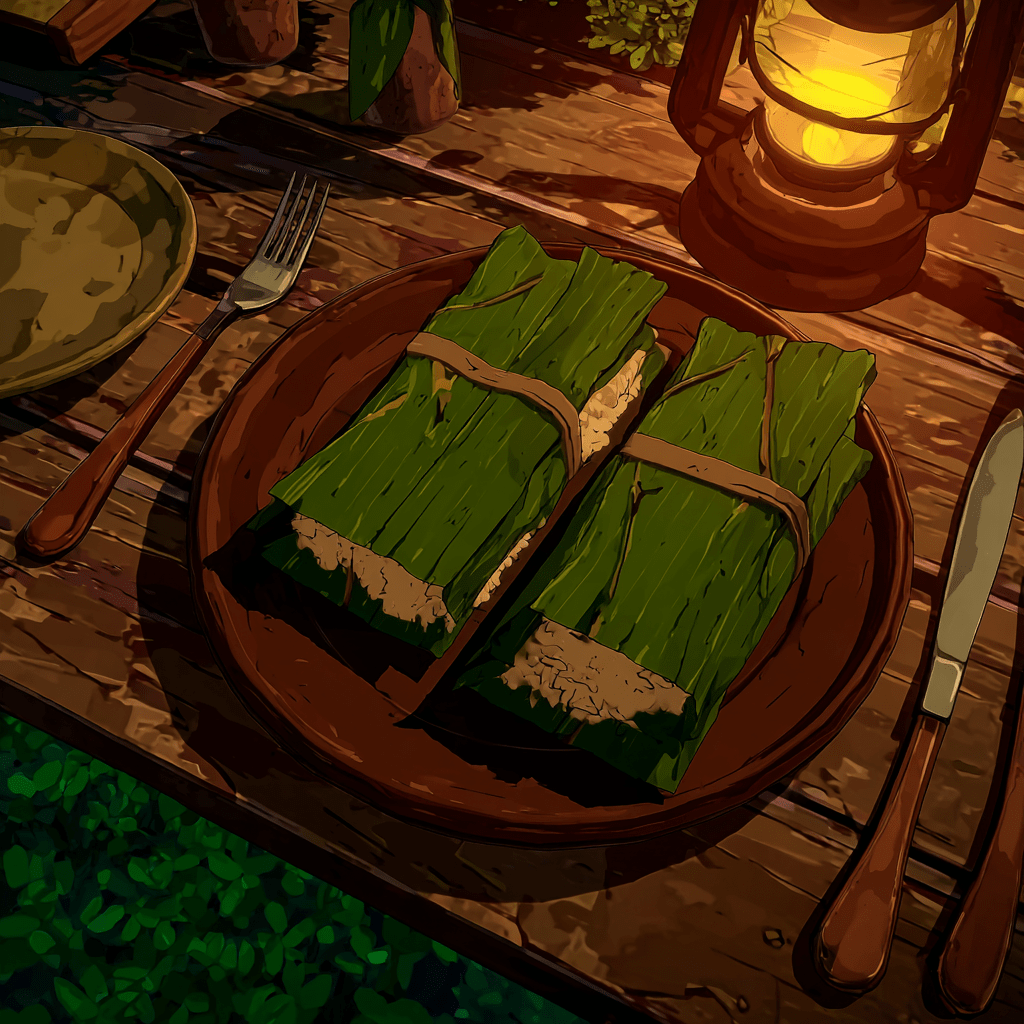
Tito Greg sits hunched over the table, unwrapping a pair of suman from their banana leaf packaging with the focus of a surgeon performing open-heart surgery. Suman sa lihiya, to be exact—the kind soaked in lye water that gives it that weird yellowish tint and slightly alkaline taste. They’re bundled together like conjoined twins, which is why people call them akap-akap. Literally “embrace-embrace.” Filipinos and their cutesy food names, honestly.
The man’s fingers work the leaves apart, releasing that distinct coconut-steam smell that fills the room. He grabs the container of latik—those browned coconut curds that look like crushed Butterfinger bits but taste infinitely better—and sprinkles them over the sticky rice with the confidence of a master chef seasoning his masterpiece.
His fork descends. Stab. Dip. Stab again. It’s a three-move combo that would make any Tekken player proud.
The first bite hits, and Tito Greg’s eyes do that half-closed thing that signals pure gustatory satisfaction. His jaw works slowly, savoring every molecule of coconut-infused carbohydrate. There’s almost a spiritual quality to it, like he’s communing with ancient Filipino ancestors through the medium of kakanin.
“Is it good, Greg?” Lola Emily asks from across the table, though the answer’s written all over her son’s face in high-definition clarity.
She’s in her late sixties, wearing that uniform of provincial grandmothers everywhere—floral duster, reading glasses on a beaded chain, hair pulled into a practical bun. Lolo Al sits beside her, equally absorbed in his own suman, nodding along like a backup dancer.
“So delicious, Inay,” Tito Greg says, laying it on thick with the enthusiasm of a paid testimonial. His fork’s already spearing another piece. The man’s a suman-eating machine at this point.
“It was a great idea to buy Florencia’s suman. Hers are the best in Lemery,” Lolo Al declares with the authority of someone who’s sampled every kakanin vendor within a fifty-kilometer radius.
“That’s why I always go to her for my kakanin—from biko to puto, sapin-sapin, and kutsinta, she has it all,” Lola Emily responds, voice swelling with that particular pride Filipinos reserve for discussing food vendors they’ve known for decades.
I watch this whole exchange from the doorway, mentally cataloging it under “Wholesome Filipino Family Moments™”—the kind of scene that feels simultaneously foreign and familiar, like watching a sitcom set in your own culture.
Classic side quest material, I think, but you know what? Sometimes the side quests are better than the main storyline.
Storm_warning_protocol.sav

I watch Tita Ellie execute what I privately call the “Aunt Sense Protocol”—that superhuman ability aunts have to detect incoming weather disasters like they’ve got built-in barometric pressure sensors. It’s basically Spider-Sense, except instead of dodging punches, they’re dodging potential flu season.
The guesthouse patio exists in that liminal space between inside and outside—roofed but open-aired, furnished with weathered wooden benches that have absorbed decades of family gatherings. Potted plants line the edges, their leaves already starting to shiver in the pre-storm breeze. The afternoon light has that weird apocalyptic quality, filtering through clouds that look like they’ve been copy-pasted from every disaster movie ever made.
Tita Ellie kneels on one of the benches—actually kneels, committing fully to the position like she’s praying to the weather gods for mercy. Her waist presses against the wooden railing as she leans forward, squinting at the sky with the intensity of a meteorologist analyzing satellite data. She’s in her mid-twenties, wearing a casual terno top and jeans, her hair pulled into a no-nonsense headband that says I have children to protect and no time for aesthetic concerns.
The sky looks like someone turned down the brightness settings on reality. Gray clouds stack up like a poorly-rendered skybox, dim and heavy with unspent rain. The kind of weather that makes you want to boot up Minecraft and build a shelter before nightfall.
Tita Ellie’s face does this thing—mouth pulling downward, eyebrows furrowing, the universal expression of oh hell no. “We need to call the parents and get the kids inside—it’s about to rain,” she announces, turning toward her husband.
Tito Ansel sits on the opposite bench, mid-laugh with Tito Ronald over something probably dad-joke-adjacent. He’s the chill type—button-up shirt rolled to the elbows. The request registers, and he nods with the practiced efficiency of a man who’s learned that arguing with wife-detected weather patterns is a losing strategy.
His phone emerges from his pocket—one of those newer Samsung models, screen already unlocked via fingerprint. His thumbs move across the keyboard with fitting speed for someone his age, composing a message that reads like a disaster preparedness PSA:
Ellie checked the weather, and it’s bad. Please bring the kids back to the guesthouse. Swimming in the pool while it’s raining might give them colds. If a storm hits, the waves from the shore could climb high, which would be dangerous. Best to keep the children safe.
The timestamp reads 2:50 PM. Tito Ansel hits send to Mama Thalia—Emergency Broadcast System, Sevilla Edition. Then he pulls the classic copy-paste maneuver, redirecting the same message to Mama Selena for the Kennedy delegation. Efficiency: 100. It’s like watching someone execute a perfectly timed speedrun strat.
“I’ll go inside and let Martha and Greg know,” Tito Ronald volunteers, pushing himself off the bench with a slight grunt. “Their sons—James, Benjamin, and Michael—and their daughter Sophie are still outdoors.”
He disappears through the doorway, moving with purpose, leaving Tita Ellie still stationed at her weather-watching post and Tito Ansel staring at his phone like he’s waiting for read receipts.
Classic disaster-movie setup, I think. Parents sense danger, kids are scattered across the map, timer starts counting down. Someone should really add dramatic background music right about now.
The_lost_kid_scenario.sav

Okay, so here’s the thing about family resort trips—they always devolve into that one predictable disaster arc where someone loses track of a kid. It’s like a mandatory side quest. I’ve seen this exact scenario play out in every family sitcom from Full House to Modern Family, and now I’m watching it go down IRL at the Pangilinan guesthouse kiddie pool.
Mommy Thalia and Daddy Enrico materialize at the pool area like NPCs returning to their spawn point. They’re both soaking wet, terry cloth towels wrapped around them like makeshift capes. Tito Enrico’s rocking this unbuttoned dark floral polo that screams “I’m on vacation and the rules don’t apply”—the fabric hangs open, exposing his dad-bod in all its glory. Not ripped, not flabby, just that specific middle-aged physique that says I used to work out in college. Water drips from his hair, forming small puddles on the concrete.
Mommy Thalia’s in better shape, her one-piece swimsuit visible under the towel, hair plastered to her scalp. She’s got that hurried expression—eyebrows raised, mouth set in a thin line—the look of someone carrying urgent information.
“Ansel texted, and we saw the weather—it’s about to rain,” she announces to Morissette, who’s stationed poolside like a lifeguard on break.
The maid sits on one of those white plastic monobloc chairs that exist at every Filipino gathering ever—the kind that cost fifty pesos and somehow survive nuclear-level abuse. She’s younger, early thirties maybe, wearing a black swimsuit since she’s technically off-duty but still somehow on-duty because that’s how household staff roles work.
Daddy Enrico drops into the bench next to his wife, and that’s when the boss music kicks in. His eyes scan the area—empty kiddie pool, scattered floaties, no seven-year-old in sight. “Where’s Allison? You’re supposed to be looking after her.”
Oh no, I think. Here comes the boss fight dialogue.
Morissette freezes like her character model just glitched. Her mouth opens, closes, opens again. Classic panic animation. “Allison…is missing. I sent her messages, but she hasn’t replied.”
The words hang in the air like a grenade with the pin pulled.
“What?!” Mommy Thalia’s shock registers at maximum volume, her entire body jerking forward. For a split second, her brain refuses to process the information—error 404: daughter not found.
Daddy Enrico’s face shifts through several expressions in rapid succession: confusion, comprehension, then pure parental rage. “You lost our daughter? What happened?”
Morissette’s hands twist together, fingers knotting like she’s trying to physically hold herself together. “Uh…I was getting a back massage from Carlisle—you know, the butler of the Kennedys. Allison asked for permission to go to the girls’ restroom, and after that, she just disappeared.”
Wow. I mentally categorize this under “Explanations That Make Everything Worse.”
Mommy Thalia’s disappointment hits like a critical damage multiplier. “So, you prioritized your love life over our daughter’s safety?” Her voice carries that specific mother-tone that could cut through steel. “I’ve supported your budding romance, but this? You’ve crossed the line.”
Daddy Enrico leans forward, jabbing a finger toward Morissette like he’s selecting a dialogue option. “If anything happens to Allison, I’ll fire you.”
The threat lands with finality. Morissette sits completely still, frozen in place like someone hit pause on her character. Around them, the pool area suddenly feels way too quiet, the approaching storm making everything worse.
Classic fetch quest incoming, I observe. Time limit: before the rain hits. Objective: locate one missing seven-year-old. Difficulty: Hard Mode.
The_house_hunt_debrief.sav

Here’s what I know about real estate hunting in the Philippines: it’s basically like playing The Sims, except with actual money and way more humidity. And right now, I’m watching Selena and Bill do their post-mission debriefing as they walk downslope from wherever they’ve been scouting properties all morning.
The path they’re descending is one of those semi-paved resort roads—concrete slabs interrupted by patches of dirt and the occasional rogue weed pushing through cracks like nature’s no to infrastructure. Afternoon shadows stretch long across the ground, and the dimming sky above gives everything this weird pre-storm filter that makes colors look slightly desaturated. Very cinematic, I think. Very ominous foreshadowing.
Selena and Bill walk arm-in-arm like they’re starring in some romantic drama, except they’re both in their early to mid-40s and dressed in practical resort-casual attire—her in a breezy blouse with a cardigan draped over her shoulders, him in khaki shorts and a collared shirt that’s got that “I’m a dad but I still have style” energy. They move in sync, that comfortable rhythm married couples develop after years of navigating life together.
“We managed to see three resthouses today,” Selena says, her voice carrying that satisfied exhaustion of accomplished tasks. “It’s good we started early at 9 a.m. It’s a shame the weather went bad; we could’ve checked the fourth one.”
She’s got this reflective expression—eyes slightly unfocused, mentally reviewing their morning like she’s scrolling through a highlights reel. Her free hand gestures vaguely as she speaks, the universal body language for processing information out loud.
Bill adjusts his grip on her shoulder, pulling her slightly closer. He’s got that quintessential American optimism thing going—the kind that probably drove Selena crazy when they first met but now she finds endearing. “We can still visit it. No worries, we’ll be in the Philippines for a week or so.”
His accent sits somewhere between Midwestern American and “I’ve lived abroad long enough to pick up local speech patterns”—not quite native, not quite foreign. It’s the linguistic equivalent of being a third-culture kid.
“Which one do you like best?” Selena asks, tilting her head toward him.
Bill’s face does this thing where he squints slightly, activating Professor Mode. I recognize it—that expression people make when they’re about to deliver a detailed analysis complete with supporting evidence and subsections.
“Well, the first one—it’s the best in terms of floor and lot size. It’s a big mansion with a vast green field.” His hand gestures outward, painting the picture in the air between them. “You know how Topher loves to run around.”
Valid point, I concede mentally. The kid’s basically got unlimited energy. Probably needs like three football fields just to burn through his daily stamina bar.
“The second one has the best style and design,” Bill continues, warming to his topic. He’s getting animated now, hands moving more expressively. “The tropical, Southeast Asian, authentically Filipino interior and exterior are amazing. Incorporating the country’s heritage into the modern home is a beautiful touch.”
He pauses, and his expression softens into something almost wistful. “Topher loves learning about different cultures and meeting people from all walks of life.”
There’s this tone in his voice—pride mixed with something deeper. The kind of love that manifests as understanding your kid’s personality and trying to build a life that supports who they are. It’s wholesome in a way that makes me feel slightly awkward, like I’m witnessing something too genuine for my chill worldview.
Selena’s smile quirks upward, one eyebrow raising. “If you ask me, I’d settle for the third one.”
“Are you sure?” Bill’s surprise is immediate, his head turning fully toward her. “It’s the smallest.”
“It’s still a big house,” she counters, and now there’s this different quality to her voice—something softer, more intimate. Her eyes meet his with that married-couple telepathy that speaks volumes without saying anything. “The smaller rooms are better for intimate family gatherings. I don’t need to search far to find you or Topher. We’d see each other more easily.”
Oh, I think. That’s actually kind of devastating in the best way. It’s the kind of reasoning that reveals priorities—not about square footage or architectural aesthetics, but about proximity, about family being present with each other. It’s the emotional intelligence response to the logical analysis, and somehow it makes perfect sense.
Bill’s face melts into this dopey smile that confirms he’s absolutely sold on whatever his wife wants. Classic husband behavior. He’s probably already mentally rewriting his property analysis to justify why the third house was actually his first choice all along.
Then Carlisle appears.
And by “appears,” I mean the dude basically materializes in front of them like he’s got teleportation abilities or really good stealth stats. He’s the Kennedy family butler—a gentleman, probably late twenties, wearing slacks and a button-up shirt that somehow remains crisp despite the humidity. His posture is impeccable, that trained domestic staff bearing that makes everyone else’s slouching look even worse by comparison.
“Carlisle, you’re here,” Selena says, her smile reflexive and warm. Then her brain catches up with the visual data: Butler present. Child absent. Her expression shifts, eyebrows drawing together. “But where’s Topher? He’s not with you.”
Carlisle’s professional composure cracks just slightly—a microscopic flinch, a tightening around his eyes. “I’m sorry, Madam. Your son wandered off, and I lost track of him.”
The words land like a critical hit.
“What do you mean?” Selena’s confusion is immediate, her head tilting as if changing the angle will make the information make more sense.
Bill’s entire body language transforms in real-time. His shoulders tense, jaw setting, eyes sharpening with that primal parental fear that overrides every other system. The casual, relaxed tourist-dad vanishes, replaced by concerned father entering emergency protocol. His hand drops from Selena’s shoulder as he steps forward slightly, body instinctively positioning itself between his wife and the bearer of bad news.
And there it is, I observe, watching the scene crystallize into disaster. Lost kid #2. This is officially a pattern. Someone needs to implement better party management systems around here, because clearly everyone’s failing their Perception checks.
The storm clouds overhead choose this exact moment to darken another shade, because of course they do. Dramatic timing is apparently a meteorological feature in this region.
The_cavern_discovery.sav

Topher hits the cavern first, and I gotta admit—the kid’s got protagonist energy. Like, serious main character syndrome, the kind where background music should be swelling and the camera should be doing that dramatic slow-pan reveal. He bursts into the chamber with the enthusiasm of a Zelda player who just found the dungeon’s treasure room, his sneakers skidding slightly on the damp stone floor.
The cavern itself is legit impressive—one of those natural formations that makes you wonder if nature’s secretly running procedural generation algorithms. The ceiling arches high overhead, easily twenty feet up, with stalactites hanging like nature’s chandeliers. Moisture gleams on the rock walls, catching whatever dim light filters in from the cave entrance behind them. The air tastes mineral-heavy, cool and slightly musty, with that underground smell that’s somewhere between “ancient history” and “potential bat habitat.”
And there, sandwiched between two moss-covered boulders like the world’s most elaborate hiding spot, sits the board game.
Topher’s face does this whole Christmas morning transformation—eyes widening, mouth splitting into this massive grin that shows all his teeth. His entire body language screams VICTORY ACHIEVED. “It’s here, guys. Look!” He’s pointing at the board like it might vanish if he doesn’t physically direct everyone’s attention to it.
The rest of the party files in behind him—James, Benjamin, Michael, Sophie, Roanne, and Allison, who’s still got her phone mounted on that selfie stick like she’s documenting an archaeological expedition for her YouTube channel. The Blair Witch Project, but make it Filipino family vacation content.
Benjamin’s analytical brain kicks into overdrive the second he sees the board. That board game is huge. It looks like two boards stuck together. His eyes trace the dimensions, already calculating measurements, his head tilting slightly in that signature “processing information” pose he does. The dude’s probably running mental comparisons to standard board game sizes, cross-referencing with every tabletop game he’s ever seen.
What none of them notice—except maybe Topher, because the kid’s apparently got some kind of mystical connection going on—is the navy crystal ball at the board’s center. Inside, the blue-white shooting star pulses with faint luminescence, and around it, six other tiny lights have appeared: cyan, scarlet, orange, yellow, pink, and seafoam green. They orbit the shooting star like a miniature solar system, glowing with the subtle intensity of LEDs on standby mode.
Very sci-fi, I think. Very “ancient alien technology disguised as a children’s toy” vibes.
Topher drops to one knee beside the board, hands pressed against the cold stone floor, leaning forward with the kind of reverence usually reserved for holy relics. “My little friend, my cousins and I are here to save you. Roanne’s here too.”
He’s talking to the shooting star. To the board game. With complete sincerity.
Okay, so we’ve officially entered the “kid believes in magic” territory, I catalog. Classic fantasy protagonist origin story. The Chosen One Who Believes When No One Else Does.
“Kuyas James, Benjamin, and Michael, can you help me pull the board game out from between the boulders?” Topher’s politeness is almost painful—that formal respect Filipino kids show their elders mixed with genuine pleading.
Michael’s response is immediate and characteristically extra. “We’re gonna yank that board out!” He flexes his bicep like he’s about to enter a strongman competition, the muscle definition barely visible under his eleven-year-old arms. The kid’s got confidence though, I will give him that.
Michael charges forward first—because of course he does, the dude’s basically hardwired for action-first-think-later gameplay. James follows with more measured movement, hands already reaching for the board’s edge. Benjamin brings up the rear, probably still calculating optimal force distribution and grip points.
The three boys position themselves around the board, fingers wedging into the gaps between wood and stone. Their shoulders bunch, backs tensing as they coordinate the pull. Michael grunts with effort, James’ face scrunches in concentration, and Benjamin mutters something under his breath that’s probably mathematical.
The board shifts. Slowly. Rock scrapes against wood with this low grinding sound that echoes through the cavern.
Sophie watches from the sidelines, her four-year-old hands clasped together against her chest like she’s praying. The shooting star is one step closer to freedom, she thinks, her imagination fully committed to Topher’s narrative. Her eyes are huge and shining, reflecting that pure childhood belief in magic that hasn’t been cynicism-poisoned yet.
Roanne stands slightly apart, her gaze directed upward toward the cavern ceiling. Her posture is contemplative, arms crossed loosely, expression unreadable. She’s the outlier in this group dynamic—the older kid who’s adjacent to the cousins but not quite part of them, observing more than participating.
And Allison? Allison’s got her arm extended at maximum selfie-stick range, phone camera capturing everything with the dedication of a professional documentarian. Her thumb probably hovers over the record button, making sure she’s getting all the angles, already mentally editing the footage into content gold.
This whole scene, I think, is either the beginning of something incredible or the setup for the world’s most elaborate prank. Either way, it’s definitely going viral.
 B. K. P. Carreon
Leave a comment