Overview:
| Roanne watches as Topher, a young scout, builds a fire for the group. Benjamin compares the board game’s cover to the Aristotelian model of the universe, while Allison opens the game’s twin doors akin to unboxing. For her vlog, Allison showcases the board’s seven panels, the Seven Worlds, along with the color-coded platforms sprawling across its interconnected surface. James reads the rules aloud to the group as Michael grows excited over the ominous prophecy that foreshadows the game’s end. |
Achievement_unlocked_firecraft.sav
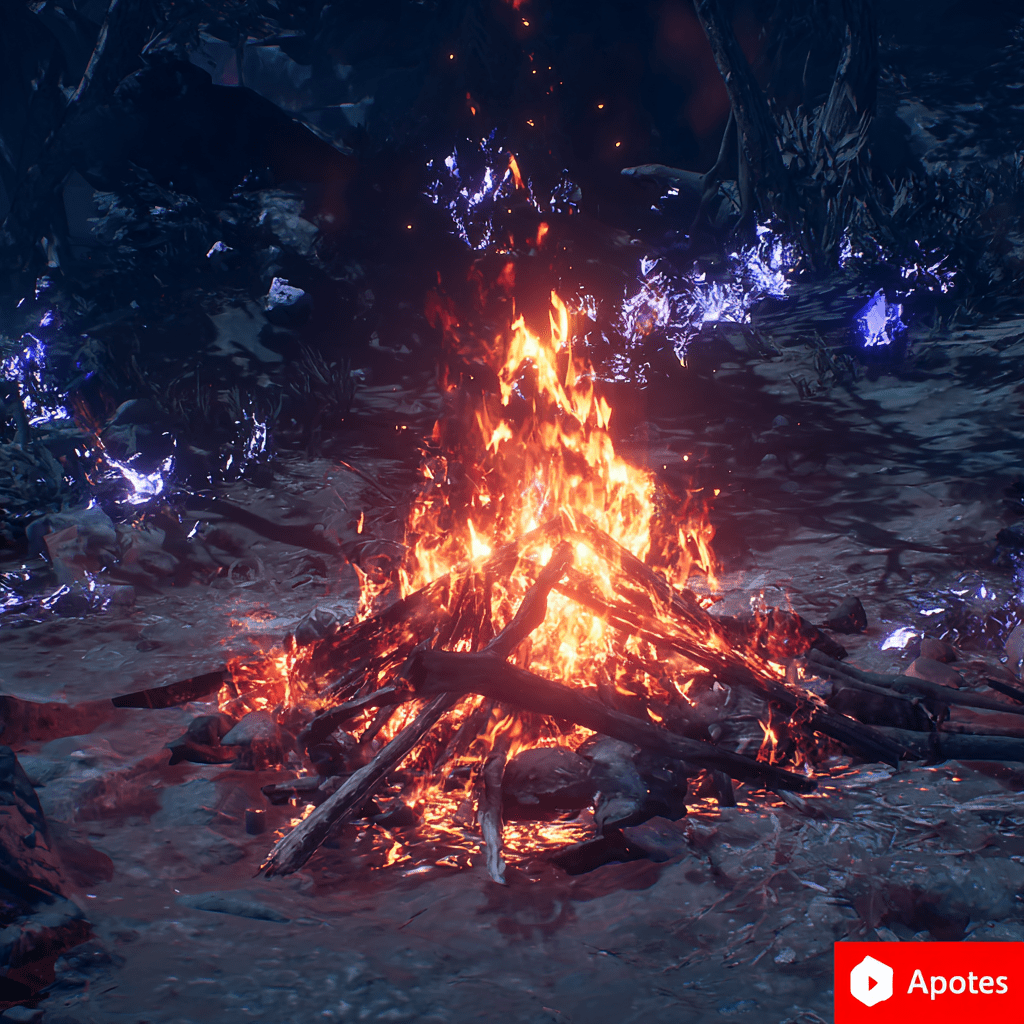
Topher—or as I mentally tag him, Kid Paladin—crouches near a flat patch of cave floor, squinting like he’s sizing up a boss arena in Dark Souls. The rock beneath his sneakers is cold, damp, gritty. Around him: a scattered loot table of nature’s starter pack—gnarled branches, brittle twigs, a carpet of dead leaves that crunch when he nudges them with his fingertips.
Classic survival game mechanics, I think, watching from a few feet away. Gather materials. Craft fire. Don’t die.
Topher’s hands move with surprising precision for a nine-year-old. He arranges a ring of stones—his firepit boundary, like placing torches in Minecraft to mark safe zones. Then he lays down the base layer: sticks crisscrossed like a makeshift grid, twigs wedged between gaps. Dry grass and crumbled leaves go on top, a tinder nest that looks almost too textbook. Kid’s been watching Bear Grylls or something.
Then comes the moment. Topher digs into his cargo shorts pocket—because of course he’s got cargo shorts, maximum inventory space—and pulls out a blue plastic lighter. The flick echoes in the cavern. Sparks. Flame. Contact.
The fire catches. Small at first, a timid orange glow licking at the edges of the leaves. Topher leans in, cheeks flushed, and blows—steady, controlled puffs like he’s playing a wind instrument in band class. The flames respond, growing bolder, hungrier. He feeds it more kindling, twig by twig, and I note the kid’s focus: brow furrowed, tongue poking out the corner of his mouth. That universal concentration face.
Four branches go down next, one on each cardinal direction—north, south, east, west—forming a perfect square perimeter. Then Topher stacks another four in a teepee formation inside the square, the classic log cabin-meets-tipi hybrid structure. Air flows through the gaps. The fire roars to life, a miniature bonfire now, spitting embers like tiny fireflies and billowing smoke toward the cave ceiling.
“It’s done!” Topher springs up, fists pumping, grin splitting his face ear to ear. Victory pose. Achievement unlocked: Firecraft 101.
Roanne—Ate Roanne, because she’s Filipino and older and that’s how it works—sits nearby, arms crossed, expression caught between impressed and deeply concerned. Her long dark hair frames a face that’s trying really hard to stay calm. She’s got that older-sister energy, the kind that’s equal parts protective and exasperated.
“If you ask me,” she says, voice measured but firm, “I’d prefer you hadn’t started a fire. You’re still too young.”
Topher’s grin falters. Just a bit.
“But we need a reliable light source,” Roanne continues, softening. Her shoulders drop half an inch. “And you’re the only one who knows how to build a fire. I can only watch over you to make sure you don’t burn or hurt yourself.”
There it is, I think. The classic mentor-student dynamic. Roanne’s running the support class build—no direct combat abilities, but clutch healing and buffs. And Topher? He’s the protagonist archetype. Brave. Resourceful. Probably gonna save everyone by the end of this cave side quest.
The firelight dances across their faces, warm and alive in the cold stone dark.
The_board_analyzing_the_artifact.sav
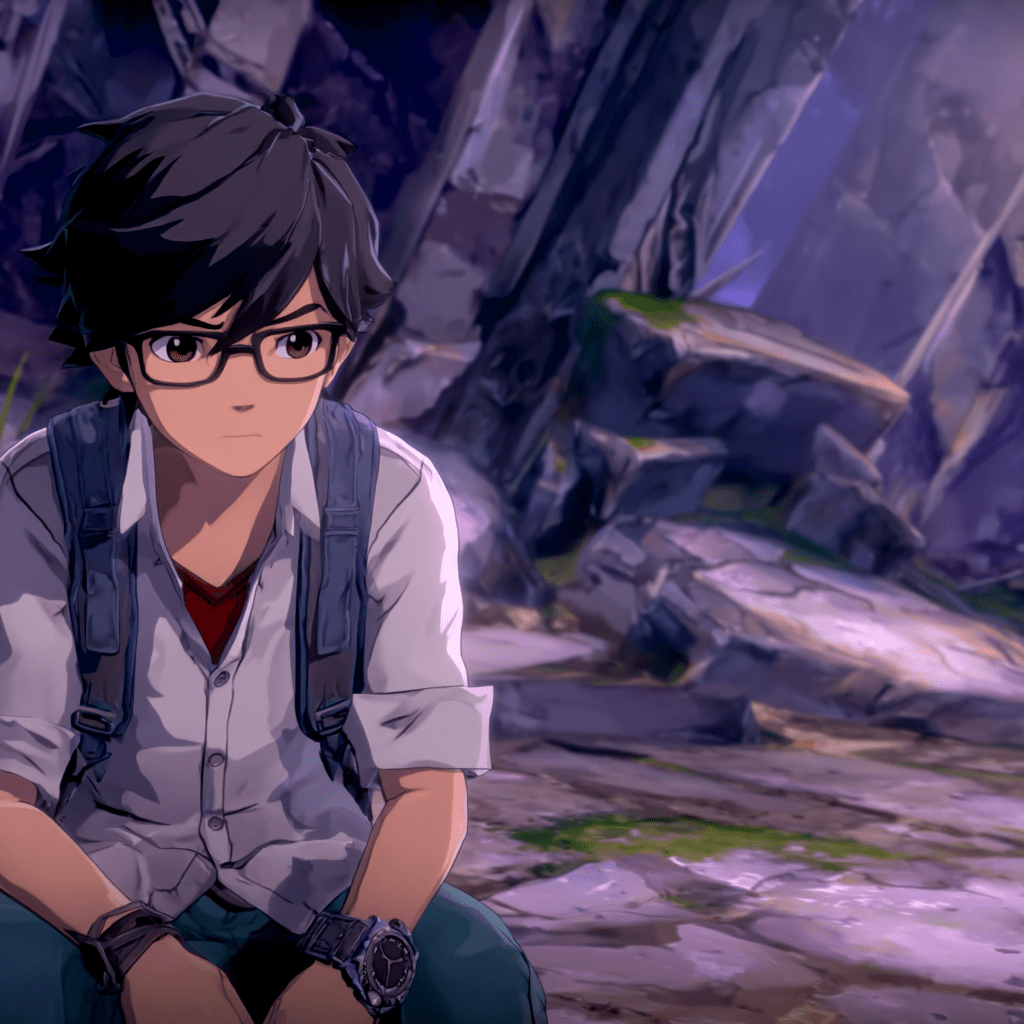
Benjamin—Captain Logic, as I privately dub him—hunches over the board game like a scholar deciphering the Rosetta Stone. His eyeglasses catch the flickering firelight, twin orange reflections dancing across the lenses as he leans closer, closer, until his nose is practically touching the wood. The kid’s got that trademark Benjamin Pangilinan posture: shoulders slightly hunched, jaw set in concentration, one hand braced on his knee while the other hovers above the board’s surface, tracing invisible lines through the air.
The board itself is massive. Not your standard Monopoly-sized rectangle—this thing’s double-wide, like someone fused two game boards together in some kind of tabletop Voltron situation. The wood is dark, polished, intricate. Hand-carved, maybe? I’ve seen enough custom gaming setups to recognize craftsmanship when it’s staring me in the face.
At the center sits a navy crystal ball, and inside it—suspended like a frozen comet—glows a blue-white shooting star. The carving radiates outward from there in concentric circles, each ring meticulously etched into the wood grain.
Benjamin’s internal monologue practically broadcasts itself through his furrowed brow and muttering lips. I heard enough of my ‘cousin’s’ nerdy tangents to translate: This isn’t random. This is a system. A model.
“It’s like an Aristotelian universe,” Benjamin murmurs aloud, pushing his glasses up the bridge of his nose with his index finger—classic anime intellectual move. “Seven concentric planes. Not eight elliptical orbits like the modern solar system.”
Okay, Captain Logic’s doing the exposition dump, I think, arms crossed, leaning against the cave wall. Let the man cook.
Benjamin traces the rings with his fingertip, not quite touching the surface. “The heliocentric model—Copernicus—puts the Sun at the center. Eight planets orbiting: Mercury, Venus, Earth, Mars, Jupiter, Saturn, Uranus, Neptune.” He pauses, lips twitching into the faintest smirk. “Pluto used to be ninth. RIP, little guy.”
Pour one out for Pluto, I mentally salute. Demoted in 2006. Never forget.
“But this“—Benjamin gestures at the board—”follows the geocentric model. Earth at the center, seven luminaries around it: Sun, Moon, Mercury, Venus, Mars, Jupiter, Saturn.” His finger stops mid-air. “Except… the Earth’s been replaced by the shooting star.”
So we’re dealing with cosmic substitution, I note. Main Character Syndrome for a literal star. Very anime. Very JRPG.
Benjamin’s gaze shifts to the outer edge of the board. Fifteen segments, each marked with strange glyphs—symbols that look half-astrological, half-Elder Scrolls Daedric script. “Earth’s zodiac has twelve constellations. Twelve segments. But this has fifteen.” His voice drops, like he’s stumbled onto a conspiracy theory subreddit. “What do these represent? What’s the pattern?”
Before he can spiral further into Academic Overthinking Mode™, Allison barrels in from stage left.
“Move, Sophie!” Allison hip-checks her little sister—gently, but with the confidence of someone who’s claimed this territory for Content Creation Purposes. Sophie squeaks, stumbling sideways, clutching her Winnie the Pooh coloring book to her chest like a shield.
Allison’s already got her phone out, screen glowing, front-facing camera active. Her thumb hovers over the record button. Her expression shifts instantly—from Bossy Older Sister to Bubbly Influencer—and I recognize the transformation. I’ve seen it a thousand times on YouTube. The Performance Face.
“Seven Worlds,’” Allison announces to her phone, voice bright and theatrical, practically dripping with hype. She angles the camera to capture both herself and the board. “What a title! Guys, you’ve never heard of it, right?”
She pauses for effect. I can almost hear the phantom YouTube editor dropping in a dramatic sting sound effect.
“Why? Because this is a prerelease board game!”
Oh, she’s doing the unboxing thing, I realize. We’re in an unboxing video. We’re NPCs in Allison’s vlog.
Allison runs her free hand—nails painted pink, because of course—over the board’s façade, fingers gliding across the carved wood like she’s caressing a holy relic. She stops at the crystal ball, tapping it lightly with one fingernail. Tink tink.
“This must be the star,” she coos into the camera, zooming in on the glowing blue-white star trapped inside the navy sphere.
Behind her, Benjamin’s still muttering about constellations and cosmological models. Sophie’s peeking over Allison’s shoulder, wide-eyed and curious. The bonfire crackles. Shadows dance on the cave walls.
And me? I watch it all unfold—this chaotic collision of intellectual analysis and social media documentation—and think, This is how every campaign starts. Someone finds a mysterious artifact. Someone else vlogs it. And then everything goes sideways.
I’ve played enough Mass Effect to know: they just triggered the main quest.
The_seven_worlds_unwrapping_the_mystery.sav
“The top façade is split into two sides,” Allison narrates into her phone, voice hitting that sweet spot between enthusiastic tour guide and late-night infomercial host. Her thumb swipes across the screen—adjusting angle, checking framing, making sure the lighting’s decent. “Each the size of one board. These must be the doors of the board game.” She pauses, eyes glinting with dramatic flair. “Or rather—gates to the Seven Worlds.” She finger-guns at the camera. “Sounds more fantasy, right?”
She’s not wrong, I admit from my mental peanut gallery. Doors = mundane. Gates = epic. It’s all about the branding.
“Let’s open it like we’re unwrapping a Christmas present!” Allison grips the edges of the façade—those ornate cosmic gates carved into the wood—and pulls. The doors swing open with a satisfying creaaak that echoes through the cave, revealing the board’s interior in all its multicolored, hyper-detailed glory.
I lean forward. Okay. Now we’re cooking.
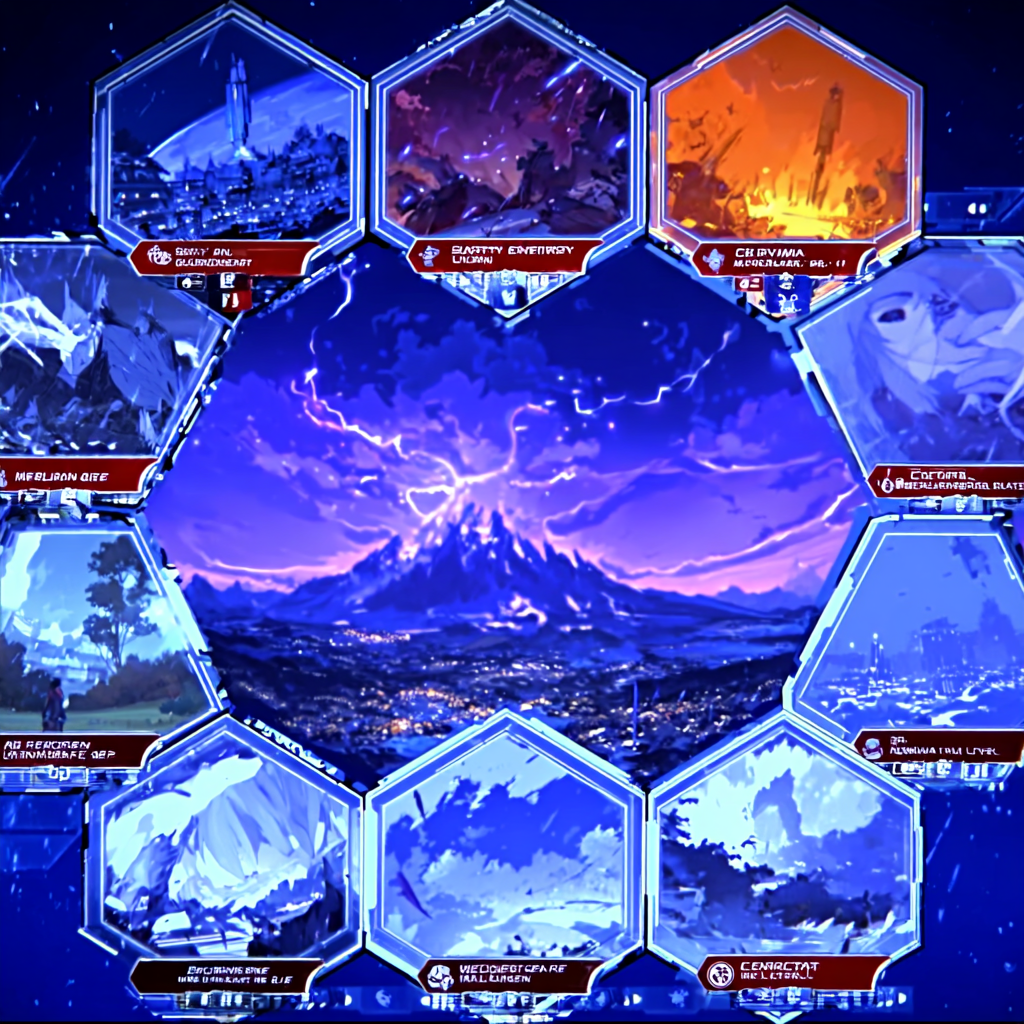
The board unfolds like a pop-up book from some fantasy artist’s fever dream. Seven distinct panels radiate outward from the crystal ball at the center, each one a self-contained world painted in vivid, almost too-saturated colors. It’s like someone took a pizza, made it square, and replaced the pepperoni with entire dimensions.
“Oh, it’s like a pie with seven slices—but square!” Allison zooms in on the board, panning slowly for her future viewers. “These seven panels must be the Seven Worlds. It makes sense to differentiate them.”
She starts at the top, camera following her finger as she traces the northern panel. “In the north—the heavens, shining golden.” The panel depicts a sky of radiant gold, clouds limned in holy light, the kind of celestial real estate you’d see in a Kingdom Hearts endgame level or a Renaissance painting. Angelic aesthetic. Maximum divine vibes.
Allison moves clockwise. “In the northwest—Kuya Benjamin, what’s this?” She tilts the phone toward her older cousin, who’s still crouched beside the board, squinting at the panel in question. “It looks like space, but with glowing clouds.”
Benjamin doesn’t even glance at the camera. His voice is flat, clipped, the tone of someone who’s been dragged into a YouTube video against his will. “That’s a nebula.”
Classic Benjamin, I think. Give the man a Nobel Prize for enthusiasm.
Allison pivots northeast without missing a beat. “In the northeast—a floral kaleidoscope of roses, hearts, and sparkles.” She emphasizes the last word with a little hand flourish, fingers wiggling. The panel is aggressively feminine: pink and pastel, flowers blooming in geometric patterns, hearts drifting like confetti, sparkles everywhere. It’s Sailor Moon meets Barbie Dreamhouse. I can practically hear the magical girl transformation music.
“In the west—oh, I see!” Allison’s voice kicks up a notch. “Under the sea: seaweed, corals, and fish.” The western panel is teal and aquamarine, an underwater kingdom straight out of The Little Mermaid or Aquaman. Coral reefs twist in impossible spirals. Schools of fish shimmer in painted schools. It’s gorgeous and slightly eerie, like something you’d find in a Miyazaki film.
She swings back east. “In the east—an army of superheroes on a rocky battlefield at sunset.” The panel shows caped figures locked in combat, silhouettes against a sky that’s caught between warm orange and cool indigo. Allison squints. “No, wait… dusk? Or somewhere in between?” Her brow furrows. “Is there even something like that?”
Twilight, I supply mentally. It’s called twilight. Or ‘magic hour’ if you’re a film nerd. The sky’s doing a gradient blend between day and night. Classic liminal space.
Allison moves on before anyone can answer. “In the southwest—it looks like a concert.” The panel depicts a stage bathed in spotlights, silhouettes of an audience raising their arms, glowsticks cutting through the dark in cyan, magenta, and yellow streaks. It’s every K-pop concert ever. Every anime music festival. Every battle of the bands. Pure kinetic energy frozen in paint.
“Finally, in the southeast—it’s inside a beehive with worker bees serving their Queen Bee.” The panel shows hexagonal honeycombs, industrious bees buzzing in formation, a regal figure at the center. It’s weirdly detailed for something bee-themed—almost too realistic, like the artist spent serious time studying actual hive architecture.
Allison pulls back, giving the camera a full view of all seven panels. “These panels are beautiful paintings, don’t you think, Sophie?”
Sophie—still clutching her coloring book, eyes wide as dinner plates—nods enthusiastically. “I love them. All of them.” Her smile could power a small city.
“Oh!” Allison gasps, leaning closer. “I was so caught up by the paintings that I forgot to mention these tiny, cute platforms!” She taps the board with her fingernail—tink tink tink—highlighting the spiral-shaped playing spaces that wind from the outer edges of each panel toward the center. “They’re so obvious in plain sight!”
To be fair, I think, when you’re staring at seven miniature worlds, the actual game mechanics can get lost in the sauce.
“Playing spaces made of platforms—that’s so innovative,” Allison gushes. She points them out one by one, camera zooming in on each color. “They’re gold in the heavens, blue in outer space, pink—my favorite color—in the floral kaleidoscope, teal in the sea, red in the battlefield, magenta in the concert, and orange in the beehive.”
I track the pattern. Seven worlds. Seven colors. Seven paths spiraling inward. It’s elegant. Symmetric. The kind of design that screams this was made by someone who knows what they’re doing. Or this was made by magic. Honestly, at this point, either explanation works.
The Seven Worlds radiate from the star like light through a prism—seven dimensions refracted from a single point. The crystal ball sits at the nexus, glowing faintly, the blue-white star suspended inside like a frozen heartbeat.
Allison lowers her phone, expression shifting from Performative Excitement to Genuine Awe. “This is incredible,” she whispers.
For once, I agree. Completely.
Rules_prophecy_reading_the_fine_print.sav
James pivots toward the left gate—the cosmic door now hanging open like the cover of an ancient grimoire—and taps it twice with his knuckle. Knock knock. The sound echoes faintly in the cave, barely audible over the crackling bonfire behind them.
“Here are the rules, my friends,” James announces, voice pitched somewhere between Dungeon Master and older cousin trying to sound authoritative. He gestures broadly at the door’s inner surface, beckoning everyone closer with a sweeping arm motion that’s equal parts theatrical and sincere.
I shifts my weight, craning my neck to get a better view. The back of the left gate is covered in text—elegant, flowing script printed on what looks like a beige celestial scroll, complete with ornate borders. Images of the Sun, Moon, luminaries, and stars frame the edges, constellations spiraling around the margins like something out of a medieval astronomy manuscript. Very Ptolemy. Very Codex Seraphinianus.
The font itself is doing way too much. Curling serifs. Decorative flourishes. The kind of typeface you’d see in a fantasy MMO’s quest log or the opening credits of Lord of the Rings. It’s trying so hard to look mystical that it loops back around to being charming.
James clears his throat and begins reading aloud, voice steady, enunciating each word like he’s narrating an audiobook:
“The Rules”
1. Open the gates – Welcome to the Seven Worlds!
Well, we already did that, I think. Step one: complete. Speedrun strats.
2. Pick a token. There can only be seven players. You must choose a character your heart desires and a world where you truly belong.
James pauses, glancing around the group. Seven kids. Seven tokens. Seven worlds. The math checks out. Convenient, I note. Almost suspiciously so. Like the game knew we’d be here. Like it was waiting.
3. Gather the seven tokens and begin the game at the ‘Start’ space in the world of superheroes from the East. The order of turns is based on birth order from eldest to youngest.
“Birth order?” Benjamin mutters, adjusting his glasses. “That’s… oddly specific.”
No kidding, I agree mentally. Most games use dice rolls to determine turn order. Or rock-paper-scissors. Or just ‘whoever grabs the dice first.’ This is weirdly rigid. Like the game has a predetermined sequence.
James continues:
4. Roll two dice to determine how many spaces to move. Stay on the color-coded platforms—small, spiral-shaped playing spaces leading toward the Star of Vis in the center.
I eye the board again. The spiral platforms wind inward from each of the Seven Worlds, converging on the crystal ball like the arms of a galaxy spiraling toward a supermassive black hole. The paths overlap, intersect, weave through each other. It’s beautiful and chaotic—the kind of board design that looks simple until you actually start playing and realize there are a million possible routes.
5. There are special spaces in powder blue called ‘Fate Spaces.’ Land on one, and you must draw a Fate Card from the Chest of Destiny. Follow its instructions.
Ah, the random event mechanic, I catalogue. Classic TRPG design. ‘Fate Spaces’ = chance cards. ‘Chest of Destiny’ = the deck. Probably has stuff like ‘Move forward three spaces’ or ‘Lose a turn’ or ‘Summon an eldritch abomination.’ You know, standard board game fare.
6. The ‘Finish’ space is in the Heavens of the North. After landing on this space, take your token to one of the seven pedestals around the Star of Vis inside the Visean Zodiac. You will then ascend as an Acolyte, a true follower of Astrea, Goddess of Stars.
James stumbles slightly over “Visean Zodiac,” pronouncing it VIS-ee-an instead of VIZ-ee-an. don’t correct him. Honestly, I’m not sure which pronunciation is right. Visean. Latin root? Greek? Made-up fantasy language? Who knows.
“Astrea, Goddess of Stars,” Allison repeats, phone still recording. “That’s so aesthetic.”
Astrea—Greek goddess of justice and innocence, I recall from my mental mythology database. Associated with the constellation Virgo. Fled to the heavens during the Bronze Age when humanity became corrupt. Fitting symbolism for a game about ascending to the stars.
7. The game is complete when the Seven Acolytes are hailed, and the Seven Luminaries revolve around the Star of Vis.
James finishes reading and steps back, crossing his arms. His expression is thoughtful, brow slightly furrowed, lips pressed into a thin line. “Wow,” he says after a beat. “These rules are fancy—lots of fantastical terms and enchanting phrases.”
Understatement of the century, I think.
“But some of the mechanics are a bit weird,” James continues, tapping his chin with one finger. “Like, it only works if there are exactly seven players. Not six. Not eight. Seven. And the turns are based on absolute birth order—eldest to youngest. No flexibility.”
He shrugs, mouth quirking into a half-smile. “Still, it’s cool.”
Cool is one word for it, I muse. Ominous is another. Suspiciously specific is a third.
Meanwhile, on the opposite side of the board, Michael’s already lost interest in James’s rule-reading. Of course he has. Michael’s attention span operates on a fifteen-second timer unless there’s immediate action involved. He’s crouched by the right gate now, fingers prying at something inside.
“What’s this?” Michael mutters to himself, tugging at a cluster of small objects wedged into a recess in the door. Fifteen gray clay tokens tumble out into his palm, clinking softly against each other. They’re polished, each one about the size of a poker chip. Generic gray human shapes—like little clay golems waiting to be painted.
Beneath the tokens, Michael spots a stack of paperboards—character profiles, maybe?—each one a different color. He picks up the stack and flips through them quickly: red, pink, yellow, orange, seafoam green, blue, ivory among others. Seven colors. Seven profiles. Fifteen tokens total.
And beneath that, carved into the wood of the right gate, is more text. Michael squints, leaning closer to read it by firelight.
His lips move silently at first, then he starts reading aloud—voice dropping into a tone that’s half movie trailer narrator, half kid who just found the spooky part of a creepypasta:
“When the Seven Acolytes are all hailed… Seven tokens—clay and gray—on the pedestals… After reaching the ‘Finish’ space in the Heavens of the North… Gathered within the Visean Zodiac… Surrounding the Star of Vis inside the crystal ball…”
Michael pauses, eyes widening. His grin starts small, then spreads across his face like wildfire.
“The Seven Luminaries shall all revolve around Vis. A cosmic cataclysm shall rise. A twister of stars will shine brightly. The true followers, afraid, will run. The Earth will tremble. The Seven Luminaries will set out for their hosts. Heroes are born, beings breathed into life, and things brought onto the world.”
He stops. Looks up. The firelight dances in his eyes.
At the bottom of the inscription, in smaller, more ornate script:
The Prophecy
Michael’s grin morphs into something feral. He rubs his hands together like a cartoon villain plotting world domination, and I can practically see the adrenaline flooding his system. Michael’s pupils are dilated. His breathing’s quickened. He’s vibrating with excitement.
“Whoa,” Michael breathes. “Now this is good.”
He stands up abruptly, clutching the tokens and profiles in one hand, gesturing wildly with the other. “A cosmic cataclysm—I’m smelling danger!” His voice cracks slightly on the last word, but he doesn’t care. “The Earth will shake, and we’ll be running for our lives! The Seven Luminaries will chase us, and we’ll become heroes!”
Michael’s pacing now, words tumbling out faster and faster. “Creatures and all that stuff? This is like experiencing Marvel Comics firsthand!” He spins toward the group, eyes alight. “We’re talking Infinity War stakes! Avengers-level threat! End-of-the-world scenario!”
Okay, someone needs to dial it back, I think, watching Michael bounce on the balls of his feet like he’s just mainlined a six-pack of energy drinks. Kid’s treating this like a hype trailer for the MCU Phase 5.
But here’s the thing: Michael’s not entirely wrong.
My brain is already running probability calculations, cross-referencing tropes, pulling from his mental archive of every sci-fi and fantasy story I’ve ever consumed. Prophecies in games = Chekhov’s Gun. If a board game has a prophecy, it’s not just flavor text. It’s foreshadowing.
The rules are mechanical. Instructional. How to play.
But the prophecy? That’s narrative. What happens when you win.
And if the prophecy’s talking about cosmic cataclysms, heroes being born, and the Earth trembling?
Then this isn’t just a game.
It’s a catalyst.
I glance at the Star of Vis—the blue-white glow pulsing faintly inside the crystal ball—and feels something shift in my chest. A flutter. Anticipation mixed with unease. The sensation you get right before a boss fight, when the music changes and you know something’s about to go down.
Here we go, he thinks.
Michael’s still grinning, holding the tokens aloft like they’re Infinity Stones. “We’re doing this, right? We’re totally doing this.”
No one answers immediately.
But I know—they all know—that the answer is yes.
They were always going to play.
 B. K. P. Carreon
Leave a comment