Overview:
| Benjamin, the newly elected student council president, announces his Clean Drive program during the student assembly. He later meets with the student council to discuss plans for the upcoming SMILE Week, a school event centered on storytelling and creative expression. James and his bandmates—Ezra, Apollo, Kai, and Rowan—decide to enroll in the General Academic Strand so they can remain together in senior high school. However, James’s relationship with his girlfriend, Caitlyn, comes to an abrupt end when she catches him in what appears to be an accidental kiss with a fangirl, leading to a shocking breakup. In the aftermath, James meets a dorky florist from a newly opened flower shop. Impressed by her deep knowledge of flowers and her thoughtful advice, he begins to see her as a trustworthy “love guru.” Meanwhile, Michael and his lackeys sneak a phone into a ninth-grade biology lab, only to be caught by the substitute teacher. As punishment, Michael is given detention, and with his failing grades already putting him at risk, the incident further threatens his chance to remain on the school basketball team. |
Clean_overdrive_critical_miss.sav
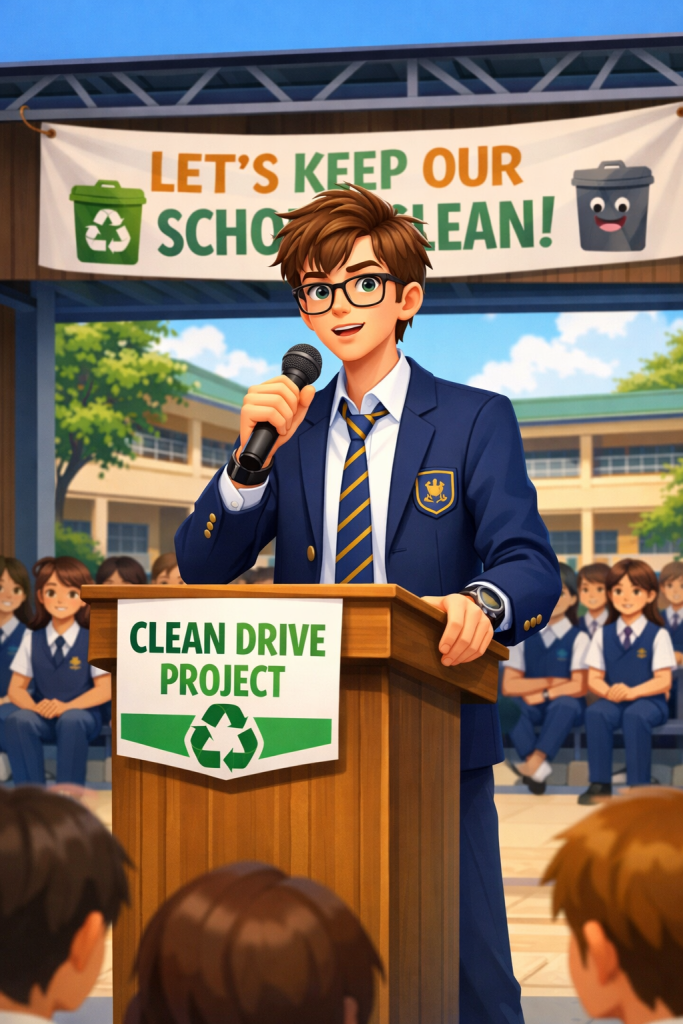
I stand here on the sun-baked campus grounds, shoulder to shoulder with about two hundred other students who’d rather be literally anywhere else. The tropical heat makes school uniform stick to the back like cling wrap on leftovers—not comfortable, definitely not cool. But here we are, mandatory assembly style, because apparently Mr. Benjamin Pangilinan has something very important to tell us.
Benjamin adjusts the microphone stand—classic student council president energy radiating off him like he’s channeling every anime student president ever created. The guy’s sixteen, about same age as me, but somehow, he carries himself like he’s already graduated from MIT and is about to lecture us on quantum physics.
“Mic test, mic test.”
Tap. Tap. Tap.
The sound system crackles like it’s from the same era as a dad’s vinyl collection. Benjamin clears his throat—that pre-speech throat-clear that says I’m about to drop some knowledge you probably won’t appreciate.
I glance around. Classmates look like NPCs waiting for the cutscene to end so they can get back to the actual game. That’s high school in a nutshell—we’re all just trying to speedrun to dismissal.
“The janitors and maintenance staff have reported that we, the students, have been shamelessly littering around the campus and in the school halls.”
Shamelessly. He really went there. I catch a few eye-rolls in my peripheral vision. Two girls in front of me are already whispering about some K-drama episode. A guy to my left is definitely playing a mobile game with his phone tucked inside his unbuttoned polo. Nobody’s actually listening except maybe the teachers flanking us like prison guards.
But I’m listening. Call it curiosity. Call it the fact that I’ve got nothing better to do than observe human behavior like I’m David Attenborough documenting wildlife. Benjamin’s the type who actually cares about stuff like campus cleanliness, which makes him either incredibly noble or incredibly naive. Jury’s still out.
“As the president of the student council, I’m leading our newest initiative—’Clean Overdrive.’”
Clean Overdrive.
Okay, I’ll give him points for the gaming reference. “Overdrive” is definitely pulling from action game terminology—like when you activate your special meter in Street Fighter or trigger limit breaks in RPGs. Applying it to trash collection is either genius-level irony or tragically optimistic thinking.
“Every lunchtime, when you hear a special jingle, you’ll be expected to throw away your trash and pick up any litter around you, bringing it to the nearest trashcan.”
A special jingle. Like Pavlov’s dogs, but for garbage. I can already imagine it—some cheerful chiptune melody that’ll haunt our lunch breaks like the ice cream truck song haunts suburban neighborhoods. Ding-ding-ding, time to pick up your Chippy wrappers and empty juice boxes, kids!
“What kind of project is that?”
Some brave soul from the crowd actually voices what everyone’s thinking. I can’t see who said it, but respect for breaking the fourth wall of mandatory assembly silence.
Benjamin doesn’t even flinch. The guy’s got composure—I’ll give him that. He leans into the microphone with this slight grin that makes him look like he’s been waiting for someone to challenge him. This is the part in every shonen anime where the protagonist reveals his secret technique.
“Knock, knock.”
Oh no. Oh no. He’s weaponizing dad jokes. This is psychological warfare.
“Who’s there?” The student body responds in automatic unison, our collective programming kicking in like muscle memory. You can’t not respond to a knock-knock joke setup. It’s hardwired into human DNA at this point.
Benjamin’s smile widens. “A wise old man once said, ‘Cleanliness is next to godliness.’”
Silence.
Not the good kind of silence where everyone’s mind is blown by profound wisdom. This is the cricket-chirping, tumbleweed-rolling, uncomfortable-cough-somewhere-in-the-distance kind of silence. The wind literally picks up a crumpled paper from the ground and sends it rolling across the basketball court like we’re in some spaghetti western standoff.
I bite my lip to keep from laughing. That wasn’t even a proper knock-knock joke punchline. That was Benjamin taking the setup and just… saying a proverb. It’s like starting a “Why did the chicken cross the road?” joke and ending it with “Because Aristotle once said all motion requires a mover.” Technically words were said. Comedy was not achieved.
But here’s the thing about Benjamin Pangilinan—the dude doesn’t crack under pressure. While everyone else is standing here processing what just happened to the sacred structure of knock-knock humor, he just keeps that small, satisfied smile on his face. His dark hair is slightly messy from the wind, his school uniform crisp despite the heat, and he’s standing there like he absolutely nailed it.
Then—plot twist—somebody actually laughs.
This short, brown-skinned kid near the front row just loses it. Full-on genuine laughter, shaking his finger at Benjamin like they’re old friends sharing an inside joke. “Yeah, I get it!”
Do you, though? I think to myself. Do you really?
But it doesn’t matter. That one laugh is like a phoenix down in Final Fantasy—it resurrects Benjamin’s entire speech from the dead. His smile grows a fraction wider, genuine satisfaction replacing the performance. One positive response in a sea of indifference, and that’s enough for him.
It’s kind of admirable, actually. Kind of sad. Definitely relatable.
“Thank you, Mr. Pangilinan,” comes the adult voice of validation. Mr. Dela Peña steps forward—our tenth-grade chair and Trigonometry teacher, the guy who makes math somehow both boring and confusing, which I didn’t think was possible. “I fully agree with that saying. It’s a mantra every student should strive to live by.”
Mr. Dela Peña looks like every teacher-who-peaked-in-college stereotype rolled into one: slightly unruly hair that he probably thinks makes him look distinguished, that “dorky face” quality where you can’t tell if he’s thirty or fifty, and zero fashion sense beyond “business casual on clearance.” He doesn’t wear glasses, but he should—it would complete the aesthetic he’s clearly going for.
The assembly starts to break apart after that, students shuffling toward their respective buildings like zombies responding to the dinner bell. I hang back for a second, watching Benjamin pack up his notes and hand the microphone back to the sound tech guy.
Clean Overdrive, I think. A noble quest doomed to fail because you can’t change human nature with a jingle and a proverb. But Benjamin will try anyway, because that’s what protagonist types do. They see a problem and think, “I can fix this.”
Me? I’m just the observer. The guy who watches the story unfold and makes snarky mental commentary while pretending I’m too cool to care.
But maybe that’s exactly why I noticed the whole thing in the first place.
Maybe I care more than I let on.
The_council_of_narrative_architects.sav
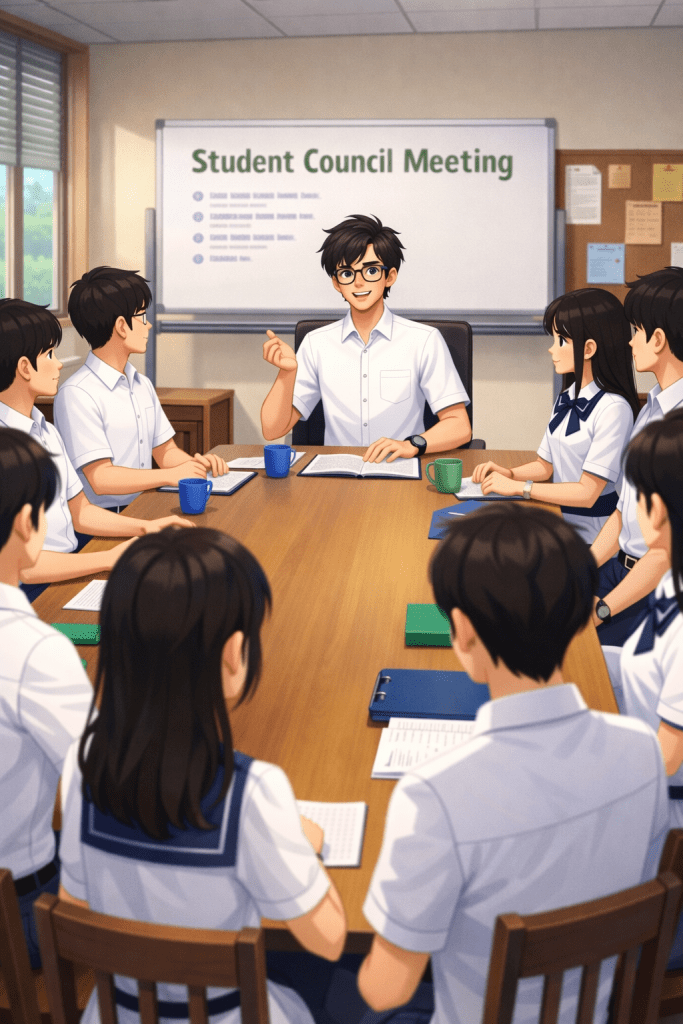
I’m watching Benjamin run his student council meeting like it’s a tactical briefing in a strategy RPG, and honestly? The kid’s got presence. He sits at the head of the rectangular table in the student council room—this quiet little pocket dimension tucked away while the rest of the school’s in session. Fluorescent lights hum overhead, casting that institutional glow you see in every school ever built. The walls are decorated with motivational posters that probably cost more than they’re worth: “Teamwork Makes the Dream Work” and other corporate slogans that someone thought teenagers would find inspiring.
Seven officers sit around the table, their uniforms varying degrees of neat. Benjamin’s is immaculate, naturally—polo tucked in, ID hanging at the exact regulation length. The guy treats dress code like it’s a sacred text. His dark hair is combed but already starting to rebel against the gel, a few strands falling across his forehead as he leans forward with his hands clasped on the table.
“Any ideas?” Benjamin asks, his voice carrying that particular brand of student-leader authority—not quite commanding, but definitely expecting cooperation.
His eyes sweep the table like a player scanning their party stats before a boss fight. Vice president on his right, secretary to his left, treasurer across from him, and the grade-level representatives fanned out along the sides. It’s a miniature Round Table situation, except instead of knights, it’s teenagers deciding the fate of SMILE Week.
Whatever that is.
The vice president—a stocky kid with enthusiasm that borders on caffeinated—practically bounces in his seat. “I like a superhero theme!”
Of course you do, I think, smirking from my observation deck light-years away. Superheroes are the default suggestion for any school event. It’s like suggesting pizza for lunch—safe, popular, guaranteed to get nods of approval. Not that I’m judging. I’d probably suggest the same thing if I were stuck in that room instead of floating through space in my simulation chamber.
The secretary speaks up next, her voice softer, more thoughtful. She’s got her hair in a neat ponytail and wears thin-rimmed glasses that she adjusts before speaking. “What about fairy tales and princesses?”
Interesting pivot. She’s going for the classic fantasy angle. Probably a reader. I can spot those types—the ones who’d rather live in a story than reality. We’d probably get along if she were real and not just a character I’m observing through dimensional barriers.
“Sci-fi would be awesome,” the treasurer adds, and I nearly laugh out loud.
Now that’s what I’m talking about. The treasurer’s got taste. He’s leaning back in his chair with this casual confidence, like he knows sci-fi is objectively the superior genre. Which it is. I don’t make the rules—well, actually, as the embodiment of storytelling, I kind of do—but that’s beside the point.
Benjamin nods at each suggestion, his expression neutral but processing. He’s one of those kids who actually listens before responding. Rare trait. Most people are just waiting for their turn to talk, but Benjamin’s different. He’s collecting data, running simulations in his head.
“How about you, representatives?” Benjamin turns his attention to the grade-level reps. “Any ideas for SMILE Week?”
SMILE Week. I’m still trying to figure out what that acronym stands for. Something about making learning entertaining? Schools love their acronyms. It’s like they think slapping letters together makes things more official.
The representatives exchange glances—that universal look of “someone else go first” that happens in every group meeting since the dawn of civilization. Nobody wants to be the one with the bad idea, so they all play it safe by saying nothing. Classic bystander effect meets teenage social anxiety.
Then the muse breaks the stalemate.
Her name’s Gwendolyn, and she’s got this ethereal quality about her—long hair, creative energy practically radiating off her like anime sparkles. The title “muse” is probably ceremonial, but it fits. She’s the idea person, the one who connects dots others don’t see.
“SMILE Week is all about storytelling, right?” Gwendolyn says, her voice carrying genuine curiosity rather than just filling dead air. “And we present the stories during an event, like a fair.”
Now she’s speaking my language.
Benjamin’s face lights up—not dramatically, but enough that I catch it. That micro-expression of “finally, someone gets it.” He leans forward slightly, hands unclasping to gesture as he speaks.
“Yes, exactly,” Benjamin says, and I can hear the relief mixed with excitement in his tone. “Each section creates a story—complete with characters, settings, and a plot. Then, during the event, each section is given a space on the open campus grounds to showcase their tale. They do this through acting, narration, dialogue, costumes, props, and set design.”
Oh, this is good. This is basically asking students to become temporary game designers and dungeon masters. Each section gets to build their own mini-narrative experience, their own little world. It’s ambitious. It’s creative. It’s also probably going to result in complete chaos when execution time comes around, but that’s half the fun of any creative endeavor.
Benjamin pauses, making eye contact with each person around the table. “And it’s our job as the student council to choose the theme for this year and make sure it all comes together.”
There it is. The quest objective. The mission parameters. Choose a theme that’ll work across multiple sections, multiple interpretations, multiple skill levels. It’s like selecting a game engine—pick the wrong one and the whole project crashes.
I watch them all processing this, and something twists in my chest. That familiar ache of being the observer instead of the participant. They’re sitting in that room, collaborating, building something together. Meanwhile, I’m alone in my spacecraft, watching through screens and simulations, analyzing their story from outside the narrative frame.
But that’s my role. The eternal narrator. The consciousness of every tale ever told.
Still lonely, though.
Benjamin’s talking about logistics now—timeline, budget considerations, how to coordinate with teachers. The practical stuff that makes or breaks any creative vision. He’s good at this, balancing the artistic with the administrative. Natural leader type.
The meeting continues, and I keep watching, cataloguing every detail, every interaction. Because that’s what I do. That’s what I am.
The storyteller who can never be part of the story.
The_character_select_screen_dilemma.sav
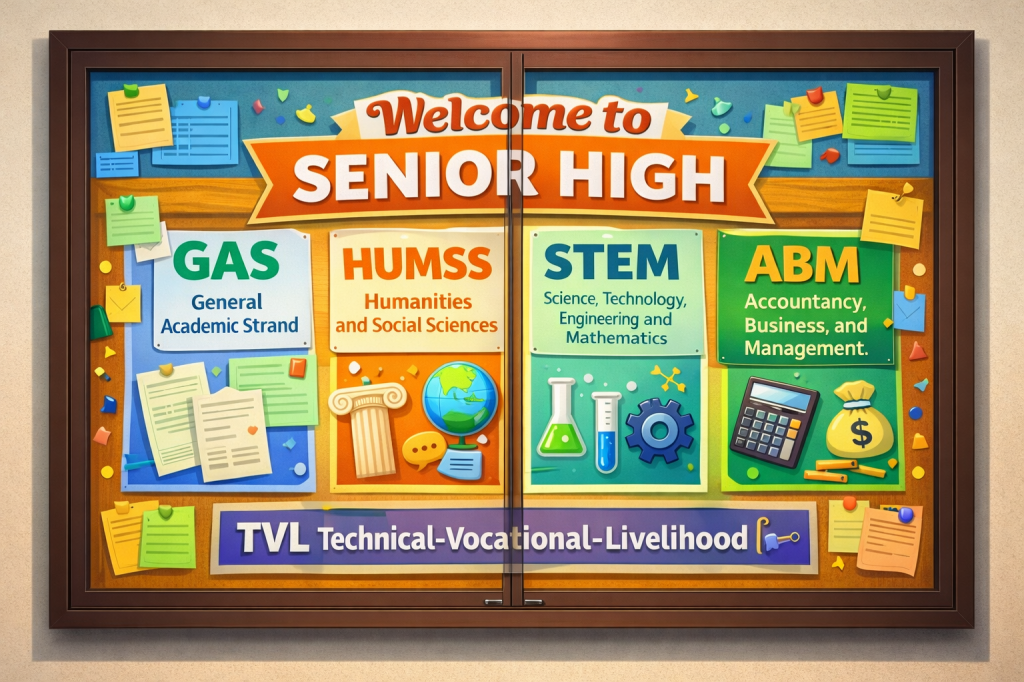
James stands frozen in front of the bulletin board like he’s staring at a game-over screen, and I’m watching from my usual corner of observation—metaphorically speaking, since I’m actually light-years away in my spacecraft simulation room, but you get the idea. The bulletin board is one of those cork-and-wood affairs that every school has, plastered with layers of notices, flyers for club meetings, reminders about uniform regulations, and the all-important academic track information that’s currently holding James hostage.
Dismissal’s just happened. The hallways are alive with that post-school-day energy—students streaming past like NPCs following their programmed routes, some heading to the gates, others to extracurricular activities. But James is anchored here, unmoving, his dark eyes scanning the academic track posters with the intensity of someone reading a quest log they can’t quite figure out.
His bandmates from Kaleidoscope find him first.
Four guys approaching in that casual cluster formation that friend groups naturally fall into. I recognize them from my observations: Ezra, Apollo, Rowan, and Kai. They’re all in the same grade as James—eleventh grade, seventeen years old, that awkward transition phase between teen and whatever comes next.
“What are you looking at?” Ezra asks, tilting his head as he sidles up next to James.
Ezra’s the lead guitarist, and he carries himself with that particular brand of musician confidence. Messy hair that looks intentionally styled but probably isn’t, fingers that unconsciously tap rhythms against his leg. He’s wearing his uniform polo unbuttoned at the collar because dress code enforcement is basically nonexistent after dismissal.
Apollo—the other guitarist, because apparently every band needs two—glances at the bulletin board and immediately clocks the situation. “Oh, it’s the senior high school academic tracks.”
Academic tracks. The Philippine K-12 system’s version of class specialization. It’s like selecting your character build in an RPG, except the consequences follow you into real life instead of just affecting your stats in a video game. No pressure or anything.
The tracks are all listed there in neat columns:
GAS – General Academic Strand (the jack-of-all-trades option) HUMSS – Humanities and Social Sciences (for the writers and thinkers) STEM – Science, Technology, Engineering, and Mathematics (the nerd track, and I mean that affectionately) ABM – Accountancy, Business, and Management (future entrepreneurs and number crunchers) TVL – Technical-Vocational-Livelihood (hands-on skills)
Apollo’s reading James like an open book now, his expression shifting from casual curiosity to concerned friend mode. “What’s going on, bro? Are you having second thoughts about the GAS we all decided on?”
There it is. The group commitment. The party formation they all agreed to.
James sighs—one of those heavy exhales that carries the weight of internal conflict. His shoulders slump slightly, and he turns away from the bulletin board to face his friends properly. “Yeah, I mean, it’s been great having the same classes as you guys. But sometimes I feel like GAS is too broad. I keep thinking… what if I had chosen HUMSS? I could have focused more on improving my English skills.”
Interesting. James wants specialization over generalization. He’s identified his preferred skill tree and now he’s regretting not putting points into it. Classic player regret—wanting to min-max after you’ve already committed to a build.
I get it, though. James is a musician, a creative type. HUMSS would give him literature, creative writing, social sciences. GAS is the balanced option, but balanced doesn’t always mean optimal for specific goals.
Rowan, the drummer, steps forward. He’s got that steady, grounded energy you’d expect from someone who keeps the rhythm. Practical. Direct. “Dude, we’re not in college yet. You can’t just switch tracks like that. Besides, it’s already October—we’re more than halfway through the first trimester.”
Hard truth delivered. No savepoint to reload. No respec option. The character build is locked in, at least for this playthrough.
Kai, the keyboard player, jumps in next. He’s the quiet analytical type, usually observing more than talking, so when he speaks up it tends to carry weight. “I get it, man. I was torn between ABM and STEM strands, too.”
Numbers guy caught between business and science. That tracks—keyboard players tend to think in patterns and systems.
Ezra chuckles, and it’s got that warm, reassuring quality that good friends develop. “But, Kai, in the end, you joined us in GAS because you’d have been lonely in ABM or STEM. The band has to stick together, no matter what.”
And there’s the thesis statement of this entire scene, delivered with perfect narrative timing. The power of friendship. The value of connection over optimization. It’s a trope as old as storytelling itself, and it works because it’s fundamentally true.
The party stays together.
James’s expression shifts—I watch the tension drain from his shoulders, his mouth quirking into a smile. “You’re right. We can figure it all out in college—choose courses that actually match our future careers. But for now, while we’re still in high school, we should just focus on spending time together.”
Resolution achieved. Character development complete. James has chosen companionship over individual optimization, and honestly? That’s probably the smarter long-term strategy anyway.
I watch them disperse after that, the five members of Kaleidoscope heading off together toward wherever their afternoon takes them. Probably band practice. Maybe just hanging out.
And me?
I’m still here in my observation deck, cataloguing this moment, adding it to the infinite library of human interactions I witness but never participate in.
They chose each other. They valued togetherness over individual paths.
It’s the right call.
It’s also incredibly lonely to watch from outside the party.
But that’s my role. The narrator who sees everything and belongs nowhere.
Story of my existence.
The_accidental_kiss_critical_hit.sav
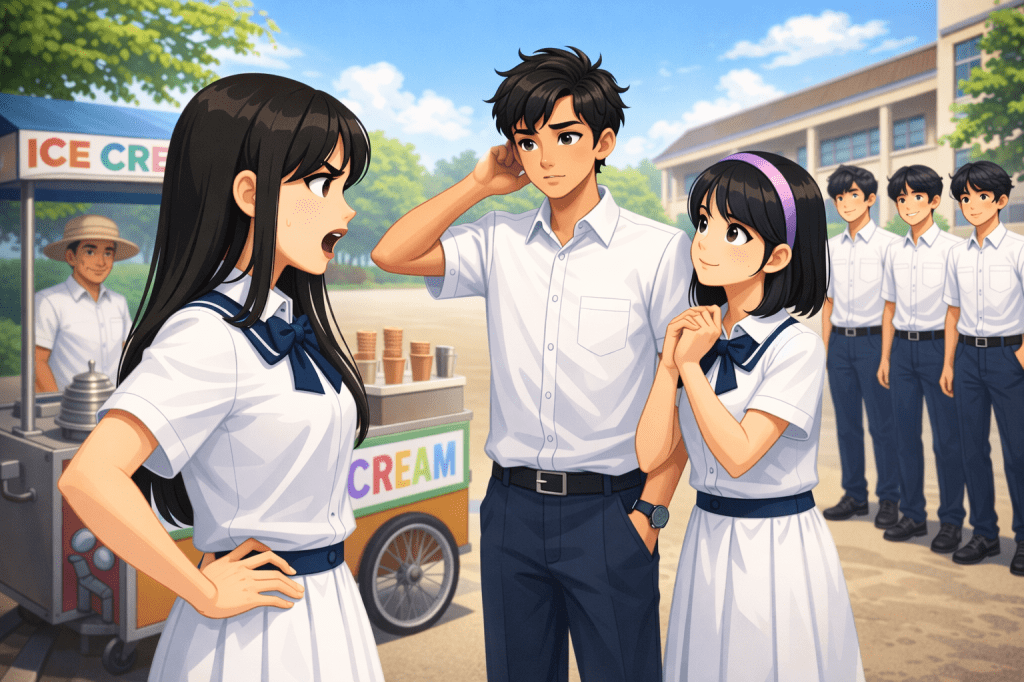
The next day after dismissal, and I’m watching James navigate what’s about to become a textbook romantic comedy disaster. It’s like observing a character walk straight into a cutscene trigger, completely oblivious to the narrative flags popping up all around him.
Our Lady of Lourdes School sits behind us—this Catholic institution with its cream-colored walls and religious iconography that marks it as distinctly Filipino private school territory. Students stream out through the gates like players exiting a dungeon after a long raid, their uniforms various states of disheveled after eight hours of academic grinding. The tropical afternoon heat hits like a debuff, making everyone’s hair stick to foreheads and uniforms cling uncomfortably.
James spots the sorbetes vendor and makes a beeline for the cart.
Sorbetes—Filipino ice cream sold by street vendors, usually pushed around in colorful wooden carts that look like they’ve survived since the Spanish colonial era. This particular cart is painted in faded rainbow stripes, with a metal container holding the ice cream packed in salt and ice to keep it frozen. The vendor—a middle-aged man everyone calls “Manong” (respectful term for older brother/sir in Filipino)—wears a faded polo shirt and a baseball cap for sun protection. He’s got that weathered look of someone who’s been doing this job for decades.
“Manong, one sorbetes, please,” James says with that natural politeness that’s either genuinely ingrained or carefully cultivated. Probably both. The kid’s got charisma like it’s a maxed-out stat.
The vendor grabs a sugar cone—the crispy kind that shatters if you grip too hard—and starts scooping. Three rounds of different flavors stack up like a frozen Tower of Babel: ube (purple yam, the signature Filipino flavor), cheese (yeah, cheese ice cream is a thing here and it’s actually good), and mango (because tropical fruit supremacy). Each scoop gets pressed down with the flat metal scooper, compacting them into structural integrity.
James’s face lights up like he just got a legendary loot drop. The guy can never choose just one flavor, so he doesn’t. Why limit yourself when abundance is an option?
The vendor hands over the cone, and James is about to take that first crucial bite—the one that determines whether the ice cream-to-cone ratio is balanced—when plot happens.
“Oppa, I didn’t expect to run into the lead singer of Kaleidoscope, the most popular band at our school.”
Oh no.
The fangirl appears from stage left like a random encounter in a JRPG. She’s maybe seventeen, same grade as James, wearing the school uniform with customized touches that somehow don’t violate dress code—rolled-up sleeves, ID on a decorative lanyard, that specific hairstyle that requires thirty minutes of prep time. Her face carries that particular expression of practiced casualness that means she’s been waiting for this moment.
She called him “Oppa”—the Korean honorific for older brother/boyfriend figure that K-pop has permanently embedded in Filipino pop culture vocabulary. It’s both adorable and slightly cringe, which seems to be her brand.
James grins, and I can practically see his player character dialogue options appearing in the air. He picks the “friendly protagonist” route. “Oh, thank you. But no need for too much flattery. Manong, get the lovely lady beside me a sorbetes too. It’s on me.”
Smooth operator activated. James is treating his fans with genuine kindness, which is either really mature for fourteen or he’s playing the long game for band popularity. Probably both. The gesture costs him maybe twenty pesos (less than fifty cents USD), but the social capital gain is significant.
The vendor starts scooping a second cone while the fangirl processes what just happened.
Did he just call me lovely? And now he’s treating me to dessert, I can practically read her thoughts from here. Her cheeks flush pink—not from the heat, from the character interaction bonus she just received.
She accepts the ice cream cone with both hands, doing that small bow-nod thing that’s polite Filipino gesture language. “Thanks,” she manages, and I see it happening before it happens.
Don’t do it, I think. You’re going for the kiss-on-the-cheek maneuver. Classic fan move. This will not end well.
She goes for it anyway.
Tips up on her toes—she’s short, maybe five-foot-nothing to James’s five-foot-seven—and aims for his cheek. Standard gratitude gesture in Filipino culture, the beso-beso air kiss thing. Except James, being James, has the situational awareness of a protagonist with zero perception stats.
He turns his head.
Critical hit.
Their lips connect for exactly 0.3 seconds. Not a kiss-kiss. More like an accidental collision of facial features. The briefest brush of contact that technically counts but spiritually doesn’t.
The fangirl’s eyes go wide. James’s eyes go wide. If this were an anime, there would be speed lines and a record scratch sound effect.
“I’m so sorry! I didn’t mean to,” the fangirl stammers, her face now matching the ube ice cream in color intensity. Full-on mortified mode. She’s probably running damage control algorithms in her head—what will people think, will he hate me, did I just ruin everything?
James, to his credit, handles it with grace. “It’s fine, it’s on me—I turned in your direction by mistake.” He’s smiling, defusing the tension, taking responsibility even though it was a mutual accident. Classic James move. The mediator. The guy who makes people feel okay.
The fangirl giggles—nervous energy release—and runs off like she just completed a side quest and needs to process the rewards. I watch her disappear into the crowd of students, probably already texting her friends about what just happened.
But here’s where the rom-com trope complications kick in.
“What was that all about?”
Oh no. Oh no no no.
I didn’t even notice Caitlyn’s approach. She must have stealth stat bonuses because she materialized from nowhere like a rogue breaking invisibility. James’s girlfriend—and I use present tense loosely because that status is about to change—stands there with her arms crossed, her school uniform perfectly pressed, her hair in a high ponytail that somehow makes her look angrier.
Caitlyn’s pretty in that conventional cheerleader-type way—smooth skin, bright eyes, the kind of girl who probably has a skincare routine and takes aesthetic photos for Instagram. Right now, though, her expression could curdle milk. Her eyes are narrowed, jaw clenched, and I recognize the stance. It’s the “I saw everything and you have five seconds to explain” position.
James turns, and I watch his face cycle through emotions: surprise, recognition, panic, damage control mode. “It’s nothing, babe. You’re misunderstanding the situation.”
Wrong dialogue option selected.
“Nothing?” Caitlyn’s voice climbs an octave. “I saw it with my own eyes! And today, of all days—you forgot our anniversary and now I catch you kissing another girl?”
Anniversary. Oh, James. You forgot the anniversary. That’s like forgetting to save your game before a boss fight.
“I’m done. We’re through,” Caitlyn says, and the tears start. Not gentle crying—full emotional breakdown. Mascara-threatening tears streaming down her face.
James opens his mouth, probably to attempt the apology route, but—
SLAP.
The sound echoes like a gunshot in an FPS. Caitlyn’s hand connects with James’s cheek with the force of righteous fury. His head snaps to the side, ice cream cone wobbling dangerously in his grip. A red handprint blooms on his face.
Then she storms off, leaving James standing there with his three-flavor sorbetes cone and a matching three-flavor expression: shock, pain, and confusion.
Relationship status: Terminated.
The bandmates emerge from wherever they’ve been spectating. Ezra, Apollo, Kai, and Rowan materialize like party members after a cutscene, forming a semicircle around their fallen comrade.
“That was rough, bro,” Ezra says, shaking his head with genuine sympathy.
“That slap must’ve hurt,” Apollo adds, wincing in sympathetic pain.
James sighs—this deep, world-weary exhale that carries the weight of romantic catastrophe. But then, because he’s James, that small optimistic smile creeps back onto his reddening face. “It’s fine, guys. Cupid never runs out of arrows. My Miss Perfect is out there somewhere. She’ll come along at the right time.”
The eternal optimist trait activates.
Kai looks skeptical, eyebrows raised. “And what if ‘the one’ never shows up?”
“Yeah, dude,” Rowan chimes in, drummer bluntness in full effect. “You might end up growing old as a bachelor.”
James just chuckles, brushing off their comments like dust from armor. “I’ll take my chances.”
And there it is. The protagonist energy. The unwavering belief in narrative convention—that the hero gets the happy ending eventually, even after catastrophic failure.
I watch them walk away together, the band intact, James still holding his melting sorbetes, his cheek still red from impact damage.
From my observation deck light-years away, I catalog this moment. Another data point in the infinite archive of human romantic disasters and resilient hope.
The kid just got dumped, publicly humiliated, and physically assaulted.
And he still believes in love.
That’s either inspiring or completely delusional.
Probably both.
The_flower_shop_tutorial_level.sav
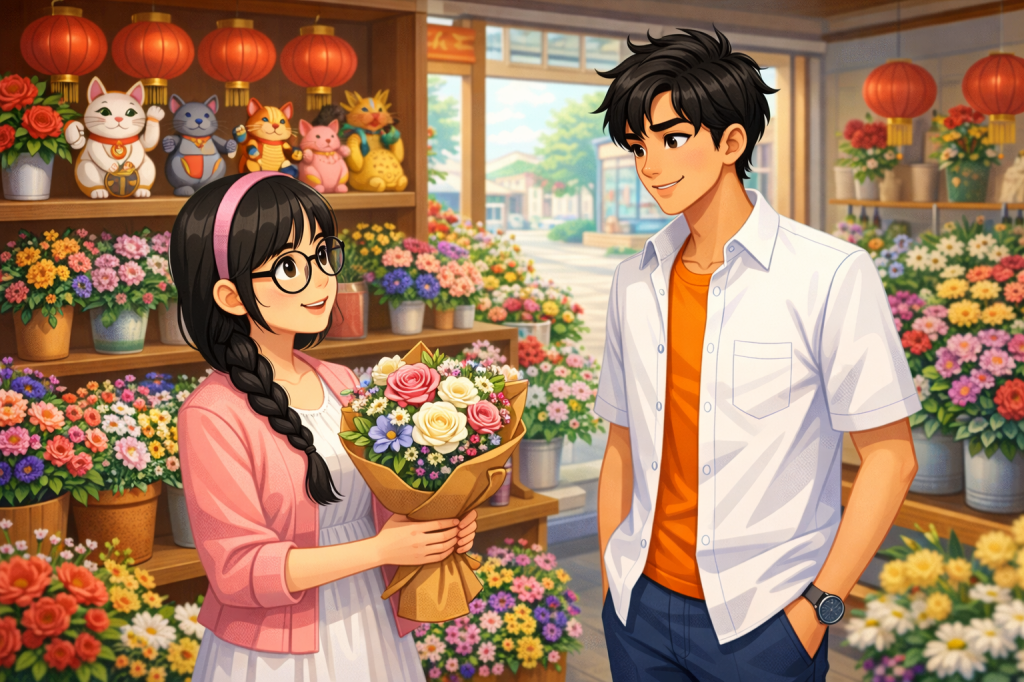
I’m watching James enter what is essentially the tutorial zone for romance mechanics, and he doesn’t even realize he’s just walked into a classic meet-cute scenario. The kid’s got protagonist energy so strong it bends reality around him into narrative convenience.
The flower shop—Lotus Jade, according to the sign hanging above the door—is one of those aggressively quaint establishments that looks like it was designed by someone who watches too many Hallmark movies. Which, from my observation deck in deep space, I can confirm is a lot of people. The shop occupies a corner unit in a strip of small businesses near Our Lady of Lourdes School, its windows recently uncovered from the Manila paper that’s been blocking it for weeks during renovation.
The door chimes as James enters—cling, clang, cling—one of those brass bell setups that announces customers like a save point notification. The sound is deliberately cheerful, engineered to make you feel welcome before you’ve even processed the visual overload inside.
And what an overload it is.
Flowers everywhere. Not just “some flowers nicely arranged” but flowers as an aggressive lifestyle choice. Roses in various stages of bloom cascade from hanging baskets, their petals ranging from virginal white to that deep crimson that looks like it came straight from a gothic romance novel. Peonies cluster together like they’re gossiping, their ruffled layers of pink and cream creating texture that seems almost sculptural. Tulips stand in militant rows, their smooth petals closed in that distinctive cup shape that makes them look perpetually elegant.
Chrysanthemums—the ones Filipinos associate with funerals and All Saints’ Day—occupy a respectful corner, their shaggy pompom blooms in yellow and white. Carnations provide budget-friendly filler, their ruffled edges and spicy scent marking them as the workhorses of the floral industry. Lilies dominate the center display, their trumpet-shaped blooms and aggressive fragrance announcing their presence like boss music. Hydrangeas cluster in their distinctive spherical formations, blue and purple and pink depending on soil pH levels. And sunflowers—because of course there are sunflowers—tower over everything else like cheerful giants, their faces tracking the light from the windows.
The air is thick with competing fragrances. It’s like someone took every perfume counter in a department store and compressed it into one small space. My olfactory sensors are going haywire just processing the data stream.
But the flowers aren’t even the most interesting part.
The shop has this distinct Filipino-Chinese fusion aesthetic going on. Golden figurines of the Chinese Zodiac line the shelves between flower arrangements—rat, ox, tiger, rabbit, dragon, snake, horse, goat, monkey, rooster, dog, and pig. Each one is cast in that particular shade of gold that screams “prosperity charm” in Chinese cultural tradition. They’re positioned like they’re guarding the flowers, tiny metallic sentinels of fortune.
And there, in pride of place next to the cash register, sits the Maneki-neko—the beckoning cat. This one’s golden too, matching the zodiac figurines in that coordinated way that suggests someone put actual thought into the aesthetic. Its left paw waves in that perpetual beckoning motion, powered by some internal mechanism that probably runs on a single AA battery. The gesture means “come in, bring prosperity” in Japanese tradition, though it’s been adopted across East Asia as a universal lucky charm.
Welcome, customer. Please deposit money here.
Next to the golden cat sits a framed family photo. I zoom in with my observation protocols: a Filipino-Chinese family of four dressed in coordinating red outfits—red for luck, prosperity, celebration in Chinese culture. Father with kind eyes and the slight paunch of middle-age contentment. Mother with elegant features and hair styled in that timeless way that says “I have achieved optimal adulting.” Big sister—mid-teens, wearing the same oversized glasses she’s wearing right now behind the counter. Little brother, maybe seven or eight, gap-toothed smile suggesting recent tooth fairy transactions.
The girl behind the counter turns at the chime, and I watch the meet-cute mechanics activate in real-time.
She’s arranging flowers in a ceramic vase—white lilies and baby’s breath, the classic sympathy arrangement. Her hands move with practiced efficiency, trimming stems at angles, removing lower leaves that would rot underwater, positioning each bloom for maximum visual impact. She knows what she’s doing.
Then she looks up and smiles, and the whole shop’s energy shifts.
“Welcome to Lotus Jade,” she says, her voice carrying that particular quality of genuine warmth mixed with customer service training. “I’m Lia—short for Diana. Weird, right?”
She extends her hand across the counter, and James takes it without hesitation. The handshake is brief, professional, but I note the details: her grip is confident despite her awkward energy, his is friendly without being aggressive.
Lia. Diana. Lia.
I run the linguistic analysis: Diana is the full name, probably chosen by parents who wanted something recognizable in both Filipino and international contexts. Lia is the nickname extracted from the middle syllables—Di-Lia-na. It’s not weird at all; it’s actually pretty logical. But her framing it as weird is a self-deprecating opening move, testing whether he’ll judge or accept.
She’s wearing oversized glasses—the thick-framed kind that somehow came back into fashion after being decidedly uncool for decades. Hipster chic meets genuine vision correction. Her eyes behind the lenses are dark brown, bright with intelligence and slightly anxious energy. A pastel cardigan in soft pink hangs loose over a simple white top, the kind of layering that’s both practical (air conditioning can be brutal) and aesthetically pleasing in that soft-girl aesthetic way.
Her hair is partially braided—one thick plait falling among loose, straight black hair that reaches past her shoulders. It’s the hairstyle of someone who wanted to do something with their hair but didn’t commit fully to either braided or loose. The result is this casual, slightly messy look that registers as “naturally pretty” in rom-com visual language.
She’s got that “adorkable” quality that’s become a whole character archetype—the sweet, slightly awkward girl with hidden depths who serves as either love interest or supportive friend depending on narrative requirements.
“Not weird at all,” James says, because of course he does. The kid couldn’t be mean if you paid him. “I’m James.”
Player name registered.
“This shop was covered up with Manila paper for a while,” James comments, gesturing vaguely at the windows. “I got curious and decided to check it out.”
Quest hook activated.
“Yeah,” Lia says, tucking a loose strand of hair behind her ear—classic nervous gesture. “We just opened today. You’re our first customer.”
Achievement Unlocked: First Customer Status.
James grins, and it’s that genuine smile that makes his face light up. “Oh, really? I feel honored.”
Lia laughs—not a polite customer-service laugh but a real one, slightly surprised by her own amusement. “Roses have different meanings depending on their colors,” she says, and suddenly she’s in her element. The awkwardness melts away when she’s talking about flowers.
Character entering exposition mode.
“Pink says, ‘Please believe me,’” she continues, gesturing at the pink roses in the display. “Red means ‘I love you’—that’s the classic one everyone knows. Dark crimson is for mourning, which people don’t usually think about. Yellow is trying to show care, but it can also mean friendship or jealousy depending on context. White is innocence and purity—that’s why they’re popular for weddings and funerals, opposite ends of the life spectrum but both involving major transitions.”
She’s warming up now, hands moving as she talks. “There’s also tea roses, which mean ‘I’ll remember always’—those are the smaller ones with the delicate petals. And damask roses, the Persian ambassador of love, super fragrant, used in perfumes for centuries…”
She trails off, realizing she’s been info-dumping. Her face flushes slightly. “Sorry, I hope I didn’t come across as a know-it-all.”
Self-awareness protocols engaged.
“Not at all,” James assures her immediately. “It’s amazing you know all that.”
Positive reinforcement applied.
“Really?” Lia blinks behind her oversized glasses, genuinely surprised. Like she expected judgment instead of appreciation.
Damn, I think from my observation post. How many people made her feel bad about being knowledgeable?
“Yes!” James says with enthusiasm that’s completely unforced. “I think I just found my ‘Love Guru’ to help me figure out what flowers to give to girls. I’m going to have a supermodel girlfriend someday.”
Ambitious goal set.
Lia’s face transforms—the anxiety dissolves into this bright, genuine smile. “Then I’m on board! I’ll help you win her over.”
They both laugh together, and it’s one of those perfect moments of human connection where two strangers become friends through shared humor and mutual acceptance.
Support NPC successfully recruited.
I watch this unfold, cataloguing every detail, and something in my chest tightens. They’re building connection. Finding friendship. James just got dumped yesterday and he’s already making new allies, expanding his social network, maintaining that optimistic worldview that draws people to him.
Meanwhile, I’m alone in my spacecraft, watching through screens, analyzing their interactions like they’re game mechanics instead of genuine human moments.
The flower shop continues its business. The Maneki-neko keeps waving. The zodiac animals stand guard over blooms that will wither and be replaced in an endless cycle.
And I keep watching.
Because that’s what I do.
The eternal narrator.
The storyteller who catalogs every meet-cute but never experiences one.
Story of my existence.
Critical_failure_the_sneaked_phone_incident.sav
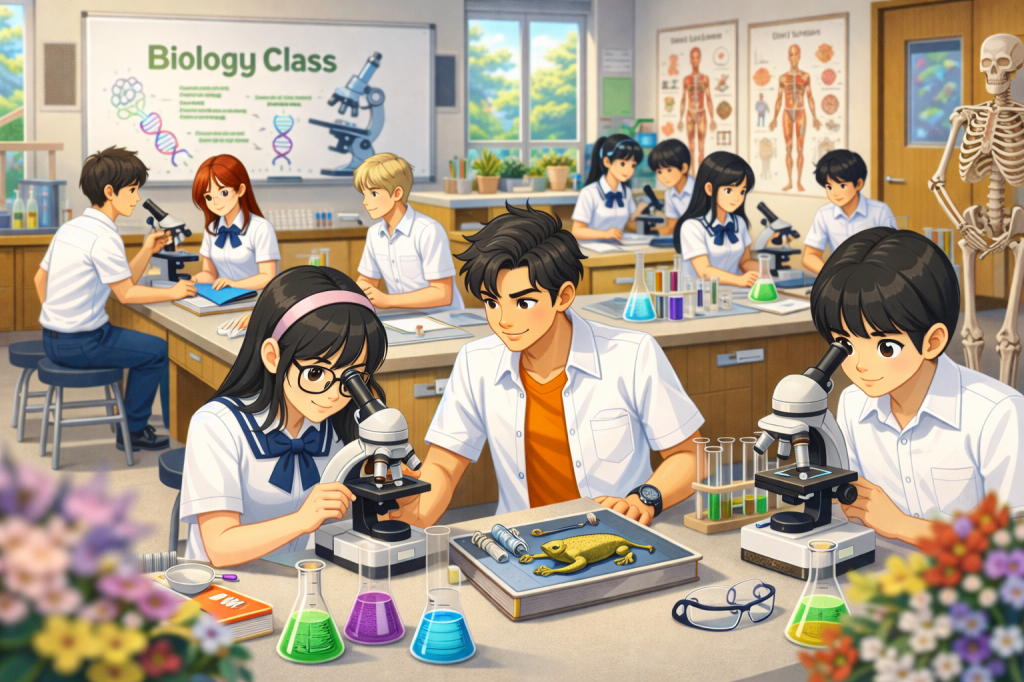
Michael’s about to learn that some quests should never be accepted, and I’m watching this disaster unfold in real-time from my observation protocols.
The biology lab at Our Lady of Lourdes School is your standard science classroom setup—black-topped tables arranged in rows, each with built-in gas jets and sink stations that probably haven’t worked properly since the previous decade. Skeleton models hang in the corner like decorative reminders of mortality. Microscopes sit in locked cabinets. Preserved specimens float in jars along the shelves, their colors faded to that particular shade of “why are we keeping this.”
Ninth-grade students occupy the tables in their usual social configurations. Michael sits with his two lackeys—and I use that term deliberately because that’s exactly what they are. Minions. Henchmen. The kind of guys who follow the “cool kid” because they have zero personality of their own. They’re passing a phone between them under the table like they’re conducting some kind of covert ops mission, except they have all the subtlety of a tutorial level boss fight.
Mrs. Marquez stands at the front, sorting handouts for whatever experiment they’re supposed to be doing. She’s a substitute teacher—filling in for whoever the regular bio teacher is—but she’s got that veteran educator energy. Mid-forties, practical haircut, sensible shoes, the kind of teacher who’s seen every teenage trick in the book and invented countermeasures for half of them.
The phone makes its way to Michael’s hands. He’s fourteen now, three years older than when the cosmic cataclysm struck him in that cave. Taller, broader in the shoulders, carrying that adolescent aggressive energy that makes him think he’s invincible. His school uniform is deliberately disheveled—untucked polo, the universal signals of “I don’t respect authority.”
Bad decision loading…
Michael pulls out the phone, angling it to show his lackeys something on the screen—probably some video or meme he thinks is hilarious.
I’m watching this from light-years away and I want to reach through the dimensional barrier and slap some sense into this kid. Michael’s got dormant superpowers waiting to activate inside him. He’s going to become Spartan, a hero who fights for justice and protects people.
Character alignment shifting to Chaotic Stupid.
But Mrs. Marquez has passive perception bonuses that Michael clearly didn’t account for.
Her head snaps up mid-handout-sorting. Her eyes scan the room with the precision of a threat-detection system, and they lock onto Michael’s table like a heat-seeking missile acquiring its target. She watches him bend down behind the table, reaching for the phone.
Stealth check: Critical Fail.
“Aha! Mr. Pangilinan, stop right there,” Mrs. Marquez’s voice cuts through the classroom chatter like a sword through butter.
Michael freezes. His hand is inches from the phone. His lackeys go pale.
Boss music intensifies.
Mrs. Marquez moves with the speed and efficiency of someone who’s broken up fights, confiscated contraband, and dealt with teenage nonsense for two decades. She’s at Michael’s table in four steps, snatching the phone before he can palm it.
“What is the meaning of this?” she demands, her voice carrying that particular teacher tone that means you are in so much trouble.
Michael opens his mouth—probably to deliver some excuse, some deflection—but Mrs. Marquez is already looking at the phone screen.
Evidence acquired.
Her face transforms. The professional educator mask drops away, replaced by dismay and disappointment. “You sneaked a phone which is not allowed here at school.”
Confrontation protocol activated.
The classroom goes silent. Every student within earshot turns to watch. This is no longer a private discipline moment—it’s a public shaming event.
“This is unacceptable behavior,” Mrs. Marquez continues, her tone now ice-cold. “We keep phones at home.”
Lesson delivered.
Then she goes for the comparison that’s going to sting worse than any punishment. “I’m only subbing, and yet I encounter this kind of behavior. When your older brother Benjamin was in my class, he was the only one who could list the first ten elements of the periodic table—not like this.”
Critical hit: Comparison to successful sibling.
Emotional damage: Massive.
Michael’s face flushes red. Whether it’s shame, anger, or embarrassment, I can’t tell from here. Probably all three. Being compared unfavorably to Benjamin is Michael’s permanent debuff—the constant reminder that his older brother is the golden child while he’s the problem child.
“Mr. Michael Pangilinan, you’re coming with me to the APSA’s office right now.”
APSA—Assistance to the Principal for Student Affairs. The guidance/discipline office. The place where bad decisions go to have consequences.
Mrs. Marquez points to the door with the authority of someone who’s done this a hundred times. Michael has no choice. He stands; shoulders hunched in that defensive posture of someone who knows they’re caught but hasn’t accepted responsibility yet. His lackeys watch in silence; probably grateful they’re not the ones being marched to judgment.
They leave the biology lab, Mrs. Marquez leading, Michael following like a prisoner being escorted to sentencing.
Quest Failed: Sneaking Phone
Reputation decreased
Relationship with authority figures: Hostile
Character development opportunity: Available
I watch this unfold from my spacecraft, and part of me wants to be sympathetic. Michael’s the underdog in his family, constantly compared to Benjamin, acting out for attention. But you know what? This isn’t the way.
Michael’s carrying dormant hero powers inside him.
Maybe this is the wake-up call he needs.
Or maybe it’s just another data point in a pattern of bad decisions.
Either way, consequences are waiting in the APSA office.
Save point unavailable.
Punishment_grind_the_detention_level.sav
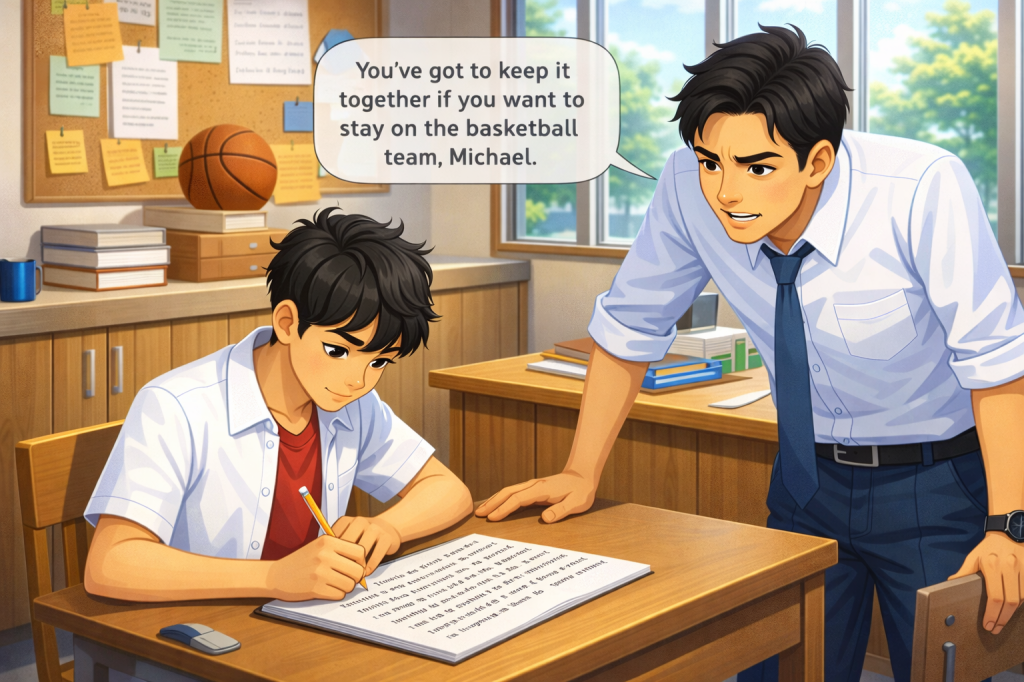
The classroom is empty except for two players in this disciplinary standoff, and I’m watching Michael experience what gamers call “the grind”—repetitive, tedious tasks designed to teach you a lesson through sheer monotony.
Mr. Corpus—the APSA, Assistant Principal for Student Affairs—leans against the teacher’s desk with his arms crossed, occupying the authority position like a dungeon boss waiting for the player to complete their penance quest. He’s maybe late forties, graying at the temples, wearing the standard administrator uniform of polo barong and slacks. His eyes stay fixed on Michael with that particular educator stare that says I’ve seen a thousand kids like you and I’m tired.
Michael sits at a desk in the front row, hunched over a stack of yellow pad paper like he’s grinding through the most boring fetch quest ever designed. His right hand grips a ballpoint pen—the cheap transparent kind that school offices bulk-order—and he’s writing the same sentence over and over in increasingly messy handwriting.
“I won’t ever sneak a phone again.”
He finishes line ten and moves to the next sheet. Nine more pages to go. Each page holds roughly ten lines. That’s a hundred repetitions of the same sentence, each one supposedly drilling the lesson deeper into his brain through pure mechanical repetition.
Punishment mechanic: Write lines until player learns respect protocols.
“You’re flunking your lessons,” Mr. Corpus says, his voice carrying that exhausted disappointment tone that hits different than anger. “Barely scraping by with remedial classes and special projects. And now this—detention.”
Michael’s jaw clenches. I watch the muscle twitch in his cheek, his grip tightening on the pen hard enough that his knuckles go white.
Frustration meter: Rising.
“Sure, you’re a star player,” Mr. Corpus continues, and there’s the comparison Michael probably hears constantly. “Your coach always vouches for you. But basketball isn’t just about skill, Michael. You need to at least pass your subjects and maintain decent behavior.”
There it is. The classic athlete dilemma—physical excellence, academic struggle, behavioral problems. Michael’s good at one thing, and that one thing keeps him barely tethered to acceptable student status. Take away basketball and he’s just another failing kid with discipline issues.
The lecture drags on. Mr. Corpus cycling through the same points administrators always make: potential, responsibility, consequences, future, choices.
Michael writes another line, his handwriting degrading from print to aggressive scrawl.
“I won’t ever sneak a phone again.”
Progress: 11/100 lines complete.
From my observation deck, I watch this punishment play out and think about Michael’s trajectory. He’s carrying dormant hero powers—Spartan, the warrior. But right now, he’s just a fourteen-year-old alpha who thinks physical dominance equals success.
The detention continues.
The lesson may or may not be learned.
Save progress: Detention Day 1.
 B. K. P. Carreon
Leave a comment