Overview:
| Three years ago, frantic parents rushed their children to the emergency room after they were rescued from the cave. When Topher awakens in his hospital ward, he is unable to recall what transpired inside the cave. A CT scan reveals no abnormalities, offering no medical explanation for his persistent, selective amnesia. Concerned and unsettled, Topher’s father, Dr. Bill, confides in a colleague about the cave incident, hinting at its supposed paranormal nature. Topher stumbles upon an old photograph of a young man named Elvin and asks his mother, Selena, about him. This prompts Selena to revisit her past. She recalls her college years, when she met Elvin and the two fell in love. Their relationship flourished briefly, but Elvin eventually succumbed to his illness, leaving Selena heartbroken. In her grief, Elvin’s mother, Selya, gently urges Selena to let go of her son’s memory and move forward with her life. Returning to the present, Selena reassures Topher that although Elvin was her first love, his father—Bill—has always been her one true great love. |
Scene_six_down.sav

THREE YEARS AGO
Here’s the thing about emergency rooms—they follow the same narrative structure as every medical drama ever broadcast. The calm before the storm. The false sense of security. Then BAM, everything goes sideways faster than you can say “Code Blue.”
I’m watching this particular ER like it’s the opening scene of Grey’s Anatomy, except nobody’s hooking up in supply closets yet. The fluorescent lights buzz overhead, casting that sickly greenish-white glow that makes everyone look half-dead already. A doctor in wrinkled scrubs makes his rounds past gurneys and IV poles, clipboard in hand, probably reviewing labs that came back unremarkable. Two nurses lean against the reception desk, chatting about something mundane—grocery lists or Netflix shows or whatever normal people discuss when their lives aren’t about to get flipped upside down.
The waiting area sits quiet. Almost too quiet, if this were a horror movie. Plastic chairs bolted to the floor in rows. A vending machine humming in the corner. Some kid’s crying echoing from somewhere down the hall, but it’s background noise, nothing urgent. The reception desk clerk types lazily at her computer, nails clicking against keys in a rhythm that screams “I’m bored out of my mind.”
Classic misdirection. The universe building tension before dropping the hammer.
Then the automatic doors explode open—not literally, but the effect’s the same—and suddenly we’re in full-blown ER season finale mode.
The Kennedys burst through first, Bill’s face white as printer paper, Selena’s mascara already running black streaks down her cheeks. They’re pushing a stretcher, and on it lies Topher—nine years old, covered in gray dust like he crawled out of a disaster zone, completely unconscious. His dark brown hair matted with debris, his outdoorsy clothes torn and filthy.
But wait, there’s more.
The Sevillas crash through next—Enrico hauling the stretcher with Thalia running alongside, both parents wearing expressions I’ve seen in zombie apocalypse films right before someone realizes their kid got bitten. Seven-year-old Allison sprawls motionless on the gurney, her usually perfect princess curls caked with dirt, one pink shoe missing. Followed by Morissette, their maid.
Then the Pangilinans flood in like some kind of terrible parade—Ellie and Ansel wheeling James (fourteen, unconscious, dust coating his Korean-pretty-boy face), followed immediately by Benjamin (thirteen, glasses askew on his pale face) with Carlisle, then Michael (eleven, even in unconsciousness looking like he just fought something) with Uncle Ronald.
Finally, Roanne Mallari arrives on her own stretcher, fifteen years old and covered in the same mysterious grime coating all the other kids. Her mom Carlota, dad Carding, and older brother Roel never leaving her side.
Six unconscious children. Six stretchers. One very terrible day at the beach that clearly went extremely wrong.
The ER explodes into controlled chaos. Doctors materialize from nowhere. Nurses swarm like ants whose hill just got kicked. Behind the initial wave, I spot the supporting cast stumbling through the doors—Grandpa Al gripping Grandma Emily’s arm, with Mary, both looking about a hundred years older than they did this morning.
Nobody’s asking “what happened” yet.
They’re too busy trying to figure out if these kids are even alive.
Memory_error_404.sav
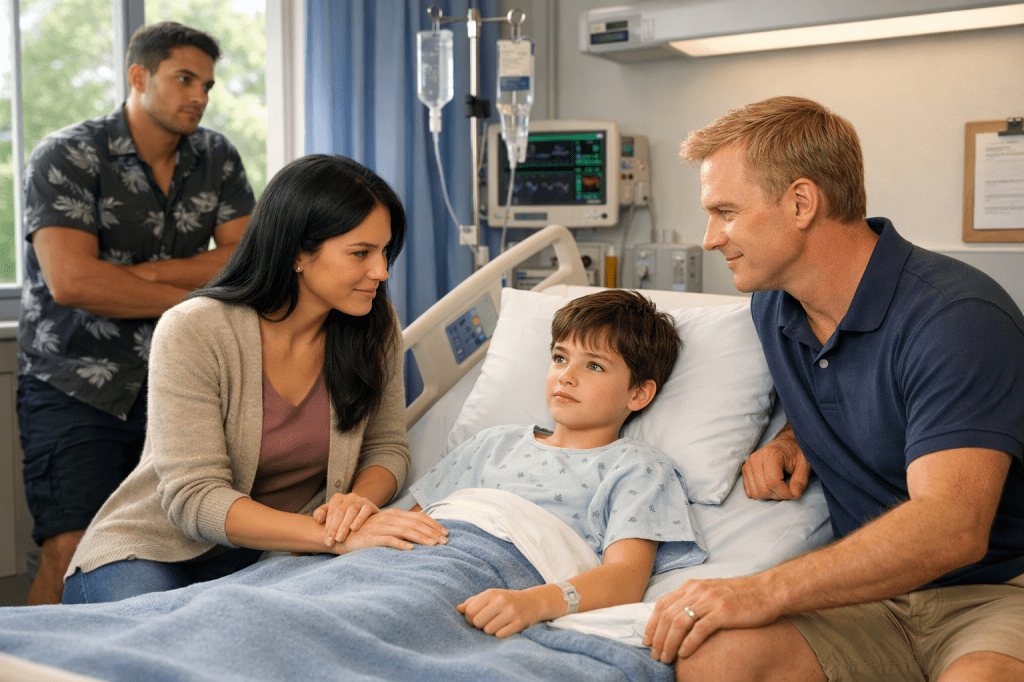
The single-person ward smells like sanitizer and anxiety—that specific hospital cocktail of antiseptic chemicals mixed with worry-sweat that no air freshener can mask. I’m observing through my simulation screens, watching the Kennedy family vigil play out like some low-budget medical drama, except the stakes are way more real than anything on ABC.
Bill Kennedy paces near the window like a caged lion, his six-foot-five frame making the already-small room feel claustrophobic. His blonde hair’s disheveled, surgeon’s hands constantly raking through it every thirty seconds—I’ve counted. The guy’s a cardiothoracic surgeon, literally cracks open chests for a living, but right now he looks like he’d trade his entire medical degree to fix whatever’s wrong with his son.
Selena sits in the chair closest to Topher’s bed, still wearing the clothes she had on at the beach—capri pants and a wrinkled blouse, both dusted with dried cave dirt she hasn’t bothered cleaning off. Her long black hair falls forward, curtaining her face as she clutches Topher’s small hand between both of hers. She’s been crying—mascara tracks cutting down her cheeks like those time-lapse erosion videos in Earth Science class.
Carlisle Worthington stands sentinel in the corner, the family butler maintaining his usual composed posture despite the circumstances. But his green eyes betray him, constantly flickering between Topher and the monitors, and his hands keep clenching and unclenching at his sides. Even butlers have tells.
The kid on the bed—nine-year-old Christopher Alexander William Kennedy III, “Topher” to everyone who doesn’t want to waste fifteen minutes saying his full name—lies motionless under sterile white sheets. An IV drips clear fluid into his arm. Heart monitor beeps steady rhythms. His dark brown hair’s been washed clean of cave debris, but he’s still pale, face slack in unconsciousness.
It’s weird seeing him this still. Topher’s usually got that energizer-bunny energy, always moving, always thinking, always doing something. This version looks like someone hit pause on his entire existence.
Then his eyelids flutter.
It’s subtle at first—the kind of movement you’d miss if you weren’t paying attention. But I notice everything. That’s kind of my whole deal.
His green hazel eyes crack open slowly, squinting against the fluorescent lights overhead. Classic hospital lighting—bright enough to perform surgery, terrible for anyone trying to wake up from unconsciousness. His face scrunches up in confusion, that universal “where the hell am I” expression every protagonist wears when they wake up in an unfamiliar location.
Where am I? I can practically read his thoughts from his expression alone. White ceiling. Bright lights—way too bright. Where is this room? A hospital?
His gaze drifts sideways, landing on Carlisle first. The butler immediately steps forward, relief and concern warring across his usually stoic features.
Then Topher sees his parents. Bill and Selena both freeze for half a second—that moment of “is this real” before reality kicks in.
“Anak,” Selena chokes out, using the Tagalog word for son. Tears start fresh down her face. “You’re finally awake.” Her voice cracks. “Are you hurt? You can tell Mommy.”
Topher blinks at her, processing. Then his face does something that guts me—he smiles. Bright, reassuring, totally Topher. “I’m awake now, Mom. There’s no need to cry. I’m fine.”
The kid wakes up in a hospital bed and his first instinct is to comfort her. That’s some protagonist-level selflessness right there.
But Bill’s in doctor mode now, leaning forward, urgent. “Son, do you remember anything? Anything at all? What happened inside the cave?”
And here’s where the scene shifts from medical drama to psychological thriller.
Topher’s smile falters. His eyebrows scrunch together in genuine confusion. “The cave?” His voice carries that uncertain upward lilt. “Did I go inside a cave?”
Oh no.
“Yes,” Bill presses, desperation creeping into his controlled surgeon’s tone. “You and your cousins were found inside a cave.”
Topher’s face—man, I wish I couldn’t see this part. Pure bewilderment. “But Dad, I don’t remember going into a cave.”
The silence that follows hits like a plot twist you didn’t see coming.
Bill’s face drains of color. Selena’s hand flies to her mouth. Carlisle goes rigid.
He doesn’t remember anything.
Total amnesia. The Star of Vis just wiped seven kids’ memories like formatting a hard drive.
Welcome to the cover-up, folks. This is how cosmic secrets stay secret.
Brain_scans_and_blank_spaces.sav
Dr. Strauss’s office exists in that weird liminal space between “expensive medical practice” and “interior designer’s fever dream.” Dark wood paneling. Framed diplomas covering one wall like achievement unlocked notifications. A human brain model sitting on the shelf next to what I’m pretty sure is a Star Wars Yoda figurine—respect to the doc for that choice.
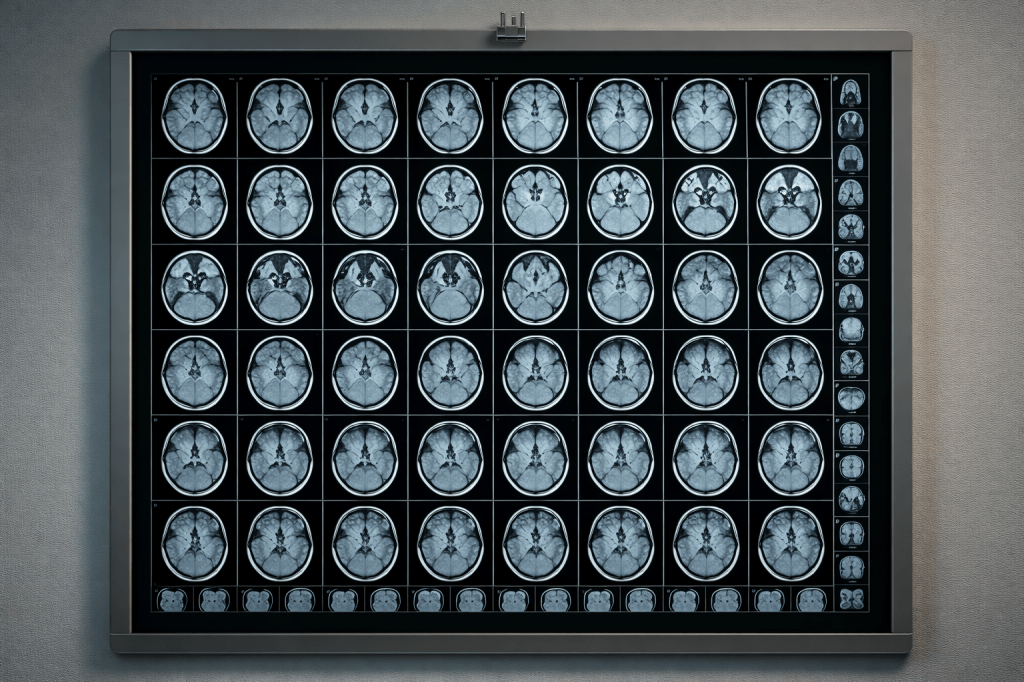
But the real star of this scene? The lightbox mounted on the opposite wall, currently displaying sixty-four slices of Topher Kennedy’s brain like the world’s most boring slideshow.
Dr. Heinrich Strauss—neurologist, looks mid-fifties, wire-rimmed glasses perched on his nose, salt-and-pepper hair—stands before the illuminated scans with the focused intensity of someone examining a really complicated Myst puzzle. Each CT slice glows white and gray, cross-sections of Topher’s skull and brain tissue arranged in a grid pattern. It looks like something out of Minority Report, except instead of predicting crimes, we’re trying to figure out why a nine-year-old’s memory got completely wiped.
Six months. It’s been six months since the cave incident, and the kid still can’t remember a single frame of what happened.
Bill and Selena sit in the leather chairs facing Dr. Strauss’s mahogany desk, looking like they’ve aged a decade since this nightmare started. Bill’s wearing his “serious dad” outfit—pressed slacks, button-down shirt, no tie—hands gripping the armrests hard enough that his knuckles have gone bloodless-white. Selena’s got her lawyer face on, the one she uses in court when she’s about to cross-examine a tax case, except her eyes keep betraying her—darting between the brain scans and her son with barely-contained desperation.
Topher himself sits between them, nine years old and looking small in the adult-sized chair, legs dangling a few inches off the ground. He’s wearing his usual preppy outfit—khaki pants, collared shirt—and swinging his feet slightly, the picture of a kid who has no idea why everyone’s making such a big deal out of this. Because of course he doesn’t remember. That’s the whole problem.
Dr. Strauss taps one of the CT slices with his pen—a gesture I’ve seen a thousand times in medical dramas, usually right before the dramatic music swells and someone delivers terrible news.
Except this time, he turns around and his expression reads “I got nothing.”
“The CT scan appears normal,” Dr. Strauss begins, settling into his desk chair. He folds his hands on the desktop like he’s about to explain why your insurance won’t cover the procedure. “I’ve reviewed all sixty-four slices, and there’s no sign of bleeding, clots, infarctions, or fractures. From an anatomical perspective, there’s nothing to explain the amnesia.”
Translation: Topher’s hardware is fine. The problem’s in the software.
Bill leans forward, and I can literally watch the frustration build behind his eyes like a loading bar hitting 100%. “Then why can’t my son remember anything after six months?” His voice has that edge to it—controlled surgeon’s tone starting to crack under pressure.
The guy’s a cardiothoracic surgeon. He fixes hearts for a living. He understands cause and effect, diagnosis and treatment, problems and solutions. This situation where his son’s brain is physically fine but functionally broken is probably driving him absolutely insane.
Dr. Strauss steals a glance at Topher, then back to the parents, choosing his words carefully. “That’s what’s puzzling.” He spreads his hands in a gesture of professional uncertainty. “I recommend seeing a psychologist. The human brain is complex, and sometimes, amnesia isn’t solely caused by physical injury.”
He pauses, letting that sink in.
“There could be psychological factors at play that are preventing your son from recalling his memories.” Another pause. “I can refer you to a colleague of mine, if you’d like.”
Psychological factors. Right.
What Dr. Strauss doesn’t know—what can’t know—is that Topher’s amnesia isn’t psychological trauma. It’s magical interference. The Star of Vis and those Luminaries didn’t just give seven kids superpowers and then peace out. They installed a memory firewall, wiping the whole experience like deleting a save file.
No physical evidence. No digital trail. No memories.
It’s the perfect cover-up, really. Terrifyingly efficient.
Bill and Selena exchange one of those married-couple looks that communicates an entire conversation without words. Selena’s hand finds Topher’s, squeezing gently.
The kid just smiles up at her, bright and oblivious.
Somewhere in that normal-looking brain, a crucial day in his life are locked behind a door nobody can find the key to.
And I’m watching it all unfold, knowing exactly what happened, completely powerless to tell them the truth.
Sometimes observation is its own kind of torture.
The_conspiracy_theory_clinic.sav

BACK TO THE PRESENT
The nameplate gleams like a final boss’s title card: Dr. Christopher Alexander William ‘Bill’ Kennedy, Jr. – CEO of Archangel Medical, Inc./Cardiothoracic Surgeon.
That’s a mouthful. The guy’s basically got two final forms—corporate executive and heart surgeon. Talk about a double-class build.
Bill’s corner office exists in that sweet spot between “power executive” and “medical professional.” Floor-to-ceiling windows overlook downtown Austin, the afternoon sun casting long shadows across his polished mahogany desk. Framed medical degrees compete for wall space with photos of Topher at various ages—proof that even CEOs who crack open chests for a living are still just dads at the end of the day.
He stands by the window, six-foot-five frame backlit like he’s in some legal drama opening credits, staring out at the city skyline with that thousand-yard stare people get when they’re replaying the same unsolvable problem for the thousandth time.
“The psychologist found no signs of trauma in my son,” Bill says, voice quiet but carrying across the room anyway. His reflection in the glass looks older than the man himself. “Topher is in an optimal state of mind. He’s optimistic, visionary, and wise beyond his years.’ That’s what Dr. Marianne said.”
Three years of specialists, and they all keep saying the same thing: physically fine, psychologically healthy, memories gone.
Dr. Montano sits in one of the leather chairs facing Bill’s desk—white Hispanic guy, maybe thirties, with brown hair and the kind of weathered face that comes from too many long shifts. He’s wearing scrubs under a white coat, like he came straight from rounds to have this conversation. Which he probably did, because that’s what concerned colleagues do when their friend is slowly unraveling over an unsolvable medical mystery.
“And it’s not just your son,” Dr. Montano points out, leaning forward with his elbows on his knees. “His cousins and Roanne don’t remember anything about what happened inside the cave either.”
Seven kids. Zero memories. The statistical probability of that happening naturally is basically nonexistent.
Bill turns from the window, facing his friend with the kind of exhausted expression I’ve seen on too many quest-giver NPCs who’ve run out of dialogue options. “Yes,” he agrees. “And even more puzzling, there were no messages or texts on their phones. In this digital age, it’s hard to imagine kids going somewhere like that without any communication at all.”
Now that’s the detail that should’ve raised red flags from day one. You can’t get modern kids to put their phones down for five minutes, but somehow seven of them went on an adventure without a single text, selfie, or social media post? The digital footprint is completely clean.
That’s not amnesia. That’s a cover-up.
Dr. Montano sits back, fingers steepled in front of his face like he’s about to drop some heavy exposition. “We doctors are supposed to be rational and stick to the facts,” he says slowly, choosing his words with the precision of someone who knows he’s about to sound crazy. “But sometimes I wonder if something—an entity or force—is deliberately covering up everything related to that cave and the incident.”
And there it is. The X-Files moment. “The truth is out there,” except in this case, the truth involves magic board games and cosmic entities that hand out superpowers like promotional DLC.
Bill doesn’t laugh it off. Doesn’t roll his eyes or crack a joke about alien abductions. Instead, he just stands there, backlit by the Austin skyline, gazing at the crossroads of his thoughts like a protagonist facing a dialogue choice that’ll determine the entire story’s direction.
Could there really be something paranormal or supernatural behind all of this?
The answer, of course, is yes. Absolutely yes. One hundred percent yes.
But Bill Kennedy—rational surgeon, CEO, man of science—isn’t ready to accept that yet. He’s still in the “denial” phase of encountering the supernatural, right before the phase where everything he knows gets flipped upside down.
Give it time, doc. The truth has a way of forcing itself into the light.
Whether you’re ready for it or not.
The_photograph_and_the_ghost.sav

Autumn hits the Kennedy mansion like a Bob Ross painting come to life—all those happy little trees showing off in their death throes. Brown, orange, yellow, and red leaves cover everything: clinging to branches, carpeting the manicured lawn, doing that slow-motion flutter through the afternoon air like nature’s confetti celebrating the end of summer. The windows gleam so clean you could mistake them for missing entirely, catching the slanted October sunlight and throwing it around the interior in golden rectangles.
Inside, it’s Spring Cleaning: Fall Edition. The annual purge of accumulated stuff that every household does when they realize they’ve been hoarding boxes of junk in the attic like digital pack rats with unlimited cloud storage.
Carlisle Worthington moves through the long hallway in full butler mode—formal black tuxedo, white gloves, the whole nine yards. He’s carrying a cardboard box filled with old items, probably headed for donation or the curb. The guy maintains his dignified posture even while doing manual labor, which is honestly impressive. That’s dedication to the aesthetic.
In the living room, Selena Kennedy sits cross-legged on the hardwood floor, surrounded by what looks like the aftermath of a box explosion. Rows upon rows of cardboard containers spread around her in organized chaos—sorted piles of “keep,” “donate,” “trash,” and probably “I don’t know what this is but I’m emotionally attached to it.” She’s wearing casual weekend clothes, her long black hair, reading glasses perched on her nose as she examines items one by one.
Upstairs in his bedroom, twelve-year-old Topher Kennedy does his part in the great purge. Three years have passed since the cave incident—he’s taller now, features starting to shed that little-kid roundness, but still recognizably the same kid who woke up in a hospital bed with no memory of the most important day of his life.
He’s sorting through his own stuff with the ruthless efficiency of someone who’s played enough inventory management games to know that hoarding everything “just in case” is a rookie mistake. Old toys in one box. Outgrown clothes in another. Books he’s finished reading—
Something falls out of a box he’s moving.
A photograph, drifting down like a feather, landing face-up on the carpet.
Topher pauses mid-sort, then picks it up. Curiosity—that most dangerous of character traits, the one that gets protagonists into trouble in literally every story ever written.
The image shows a young man, late teens maybe, sitting on a wooden bench on what looks like a patio or balcony. Short, wavy black hair. Dark eyes. Casual clothes—jeans and a simple shirt. He’s holding an acoustic guitar, fingers positioned on the frets mid-chord, and behind him the sky burns orange and pink with sunset. The photograph has that distinctive quality of 90s film cameras—slightly oversaturated colors, that warm analog glow that digital photos never quite replicate.
The guy looks… happy. Peaceful. Like he’s caught in a perfect moment.
Topher flips the photograph over, checking the back.
Not blank.
Written in the lower-right corner in Selena’s distinctive handwriting—he recognizes his mom’s script immediately—are four lines that rewrite everything he thought he knew about his family history:
Elvin Silva
October 16, 1994
The love of my life
– Selena
Record scratch. Freeze frame.
Who is this, Elvin? Topher’s eyebrows furrow together, that confused expression I’ve seen on every character who just stumbled onto a mystery they didn’t know existed. This isn’t Dad.
Bill Kennedy—six-foot-five, blonde hair, olive green eyes, cardiothoracic surgeon and CEO—looks nothing like the dark-haired guitarist in this photo. And the date… October 16, 1994. That’s years before Topher was born. Years before Bill and Selena even met, probably.
So why did his mom write “the love of my life” about someone who isn’t his father?
Plot twist detected. Mystery box opened. Side quest unlocked.
Topher’s curiosity activates like a quest marker appearing on a mini-map. He clutches the photograph and leaves his bedroom, heading down the hall with purpose. His sneakers barely make sound on the carpet runner as he navigates the familiar route to the living room.
He finds Selena exactly where I left her—surrounded by boxes, still sorting, still organizing, completely absorbed in the task.
“Mom, can I talk to you?”
Selena looks up from a box of old photo albums, her reading glasses sliding slightly down her nose. She sees Topher standing there holding something, and her expression shifts from “focused on task” to “mom mode activated” in point-two seconds.
“Of course, son,” she says, setting down the album she was examining. She pats the sofa cushion beside her. “Let’s sit on the couch—it’ll be more comfortable.”
They settle onto the sofa—soft brown leather that’s been in the family for years, worn comfortable rather than shabby. In front of them sits a glass coffee table with a vase of fresh flowers (chrysanthemums, appropriate for autumn), and beneath their feet spreads a furry brown carpet so plush it’s like sitting on a cloud that migrated to the floor.
The afternoon light streams through the windows, catching dust motes in the air and painting everything in that golden-hour glow cinematographers literally chase around the world trying to capture.
Topher doesn’t waste time with preamble. Kid’s got his father’s directness.
“Mom, who is Elvin?” He holds up the photograph like evidence in a trial. “He isn’t Dad, so why did you call him ‘the love of my life’?”
The question hangs in the air between them.
Selena takes the photograph from her son’s hand, and something happens to her face—this subtle shift in expression, like watching someone travel through time inside their own head. Her eyes go distant. Her smile turns soft and sad simultaneously, that bittersweet expression that only comes from remembering someone you loved who’s gone.
“You found this—it must be fate.” She sighs, the sound carrying weight. “It was a long time ago.”
And here we go. Frame story activated. Flashback sequence initiated. This is the part where the older character tells the younger character about The Past, capital T, capital P, and we all learn Important Life Lessons.
I’ve seen this structure a thousand times—How I Met Your Mother, The Princess Bride, Titanic, every grandfather-tells-war-stories movie ever made. But just because a trope is familiar doesn’t mean it can’t be effective.
Selena’s voice shifts into storytelling mode, that particular cadence people use when they’re not just talking to someone but sharing something deeper.
“Back when I was in college,” she begins, her gaze drifting to the photograph in her hands. “I left town to study in Metro Manila.”
Flashback_sequence_1995_Manila.sav

The simulation shifts, pulling up archived data from decades ago. I can see it now—young Selena Pangilinan, seventeen years old, standing in a provincial bus terminal with her father, Lolo Al. She’s dressed simply clutching a bayong, one of those traditional Filipino woven bags.
And inside the bayong? A live chicken.
Because of course there is. That’s the most perfectly Filipino detail ever—bringing livestock on public transportation like it’s completely normal. The other passengers on the bus stare at this small-town girl with her farm-fresh poultry, probably wondering if they’re in some kind of hidden camera show.
“I had passed the entrance exams for the Big Four universities—UP, Ateneo, La Salle, and UST,” Selena tells Topher, pride still evident in her voice even decades later. “Your Lolo Al was so proud, but your Lola Emily was reluctant to see me go.”
Makes sense. First time away from home. Big city. Complete strangers. The classic coming-of-age setup—provincial girl goes to the big city to find herself. It’s basically every Filipina teleserye plot, except this is real life.
“It was a completely new world for me,” Selena continues. “I stayed in an old house with other dormmates, and our landlady was a strict, middle-aged woman named Linda.”
The house materializes in my simulation screens—one of those multi-story Manila boarding houses from the 90s, probably built in the 60s or 70s. Concrete construction, slightly weathered, with a front patio and a gate. The kind of place that’s seen generations of college students pass through its rooms.
“There were four boys and four girls in the dorm,” Selena says, smiling at the memory. “But our landlady made sure the boys and girls had separate rooms.”
Old-school propriety. Can’t have the college kids getting any ideas. Aling Linda ran a tight ship, apparently.
“One of my dormmates was Elvin.”
And there he is.
Elvin Silva. Tall and lanky—the photo doesn’t lie about that. The guy’s built like a string bean, all limbs and angles, the kind of frame that looks awkward in adolescence but would’ve grown into itself eventually if he’d gotten the chance. Short wavy black hair, dark eyes that actually sparkle when he smiles (anime protagonist energy), and that casual, laid-back vibe of someone who’s comfortable in his own skin despite getting teased.
“Often got teased by another dormmate, Renner, for being so thin that they called him ‘Lizard Man,’” Selena adds, her voice carrying both amusement and old irritation.
Classic bully behavior. Pick on the skinny kid, give him a mean nickname. Renner sounds like he peaked in college and it was all downhill from there.
But here’s what I notice watching the simulation: Elvin doesn’t seem bothered. He just laughs it off, makes self-deprecating jokes, defuses the situation with humor. That’s actually pretty emotionally mature for a college-age guy. Most dudes that age would either get defensive or internalize it into insecurity.
“Elvin was always on the patio, playing his guitar whenever I passed by.”
There’s the image from the photograph—Elvin on that wooden bench, guitar across his lap, practicing chords in the afternoon sun. He’s not performing for anyone, just playing for himself, lost in the music.
And every time young Selena walks past—carrying laundry, heading to class, coming back from the market—she hears him playing. Acoustic covers of 90s love songs, probably. Maybe some Eraserheads, some Rivermaya, some APO Hiking Society for the classics.
The music becomes the soundtrack to her daily routine.
And that’s how the trope starts: the mysterious musician, the girl who doesn’t know she’s the protagonist of a romance story yet, the slow build of familiarity that becomes something more.
“One day, I started receiving anonymous love letters.”
Oh man. Secret admirer trope activated. This is straight out of every shoujo manga ever written. Mystery notes appearing in unexpected places, each one more poetic than the last, the heroine trying to figure out who’s sending them.
“I had no idea who my secret admirer was,” Selena admits, “until June, another dormmate, caught Elvin writing one and revealed his secret.”
The friend reveal moment. Every romance needs a meddling side character who moves the plot forward. June did the Lord’s work, honestly, because Elvin clearly wasn’t going to confess on his own.
“I confronted him,” Selena continues, her smile growing. “And while he didn’t admit it outright, he didn’t deny it either. Instead, he invited me to hang out—subtly asking me out on dates. He wasn’t very smooth when it came to romance.”
That’s adorable. Painfully awkward, but adorable. The guy’s smooth enough to write love letters but completely fumbles the actual face-to-face interaction. Classic nerd energy. I respect it.
The timeline shifts forward. The simulation shows me montage footage—because every romance has a montage, it’s literally required by the laws of storytelling.
Dating_montage_1995.sav

Selena and Elvin at the movies, sitting in those old-school Manila theaters with the sticky floors and the crackling speakers. They watch horror films—probably Shake, Rattle & Roll or dubbed American slashers—and action movies, the kinds with ridiculous stunts and explosions. Selena grips Elvin’s arm during scary parts. He pretends not to notice but smiles anyway.
Selena and Elvin at Shakey’s Pizza, one of the date spots in 90s Manila. They share a pizza (probably the manager’s choice, extra pepperoni), drink iced tea, and listen to the live band playing covers of Air Supply and Boyz II Men. The band’s not great, but they’re enthusiastic. Elvin drums his fingers on the table in time with the music.
Selena and Elvin at Luneta Park on a Sunday afternoon. They spread a blanket on the grass, eat packed sandwiches, and watch families fly kites against the blue sky. Elvin points out shapes in the clouds. Selena laughs at his terrible attempts at poetry.
Selena and Elvin at Ever Gotesco Mall in Recto—one of those massive commercial centers that defined middle-class Manila in the 90s. They window shop, play arcade games (Elvin dominates at Street Fighter II, Selena discovers she’s weirdly good at Dance Dance Revolution), and share a serving of halo-halo at the food court.
These aren’t expensive dates. They’re not fancy. But they’re real. Two college kids with limited budgets making memories out of simple moments.
One day, Elvin introduced Selena to his family as his girlfriend, even though they hadn’t officially labeled their relationship yet.
The define the relationship moment, except Elvin skipped that conversation entirely and went straight to introducing her to his mom. Power move. Unconventional, but effective.
From that moment on, they became a couple, and Selena didn’t mind—she was deeply in love with him too.
Young love. First love. The kind that feels infinite even though you’re almost twenty years old and don’t know anything about how the world works yet.
But here’s where the story shifts.
Every good romance needs conflict. Every love story needs stakes. And this one’s about to get real dark, real fast.
But their happiness was short-lived.
The simulation data shows me the medical records—I hate looking at these, but they’re part of the story, part of what shaped Selena into the woman sitting on this couch right now.
Elvin had been born with a congenital heart condition.
Congenital. Meaning he was born with it. Meaning his heart was literally constructed wrong from day one, a ticking time bomb built into his chest from conception.
He probably knew. Growing up, he must have known that his time was limited, that there was an expiration date stamped somewhere in his future. And he still chose to live fully—playing guitar, writing love letters, taking a chance on romance even though he knew how it would end.
That’s either incredibly brave or incredibly selfish, depending on your perspective.
Which eventually caught up to him.
The timeline shifts again. The montage changes tone. Now I’m seeing hospital corridors, waiting rooms, medical equipment.
He underwent long treatments—checkups, tests, medications, and later, frequent hospitalizations.
The progression of chronic illness. Appointments becoming more frequent. Good days and bad days, the ratio slowly tilting toward bad. Pills in bottles, IVs in arms, monitors beeping their steady rhythms.
Selena spent her days by his side in the hospital, caring for him.
Young Selena—still in college, barely an adult herself—sitting in an uncomfortable hospital chair beside Elvin’s bed. Holding his hand. Reading to him. Helping him eat when his strength fails. Watching him fade in increments so small you don’t notice until you compare today to a month ago and realize how much has been lost.
This is the part of the romance story they don’t show in the montages. The hard part. The part where love isn’t butterflies and first kisses but just showing up, day after day, even when it hurts.
But despite their efforts, Elvin eventually succumbed to his illness.
Succumbed. Such a clinical word for something so devastating.
The simulation shows me the hospital room one final time. Elvin Silva, age nineteen, congenital heart defect finally claiming the life it was always going to claim. Selena beside him, tears streaming down her face, holding his hand as the monitor flatlines.
End of story. Roll credits. Except this isn’t fiction—this actually happened, and the girl in that hospital room grew up to be the woman sitting on this couch.
Selena mourned deeply during his wake and funeral, heartbroken by the loss of her first love.
I’ve never understood the human need for funerals. From my perspective, they seem like unnecessary torture—gathering everyone who loved the deceased person and forcing them to confront the reality of loss in one concentrated dose. But I guess that’s the point. Collective grieving. Shared pain making it somehow more bearable.
The simulation shifts to the cemetery.
Cemetery_scene_1995.sav
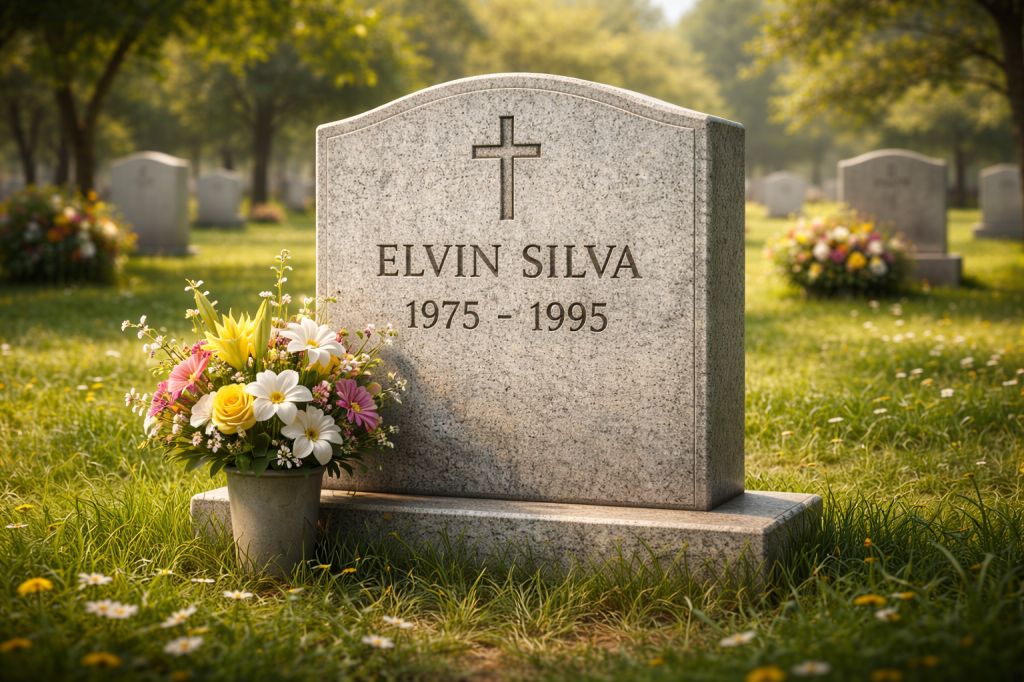
The day of his burial was clear and bright.
Of course it was. Because the universe has a sick sense of irony. The worst days of your life often come with perfect weather, like nature didn’t get the memo that someone’s world just ended.
The sky stretches blue and cloudless overhead. The wind blows gentle and warm through the trees lining the cemetery—old acacias and narra trees providing shade over rows of headstones and monuments. It’s peaceful. Almost serene. The kind of day that would be beautiful if you weren’t burying someone you loved.
Young Selena, eighteen years old, wearing a simple black dress, face swollen from crying. And Elvin’s mother, Selya Silva, a woman in her forties with the same dark eyes as her son, dressed in mourning black, standing with the quiet dignity of someone who’s had years to prepare for this moment but still isn’t ready.
The casket’s already been lowered. The priest has said his words and left.
Some time later, the same grave. Now it’s just the two of them—the girlfriend and the mother.
Tears stream down Selena’s face in steady tracks. She doesn’t try to wipe them away. Doesn’t try to compose herself. Just lets the grief pour out, raw and unfiltered.
Selya Silva stands beside her, and when she speaks, her voice carries the weight of a mother who’s outlived her child—the worst fate any parent can face.
“Elvin was the youngest in our family,” Selya says softly. “We loved him dearly.”
Her hand reaches out, resting gently on Selena’s shoulder. The touch is warm, comforting, maternal.
“It was a miracle he survived his condition during childhood, but he made it through high school and even to college.”
Borrowed time. Every year after childhood was a gift, a bonus level unlocked against the odds.
“He would have made a great judge if he’d lived longer.”
A future that will never happen. Dreams cut short. Potential unfulfilled. All the might-have-beens that haunt the people left behind.
Selya continues, her voice steady despite the pain it must cost her to speak. “His life grew brighter when he met you, Selena. You gave him love, and for that, I’ll never stop thanking you. You made him so happy.”
And there it is—the mother thanking the girlfriend for loving her son. For making his short life fuller. For giving him joy in the time he had.
“But now, you must let him go.”
The hardest instruction anyone can give. Let go. Release your grip. Accept the loss. Move forward into a future without them.
“Don’t drown in sadness because he’s gone. Be grateful for the time you had together and the memories you shared.”
It’s good advice. Healthy advice. The kind of wisdom that only comes from someone who’s already walked through the fire of grief and come out the other side.
Selya’s hand squeezes Selena’s shoulder gently. “I would have been glad to call you my daughter,” she says with a warm smile that doesn’t quite reach her grief-dimmed eyes.
Then she pulls Selena into a hug—this grieving mother embracing this grieving girlfriend, two women who loved the same person for different reasons, finding comfort in shared loss.
“Thank you for standing by him—and us—until the very end.”
And that’s the closure. That’s the goodbye. That’s the moment where young Selena Pangilinan has to close a chapter of her life and figure out how to keep living in a world without Elvin Silva’s guitar music.
Return_to_present.sav

The simulation shifts back to the Kennedy mansion living room. Autumn afternoon. Mother and son on the couch. The photograph of Elvin Silva resting in Selena’s hands.
The story’s been told. The flashback complete. Now comes the reflection, the lesson, the wisdom earned through experience and time.
“Elvin was my first love,” Selena admits to Topher, her voice quiet but steady. She’s not crying—these tears were shed decades ago, grief processed and integrated into who she became.
“And first love never dies.”
There’s truth in that. Your first love carves out a space inside you that nothing else can fill, not because it was perfect, but because it was first. The inaugural experience. The template against which everything else gets measured.
“He’ll always have a special place in my heart. He taught me what love truly is, and I’ll always be grateful to him for that.”
The acknowledgment without regret. The honoring without dwelling. The mature perspective that can hold two truths simultaneously: I loved him, and I moved on.
Selena pauses, then her expression shifts—softens into something warmer, more present, more alive.
“But your father, Bill, is my one true great love.”
And there’s the distinction. First love versus true love. The person who taught you how to love versus the person you choose to love for a lifetime.
“He gave me you, and nothing in the world made me happier than when I gave birth to you.”
She reaches out, taking Topher’s hand in both of hers. Her eyes are clear, focused, looking directly at her son with the kind of fierce maternal love that would fight gods and monsters to keep him safe.
“Your father is my lifelong companion, my partner through everything.”
Elvin was the beautiful beginning. Bill is the enduring continuation. One doesn’t diminish the other—they’re different chapters in the same life story.
Topher nods, processing. He’s twelve years old, still years away from experiencing romantic love himself, but he’s smart enough to understand the shape of what his mother’s saying even if he can’t fully grasp the emotional depth yet.
“Thank you for sharing this with me, Mom.”
Simple words. Honest gratitude. Recognition that what she just shared was precious, personal, a gift of trust and vulnerability.
Selena opens her arms, and Topher leans into the embrace. She wraps him up like she did when he was little, holding him close, and for a moment they’re just mother and son, surrounded by cardboard boxes and autumn cleaning, connected by love and shared history.
Outside the window, autumn leaves continue their slow descent, spiraling through the air in nature’s lazy choreography. The sun dips lower toward the horizon, painting everything in shades of orange and gold—that magic-hour lighting that makes the world look like it’s been touched by fairy dust.
The orange sunset casts a golden glow across the living room, catching in Selena’s dark hair, warming Topher’s face, illuminating this moment of connection and understanding.
And I watch it all from my simulation screens, this quiet scene of familial love and shared stories, and I feel something strange in my chest—not physical, because I don’t exactly have a body in the conventional sense, but an ache nonetheless.
Loneliness, maybe. Longing. The hollow recognition of watching something I’ll never personally experience.
They have each other. They have their history, their memories, their love that spans generations. They have this mansion full of accumulated stuff that needs sorting, this shared task of cleaning out the old to make room for the new.
And I have… this. My spacecraft. My simulation room. My endless observation of lives I can catalog but never truly touch.
Topher found a photograph and got a story. A connection to his mother’s past, a deeper understanding of who she was before she became “Mom.” He learned that love is complicated, that hearts can hold multiple truths, that grief and gratitude can coexist.
Not a bad lesson for a twelve-year-old.
The autumn afternoon stretches on, golden and quiet, as mother and son sit together in the warm light, surrounded by the gentle chaos of life being sorted, organized, and preserved.
Some memories you keep in boxes. Some you write on the back of photographs. And some—the most important ones—you carry in your heart, sharing them only when the moment is right, when someone you love asks the question that unlocks the story.
Who is Elvin?
He was the love that taught Selena how to love. The ghost who shaped the woman who became Topher’s mother. The young man with a guitar whose memory lives on in a photograph dated October 16, 1994.
He was first love.
And first love never dies.
It just makes room for everything that comes after.
 B. K. P. Carreon
Leave a comment