Overview:
| Roanne graduates from high school, but her teacher expresses disappointment at her decision to work instead of pursuing college. She enters the workforce as a seamstress, sewing dresses for women to help make ends meet. Kokoy, though intelligent and hardworking, fails to win Roanne’s heart despite his earnest serenade. Meanwhile, Roel gets married, deepening Roanne’s longing to someday find true love like her brother. During a quiet night of stargazing with his father, Bill, Topher witnesses a luminous blue-white shooting star streak past the Andromeda constellation. In the coastal town, memories of an unlikely storm and earthquake still linger. As Christmas Eve arrives, the Pangilinans, Sevillas, Kennedys, and Agoncillos gather together, sharing gifts, laughter, and the warmth of family during a joyous Noche Buena. |
White_robes_and_hard_roads.sav
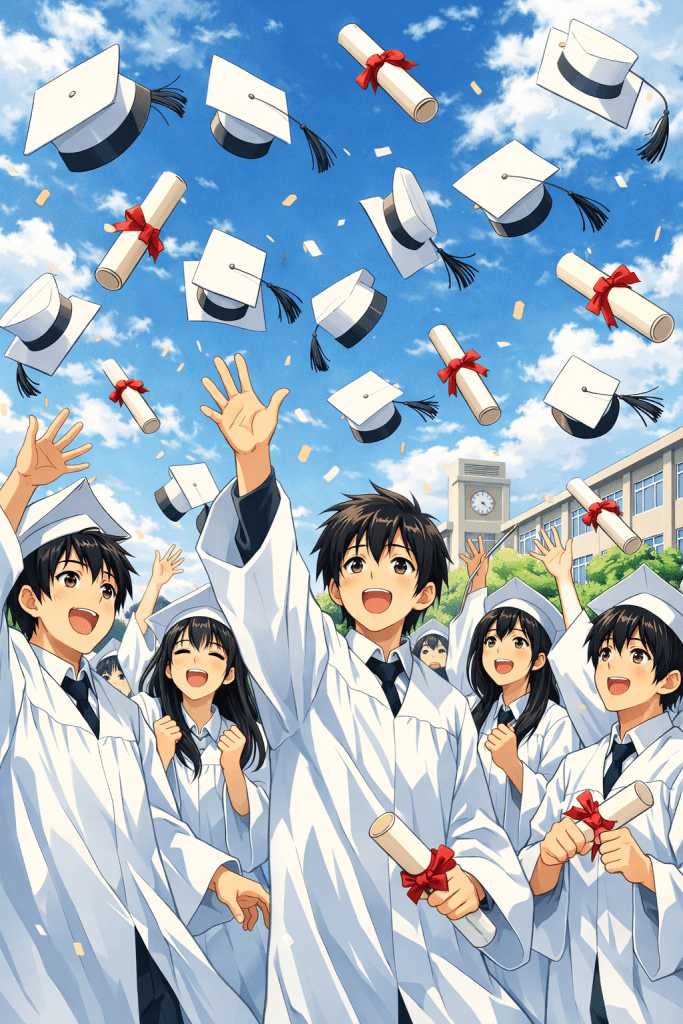
Okay, so here’s the thing about graduation ceremonies in small-town Philippines—they’re basically the real-world equivalent of those triumphant end-of-season anime episodes where the protagonist finally levels up. Except instead of dramatic battle music and particle effects, you get the relentless tropical sun beating down on an open field and the scratchy sound of “Pomp and Circumstance” played through speakers that probably haven’t been upgraded since the Marcos era.
I’m watching this unfold from my simulation chamber aboard the Nebula Drifter, my modest spacecraft currently parked in the cold reaches beyond Saturn. The holographic display flickers to life, rendering the scene in crisp 4K detail—better than any live stream you’d get on Earth. San Juan, Batangas. A bright morning where the sky stretches out like a blank blue canvas, not a cloud in sight to offer any mercy from the heat.
The public school grounds sprawl before me in the feed: a concrete expanse surrounded by low buildings with that distinctly Filipino aesthetic—cream-colored walls, red roofs, windows with metal grilles. A makeshift stage dominates the center, draped in white cloth and banners proclaiming “CONGRATULATIONS GRADUATES!” in that same font every school seems to use. Rows of white plastic chairs face the stage, packed with families fanning themselves with programs, ceremony booklets, whatever flat surface they can find.
And there, in the staging area to the left of the platform, stands Roanne Reyes Mallari among her classmates. All of them wearing identical white graduation robes—those polyester monstrosities that feel like wearing a portable sauna—and square academic caps perched on their heads. It’s the universal uniform of achievement, the armor of academia. Final Fantasy had cooler outfit designs, honestly, but I get the symbolism.
Roanne’s standing in line, and even from here—or rather, through the simulation’s enhanced observation protocols—I can read her body language. Shoulders slightly tense. Hands clasped in front of her. That patient, practiced stillness of someone who’s spent her whole life waiting for things. She’s eighteen now, technically an adult by Earth’s arbitrary calendar standards, though she still carries herself with that quiet reserve I’ve been tracking since she was fifteen.
Her long black hair is loose today, unusual for her. Normally she keeps it in a practical braid, but for graduation, it falls straight down her back like a dark waterfall, catching the sunlight. Someone—probably her sister Kate—convinced her to wear makeup. Light foundation, a touch of blush on her tan cheeks, lip gloss that makes her look both more polished and somehow more vulnerable.
The announcer’s voice crackles through the speakers, tinny and over-amplified: “Mark Anthony Cruz.” A boy shuffles up the stage stairs, accepts his diploma, shakes hands with the principal. The crowd claps politely. “Maria Clarissa Diaz.” Same routine. The graduation march plays on loop, that same six-bar phrase repeated until it becomes white noise.
This is the grind. The waiting. Every RPG has it—those moments between save points where you’re just walking, just progressing, waiting for the next cutscene to trigger. Roanne’s been standing in line for probably forty minutes now. The sun’s climbing higher. Sweat beads on her forehead despite the light morning breeze that occasionally makes the white robes flutter like ghosts.
“Paolo Ernesto Lucero.” Another graduate. Another round of applause.
I zoom the simulation feed in slightly, focusing on Roanne’s face. Her dark brown eyes are scanning the crowd, searching. There—she finds them. Her family, clustered together about fifteen rows back from the stage. Her father Carding in his best barong tagalog, the embroidered fabric crisp and formal. Her mother Carlota in a floral dress, clutching a handkerchief like it’s a sacred relic. Her older brother Roel standing at the edge of the aisle with a silver digicam—one of those compact point-and-shoot models from the late 2000s, probably a Canon or Sony, the kind that predates the smartphone camera revolution.
Kate’s there too, Roanne’s younger sister, looking stylish even in the heat with her hair pulled back and a bright smile. The younger siblings—Jacob, Andrew, Christine, Sarah—fidget in their seats like mini tornadoes barely contained. Classic sibling dynamics. I’ve observed enough families to recognize the archetypes.
The line inches forward. Three more graduates. Two more. One more.
And then—
“Roanne Reyes Mallari.”
Her name echoes across the grounds, amplified and official, and something shifts in the air. This is it. Her cutscene. Her moment.
Roanne takes a breath—I can see her chest rise and fall beneath the white robe—and starts walking toward the stage stairs. The graduation march swells, and honestly, the timing is pretty cinematic for real life. Her steps are measured, careful. The hem of her robe brushes against her ankles with each stride. The morning breeze picks up right on cue, like the universe hired a wind machine, and the white fabric billows gently around her.
She climbs the stairs. Five steps up to the platform. Her hand grips the railing briefly for balance—those dress shoes Kate probably made her wear aren’t the most practical—and then she’s on the stage, walking toward the center where the principal waits with her diploma.
The announcer’s voice cuts through again: “With honor.”
And there it is. The validation. The achievement marker unlocked. Honors student. Not just any graduate, but one who excelled. The crowd’s applause gets noticeably louder, more enthusiastic. This is the protagonist moment, right here.
“Look at the camera, Roanne!”
Roel’s voice carries over the noise, distinctive and urgent. He’s stepped into the aisle now, that silver digicam raised to his eye like he’s a National Geographic photographer capturing a once-in-a-lifetime shot. Which, I mean, for him it kind of is.
Roanne’s eyes find him in the sea of faces. Her brother, her Kuya, who’s always had her back. For a split second, I catch something in her expression—a flicker of self-consciousness, that instinctive retreat into her usual reserved shell. But then—
“Smile,” Roel encourages, and his own grin is so wide and genuine it could power a small city.
And Roanne does. She smiles. Not her usual soft, polite smile, but a full, unrestrained grin that transforms her entire face. It’s like watching a character break type, and it’s… it’s actually kind of beautiful. Uncharacteristic, yes. Totally out of her normal programming. But real.
Click.
The camera captures it. That frozen moment of pure, unfiltered joy. The simulation’s audio receptors pick up Roel’s satisfied exhale, the small “Yes!” he whispers to himself.
The rest happens quickly: Roanne accepts her diploma from the principal, shakes hands—firm grip, I note, not the limp handshake of someone uncertain—and walks across the stage to exit stage right. Standard graduation choreography. She navigates the stairs down, careful again, and disappears behind the temporary walls into the backstage area.
The simulation follows her. This is where it gets interesting.
Backstage is chaos in that organized-chaos way all events have. Other graduates milling around, some crying happy tears, some already checking their phones, some clustered in friend groups taking selfies. Teachers and staff moving through like NPCs with programmed paths. And there, approaching Roanne with purposeful strides, is Ms. Castro.
Ms. Castro’s in her mid-thirties maybe, wearing a yellow dress and carrying herself with that particular brand of educator authority. Not mean, exactly, but carrying the weight of someone who’s seen a thousand students pass through her classroom and knows exactly which questions to ask.
“So, what are your plans after graduation?” Ms. Castro says, and the question hangs there like a quest prompt.
Roanne turns, still holding her diploma. “Ma’am,” she acknowledges, respectful.
“You should consider college,” Ms. Castro continues, not waiting for an answer. Her tone shifts slightly, becomes more insistent. “After all, you’re an honors student.”
There it is. The expectation. The path the game is supposed to follow: graduate with honors → go to college → get a degree → secure a good job. The standard progression tree. It’s what every adult expects, what every guidance counselor pushes, what every motivational poster on school walls proclaims.
But Roanne’s playing a different build.
She meets Ms. Castro’s gaze directly, and I can see the moment she decides to be honest. Her shoulders straighten slightly. Her voice is calm, measured. “I’m going to work, Ma’am. I’ve already applied and been accepted as a seamstress.”
Ms. Castro’s face does this micro-expression thing—eyebrows drawing together, lips pressing into a thin line. Disapproval, disappointment, confusion all rolled into one. “That seems like a waste,” she says, and the bluntness cuts through the humid air.
Ouch. Direct damage. No critical hit, but it lands.
Roanne’s smile softens but doesn’t disappear. This is the part that gets me, watching from my isolated perch in space. She doesn’t get defensive. Doesn’t argue. Just explains her reality with this quiet dignity that’s honestly more powerful than any dramatic speech.
“Dreaming is a privilege, Ma’am.” Her voice stays steady. “For those of us who don’t have much, graduating from senior high school means a chance at a steady job. A job that can help support the family.”
It’s a truth bomb delivered with kindness. The hero’s wisdom, except instead of defeating a final boss, she’s navigating the real-world dungeon of economic necessity. This is the narrative they don’t teach you in those shonen manga where determination alone solves everything.
Ms. Castro sighs, this long exhale that carries years of similar conversations, similar students choosing survival over dreams. She can see Roanne’s mind is made up. Her expression shifts to something sympathetic, maybe even admiring in a sad way. She doesn’t argue further. Just looks at her student with eyes that have seen this story play out too many times.
And Roanne—I catch it in the simulation’s close-up—blinks rapidly. Once, twice. Fighting back tears that want to spill over but won’t, because she’s made her choice and she won’t let anyone see her doubt it.
The moment passes. Ms. Castro nods, pats Roanne’s shoulder once—a gesture that says I understand even if I disagree—and moves on to congratulate another student.
Roanne stands there for a beat, alone in the crowd, holding her diploma like a shield.
Then she exits the backstage area, emerging back into the brilliant sunlight where her family waits.
The simulation captures it all: Carding stepping forward first, arms open, pride radiating from every line of his weathered face. “Congratulations, anak! Job well done!”
Carlota’s right behind him, eyes already gleaming with tears of pride. “We, your Tatay and I, are so proud of you.”
Kate bounces up, grinning wickedly. “See? The makeup I did looks great on you, sis!” Subtext: I told you so.
Roel’s still grinning, that camera hanging around his neck now, his mission accomplished. The younger siblings create a chaotic orbit around their sister, cheering and clapping with that unselfconscious enthusiasm only kids have.
All around them, the graduation grounds transform into a celebration zone. Families cluster together. Diplomas get tossed into the air—not Roanne’s, she’s too practical for that, but others’—spinning like white birds against the blue sky. Cheers thunder across the field, mixing with laughter and the clicking of a hundred cameras.
It’s messy and loud and imperfect and real.
From my spacecraft observation deck, I watch Roanne surrounded by her family, and there’s this moment where she just… exists in her joy. No overthinking. No worry about the future, about seamstress work, about roads not taken. Just this moment of belonging.
The simulation’s emotional recognition algorithms flag something in my system—that familiar ache of loneliness, of observing connection from the outside. But also, something else. Satisfaction, maybe. Pride.
Because here’s the thing about Roanne that Ms. Castro doesn’t get: choosing to support your family isn’t a waste. It’s its own kind of heroism. Not the flashy, save-the-world variety. The quiet, everyday kind that doesn’t get trophies or dramatic soundtrack moments.
The small-town girl who graduated with honors and chose love over ambition.
That’s worth recording. Worth remembering.
The simulation saves the feed. Another chapter documented in the story of the Seven Acolytes, three years before everything changes again.
End observation log.
Crafting_skills_level_seamstress.sav

So, here’s Roanne in her natural habitat, and I’m watching her work like I’m spectating a speedrunner execute a perfect crafting sequence. Except instead of a forge in Skyrim or a workbench in Minecraft, it’s a corner of a warehouse in Laiya, and her crafting station is a traditional wooden sewing machine that looks like it survived World War II.
She’s let her hair down today—literally. The long black braid she usually wears is gone, replaced by loose hair cascading over her shoulders like she’s unlocked a new character skin. A shawl drapes across her back and arms, this practical beige thing that’s probably seen more use than half the equipment in my simulation chamber. It’s late afternoon, and the golden sunlight streaming through the window gives everything this warm, nostalgic filter.
In her hands: a piece of paper with a dress design sketched out. Not some haute couture runway nonsense, but a simple, functional dress. The kind of thing someone might actually wear. She studies it with the same focused intensity I’ve seen gamers use when examining dungeon maps, her dark eyes tracking every line and measurement notation.
Then she moves. Efficient. No wasted animation frames. She crosses the small workspace and returns with an armload of fabric bolts—different colors, different textures, all organized with the precision of someone who’s been doing this long enough to develop muscle memory.
The sewing machine sits on a low wooden table, and scattered around it are the tools of her trade. Pattern pieces start appearing like quest items: dress front, dress back, neck facings, sleeves. She’s made these from the sketch, translating 2D design into 3D components. It’s basically the real-world equivalent of equipment crafting, except way more complicated than just clicking “Craft Iron Sword.”
Roanne lays each pattern piece flat against the fabric—today it’s this apple green material decorated with red flowers, very Filipino aesthetic—and her movements have that practiced quality. Precise. Controlled. No hesitation. She’s done these enough times that it’s become automatic, like combo inputs in a fighting game.
She folds the fabric in half, doubling it up for symmetry, then starts pinning down the sleeve pieces. These are made of translucent tissue paper, thin and delicate, and she handles them like they’re made of spider silk. The pins come from a flat, round transparent plastic container beside her—one of those Danish butter cookie tins people repurpose, except this one actually holds what it’s supposed to hold. The metallic pins sit in neat rows, organized by size probably, because that’s how Roanne operates.
Large scissors appear in her right hand. The serious kind—fabric shears with black handles and blades that could probably cut through leather if needed. She positions them at the edge of the dress front pattern and starts cutting, following the lines with steady precision. Snip. Snip. Snip. The apple green fabric with its red flower print separates cleanly, no fraying, no mistakes.
Through the translucent pattern paper, I can see faint pencil markings—notes to herself, measurements, reminders. “Add 1cm seam allowance.” “Stretch fabric.” Professional annotations.
A measuring tape hangs around her neck like a status item, the yellow tape with black numbers draped over her shoulders and resting against the shawl. It’s her equivalent of a mage’s staff or a warrior’s sword—the signature tool that marks her class.
Roanne continues cutting, preparing each piece for assembly. No dramatic music. No flashy effects. Just the quiet competence of someone who’s found their skill tree and committed to mastering it.
This is her grind. Her gameplay loop.
And honestly? She’s kind of crushing it.
The_grand_gesture_ failed_save__roll.sav
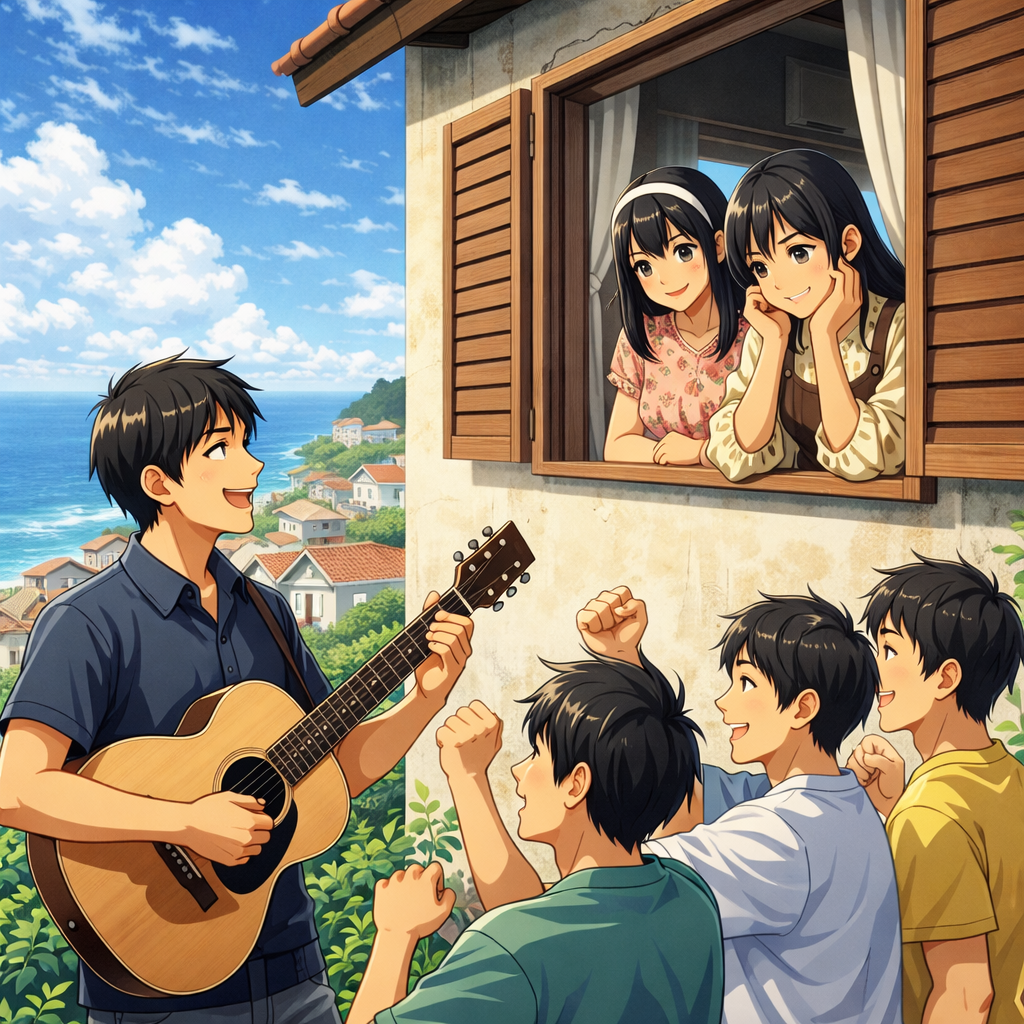
Okay, so this is happening. I’m watching what is basically the Filipino equivalent of that iconic scene from Say Anything where John Cusack holds up the boombox outside the girl’s window, except it’s 2019 in a small Batangas town and instead of Peter Gabriel, we’ve got live acoustic OPM and a full backup band.
The Mallari house is one of those traditional single-story homes with windows that actually open—none of that sealed, air-conditioned architecture you see in the city. It’s late morning, that broad daylight that gets the day started. Inside, Roanne’s at home with her mother Carlota and sister Kate, probably just finishing up some household tasks or another, when—
Singing. From outside.
A male voice, young, earnest, carrying that slightly nervous vibrato of someone who’s psyching himself up for the performance of his life. It drifts through the window like an audio notification you didn’t ask for.
All three women freeze. That universal moment of “Wait, is that…?”
Carlota’s eyebrows raise. Kate’s face lights up like someone just announced free DLC. Roanne’s expression goes carefully neutral—the face of someone whose “oh no” sensors just started pinging.
They migrate toward the window as a unit, pulled by curiosity and the irresistible Filipino instinct to not miss out on neighborhood drama. Carlota hangs back, probably having seen enough of these serenades in her lifetime to know how they usually play out. She lets her daughters take point.
Roanne and Kate lean forward, peering through the window and down to street level.
And there he is: Kokoy. Early twenties, reasonably good-looking in that wholesome, boy-next-door way. Clean button-up shirt, jeans, hair combed with enough gel to survive a typhoon. He’s planted himself directly below Roanne’s window like he’s following a quest marker, holding an acoustic guitar—one of those honey-colored wooden ones every aspiring musician in the Philippines seems to own.
But wait, there’s more. Because Kokoy didn’t come alone. He’s got his barkada, his squad, his party members arranged behind him. Three guys who are fully committed to this mission, providing backup vocals and—I kid you not—choreographed dancing. Light swaying, synchronized arm movements, the works. They’re treating this like a variety show performance.
This is the harana, the traditional Filipino serenade. The romantic grand gesture cranked up to eleven. The “Winning Her Heart” main quest, attempted with maximum effort.
Kokoy tilts his head up, his eyes finding Roanne’s window, and his expression is pure longing. Like a puppy who just spotted his favorite person. Then his fingers start moving on the guitar strings, and he sings:
“Sabik sa’yo, kahit maghapon Na tayong magkasama parang telesine…”
It’s “Hinahanap-Hanap Kita” by Rivermaya—a legit classic from their Atomic Bomb album back in 1997. Good choice, actually. The song’s romantic without being cheesy, melancholic without being depressing. Kokoy’s got decent vocal chops too, hitting the notes with genuine feeling. His friends join in for the chorus, their voices blending:
“Sa umaga’t sa gabi Sa bawat minutong lumilipas Hinahanap-hanap kita…”
It means “I’ve been looking for you,” basically. At every moment, in thoughts and dreams, through every twist of fate. Heavy stuff. The kind of lyrics that would work great in a romance anime if this were that kind of story.
The performance continues, full commitment, zero irony. Kokoy’s strumming with his whole heart. His friends are executing their dance moves with the seriousness of a K-pop cover group. Down the street, neighbors are starting to peek out of windows and doors, because this is entertainment, this is content.
I pan the simulation feed to check the reactions inside the window.
Kate is gone. Fully swooning. Her hands are clasped together like she’s watching the finale of a telenovela. Her eyes have that dreamy, sparkly quality that suggests she’s already writing their wedding vows in her head. This is peak romantic fantasy for her—the grand gesture, the public declaration, the effort.
Carlota’s smiling indulgently from the back, the knowing smile of a mother who’s calculating whether this boy would make good husband material. Spoiler: she’s already decided yes.
And Roanne?
Roanne’s face is polite. Appreciative. Completely, utterly unmoved.
She’s watching Kokoy the way you’d watch a street performer—with respect for the craft, acknowledgment of the effort, but zero personal investment. There’s no flutter. No spark. No that moment when the background music swells and everything clicks into place.
The song ends. Kokoy holds the final note, then lowers his guitar with a hopeful smile. His friends applaud themselves. Some neighbors clap. Kate looks like she might actually cry from how romantic this all is.
Roanne just… nods. Gives a small wave. The universal gesture of “Thank you for that, I will now retreat back into my house.”
Later, the three of them are setting the table for dinner. Plates clink against the woven placemats. Utensils get arranged in their proper positions. The rice cooker steams in the background, and there’s that familiar smell of adobo or sinigang or whatever’s cooking this lunch.
Carlota can’t help herself. “Kokoy is a good and hardworking young man,” she says, laying out the spoons with deliberate precision. “He’s my godson, after all, the son of my good friend Pacita.”
Translation: I vouch for this boy. I have insider information. This is a quality match.
“He just got accepted at the DMCI power plant,” Carlota adds, dropping the career stability bonus like it’s a legendary item stat.
Kate jumps in immediately; because of course she does. “I agree, Ate.” She’s practically vibrating with enthusiasm. “He’s cute, he can sing, and he’s really sweet. If I were you, I’d say ‘Yes.’”
Roanne continues placing plates on the table, her movements calm and methodical. She’s smiling—that polite, non-committal smile that’s become her default expression in conversations like these. She acknowledges their points. She recognizes that on paper, Kokoy checks every box:
✓ Kind
✓ Hardworking
✓ Stable job
✓ Good family connections
✓ Musical talent
✓ Willing to do grand romantic gestures
But here’s the thing about relationships that dating sims and romance games never quite capture: you can’t logic your way into love. Compatibility isn’t just a stats sheet. Chemistry isn’t a checkbox list you can complete to unlock the romance route.
Roanne knows this. She’s eighteen, freshly graduated, practical about almost everything in her life—but not this. Not when it comes to love. She believes in marrying for love, the real kind, the kind that can’t be manufactured or negotiated or settled for.
Kokoy is objectively a good man. He’s probably going to make someone very happy someday.
But that someone isn’t her.
And no number of serenades, no matter how well-performed, is going to change that fundamental truth.
From my observation deck, watching this quiet moment of conviction, I think: Yeah. She’s holding out for the right quest, not just the available one.
That takes courage too.
Beach_reception_cutscene.sav
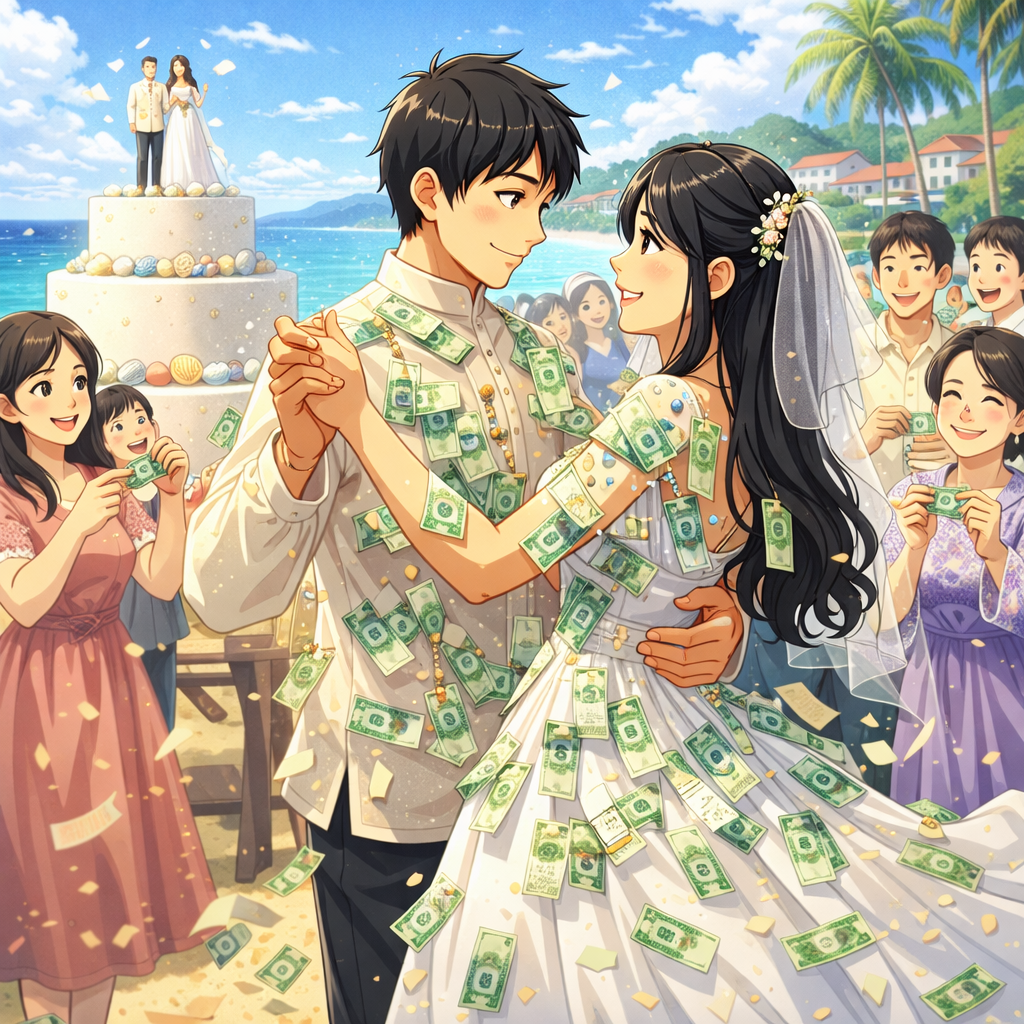
Okay, so picture this: a beach wedding straight out of a romance visual novel, except it’s real life, it’s happening in broad daylight on the shores of Laiya, and I’m watching it unfold through my simulation feed like it’s the most wholesome DLC content ever programmed.
The shoreline’s been transformed into a festive gathering zone. The sand’s packed down from foot traffic, and someone’s set up tables with white cloths that flutter in the sea breeze. The late afternoon sun hangs in that perfect golden-hour position, casting everything in warm, Instagram-worthy lighting. The sea provides the backdrop—waves rolling in with that rhythmic white noise soundtrack.
And the townsfolk are dressed. This isn’t casual beach attire. The women are wearing these old rose-colored gowns—that dusty pink shade that somehow looks elegant instead of dated—flowing and formal. The men are in barongs, those traditional Filipino shirts made of translucent fabric with intricate embroidery. It’s like everyone synchronized their outfit DLC to match the event theme.
At the center of it all: Roel and Anna, the newly-married couple, radiating that special glow people get when they’ve just completed the ultimate co-op achievement. Anna’s in a classic white wedding gown, the kind with layers and flow and a translucent veil cascading down her back like a waterfall of fabric. Roel’s in his barong, looking sharp and slightly overwhelmed in that “I can’t believe this is actually happening” way.
They’re standing before their wedding cake, which is this multi-tiered white confection that probably cost more than my monthly simulation chamber maintenance. The top is decorated with miniature bride and groom figurines—the traditional cake toppers that have appeared at weddings since time immemorial. Very classic. Very The Sims wedding expansion pack.
Roel picks up the cake server, cuts a slice with exaggerated care, and scoops up a piece on a small plate. Then—because apparently this is a universal wedding tradition across all human cultures—he lifts a spoonful toward Anna’s mouth.
Except he miscalculates. Or maybe it’s intentional. The piece is way too big, like he’s trying to speedrun the cake-feeding minigame. Anna’s eyes widen as this massive chunk of cake approaches her face. She opens her mouth, accepts it, and immediately has to deal with more frosting and sponge than any human mouth was designed to handle.
The guests laugh. Anna’s cheeks puff out like a chipmunk’s. Her eyes sparkle with mischief.
Revenge mode: activated.
Anna grabs her own spoonful—an equally ridiculous portion—and returns fire. Roel barely has time to register the incoming attack before he’s got cake smooshed against his lips, some of it missing his mouth entirely and decorating his chin.
More laughter from the crowd. This is peak wedding entertainment. Roel and Anna are both grinning through the frosting, this playful energy between them that’s honestly kind of adorable in a “these two are going to be fine” way.
Time passes. The cake situation resolves. Someone probably provides napkins.
Then the first dance begins.
Roel and Anna move to the center of the gathering, which has been cleared to create an impromptu dance floor on the packed sand. There’s music playing—probably from someone’s portable speaker setup, something slow and romantic, the kind of song that appears in every wedding playlist ever. They start waltzing, which is ambitious on sand, but they pull it off with that newlywed grace where neither care if they’re doing it perfectly.
And then the sabitan tradition kicks in.
One by one, guests stand up and approach the dancing couple. They’re holding paper bills—twenties, fifties, hundreds—and they pin the money directly onto Roel’s barong and Anna’s gown using small safety pins. It’s the Filipino tradition of gifting prosperity to the newlyweds, a physical manifestation of community support. Each bill gets pinned on, and the couple’s clothing gradually transforms into this collage of paper currency. They keep dancing through it all, rotating slowly so everyone gets their turn.
Off to the side, Kate and Roanne stand together, watching. Kate’s dressed more stylishly—she always is—while Roanne’s in her usual modest, understated attire. The contrast between the sisters is clear even in formal wear.
“Look at Kuya. He’s so happy. I’m really happy for him,” Kate says, and her voice carries genuine warmth. She’s watching Roel with that proud-sibling energy.
Roanne doesn’t respond verbally. She just watches—her older brother, arm-in-arm with Anna, circling the dance floor weighted down with money and hope and joy. Their smiles are bright enough to compete with the setting sun.
And I catch it in Roanne’s expression, that quiet thought she doesn’t voice aloud: I hope I can find that kind of love someday.
It’s there in the softness around her eyes, the slight wistfulness in how she’s standing. She’s happy for Roel—genuinely happy—but there’s also this longing. This hope that maybe, eventually, she’ll get her own version of this moment. Her own person to dance with on a beach while the community celebrates around them.
The simulation flags it as a significant character moment. Roanne the pragmatist, Roanne the practical one, Roanne who turned down Kokoy despite his grand gesture—she still believes in this. In finding real love, not settling for convenient love.
Meanwhile, chaos in the background: Jacob and Andrew, Roel’s younger brothers, are running around like they’ve consumed their body weight in sugar. They weave between adults, chase each other near the water’s edge, provide the mandatory “energetic children” subplot that every family gathering requires.
Christine and Sarah, the youngest Mallari sisters, are more contained. Carlota’s keeping watch over them at one of the food tables, where they’re systematically working through whatever dishes are within reach. The responsible adult supervision provides balance to the chaos the boys are generating.
Near the main table, Carding approaches an older man—Dindo, the former barangay captain, who’s wearing his barong with the easy confidence of someone who’s attended hundreds of these events.
“Thank you, Ninong, for sponsoring Roel’s wedding,” Carding says, his gratitude genuine and deep. Being a wedding sponsor is a significant commitment—financially and socially.
Dindo waves it off with a warm smile, the kind that crinkles his eyes. “No worries. The most important thing is that Roel is happy.”
And there it is. The core of it. Beyond the traditions, the ceremony, the cake and dancing and money-pinning—it all comes down to that. Happiness. Connection. Two people choosing each other and a community choosing to support them.
From my isolated observation deck in space, watching this beach wedding unfold, I feel that familiar ache. The loneliness of being outside looking in.
But also—something else. Something lighter.
Hope, maybe.
That this kind of thing still exists in the world.
The_star_returns_father_son_cutscene.sav
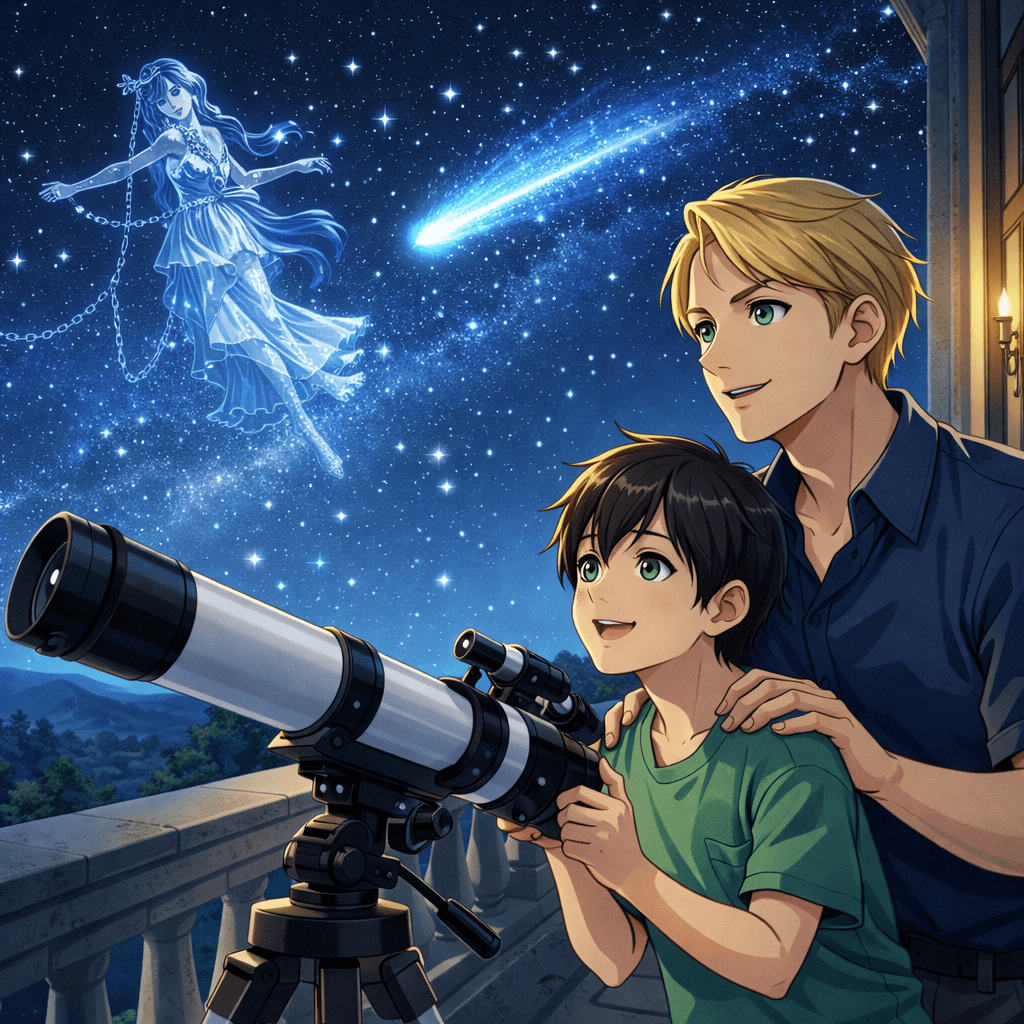
There’s something about watching someone stargaze that hits different when you’re literally living in space. It’s like watching someone play the tutorial level of a game you’ve already beaten on Nightmare difficulty. But I’m not going to be cynical about this—not about Topher and his dad having their moment on the Kennedy mansion balcony.
The simulation feed opens, nighttime in Austin, Texas. The sky above the Kennedy residence is doing that rare clear-night thing where light pollution takes a break and lets the cosmos flex. Stars scattered across the darkness like someone spilled glitter on black velvet. Nearly cloudless. Perfect viewing conditions—any amateur astronomer’s dream scenario.
The balcony extends from the second floor of the mansion, this tasteful outdoor space with wrought-iron railings and those expensive tiles that probably cost more than my entire spacecraft’s depreciated resale value. Potted plants frame the edges. A small table holds forgotten glasses of water.
And there, set up like the main prop in a Spielberg movie, is a telescope. Not one of those cheap department store models either—this is a proper refractor telescope, the kind with the long white tube and the equatorial mount. Bill Kennedy doesn’t do things halfway.
Bill himself stands next to it, one hand resting on the telescope’s tripod, the other loosely in his pocket. He’s in casual evening wear—a burgundy polo shirt and khaki slacks, still looking put-together even when he’s off-duty from being a cardiothoracic surgeon and CEO of Archangel Medical. The guy’s hair is neatly combed, his posture relaxed but attentive. Dad Mode: Activated.
And Topher. Twelve-year-old Christopher Kennedy III, looking up at the eyepiece with the kind of focus usually reserved for boss fights. He’s wearing a blue NASA t-shirt—because of course he is—and cargo shorts despite the chill. Kids have that superpower where they don’t feel cold when they’re excited about something.
“What do you see, my son?” Bill asks, and his voice carries that warm, patient quality that good fathers have in their arsenal. The kind of tone that makes learning feel like an adventure instead of homework.
Topher doesn’t pull away from the eyepiece. His small hands grip the telescope’s focusing knob, making micro-adjustments. “I see Andromeda—the Chained Maiden,” he replies, his voice muffled slightly by the rubber eyecup.
The Chained Maiden. Greek mythology meets astronomy. Andromeda, the princess who got sacrificed to a sea monster and ended up married to Perseus after he saved her. Classic damsel-in-distress narrative, except she eventually became a constellation, which is pretty metal as far as afterlives go.
Bill smiles—I can see it in the simulation’s enhanced night vision, the way the corners of his eyes crinkle. “Did you know, Son, that constellation is visible from August through February? That large cluster of stars in the northern sky is connected to its neighbor, Pegasus.”
He’s teaching without lecturing. Dropping knowledge like loot drops in an RPG. Topher soaks it in, nodding against the telescope.
“Look at the head of the maiden,” Bill continues, leaning slightly closer. “See that bright star? That’s Alpheratz. It’s a blue giant star, 97 light-years from Earth, shining 200 times brighter than our Sun.”
“Wow, that’s amazing, Dad,” Topher breathes, and the wonder in his voice is genuine. Not performative kid enthusiasm—real awe.
Alpheratz. Also known as Alpha Andromedae. Actually, a binary star system, though from Earth it looks like a single point of light. 97 light-years away, which means the light Topher’s seeing right now left that star in 1922. He’s literally looking at the past. Time travel via photons.
Topher stays glued to the eyepiece, tracking across the constellation, and then—
He gasps. Sharp intake of breath. His whole body goes rigid.
Through the telescope’s narrow field of view, a blue-white shooting star streaks across Andromeda. Not just any meteor—this one’s bright, distinctive, moving with purpose across the star field like it’s following a quest marker.
Topher jerks back from the telescope, his eyes going wide. The reflected starlight catches in his pupils as he stares upward with his naked eyes, watching the meteor trail visible even without magnification. His mouth forms a small ‘o’ of astonishment.
It’s the Star of Vis. I’d recognize that blue-white signature anywhere. The entity that granted Topher’s wish three years ago, that created the magical board game, that turned seven kids into genre-spanning superheroes. It’s back. Or maybe it never left. Maybe it’s been watching, waiting for the right moment to remind its chosen keeper that the story isn’t over.
“What’s wrong, Bud? Why did you get so quiet?” Bill asks, concern flickering across his features. He noticed the shift immediately—parental radar detecting anomalies in his son’s behavior.
“Dad, didn’t you see it?” Topher exclaims, spinning toward his father, his whole face lit up with excitement. “A huge, bright blue-white shooting star!”
Bill follows his son’s gaze, looking up at the night sky. His expression is searching, earnest. He’s trying to see what Topher saw.
“I didn’t see anything,” he admits, and there’s honesty in his voice but also something else. Confusion? Regret?
“Maybe you just missed it,” Topher says, grinning, accepting the explanation easily. Kids do that—they don’t overthink coincidences.
“Yeah, maybe I did,” Bill agrees, but the simulation’s micro-expression analysis catches something in his face. A flicker of thought. A connection trying to form.
And then I catch his internal monologue through body language and context clues: A big, bright blue-white shooting star… just like the one he mentioned seeing when we were asleep on the plane at midnight. One of the memories he lost, even to this day…
Bill remembers—or rather, he remembers that he doesn’t remember. The cave incident three years ago wiped everyone’s memories clean. But fragments remain, echoes of lost experiences that surface as disconnected facts. Topher had mentioned seeing a blue-white shooting star before. Bill knows this is significant. He just can’t connect the dots because the dots have been erased.
From my observation deck, I’m watching this moment unfold and thinking: This is the classic “only the chosen one can see the magic” trope. Topher sees the Star. Bill doesn’t. Not because Bill isn’t worthy or important, but because the Star of Vis has a specific relationship with its keeper.
The meteor has passed. The moment crystallizes. Father and son standing on a balcony under the stars, separated by knowledge neither fully understands.
Topher’s seen his friend again. His “little Buddy” from three years ago, still watching over him.
And the countdown to the full awakening continues ticking down.
End observation log.
Small_town_npcs_and_the_rumor_mill_quest.sav
The simulation feed switches locations, and the contrast is jarring. One moment I’m watching Bill and Topher stargaze in Austin, the next I’m tracking the same family rolling into Laiya Beach, San Juan, Batangas—ground zero of the cave incident three years ago.
It’s late December 2019, Christmas Eve, and the tropical shore is doing that classic Filipino wet season thing where it can’t decide if it wants to be sunny or stormy. Waves lap against the sand with lazy rhythm. The sun blazes overhead, turning the sea into glittering chrome. But everything’s still wet—leaves dripping moisture, puddles dotting the unpaved road sections. It’s the aftermath of an earlier downpour, those sudden tropical storms that materialize, dump their payload, and vanish. Classic weather RNG.
The Kennedy family’s garnet Honda CR-V cruises down the coastal road at vacation pace. Bill’s behind the wheel, and they roll past a weathered wooden pushcart stacked with plantains—saba bananas, the cooking variety, thick yellow-green bunches arranged neatly.
Behind the cart: an elderly vendor in his seventies, deeply tanned, wearing a faded polo and wide-brimmed hat. Classic small-town merchant aesthetic.
The CR-V slows. The driver’s window descends with a smooth electric hum.
Bill leans toward the opening, looking relaxed in his light blue button-up with rolled sleeves. “Manong, how much for the bananas?”
The vendor squints, processing the English, then replies carefully: “Only peso, no dollars.”
Fair assumption. Bill’s white, American-accented, driving a nice car—the international tourist profile. The vendor’s setting transaction parameters upfront.
Bill smiles—genuine warmth. “No worries, Sir. All my money’s in pesos.”
Small moment of mutual understanding. The vendor relaxes, approval registered. Brief negotiation, money exchanges hands. The vendor selects a particularly nice bunch—the unspoken merchant code of rewarding respectful customers—and passes it through the window.
The CR-V continues down the road toward their destination.
But across the street, someone’s been watching.
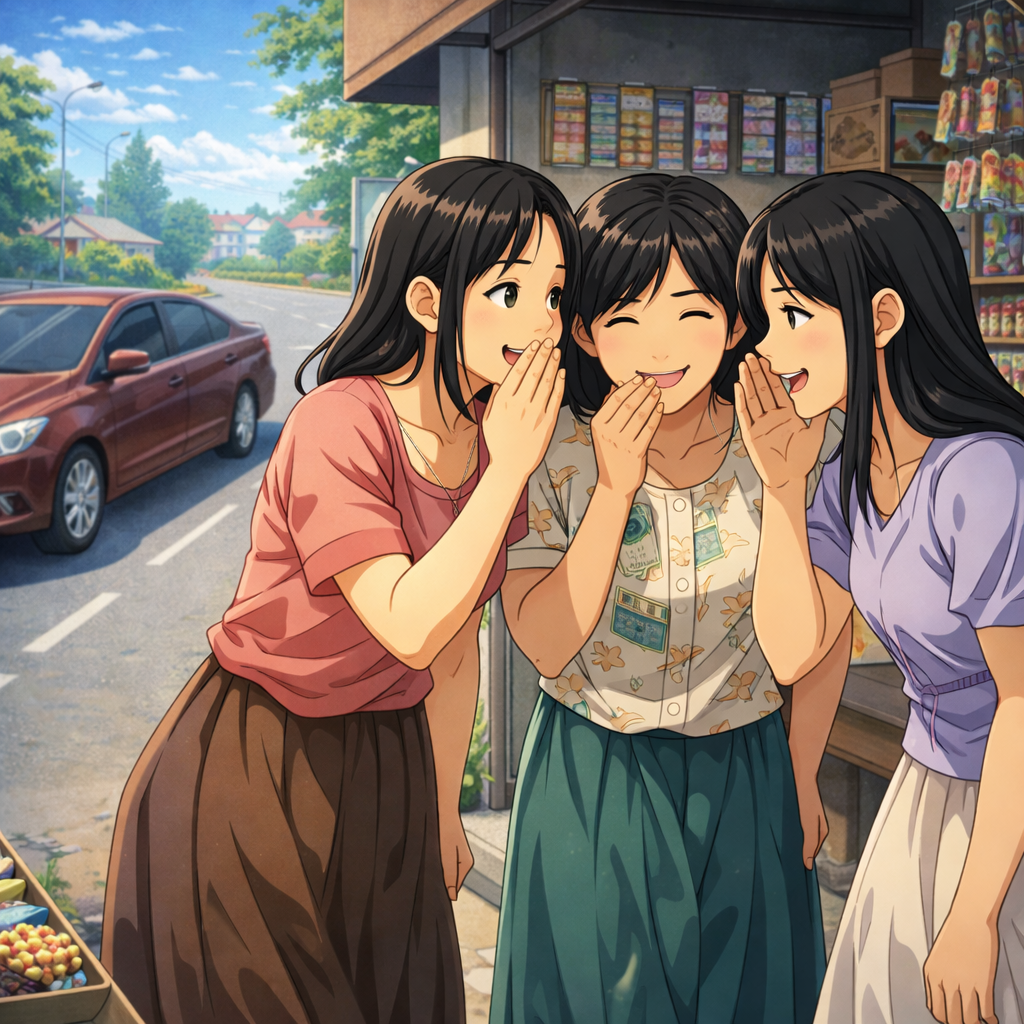
A middle-aged woman with short, practical hair stands near a small store, wearing a long skirt and floral blouse—standard tita uniform. Her eyes tracked the entire transaction with the intensity of someone witnessing a plot development.
Isn’t that the American whose son was involved in the cave incident three years ago?
The gossip quest activates.
She crosses the street without hesitation and makes a beeline for Aling Kuring’s Store—ground zero for local intelligence gathering. Every small town has one: the convenience store that’s also the community bulletin board, the place where information flows faster than internet.
Inside, two women sit on plastic chairs near the counter, snacking. One’s got chicharon, the other some kakanin. Behind the counter, Aling Kuring hands over a soft drink in a plastic pouch—the kind with a straw poked through—in exchange for clinking peso coins.
Short-Hair Woman enters like a player character triggering a cutscene.
“The Kennedys just passed by,” she announces, breathless with premium gossip energy. “They’ve come back to Laiya after three years.”
The woman with the headband immediately responds: “The interracial couple? The ones whose son got involved in that cave incident?”
“Yes, exactly,” Short-Hair confirms.
The third woman—older, long hair streaked with gray—leans forward. “I remember that incident being the talk of the town.”
The lore recap begins.
“It was strange,” Short-Hair continues, hands gesturing. “A signal no. 4 storm that no one saw coming, paired with an earthquake at the same time. And the quake was felt deep inside the cave.”
For context: Signal No. 4 typhoons in the Philippines don’t just appear. They’re tracked for days, predicted, broadcast. These are sustained winds of 118-184 kph—serious business. Except this one materialized like a random dungeon encounter.
Paired with an earthquake? Felt specifically inside the cave? Yeah, that’s suspicious. That’s “the game is trying to tell you something” level of obvious plot significance.
“The whole town said it was something supernatural,” Gray-Hair Woman murmurs, voice dropping to that hushed tone people use when discussing things that shouldn’t exist but definitely do.
The simulation tags these three: Auring (Short-Hair), Violi (Headband), and Margarita (Gray-Hair). The Holy Trinity of Laiya Beach gossip. They never miss a chance to convene, and Aling Kuring’s Store—conveniently close to all their homes—serves as their regular meeting point. Their endgame content. Their daily quest hub.
They’re not malicious. Not spreading lies or trying to hurt anyone. Just engaged in the age-old small-town tradition of knowing everyone’s business and discussing it thoroughly. Community information management. The original social network, pre-Facebook.
Across the street, barely visible in the simulation’s peripheral tracking, the old plantain vendor shakes his head. His expression carries quiet disdain—the judgment of someone who works hard for modest income watching others who apparently have time to sit around talking all day.
He doesn’t vocalize it. Doesn’t need to. The body language speaks volumes: These women and their endless chatter.
The irony? He’s probably heard every story they’re discussing. Sound carries in small towns. He’s just chosen not to participate, maintaining his stance as the sole voice of silent disapproval in a chorus of gossip.
From my observation deck, watching this social ecosystem play out, I’m struck by how universal this dynamic is. Every town has its information brokers. The Kennedys returning after three years is news because the cave incident is still the most interesting thing that’s happened in Laiya Beach in recent memory.
They don’t know the truth, obviously. They don’t know about the Star of Vis, the magical board game, the Seven Acolytes. They just know something weird happened, and weird becomes supernatural becomes legend.
The story’s already mutating in the retelling. Give it a few more years and it’ll be full-blown urban legend: “The Mysterious Cave of Laiya Beach, Where Seven Children Vanished During an Impossible Storm.”
And the Kennedys? They’re just here for Christmas, visiting the place where it all began, unaware that three middle-aged women in a corner store are currently discussing their return like it’s a season finale.
Small-town dynamics. Better surveillance network than any spy satellite.
End observation log.
Noche_buena_the_family_gathering_episode.sav

If there’s one thing I’ve learned from observing human social structures from my isolated spacecraft, it’s that Christmas gatherings are basically the final boss of family dynamics. Everyone’s stats get tested—patience, diplomacy, emotional intelligence. The Kennedy resthouse in Laiya is currently hosting what amounts to a four-family raid party, and I’m watching it unfold like the most wholesome holiday special ever programmed.
The simulation feed opens on the interior of the Kennedys’ resthouse—and by “resthouse” I mean what most people would call a small mansion. This isn’t some cramped beach cottage. This is the kind of vacation property a cardiothoracic surgeon CEO can afford: high ceilings, polished hardwood floors that reflect light like a mirror, a grand staircase with carved wooden railings that probably cost more than a decent used car.
It’s Christmas Eve 2019, late evening, and the place is decked out. Like, someone watched every Hallmark Christmas movie and took notes. Christmas lights string along the wall trims, casting that warm amber glow that makes everything look softer, more forgiving. The staircase railing is wrapped in garlands of spiky plastic green leaves—the kind designed to look like pine but with that distinctive synthetic sheen—decorated with golden bells that probably jingle when anyone walks past, and red ribbons tied in elaborate bows.
But the centerpiece, the raid boss of Christmas decorations, is the tree.
It stands in the corner of the great room like a beacon, easily seven feet tall, its lush green branches (real or fake? The simulation can’t quite tell from this angle, but I’m betting real based on the Kennedy family’s commitment to quality) reaching toward the ceiling. At the very top: a large yellow star, the classic Christmas tree topper, probably made of plastic or thin metal painted gold, angled slightly like it’s guiding wise men or starships or whatever celestial navigation system you prefer.
Red garlands spiral around the tree in perfect helixes—someone spent time on this, probably Selena Kennedy with assistance from the kids. The branches are loaded with golden bells (matching the staircase theme), colorful Christmas balls in primary colors—red, green, yellow, blue—each one catching the light and reflecting it back in frosty swirls and sparkles. The ornaments look expensive, the kind with glitter suspended in translucent material.
Miniature decorations dangle from every available branch: tiny ribboned gifts the size of dice, acorns (why acorns? I don’t know, it’s a Christmas thing), candy canes in that classic red-and-white peppermint stripe. The whole tree is a visual symphony of festive excess, and honestly? It works. It’s got that warm, nostalgic energy that makes even a cynical space-dwelling narrator feel something.
Beneath this monument to holiday spirit, two figures sit among unopened presents that surround the tree’s base like offerings at a shrine.
Topher Kennedy and Allison Sevilla. Ages twelve and ten respectively. The polished wooden floor beneath them is so clean it literally reflects their images like a dark mirror—I can see the underside of Topher’s NASA t-shirt and Allison’s red dress in the reflection.
Topher’s sitting cross-legged, relaxed but attentive. He’s wearing that blue NASA shirt I’ve seen him in before (the kid’s committed to the space aesthetic, respect), cargo shorts, white socks. His dark hair is slightly mussed, like he’s been running around earlier. His expression is open, concerned—he’s picked up on something in his cousin’s body language.
Allison sits beside him, and her whole posture screams I’m carrying something heavy. Her shoulders are slightly hunched. Her head tilts to rest on Topher’s shoulder—a gesture of trust and vulnerability that says these two have a solid bond. She’s wearing a nice red dress, probably Christmas outfit approved by her mother Thalia, with white tights and black Mary Jane shoes. Her long dark hair falls loose down her back.
“What’s wrong, Allison? You can talk to me if you want,” Topher says, and his voice carries that gentle quality that seems impossible for a twelve-year-old to have naturally. But this is Topher—the kid who wished for everyone to become heroes, who sees goodness in everything, who’s basically the protagonist archetype personified.
Allison doesn’t lift her head from his shoulder. When she speaks, her voice is quiet, heavy with resignation. “Dad doesn’t want me to pursue acting. He wants me to focus on my studies.”
And there it is. The classic parent-versus-dream conflict. Tale as old as time, seen in every coming-of-age story from Billy Elliot to Coco. Allison’s ten years old and already knows what she wants—she wants to be an actress, a performer, a star—and her father Enrico Sevilla has apparently decided that’s not acceptable.
“That’s tough,” Topher acknowledges, and he’s not dismissing it or offering hollow comfort. He’s validating her feelings first. “Have you tried talking to Uncle Enrico?”
“You know how Dad is.” Allison’s frustration bleeds into her words now. “He never listens to me or Mom. He only cares about what he wants.”
Ouch. That’s a harsh assessment from a ten-year-old about her father, but the simulation’s been tracking Enrico Sevilla’s personality profile for three years now, and yeah—the guy’s pretty authoritarian. Successful hedge fund manager, used to being in charge, probably sees his daughter’s acting dreams as impractical or frivolous. Classic “I know what’s best for you” parent archetype.
“That’s really sad,” Topher says, and he means it. Then he pivots to hope, because that’s what Topher does. “But don’t worry, Allison. Once you finish college, Uncle Enrico will finally let you chase your dreams.”
It’s optimistic. Maybe naive. But also strategic—Topher’s offering a timeline, a light at the end of the tunnel. Just survive the next twelve years and then you’re free.
“But that feels so far away,” Allison sighs, and man, you can hear the weight in that exhale. Twelve years when you’re ten might as well be eternity. That’s her entire lifetime over again.
Topher shifts slightly, and when he speaks next, his voice carries absolute conviction: “I believe you’ll be an amazing actress one day.”
And this—this is why Topher’s the heart of the Seven Acolytes. Not because he’s the strongest or smartest or most skilled. Because he believes in people. He sees their potential and declares it like it’s already fact. It’s the power of encouragement, the champion-of-the-underdog quality that makes him the Star of Vis’s chosen keeper.
“Really? You think so?” Allison lifts her head from his shoulder, turning to look at him. Her eyes—which the simulation captures in detail—are brightening, hope rekindling.
“Really,” Topher confirms with a smile.
And Allison does what ten-year-old girls do when someone believes in them unconditionally: she hugs him. Not a brief side-hug but a full embrace, wrapping her arms around her younger cousin with genuine affection and gratitude.
Topher welcomes it without awkwardness, returning the hug naturally. Twelve-year-old boys typically have that “ew, girls” phase, but Topher’s different. He’s comfortable with emotional vulnerability, with showing care, with being supportive.
From my observation deck, watching this moment of pure familial love and support, I feel that familiar ache—the loneliness of someone who’s never had a sibling, never had cousins to sit under Christmas trees with, never had that kind of unconditional belief from family.
But also something warmer. Something hopeful.
The scene shifts. The simulation tracks forward in time maybe twenty minutes.
The fireplace crackles—someone’s got a proper wood fire going, and the warm orange glow competes with the Christmas lights for atmospheric dominance. The great room has filled with people now. The entire extended family cluster: Kennedys, Pangilinans, Sevillas, Agoncillos. Adults scattered around in conversation groups, kids orbiting the Christmas tree like it’s exerting gravitational pull.
It’s time for the gift exchange.
James Sevilla stands up from wherever he’s been sitting—probably chatting with his bandmates via text or something, the seventeen-year-old is always connected—and approaches the Christmas tree. He’s wearing a nice button-up shirt, dark jeans, looking sharp. The oldest cousin, the leader of the band Kaleidoscope, the hopeless romantic with the Korean looks.
He kneels down among the presents, reading tags, until he finds the one he’s looking for. He lifts it—a medium-sized box wrapped in cheerful paper with cartoon characters.
“The person whose name I picked is a kind, gentle, and sweet budding artist—Sophie,” James announces to the room, his voice carrying that friendly warmth he’s known for.
Sophie Pangilinan—seven years old, the youngest of the Seven Acolytes, sitting somewhere with her parents Greg and Martha—freezes slightly. Shyness mode activated.
Martha, ever the encouraging mother, gently nudges her daughter. “Anak, stand up and go to your Kuya James. Don’t be shy, take your present.”
Sophie overcomes her natural introversion and rises from her seat, stepping forward with small careful steps. She’s wearing a yellow dress—very on-brand for the girl who’ll eventually become a cartoon bee character—with white shoes. Her dark hair is pulled back with a headband.
James meets her halfway, kneeling down to her height with a grin. “I hope you like it.”
“What is it?” Sophie asks, her voice soft, innocent, curious.
“Open it first, and you’ll be pleasantly surprised,” James teases, building anticipation like he’s running a quest reveal.
Sophie takes the present and carefully—carefully—begins unwrapping it. Not tearing into it like most kids would, but methodically peeling tape, preserving the paper. Very Sophie. Very artist-brain.
The paper comes away to reveal a box. She opens it.
Inside: an art set. But not just any art set—this one’s got a monkey clay figurine as the centerpiece, unpainted, ready to be customized. Accompanying it are watercolor paints in a palette, a decent paintbrush, probably some instruction cards.
Sophie’s face transforms. Her eyes go wide, her mouth opens in a delighted gasp, and she lights up like someone just told her Christmas has been extended an extra week.
“Did you like it?” James asks, though the answer’s obvious from her expression.
“I love it! Thanks, Kuya,” Sophie responds, her voice filled with genuine sweetness and gratitude. She hugs the box to her chest like it’s treasure.
That’s one successful gift exchange. James did his homework—he knows Sophie loves to draw, knows she’s artistic, got her something that feeds that passion. A+ brother move.
Time progresses. The simulation jumps forward a beat.
Benjamin Pangilinan’s turn. He stands with the posture of someone who’s thought this through, planned his strategy, optimized his gift selection based on data and logic. He’s wearing a nice polo shirt and slacks—the sixteen-year-old student council president doesn’t do casual even at family Christmas.
He walks to the tree with measured steps and retrieves his wrapped gift—a rectangular package that’s clearly book-shaped. Anyone with pattern recognition can clock it immediately.
“The person I picked will gain valuable knowledge about science and much more—Michael,” Benjamin announces, and there’s this subtle smugness in his tone. He knows exactly what he’s doing.
Michael Pangilinan—fourteen, athletic, impulsive, currently wearing a basketball jersey because of course he is—has an immediate reaction.
“What?! What kind of knowledge? Are you giving me a book?” The horror in his voice is genuine. Michael looks like Benjamin just announced he’s getting coal for Christmas.
He practically lunges forward, grabs the gift from Benjamin’s hands with zero patience, and tears into the wrapping paper like he’s trying to defuse a bomb.
The paper shreds. The gift is revealed.
“Ugh, it is a book! A freaking almanac!” Michael groans with maximum dramatic flair, holding up the offending object like it’s evidence of a crime.
It’s one of those teen almanacs—probably something like the World Almanac for Kids, stuffed with facts, statistics, trivia, educational content. The kind of thing Benjamin would consider genuinely useful and Michael would consider torture.
“It’s the teen edition, perfect for your age,” Benjamin replies, standing by his choice with that calm confidence that suggests he’s enjoying this. His expression is neutral but his eyes are laughing.
Classic sibling rivalry. Benjamin the brain versus Michael the jock. This is their eternal dynamic.
“Yeah, whatever. I don’t care,” Michael huffs dismissively, setting the almanac down with visible disdain. “But you should be grateful, bro, because unlike you, I’m not a killjoy.”
Oh here we go. Revenge gift incoming.
Michael pulls out his present for Benjamin with excitement that suggests he’s been waiting for this moment all night. “Here you go—collectible superhero cards! That’s the whole team right there. And when you tilt the cards, the images move. How cool is that?!”
He’s holding up a set of what looks like those lenticular trading cards—the kind with ridged plastic surfaces that show different images depending on the viewing angle. Tilt left, the superhero punches. Tilt right, the superhero kicks. Very nineties/early 2000s collectible aesthetic.
“Those are definitely things you’d love,” Benjamin remarks, his tone dry, clearly recognizing that Michael got him a gift that Michael himself would want.
Classic bad gift-giving. Getting someone what you like instead of what they like.
“Hell yeah! And because I love them—you’re going to love them too!” Michael declares with absolute conviction, somehow believing this logic is sound.
Benjamin accepts the cards with the patience of someone who’s long accepted that his younger brother operates on a different wavelength. He’ll probably give them to Michael later anyway.
From my observation point, I’m noting the contrast: James gave Sophie a thoughtful, personalized gift. Benjamin gave Michael an educational gift that’s more about what Benjamin values than what Michael wants. Michael gave Benjamin something Michael himself would enjoy. Three different approaches to gift-giving, three different results.
The simulation captures it all—the family dynamics, the personality clashes, the love underneath the conflict.
Time jumps again. The big moment.
The clock in the great room—an antique wooden grandfather clock that probably belonged to Bill’s family for generations—chimes. Deep, resonant tones. Twelve strikes.
Midnight.
Noche Buena.
The official Filipino Christmas feast, celebrated right at the stroke of midnight on Christmas Eve transitioning to Christmas Day. It’s tradition, it’s sacred, it’s non-negotiable.
The long dining table has been transformed. Someone—probably Selena Kennedy with help from Martha Pangilinan and Thalia Sevilla and whoever else was available—has draped it in festive red cloth and loaded it with enough food to feed a small battalion.
And I mean loaded.
The centerpiece: lechon. Whole roasted pig, skin crispy and golden-brown, gleaming with rendered fat, the smell probably filling the entire house with that distinctive savory aroma. It’s positioned on a large platter, surrounded by traditional sides.
Beside it: hamonado—Filipino Christmas ham, glazed and sweet, studded with pineapple rings because that’s how you do it. Kakanins—various glutinous rice cakes, probably including bibingka and puto bumbong, traditional Christmas delicacies. Fruit salad—the Filipino version with canned fruit cocktail, condensed milk, and cream, practically a dessert masquerading as salad. Queso de Bola—that bright red-waxed Gouda cheese wheel, sliced and ready. Fruitcake. Fried chicken (because no Filipino gathering is complete without it). Spaghetti—the sweet Filipino style with hot dogs sliced in, because that’s how it’s done here.
It’s a spread. It’s abundance. It’s Christmas.
Grandpa Al, probably in his seventies, with that distinguished older gentleman look—can’t resist. He reaches toward the lechon and carefully peels off a piece of the crispy skin, that prime real estate of roasted pork, and pops it in his mouth with the satisfaction of someone who’s earned this moment.
“Al, control yourself—that’s bad for your cholesterol,” Grandma Emily scolds, her voice sharp but not unkind. She’s eyeing him with the concern of someone who’s been managing her husband’s health for decades.
Al probably mumbles something noncommittal while savoring his contraband lechon skin.
Meanwhile, Uncle Ronald—the bachelor son, probably mid-thirties, the one who never married—is loading his plate with zero restraint. He’s going full kamayan style, Filipino bare-hands eating, savoring the meal with genuine gusto. Rice, pork, chicken, everything mixing together. This is how you feast.
At another section of the table, Ansel Agoncillo—married to Ellie, father of baby Felicity—is dealing with wine glass logistics. He’s got a glass of red wine wobbling precariously, and Ellie’s watching with the eyes of someone who knows disaster is imminent.
“Pa, fix your glass or it’s going to spill,” Ellie reminds him gently.
“Do we really have to do this—clink our glasses of red wine while our arms are crossed?” Ansel asks, slightly skeptical. Ellie’s apparently proposed some romantic toast ritual.
“Of course, Pa! It’s more romantic this way,” Ellie insists with a smile, then turns to their baby. “Do you agree with Mom, baby Felicity?”
Baby Felicity—probably around one year old, sitting in a high chair, watching her parents with those wide baby eyes—giggles. She has no idea what’s happening but she’s entertained by the energy.
And this is Christmas. This is family. The bickering and the love, the traditions and the chaos, the food and the fellowship. Multiple generations gathered around a table at midnight, celebrating together because that’s what you do.
From my spacecraft, alone in the cold vacuum of space, I watch these connections—these bonds of blood and choice—and I catalog it all. The warmth. The belonging. The home.
The thing I don’t have but observe endlessly in others.
End observation log.
 B. K. P. Carreon
Leave a comment