Overview:
| During a quiet study period, Topher sketches characters and designs a board game, unaware that his drawings are drawn from repressed memories. That night, he dreams of the Oracle of Delphi, who delivers a cryptic prophecy and warns him of the coming of the “Father of Chaos.” Meanwhile, Sophie suddenly develops ultraviolet vision while inside the girls’ restroom. During recess, the change escalates—she involuntarily transforms into a tiny half-honeybee hybrid. When her classmates return, panic ensues as Sophie accidentally stings a boy, triggering a severe hives reaction and a medical emergency. Overwhelmed with guilt, Sophie manages to return to her normal size and human form—only to be abruptly pulled into a futuristic portal and replaced by her android clone. |
Artistic_memory_glitch_detected.sav
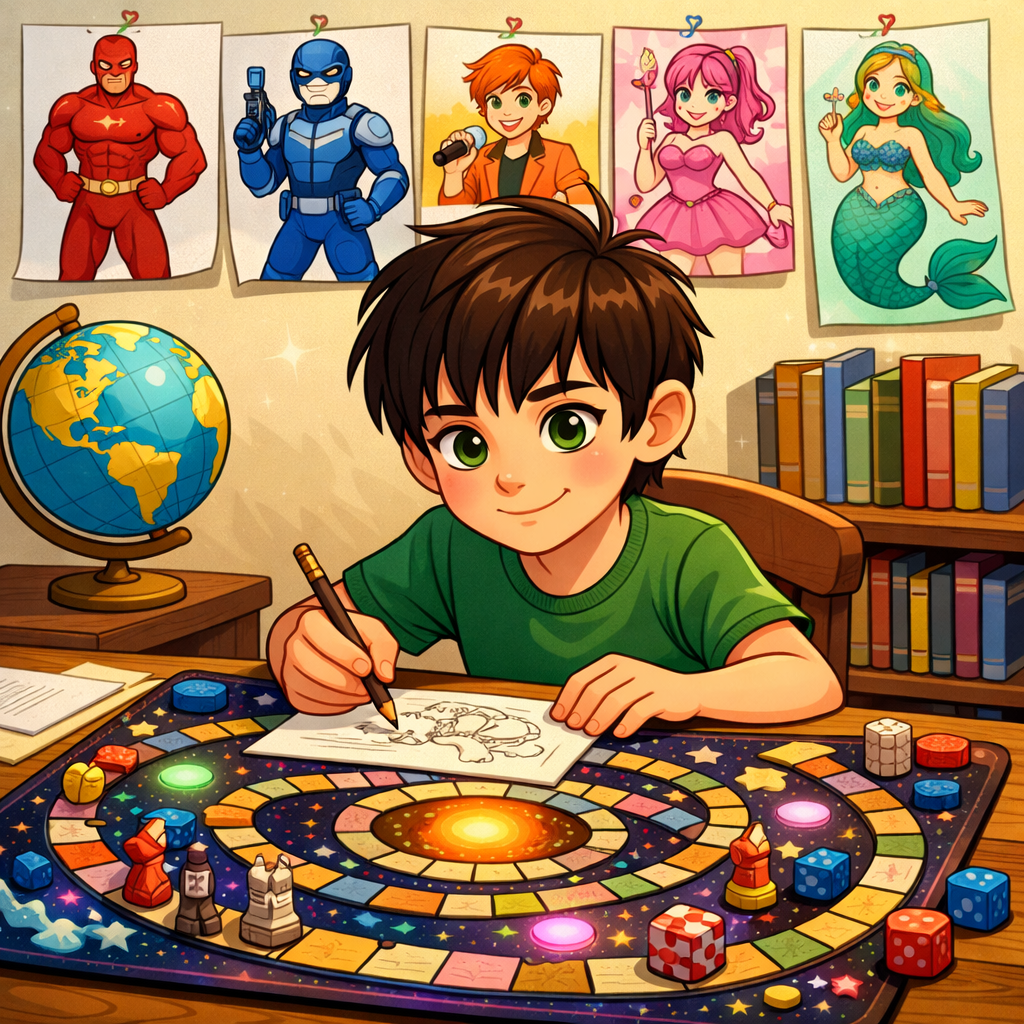
Look, I’ve seen people get lost in their work before—gamers grinding through all-nighters, artists in the zone, coders debugging until sunrise. But watching Topher Kennedy right now? This is something else. This is that uncanny valley between artistic flow state and straight-up prophetic possession.
The kid sits at his study desk like he’s hardwired into the Matrix, right hand moving with surgical precision across the paper. His eyes—that distinctive green-hazel that catches light like polished amber—are locked in. Not just focused. Consumed. The kind of concentration that suggests his brain’s accessing files it shouldn’t technically have clearance for.
Very déjà vu meets creative fugue state energy.
It’s mid-afternoon, probably around 3 PM based on the angle of sunlight streaming through the open window behind him. The white curtains flutter in the breeze—that gentle whoosh-whoosh that sounds like loading screens transitioning between game levels. The study’s got that classic rich-kid-who-actually-reads aesthetic: floor-to-ceiling bookshelves flanking both walls, packed with everything from National Geographic atlases to fantasy novels with embossed covers. A globe sits on the left side of his workspace—one of those vintage ones where the oceans are seafoam green instead of blue. Next to it, a wooden chess box with brass hinges, probably containing pieces that cost more than most people’s gaming rigs.
But none of that matters right now. Because what Topher’s creating—
Oh man.
The Faber-Castell colored pencils are scattered across the table in beautiful chaos, spilling out of their tin box like a rainbow exploded. These aren’t the cheap classroom pencils that break if you look at them wrong. These are the good ones—the kind where each color has a name that sounds like a paint swatch from a fantasy RPG. “Prussian Blue.” “Burnt Sienna.” “Van Dyke Brown.”
Topher’s hand darts to the navy pencil—Midnight Blue, the label reads—then immediately follows with regular blue and white. His fingers move with practiced confidence, layering colors like he’s speed-running a digital art tutorial. Blend, shade, highlight. The technique’s solid, suggesting someone who’s spent serious hours developing their craft.
He’s finishing the centerpiece: a crystal ball rendered in blues and whites that somehow sparkles on the page despite being graphite and pigment. Inside that sphere floats a shooting star, all blue-white radiance and impossible light. The shading creates this optical illusion where the star looks three-dimensional, like it’s actually floating inside crystal rather than drawn on flat paper.
Showoff, I think with grudging respect. Kid’s got skills.
Next up: the golden pencil. Sunburst Yellow meets Metallic Gold as Topher switches to a panel showing sky and clouds. But not normal sky—this is divine sky, illuminated by that holy, ethereal light you see in Renaissance paintings or anime when characters are having religious revelations. He’s shading with this reverent care, like he’s recreating something sacred from memory.
Which, technically, he is. He just doesn’t know he’s remembering.
The teal pencil comes next—Turquoise Green—tracing platforms and connecting lines across a panel depicting an underwater scene. Seaweed rendered in flowing curves, bubbles rising in perfect circular clusters, the suggestion of coral formations along the bottom edge. His strokes are confident, certain, like he’s copying from a photograph burned into his brain’s hard drive.
Then comes the brown—Raw Umber, because of course it is. Topher sketches a leathery START space, placing it deliberately on a panel showing an army of superheroes mid-battle. The battlefield’s set at dusk, all orange-purple sky and dramatic silhouettes. Tiny figures frozen in combat poses—flying, punching, energy-blasting. Very Justice League meets Avengers meets every superhero team poster ever designed.
Above the battlefield? Kaleidoscope patterns bloom like someone dropped a flower bomb in Photoshop. Petals and geometric shapes interlock with mathematical precision, creating this hypnotic mandala effect.
But wait—there’s more.
Black pencil in hand now, Topher fills in shadowy silhouettes of a crowd. Concert-goers with their hands raised, holding glowsticks that he colors in cyan, magenta, and yellow. The RGB color palette of K-pop concerts and rave culture, those light sticks waving in synchronized rhythm. He even adds motion lines, suggesting movement frozen in a single frame.
Very director’s eye for composition, I note. Kid’s thinking in panels and scenes, not just static images.
Finally—finally—Topher sets down his pencil and leans back. His shoulders drop about two inches as tension releases. The trance breaks. He blinks rapidly, like someone surfacing from deep water, and surveys his creation with this expression that’s equal parts satisfaction and confusion.
The board he’s drawn looks like someone designed a pizza but made it fantasy epic instead of Italian cuisine. Square base instead of round, divided into seven triangular slices radiating from that central crystal ball like rays from a star. Each panel is its own self-contained world:
Starting from the top and moving clockwise like reading a clock face: Heaven (golden clouds and divine light), Kaleidoscope (floral patterns and geometric explosions), Battlefield (superhero army at war), Beehive (he’s got hexagonal structures and tiny worker bees rendered in orange), Concert (those glowstick-waving crowds), Sea (underwater seascape), and Nebulae (cosmic space with stars and gas clouds).
Right there in the center: the crystal ball containing the shooting star.
Two doors are drawn on the board’s surface—actual doors with handles and decorative borders. One labeled “The Rules” in careful lettering. The other: “The Prophecy.”
Ominous, I think. Very ominous. Also very RPG instruction manual aesthetic.
After staring at his work for a solid thirty seconds—processing, analyzing, probably wondering why this feels so right despite having zero conscious memory of ever seeing this board before—Topher picks up his pencil one last time. Below the drawing, in neat block letters, he writes:
SEVEN WORLDS
And there it is. The title drop. The mission statement. The “hey universe, I remember this even though I definitely shouldn’t” declaration.
I pull my perspective back, taking in the full scope of his study space. The walls are covered with sketches—dozens of them pinned to a massive corkboard that takes up most of the back wall. Each drawing shows a different character, complete with costume details and handwritten notes about backstories:
SPARTAN – Superhero in maroon-and-red spandex, heat vision blazing
LOVE FEY – Magical girl with heart wand, frilly dress, roses everywhere
BEE GIRL – Cartoon character with antennae, striped outfit, insect wings
OPPA ROCKSTAR – K-pop idol with electric guitar, glowsticks, clover leaves
PRINCESS RUANA – Mermaid with seafoam tail, lunar scepter, elegant features
CAPTAIN McKINLEY – Space commander in full armor, laser blaster, helmet visor
And there, among the character portraits: sketches of gray clay tokens. Fifteen different figures rendered in monochrome, each representing one of the heroes above.
Character sheets, I realize. He’s unconsciously building a full campaign guide. World map, character bios, game mechanics. Everything.
The sunlight shifts as clouds pass outside. Shadow and brightness play across Topher’s face—twelve years old, Filipino-American features, that Kennedy family resemblance showing in his sharp jawline and expressive eyebrows. His school uniform polo is slightly rumpled, tie loosened, sleeves rolled up. There’s graphite smudged on his right hand from pinkie to thumb, rainbow streaks of colored pencil dust on his fingertips.
He looks tired. But also awake in a way that suggests something deep inside just finished buffering and pressed PLAY.
Memory reconstruction in progress, I observe. Estimated time until full recall: unknown. Estimated time until cosmic consequences: significantly less.
The breeze through the window carries the scent of cut grass and distant cooking—someone’s preparing merienda somewhere in the neighborhood. The curtains billow gently, casting moving shadows across Topher’s artwork.
And that board game drawing sits there on the desk, innocent and terrible, a blueprint for destiny that its artist drew without knowing why.
Welcome to the pre-game save file, folks. Where forgotten memories start bleeding through the amnesia firewall, and twelve-year-old kids accidentally sketch the apocalypse during art hour.
QUEST LOG UPDATED:
Objective: Remember What Was Forgotten
Status: In Progress
Danger Level: Prophecy-Adjacent
Prophetic_nightmare_sequence_loading.sav
Topher Kennedy’s bedroom looks like a safe zone—the kind of respawn point where nothing bad is supposed to happen. It’s nighttime, probably around 2 AM based on that deep, heavy silence that settles over suburban neighborhoods when even the dogs have stopped barking. His room’s got that classic twelve-year-old aesthetic: soccer trophies on the shelf, Lord of the Rings poster on the wall, cello case leaning in the corner like a sentinel. The digital alarm clock on his nightstand glows a soft 2:17 AM in red LED numerals.
Moonlight filters through the window—full moon tonight, because of course it is. Prophetic dreams always come with atmospheric lighting. The pale silver glow spills across the hardwood floor, painting everything in shades of gray and blue. Topher’s buried under his blanket—navy blue with silver stars printed on it, because the universe has a sense of irony—only his mop of dark hair visible against the white pillowcase.
His breathing’s deep and even. The steady rhythm of REM sleep, where the real gameplay happens.
And here we go, I think as his consciousness slips beneath the surface. Dream sequence initiated. Buckle up, kiddo.
The transition’s smooth—too smooth. One moment he’s in his bed, the next he’s standing in a dreamscape that feels more real than reality has any right to be. The moon appears again in this dream-sky, massive and luminous, hanging low on the horizon like someone cranked the size slider to 200%. Its light illuminates a dark cave entrance in the distance, all jagged rocks and shadows that seem to move when you’re not looking directly at them.
Very Zelda dungeon entrance energy. Very “you probably shouldn’t go in there but the quest marker says otherwise.”
Topher—because dream-Topher operates on protagonist autopilot—walks toward it. His feet move across dream-ground that feels solid but slightly wrong, like walking on a treadmill that’s calibrated just off-sync. He’s wearing his usual clothes: white polo shirt, khaki shorts, sneakers that light up when he steps. Normal kid attire.
For now, I note ominously.
The cave mouth swallows him whole. Darkness wraps around like a loading screen, then gradually lightens as his eyes adjust—or rather, as the dream decides to grant him video game protagonist vision where you can somehow see perfectly in environments that should be pitch black.
The tunnel stretches ahead, walls rough and dripping with moisture that catches moonlight filtering from cracks above. The drip-drip-drip echoes with perfect dream-logic acoustics. Topher walks deeper, each step taking him further from the waking world and closer to whatever cosmic download is waiting at the end of this neural pathway.
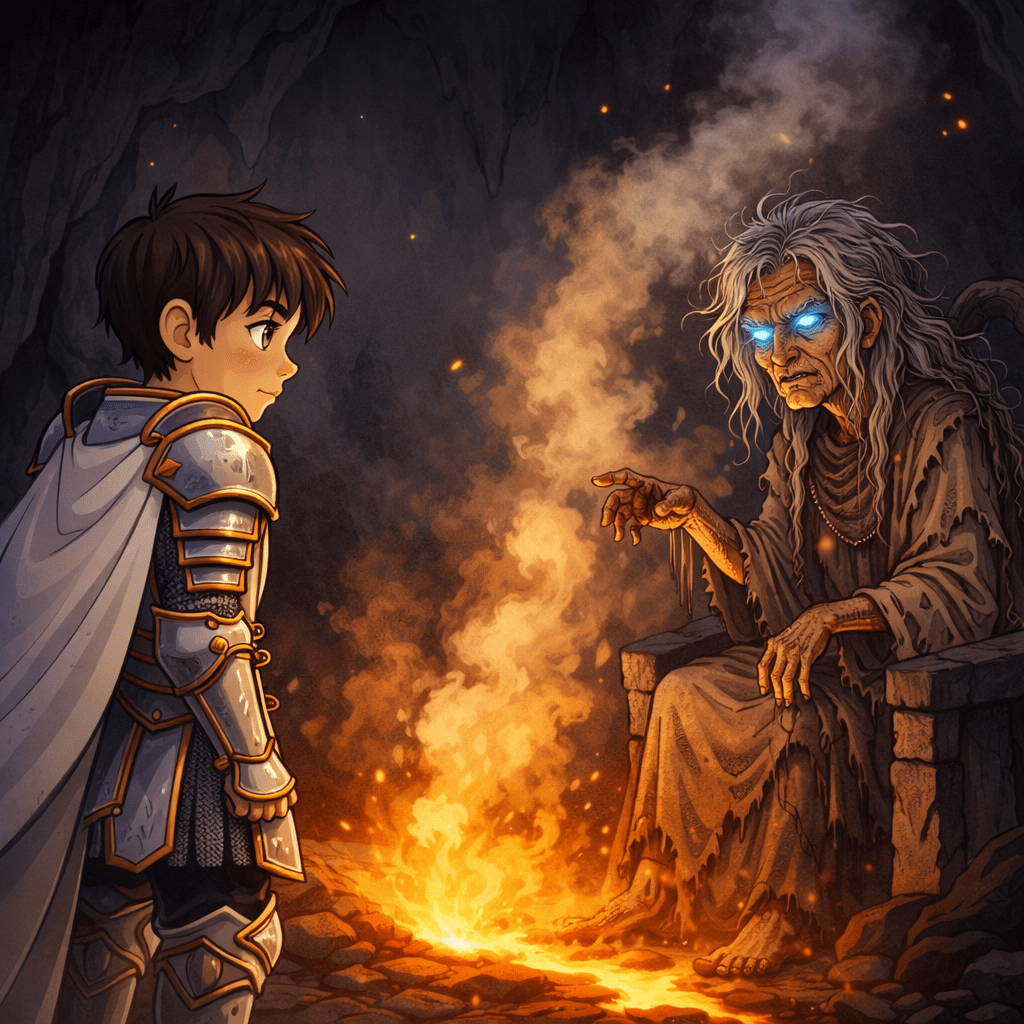
The tunnel opens into a cavern—the cavern. Chamber boss arena vibes immediately. It’s huge, maybe fifty feet across, with a vaulted ceiling that disappears into shadow. In the center of the stone floor sits a pit, maybe six feet in diameter, and from that chasm rises steam. Not normal steam, but the glowing kind, backlit by embers that float upward like reverse rain. Orange and red light pulses from below, casting dancing shadows across the cave walls.
Very Oracle of Delphi meets volcanic vent aesthetic. Very ancient prophecy delivery system.
And there, in the corner—
Oh man.
The old woman sits on a stone ledge like she’s been waiting for centuries. And maybe she has. This is the Oracle, and she looks exactly like every ancient prophecy-giver in every mythology ever: frail to the point of translucence, like one strong breeze would scatter her into dust particles. Her hair hangs long and loose, gray streaked with white, tangled in knots that suggest she stopped caring about appearances sometime during the Bronze Age. It flows down past her shoulders in matted ropes, catching the ember-light like tarnished silver.
Her skin’s leathery—actually leathery, like parchment that’s been left in the sun too long. Wrinkles etch every inch of her face, creating a topographical map of age and wisdom and probably some trauma. Her hands rest on her knees, fingers long and skeletal, ending in nails that are cracked and yellowed. The kind of hands that have pointed at destiny too many times to count.
She’s wearing what might have once been a dress but is now just tattered fabric, withered and stained, hanging off her frame like it’s given up trying to be clothing and settled for “symbolic covering.”
But her eyes—
Her eyes glow blue. Not metaphorically. Actually glow, like someone installed LED lights behind her irises. Electric blue, piercing through the darkness with unnatural luminescence.
NPC with critical quest information detected, I observe. Approach with caution. Save before dialogue.
“Come to me, child, and heed my words,” she calls out. Her voice is ancient but strong, carrying across the chamber with perfect clarity. Not the quavering voice you’d expect from someone who looks like she should crumble at any moment. This voice has authority.
Topher—brave, stupid, protagonist-coded Topher—walks forward without hesitation. No fear, no questioning the glowing-eyed cave woman. Just pure main-character confidence.
Kid’s either incredibly courageous or hasn’t played enough survival horror games, I think. Probably both.
And that’s when his outfit changes.
It happens mid-step, a transformation so smooth it’s like reality just decided to apply a different texture pack. His polo shirt and shorts dissolve into silver-and-gold armor—actual armor, the kind you see in medieval fantasy games but rendered with dream-logic perfection. Plate mail that fits his twelve-year-old frame perfectly, engraved with intricate patterns that catch the ember-light. A white cape materializes across his shoulders, pristine and flowing despite the steam-filled air.
Topher doesn’t notice. Dream-logic strikes again—characters in dreams rarely question wardrobe changes unless the narrative needs them to.
Paladin class transformation complete, I note. Holy knight skin equipped. Very Keeper of the Star aesthetic.
The Oracle rises—not standing exactly, more like manifesting in an upright position. The steam from the pit begins to swirl faster, embers rising in spiraling patterns. They twist and dance before Topher’s eyes, and within that glowing smoke, images form. Shadowy shapes, monstrous silhouettes, scenes of destruction rendered in orange fire and gray vapor.
“Oh, holy knight and mighty crusader,” the Oracle intones, and her voice suddenly has that reverb effect, like she’s speaking through a cathedral’s sound system. The steam responds to her words, shaping itself into visual prophecy.
And then she drops it:
“Seven days and monsters of old times Shall roam your world in the new age.“
The steam shows continents, oceans, the spinning Earth.
“On the first day, the Sirens of the Sea.“
Three women with bird wings materialize in the vapor, their mouths open in silent song. The image is beautiful and terrifying.
“On the second day, the Beast of the Labyrinth of Crete.“
A massive bull-headed humanoid forms, muscles rippling, horns sharp as spears. The Minotaur, rendered in steam and ember-light.
“Slithering snakes with a gaze that turns to stone,“
Medusa’s face appears, serpents writhing where hair should be, eyes that glow with petrifying power.
“Guardians of the Underworld baring their fangs.“
Three-headed Cerberus erupts from the pit-steam, each head snarling with rows of teeth like daggers.
“On the third day, divine retribution Spreads its wings and tears with its talons.“
Harpies—three of them—winged women with vicious claws, diving through the vision like fighter jets.
“The Lion, the Goat, and the Serpent.“
The Chimaera assembles itself from smoke: lion’s head roaring, goat’s head bleating, serpent tail striking. The ultimate mythological mashup monster.
“On the fourth day, The Riddler of Thebes.“
The Sphinx materializes—lion body, human head, eagle wings. Her expression is knowing, mocking, dangerous.
“On the fifth day, Hercules’ First Labor.”
A gigantic lion, with golden fur.
“Echidna, She who bore Four. She sees through them and commands thee.“
A woman’s form coalesces, but this one’s different—half-woman, half-serpent, massive and terrible. The Mother of Monsters herself. The steam shows her commanding the previous creatures like puppets on strings.
“On the sixth day, Twin Terrors of the Sea Strait.“
Two forms manifest on opposite sides of the vision: a six-headed sea monster (Scylla) and a whirlpool with teeth (Charybdis). The straits between them spell certain doom.
“On the seventh day, a Behemoth— Serpents of the Sea shall rise And destroy the land and life within it.“
The final image is apocalyptic: a colossal sea serpent erupting from the ocean, city-sized, wrapped in storm clouds and lightning. Typhon or Leviathan or something worse. The kind of creature that ends civilizations.
The steam rises faster now, spinning around Topher in a vortex. He stands frozen—not scared frozen, but overwhelmed frozen. His nine-year-old brain is trying to process the cosmic horror PowerPoint presentation he’s just witnessed.
The Oracle’s blue eyes burn brighter. Her voice drops to a register that vibrates through the cave floor:
“O Keeper of the Star, The Wretched Mother covets the Meteor To resurrect the Father of All Chaos and Destruction, Who seeks to rule and conquer your world.“
The steam-tornado engulfs Topher completely. Orange embers swirl around him like angry fireflies, heat pressing against his armor, light blazing so bright it’s blinding—
And then—
SYSTEM CRASH. DREAM SEQUENCE TERMINATED. EMERGENCY WAKE PROTOCOL ACTIVATED.
Topher gasps, eyes flying open, and he’s back in his bed. No armor. No cave. No glowing-eyed Oracle. Just his bedroom, his navy-blue-with-stars blanket tangled around his legs, moonlight still streaming through the window.
But he’s drenched in sweat. His polo shirt clings to his chest, hair plastered to his forehead. His heart hammers against his ribs like it’s trying to escape. Breathing comes in short, sharp gasps.
What—what was that? The thought races through his mind, panicked and confused. Dream? Nightmare? Vision?
His hands shake as he pushes himself upright, kicking free of the blanket. The clock reads 2:34 AM. Seventeen minutes. The whole prophecy download took seventeen minutes.
Welcome to the pre-game tutorial, kid, I think from my distant observation point. That wasn’t a dream. That was a mission briefing. And the countdown just started.
QUEST LOG UPDATED:
New Objective: Seven Days Prophecy Received
Status: Cannot Be Ignored
Time Until First Day: Unknown
Pants Status: Officially Scared
Vision_mode_glitch_bathroom_edition.sav
WHOOSH.
The toilet flushes from inside the cubicle, that unmistakable sound effect of modern plumbing doing its job. Standard restroom audio. Nothing unusual.
Yet.
The door creaks open—metal hinges that probably haven’t seen maintenance since the school was built—and Sophie Pangilinan steps out. Seven years old, wearing her elementary uniform: white blouse with the school logo embroidered on the pocket, plaid skirt in navy and green, white socks pulled up to her knees, black Mary Jane shoes that click softly against tile floor.
Her black hair’s tied in two side ponytails with yellow ribbon clips shaped like bumblebees. Thematic foreshadowing much? The bathroom’s your standard elementary school setup: three sinks with chrome faucets, soap dispensers that never work properly, paper towel dispenser mounted too high for kindergarteners to reach comfortably.
Sophie heads toward the nearest sink, small hands reaching for the faucet handle. Water streams out. She pumps soap—miraculously, it actually dispenses—and starts washing.
Then she glances up at the mirror.
And her entire world shifts.
Here we go, I think. Power activation sequence initiated.
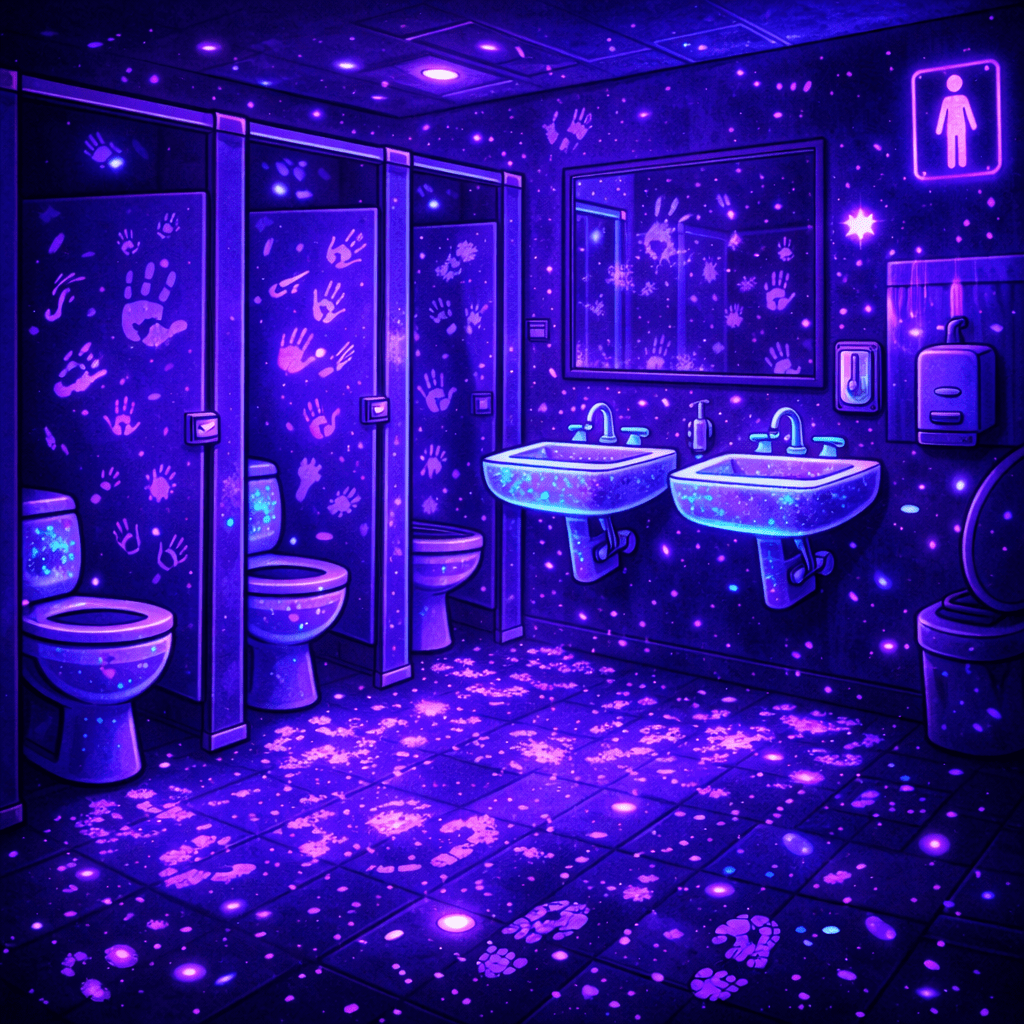
Sophie’s eyes go wide—like, anime-protagonist-realizes-something’s-wrong wide. Her hands freeze mid-wash, soap suds dripping between her fingers. Because everything—everything—is suddenly bathed in ultraviolet light.
The bathroom transforms into a rave scene minus the music. The white tiles glow electric purple-blue. The mirror reflects her face in shades of indigo and violet. Even the water streaming from the faucet looks like liquid neon. Every surface pulses with that distinctive UV frequency, the kind you see in blacklight bowling alleys or those forensic crime shows when they’re hunting for evidence invisible to normal human vision.
UV vision unlocked, I observe. Very bee-themed power set. Very insect-perception upgrade.
Sophie’s face cycles through confusion, shock, and rising panic in about three seconds flat. Her small fingers squeeze her eyes shut tight—the universal kid response to “if I can’t see it, maybe it’ll go away.”
What is happening? Her thought-voice carries that trembling edge of someone whose brain is trying to debug reality and failing. What’s wrong with my eyes?
She keeps her eyes closed for five full seconds—I count—breathing fast through her nose. Then slowly, cautiously, she opens them again.
Still purple. Still glowing. Still wrong.
Her gaze darts around the bathroom, checking if maybe it’s just the mirror acting weird, maybe someone installed blacklights as a prank, maybe anything except “my eyeballs just developed superhero powers in the middle of a bathroom break.”
But no. Wall tiles: UV purple. Ceiling lights: electric blue halos. Paper towel dispenser: glowing like it’s radioactive.
Is it the room? Sophie’s internal panic ratchets up another notch. Or is it really my eyes?
Her chest rises and falls faster. Breathing’s going shallow. Classic anxiety response kicking in. Her hands grip the edge of the sink, knuckles pale despite the purple light washing over them.
Please, let this go away, she begs silently, squeezing her eyes shut again. Please…
Kid’s praying for a rollback to default settings, I note. Unfortunately, supernatural power activations don’t come with undo buttons.
She opens her eyes.
And—just like that—everything snaps back to normal.
White tiles: actually white. Mirror reflection: normal human color spectrum. Water: clear and colorless. The bathroom looks exactly like it did three minutes ago, before her ocular hardware decided to install an upgrade without permission.
Relief floods Sophie’s face so fast it’s almost visible. Her shoulders drop, tension releasing like someone cut puppet strings. She exhales hard—whoosh—the kind of breath you let out when the jump scare turns out to be nothing.
But she doesn’t stick around to test if it’ll happen again.
Sophie bolts for the door, Mary Janes clicking rapidly across tile in double-time. Her small hand yanks the door open, and she’s gone, escaping the bathroom like it’s suddenly a boss arena she’s not leveled up enough to face.
Smart move, kid, I think as she disappears down the hallway. When your superpowers start glitching during bathroom breaks, tactical retreat is the correct response.
Also: Note to self—bee-based powers apparently include ultraviolet spectrum vision. Makes sense. Bees see in UV to locate nectar patterns on flowers. Sophie just got the biological upgrade. Whether she wanted it or not.
POWER ACTIVATION LOG:
Character: Sophie Pangilinan
Ability: UV Vision (Bee Girl power set)
Status: Unstable, intermittent
Panic Level: High
Next Glitch: Inevitable
Full_transformation_sequence_witness_protection_failed.sav
Room 104, second floor, Our Lady of Lourdes School—your standard early elementary classroom on a Wednesday morning. The clock above the blackboard reads 8:00 AM, which means everyone’s operating on that day starting energy dip where brains are sluggish and attention spans are measured in microseconds.
Ms. Manalastas stands at the front, mid-thirties, wearing a floral blouse and black slacks, holding a whiteboard marker like a conductor’s baton as she explains—checks notes—something about addition with regrouping. Her voice carries that practiced teacher cadence, clear and patient, designed to penetrate the fog of seven-year-old distraction.
And boy, is there distraction.
The classroom’s got that classic Filipino private school setup: forty students crammed into armchair-desks arranged in neat rows, windows along one wall letting in afternoon sunlight that makes dust particles visible in the air, educational posters covering every available wall space (Parts of Speech! Solar System! Kindness Counts!), and at the back, a row of metal lockers painted institutional beige.
Maybe half the class is actually listening. The front-row overachievers sit with perfect posture, hands folded, eyes tracking Ms. Manalastas like she’s streaming premium content. The middle rows? Mixed bag. Some kids dutifully copy notes into their spiral notebooks—7 + 8 = 15, carry the 1—while others conduct whispered conversations behind strategically positioned textbooks.
Classic classroom dynamics, I observe. The engaged, the pretending, and the completely checked out.
Several hands shoot up when Ms. Manalastas asks, “Who can tell me what comes next?” The usual suspects—Jonathan, the boy with his perfectly combed hair and pristine uniform; Mia, who probably has every answer memorized; that one kid who raises his hand for everything even when he doesn’t know.
And then there’s Sophie Pangilinan.
Seven years old, sitting in the third row near the window. She’s wearing her school uniform—white blouse with the school crest embroidered on the pocket, plaid jumper in navy and green, white knee socks, black shoes. Her long black hair’s tied back with those yellow bumblebee clips again, because the universe really enjoys thematic consistency.
But Sophie’s not taking notes. She’s not raising her hand. She’s not even pretending to pay attention.
She’s doodling.
Her math notebook lies closed on her desk. Instead, she’s got a spare spiral notebook open—the kind with the cartoon puppies on the cover—and she’s sketching with a yellow colored pencil. I zoom in on her artwork: flowers with swirly petals, butterflies with elaborate wing patterns, and what looks like a very happy honeybee wearing a crown.
Kid’s got her priorities straight, I think. Why learn addition when you can perfect your bee monarchy illustrations?
Sophie’s face is pure concentration, but the relaxed kind. Her tongue pokes slightly out the corner of her mouth—classic artist focus tell. Her small hand moves across the page with surprising confidence for a seven-year-old, adding details to the bee’s crown, little sparkles around its head.
Ms. Manalastas doesn’t call her out. Either she hasn’t noticed, or she’s picking her battles. Smart teachers know when to let the quiet kids coast.
“Alright, everyone,” Ms. Manalastas announces, capping her marker with a decisive click. “I’m going to give you a worksheet for seatwork. Complete problems 1 through 10. Show your work.”
The collective groan is immediate and universal. Seatwork is teacher-code for “I need fifteen minutes of silence to grade papers or answer emails or just exist without small humans demanding my attention.”
Ms. Manalastas distributes photocopied worksheets, walking up and down the aisles with practiced efficiency. Students receive them with varying degrees of enthusiasm ranging from “yes, I love math!” to “this is my personal hell.”
Sophie accepts her worksheet without protest, sets it on her desk, and immediately returns to her bee drawing.
Absolute legend, I note with approval. Kid knows what matters.
The classroom settles into that specific ambient noise of seatwork mode: pencils scratching against paper, the occasional whispered “what’s number 4?”, chairs scraping, papers rustling. Ms. Manalastas sits at her desk, eyes scanning the room periodically to ensure no one’s launching paper airplanes or engaging in contraband activities.
Time passes in that weird way it does in school, where minutes feel like hours but somehow the whole period disappears.
Then—
BRRRRRIIIIING.
The bell destroys the quiet. It’s one of those old-school electric bells that sounds like an angry alarm clock having a breakdown. The effect is immediate and dramatic.
Forty students simultaneously abandon their worksheets like someone yelled “FIRE!” Chairs scrape backward, books get shoved into bags with zero organizational thought, conversations explode at full volume. The stampede toward the door begins—a chaotic mass of seven- and eight-year-olds trying to squeeze through a single exit designed for orderly, single-file dismissal.
And they’re off! I narrate internally. The great exodus begins. First one out wins the coveted prize of… getting to the hallway three seconds earlier.
Ms. Manalastas doesn’t even try to enforce order. She’s been doing this long enough to know that bells trigger primal instincts in children. Best to just let the herd run and deal with whoever’s left standing.
Within thirty seconds, the classroom empties. Footsteps thunder down the hallway. Voices echo. Freedom rings.
Except—
Sophie hasn’t moved.
She sits at her desk, still coloring her bee’s crown, completely unfazed by the chaos. Her pencil moves in careful circles, shading in yellow highlights. The worksheet in front of her remains blank except for her name written in careful letters at the top.
Nice girls finish last, I think, watching her. Or in this case, the nice girl doesn’t participate in the stampede at all.
Ms. Manalastas gathers her things—lesson planner, water bottle, phone—and heads toward the door. She pauses, glancing back at Sophie.
“Don’t forget to submit your worksheet tomorrow, Sophie,” she says gently.
Sophie looks up, nodding with a small smile. “Yes, ma’am.”
And then Ms. Manalastas is gone, heels clicking down the hallway, leaving Sophie alone in the empty classroom.
Alone.
That’s important. Remember that detail.
Sophie finishes her bee drawing with a final flourish—a tiny heart next to the crowned bee—then closes her notebook with satisfaction. She stands up from her armchair-desk, slinging her small backpack over one shoulder. It’s got cartoon characters on it, probably from some show I don’t recognize.
And then she starts humming.
It’s a cheerful tune, something bouncy and repetitive, the kind of song that gets stuck in your head from Saturday morning cartoons. Sophie walks down the aisle between desks, swinging her arms in rhythm with her humming, doing this little skip-step that suggests she’s completely in her own world.
Kid’s vibing, I observe. Completely carefree. Completely unaware she’s about to experience the most surreal body-horror transformation of her young life.
Sophie closes her eyes—because when you’re seven and happy and humming, closing your eyes while you walk just enhances the experience, I guess—and continues her skip-step journey toward the classroom door.
And that’s when it happens.
The air around Sophie begins to shimmer.
At first, it’s subtle—just a slight distortion, like heat waves rising from summer asphalt. But then particles appear. Bright yellow particles, glowing with that 2.5D animated aesthetic that shouldn’t exist in three-dimensional reality but here we are.
Pollen, I realize. Magical transformation pollen. Very Sailor Moon meets nature documentary.
The particles swirl around Sophie in a spiral pattern, creating this golden tornado effect. They’re not just visual—they’re active, charged with whatever cosmic energy activates dormant superpowers. The glow intensifies, pulsing in rhythm with Sophie’s humming.
And Sophie—eyes still closed, completely oblivious—keeps walking and humming.
The pollen concentrates, spinning faster, and then—
Sophie starts shrinking.
Not gradually. Not slowly. Rapidly. Like someone hit fast-forward on a size-reduction algorithm. Her seven-year-old body compresses, condenses, collapses inward. Seven feet becomes six feet becomes five feet becomes three feet becomes one foot becomes—
Six inches.
Then three inches.
Then the size of an actual honeybee.
But the shrinking isn’t the only transformation.
Oh no, I think, watching with horrified fascination. Here comes the full metamorphosis.
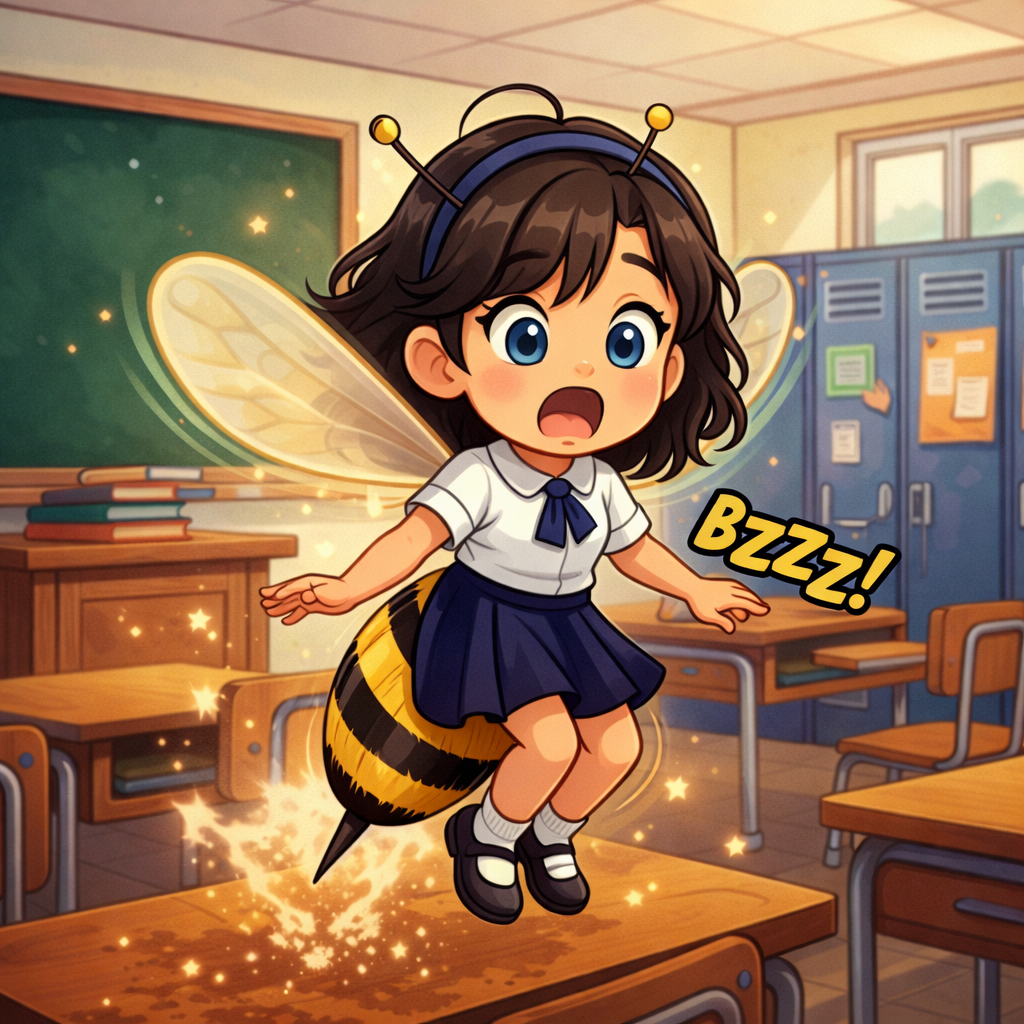
Two antennae sprout from Sophie’s head, erupting through her scalp like organic technology installing itself. They’re segmented, black and orange, and they immediately start twitching, sensing the air around her with insect precision.
Her back bulges—and I mean bulges, like something’s trying to burst out of her uniform—and then insect wings unfold. Not cute, cartoonish wings. Actual bee wings, translucent and veined, catching the afternoon sunlight streaming through the windows. Four wings total, two pairs, flapping so fast they become a blur.
The buzzing starts. That distinctive bzzzzzzz of bee flight, but somehow also coming from Sophie herself, like her entire body’s vibrating at the frequency of insect locomotion.
And then—the final transformation—
Her lower body extends. The bee abdomen grows from where her hips should be, segmented black and yellow, distinctly insectoid. It’s grotesque and fascinating simultaneously, watching human anatomy merge with honeybee biology. At the tip of that abdomen: a barbed stinger, wickedly sharp, designed by evolution for defensive purposes.
The pollen particles dissipate, job complete, leaving behind—
A bee girl. An actual, literal, bee girl.
Still wearing her school uniform, somehow—white blouse and plaid skirt scaled down to insect size. Still with Sophie’s face, her hair, her yellow bumblebee clips. But tiny. Hovering. Antennae twitching. Wings beating hundreds of times per second.
Sophie opens her eyes.
And freezes.
Her first thought is probably something like why is the ceiling so far away?
Her second thought, as her gaze drops to floor level: WHY IS THE FLOOR SO FAR AWAY TOO?
She’s hovering about three feet off the ground—which for a bee-sized person is like flying at skyscraper height. Below her, the classroom floor stretches out like a vast beige plain. The armchair-desks loom like architectural monuments, massive and imposing.
Sophie’s head whips around—antennae swiveling with the movement—taking in her surroundings with mounting horror.
The blackboard at the front of the classroom is enormous. Not blackboard-sized. Billboard-sized. Ms. Manalastas’s desk looks like a two-story building. The windows? Cathedral-scale.
“I’m—I’m flying?” Sophie’s voice comes out high-pitched and thin, barely audible over the buzzing of her own wings. She looks down at herself—sees the wings on her back beating faster than should be physically possible, feels the strange weightlessness of insect flight.
“And these wings—they’re flapping so fast!” Her voice trembles with disbelief and wonder and terror.
Then her gaze travels further down.
To where her legs should be.
To where, instead, there’s a segmented bee abdomen, black and yellow stripes, ending in a barbed stinger.
“Oh my—” Sophie’s voice cracks. “There’s an insect abdomen growing from my butt!“
It’s such a Sophie way to describe body horror. No screaming. No cursing. Just pure, innocent observation delivered with seven-year-old directness.
The buzzing intensifies. Sophie realizes with dawning awareness: That’s me. I’m making that sound. I’m BUZZING.
Panic hits.
Full, immediate, overwhelming panic.
Sophie zooms—and I mean zooms, like a tiny fighter jet suddenly hitting afterburners. Her bee wings kick into overdrive, propelling her across the classroom in a blur of yellow and black. She’s flying on pure instinct and terror, weaving between desk legs like they’re obstacle course pylons.
Her target: the lockers at the back of the classroom.
Most are shut tight, metal doors closed and latched. But one—one—has its door hanging slightly open, maybe an inch gap. That’s all Sophie needs.
She darts through the opening, wings folding at the last second to squeeze through, and crashes into the darkness inside. Her tiny body tumbles through the locker’s interior space—which from her perspective is like crash-landing in a storage warehouse—until she collides with something solid.
Textbooks. A stack of them, piled against the back wall of the locker.
Sophie scrambles behind them, wedging her bee-girl body into the narrow gap between book spines and metal wall. Her antennae press flat against her head. Her wings fold tight against her back. The stinger retracts slightly, defensive posture activating.
She huddles there in the darkness, breathing fast (do bees breathe?), heart pounding (do bee-girls have hearts that pound?), trying to process what just happened to her body.
Good hiding spot, I observe. Ten out of ten for survival instinct. Zero out of ten for long-term sustainability.
Time passes in the dark. Sophie can hear her own buzzing, quieter now, a nervous hum rather than panicked flight. Her antennae twitch, picking up sounds from beyond the locker—distant voices in the hallway, footsteps, the ambient noise of school continuing like nothing world-shattering just occurred.
Then—louder now—footsteps approaching.
Many footsteps.
The thunder of children returning from recess.
Oh no, I think. Here comes the next phase.
The classroom door bangs open. Voices flood in—loud, excited, post-recess energy still buzzing (no pun intended). Chairs scrape. Bags thump onto desks. The classroom returns to occupied status in seconds.
Sophie stays frozen behind her textbook barricade, listening.
Ms. Manalastas’s voice cuts through the chaos: “Settle down, everyone. Take your seats. Kindly take out your textbooks and we’ll read Chapter 8.”
The sounds of compliance: backpacks unzipping, books rustling, chairs adjusting.
And then—
Footsteps approaching the lockers.
Sophie’s antennae straighten. Alarm protocol activated.
A boy’s voice, close now, right outside her hiding spot: “Where did I put that textbook…”
The locker door swings open wider. Daylight floods in. A massive hand—massive from Sophie’s perspective, like a crane in a construction site—reaches into the locker space, fingers searching.
Sophie presses herself flatter against the wall. Please don’t see me please don’t see me please don’t—
The hand finds a textbook, grabs it, pulls it out.
“Bummer,” the boy mutters—Sophie recognizes the voice: Anthony, one of her classmates, usually sits two rows behind her. “My pen just ran out of ink. Let me grab my spare.”
The hand returns, rummaging through the locker interior. Fingers disturb the space, moving items, searching for a pen case.
Sophie panics.
Her wings activate—bzzzzz—and she lifts off from her hiding spot, trying to avoid those massive searching fingers. She darts left, darts right, flying in frantic evasive patterns inside the locker’s confined space.
It’s like playing a video game boss fight where you’re the tiny character and the boss’s hand keeps swiping at you.
Anthony’s hand sweeps through the space where Sophie just was.
She dodges—barely—wings beating in overdrive.
His fingers close near her abdomen.
She pivots—too fast—loses control slightly—
And her stinger makes contact with Anthony’s left hand.
The jab is reflexive. Defensive. Completely unintentional.
“OUCH!“
Anthony yanks his hand back like he touched a hot stove. The shout is loud, pained, immediate.
Oh no, I think. Oh no no no.
Sophie hovers in the locker, frozen with horror. Did I—did I just—?
Anthony’s cry draws immediate attention. Chairs scrape. Heads turn.
“What happened?” someone asks.
“Anthony, what’s wrong?” Ms. Manalastas’s voice, concerned, moving toward him.
Anthony clutches his left hand, examining it. There—visible even from across the room—a small red mark. The sting site.
“Something—something stung me,” Anthony gasps, voice tight.
And then—
This is where it gets bad.
Anthony’s eyes begin watering. Not crying-watering. Allergic reaction watering. His face flushes red—not embarrassment red, but histamine response red. His cheeks puff slightly.
He starts wheezing.
Anaphylaxis, I realize with cold dread. Kid’s allergic to bee stings. And Sophie just delivered a full dose of bee venom.
Anthony’s hand goes to his throat. His breathing becomes labored, raspy. The wheeze intensifies.
And then—
His legs buckle.
Anthony collapses onto the classroom floor like someone cut his power supply. His body hits the tiles with a sickening thump, textbook flying from his grip.
“ANTHONY!” Ms. Manalastas screams, rushing toward him.
The classroom erupts. Students jump from their seats, crowding around, voices rising in panic.
“What’s happening?”
“Is he okay?”
“Miss, what’s wrong with him?”
Sophie watches from her locker hiding spot, wings trembling, horror washing over her tiny bee-girl body. I did this. I did this. I did this.
Ms. Manalastas drops to her knees beside Anthony. Her teacher training kicks in—check breathing, check pulse, assess symptoms. Hives are already spreading across Anthony’s neck and arms, angry red welts rising on his skin.
“Jonathan!” Ms. Manalastas’s voice cuts through the panic with authority. “As class president, take charge for now. Keep everyone calm. I need to get Anthony to the clinic immediately.”
Jonathan—bless him—nods with wide-eyed seriousness, trying to project confidence he definitely doesn’t feel.
Ms. Manalastas lifts Anthony with surprising strength—adrenaline plus teacher superpowers—and rushes toward the door, Anthony’s wheezing form limp in her arms.
The classroom watches in stunned silence as they disappear into the hallway.
MEANWHILE — ABOARD THE PEREGRINE SPACESHIP
The command center’s main screen displays seven rectangular profile boxes arranged in a grid. Six remain gray, labeled DORMANT in block text.
But one—the fifth box in the row—suddenly flickers.
Gray becomes yellow. Bright, glowing yellow.
The label updates: AWAKENED.
And above the box, a name renders in crisp digital letters:
BEE GIRL — SOPHIE PANGILINAN
ROBO4000’s mechanical voice echoes through the empty bridge: “Power activation detected. Beginning observation protocols.”
And just like that, I think from my distant vantage point, the Seven Acolytes are down one member before the team even assembles. Nice job, universe. Really smooth rollout.
QUEST LOG UPDATED:
Sophie Pangilinan: BEE GIRL — Status: AWAKENED
Collateral Damage: 1 allergic reaction, 1 medical emergency
Threat Level: Unintentional but devastating
Recovery Time: Unknown
Guilt_trip_interrupted_by_extraction_protocol.sav
The classroom sits empty again. Past noon now—probably 12:45 PM based on the angle of sunlight slanting through the windows. Lunch period’s in full swing somewhere across campus, but Room 104 remains abandoned.
Just desks. Chairs. Scattered worksheets.
And one tiny bee-girl emerging from a locker.
Sophie drifts out—and I mean drifts, her wings beating in that slow, exhausted rhythm that suggests she’s running on emotional fumes. Her face is wrecked. Eyes red and puffy, tear tracks visible even on her insect-tiny cheeks, expression carrying the weight of accidental harm that seven-year-olds aren’t equipped to process.
Guilt hits different when you’re that young, I observe. No defense mechanisms built up yet. Just raw emotion and “I hurt someone and I can’t undo it.”
She flies toward the open window—drawn to escape, to air, to anywhere but here. Sunlight streams in, and Sophie passes through it, exiting the classroom into the outdoor world.
There’s a tree right outside, branches reaching toward the second-floor windows like nature’s ladder. Sophie lands on one—a thin branch, barely thicker than a pencil—and perches there. Her tiny hands grip the bark. Her wings fold against her back.
And she just… sits. Staring up at the sky. One small finger lifts to wipe tears from her cheek.
I’ve hurt that boy, her thought-voice whispers with devastating clarity. I hurt him and he fell and Ms. Manalastas had to carry him away and it’s my fault—
The guilt radiates off her like a debuff status effect she can’t shake.
Then—
The air shimmers.
Wait, I think. Round two already?
The bright yellow pollen returns—those 2.5D animated particles swirling out of nowhere like reality just remembered it has unfinished business. They spiral around Sophie in that golden tornado effect, concentrated and purposeful.
And Sophie starts growing.
Reverse transformation sequence activated. Her bee-sized body expands—three inches becomes six inches becomes one foot becomes three feet becomes—
CRACK.
The branch—designed to support maybe half a pound of bird weight, not a suddenly-normal-sized seven-year-old—snaps like a gunshot.
Sophie drops.
“Ouch!“
She crashes into the shrub below, branches cushioning her fall but also jabbing into places that definitely don’t appreciate being jabbed. She lands on her rear in the dirt, wincing hard.
At least the shrub broke her fall, I note. Could’ve been concrete.
Sophie pushes herself up, rubbing her backside, assessing damage. She’s normal-sized now—about four feet tall, wearing her school uniform that somehow survived both transformations. But her bee features remain: antennae still sprouting from her head, insect wings still attached to her back.
The abdomen, though? Gone. Vanished. Like the transformation ran out of budget for that particular effect.
Then—
The grass below her feet begins glowing.
Sophie freezes. Her eyes go wide.
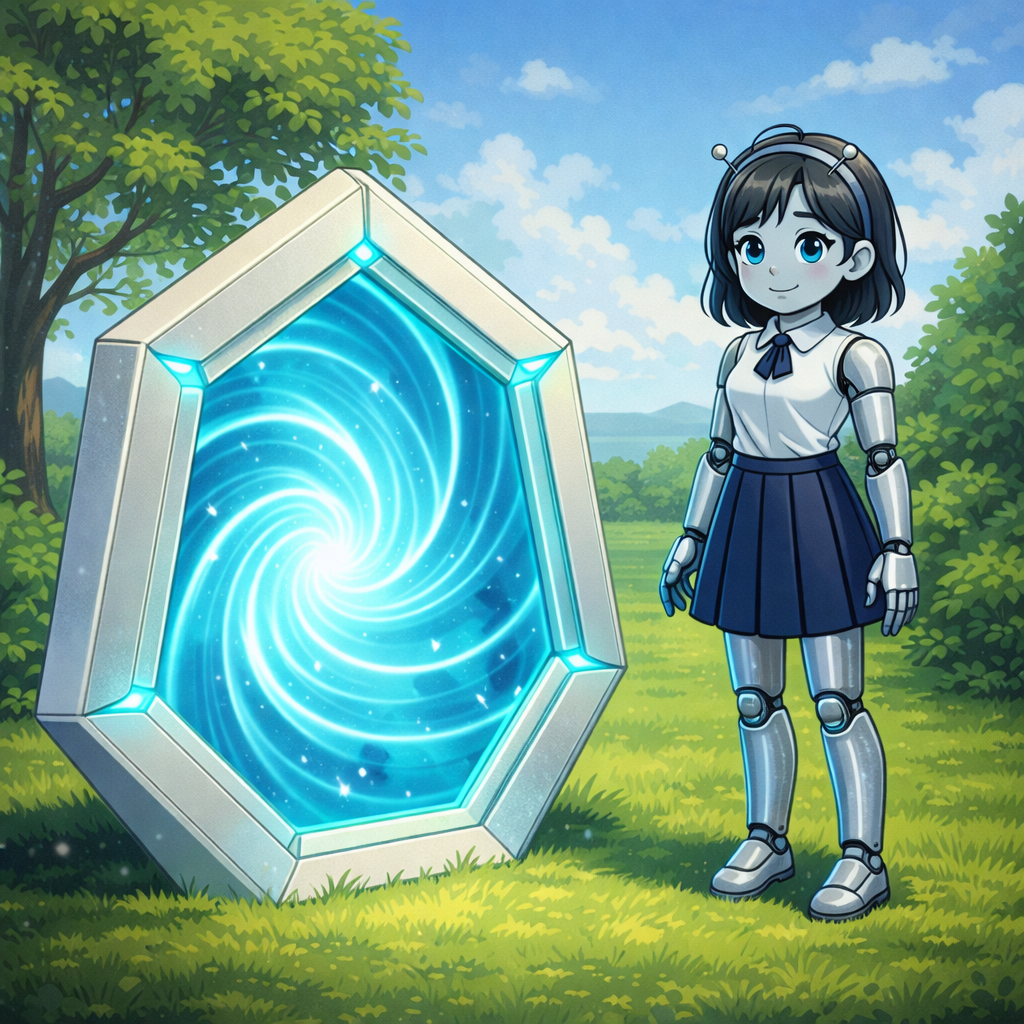
Nano-molecules—and I can see them, tiny particles of advanced technology materializing from thin air—start tracing geometric patterns in the dirt. They move with mathematical precision, drawing lines that connect into a shape: a pentagon. Large, futuristic, off-white edges that pulse with energy.
Portal activation sequence, I recognize immediately. Very sci-fi extraction protocol. Very “beam me up, Scotty” energy.
The pentagon fills with cyan light, bright and electric. The center opens—not physically, but dimensionally, creating a gateway that shouldn’t exist in normal three-dimensional space.
And then it pulls.
Sophie gasps as invisible force grabs her, yanking her toward the glowing portal. Her feet slide across grass, hands grasping at air, trying to find purchase.
“What—what’s happening?!” Her voice cracks with fresh panic.
Tractor beam, I think clinically. Non-negotiable extraction. Someone wants her aboard that spaceship now.
But wait—there’s more.
White pads materialize mid-air around the portal’s edge, hovering like platform game collectibles. Cyan lasers shoot from them, converging in the space directly in front of Sophie. The beams intersect, creating a holographic framework.
And then—construction begins.
Nanotechnology floods the framework, building from the molecular level up. Skin forms. Hair grows. Features render. Clothing materializes fiber by fiber.
Within three seconds, standing before Sophie, is—
Sophie.
An exact duplicate. Same height, same uniform, same face, same yellow bumblebee hair clips. But the eyes—the eyes are slightly off. Too perfect. Too focused. The telltale sign of synthetic life.
Android Sophie locks eyes with biological Sophie.
Oh man, I think as the portal’s pull intensifies. This is gonna be some Parent Trap meets Blade Runner situation, isn’t it?
EXTRACTION PROTOCOL: IN PROGRESS
ANDROID REPLACEMENT UNIT: DEPLOYED
ESTIMATED TIME UNTIL TOTAL FREAKOUT: 5 SECONDS
 B. K. P. Carreon
Leave a comment