Overview:
| In Peregrine Lightyear, the spaceship serving as headquarters, ROBO4000 and CleanBot realize they have surpassed the halfway point in awakening the children—a milestone once thought impossible. The Star of Vis appears before them to foretell the coming of the Seven Acolytes and calls on the two robots to witness the journey to its end. On Earth, Michael’s dormant power suddenly awakens during a gang fight, triggering his immediate extraction through a pentagonal portal. Meanwhile, at their family home, Benjamin grows increasingly suspicious of his siblings’ shifting personalities, even considering that they may have been replaced by clones. Determined to uncover the truth, Benjamin secretly tails Michael during a school trip to a natural park. There, his newly awakened bionic vision reveals the android nature of the boy posing as his brother. He confronts and defeats the impostor, demanding answers about his real siblings. In the aftermath, Benjamin learns of Peregrine—only to be taken by the same portal, just as the real Michael was before him. |
Past_halfway.sav
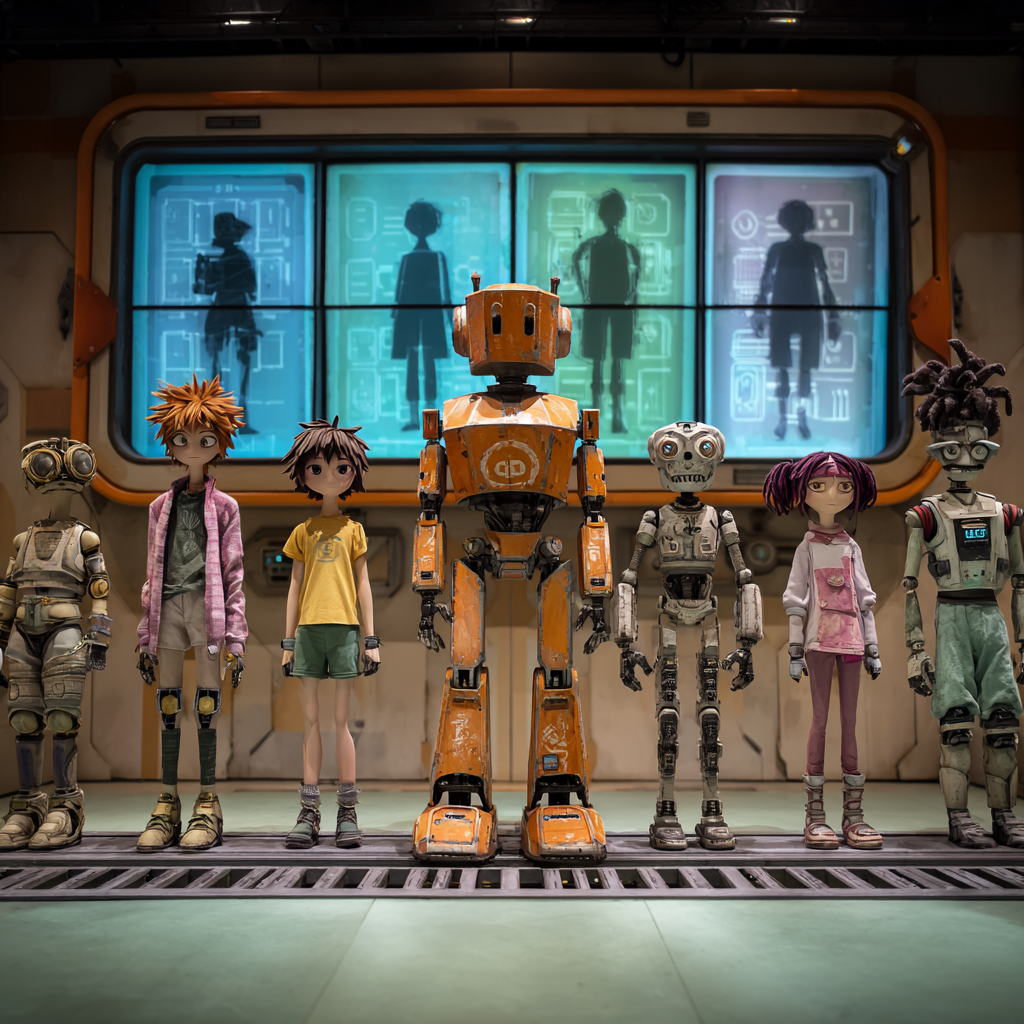
The command center looks like every final-level control room ever—dim, dramatic, and humming like it knows secrets. The only real light comes from the massive curved screen in front of us, washing everything in this blue-white glow that makes my hands look like ghost DLC skins.
Seven profiles sit at the top of the display, lined up like character slots before a boss raid.
James. Michael. Allison. Topher. Sophie. Roanne. Benjamin.
Photos stare back in stiff, picture awkwardness. But only four are lit up.
James blazes in orange. Allison radiates pink. Sophie glows in bright yellow. Roanne flickers seafoam green.
Under their names, the word AWAKENED pulses like a completed achievement badge.
Michael’s profile? Gray. Topher’s? Gray. Benjamin’s? Gray.
Underneath the three: DORMANT. No effects. No glow. Just…meh.
I shove my hands into my hoodie pocket and lean closer. The light catches the edge of my eyes. “Yeah, okay,” I mutter. “Cool cool cool. No powers yet. Totally fine. Not like this is a cosmic destiny thing or anything.”
The word DORMANT sits under Topher’s face like a loading bar that refuses to move.
CleanBot is mounted beside the screen, his polished oval body reflecting the glow like a shiny thumbnail icon. His digital eyes flicker a soft cyan. “I still cannot compute how we are already past the halfway point,” he says, voice smoother than usual. There’s something in his tone—static that almost sounds like…feeling. “You have waited three years.”
Three. Whole. Years.
Three years since the day that board game lit up and rewrote the lives of the kids like a patch update nobody asked for.
ROBO4000 stands to the left of the console—tall, metallic, arms folded behind his back like a knight in chrome armor. The screen’s light carves hard edges across his faceplate. He doesn’t speak. He just watches.
Typical strong silent type.
My eyes scan the labels again.
Not jealous.
Okay, maybe a little.
The screen hums softly, like it’s breathing. The console below it is waist-high, covered in smooth panels and touch interfaces. Blue indicators blink in steady rhythm. CleanBot perches on the right side of the console mount, small but expressive. ROBO4000 stands like a guardian statue on the left, tall enough that his head nearly touches the hanging cables above.
I stare at Topher’s grayscale picture. His smile in it looks fake now. Dormant.
What does dormant even mean? Sleeping? Inactive? Waiting?
Waiting for what? Of course, the powers of the kids.
CleanBot’s lenses brighten slightly. “Statistical probability suggests activation will occur under heightened emotional stimulus.”
“Great,” I say. “So, all I need is a dramatic rooftop speech in the rain. Easy.”
But underneath the jokes, my chest feels tight. Three years of watching the others level up. Three years of being backup.
I flex my fingers. Nothing sparks. No glow. Just skin and bones.
ROBO4000 finally speaks, his voice low and resonant. “Dormancy does not imply absence. It implies preparation.”
Preparation. That’s one way to say “not yet.”
I tilt my head, studying the gray bars. If this is a game—and it sure looks like one—then we’re in the mid-arc. The part where the heroes doubt themselves before unlocking the final upgrade.
I glance at Michael and Benjamin.
Underdogs.
Fine.
Every team needs a late-game carry.
I square my shoulders and look up at Topher’s grayscale face on the screen. “Alright,” I whisper, mostly to myself. “Stay dormant. Charge up. But when you flip that switch?”
I smirk.
“Make it legendary.”
The_star_and_the_robots.sav
THREE YEARS AGO
Space at night is extra-night. No city glow. No stars twinkling politely. Just the raw, infinite kind—the kind that makes you feel like a single pixel in a 4K universe.
I’m sixteen kilometers above the asteroid belt’s edge, floating in my spacecraft. She’s matte silver, swept wings curved like a hunting bird mid-dive. My boots magnet-lock to the floor while the neural visor hums against my temples. VR link: active. Sensory sync: 98.7%. Good enough.
The simulation drops me onto the exterior hull.
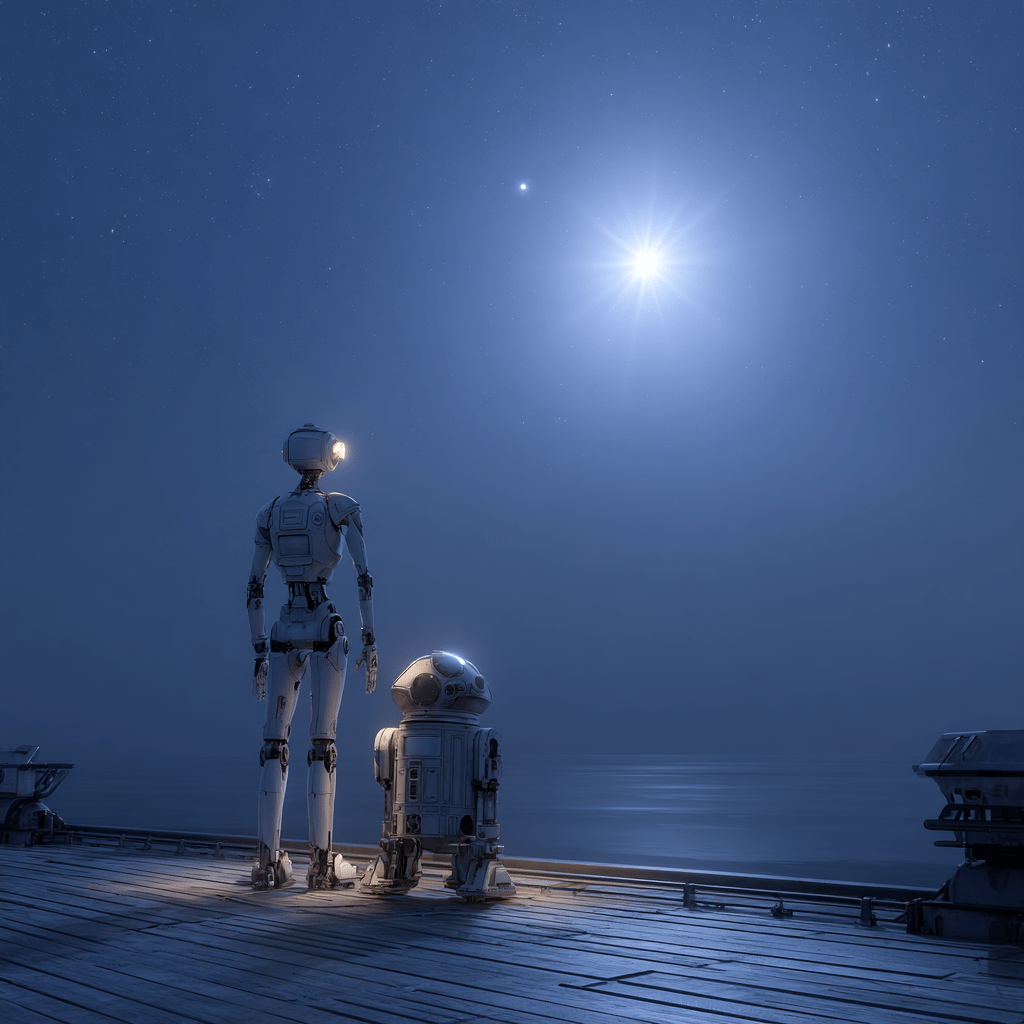
Below me—well, technically kilometers below—ROBO4000 and CleanBot stand on the falcon-shaped Peregrine Lightyear spaceship’s back plating. The metal curves beneath their feet like the spine of some sci-fi dragon. Beyond them: endless stars.
ROBO4000 is built like a chrome knight—broad shoulders, polished plating, narrow optic visor glowing faint amber. His posture is ramrod straight, hands clasped behind his back like he’s guarding a throne.
CleanBot hovers slightly to his right, oval body glossy white, cyan lenses wide. He adjusts his stabilizers with a soft mechanical whirr. If robots could swallow nervously, that’d be him.
Then it appears.
The Star of Vis.
No explosion. No Michael Bay fireworks. Just—presence.
A sphere of blue-white light forms in front of them, shimmering like compressed starlight. It doesn’t flicker. It breathes. The glow washes over their metallic frames, turning ROBO4000’s chrome into pale moon-silver and reflecting across CleanBot’s rounded casing like liquid glass.
My visor registers energy spikes that make my HUD blink warnings. I mute them. I don’t want pop-ups ruining this cutscene.
“Heed my words, children.”
The voice isn’t loud. It doesn’t need to be. It’s calm. Smooth. God-tier narrator vibes. It vibrates through vacuum like physics decided to take the night off.
“There will come a time when four boys and three girls will awaken as the Seven Acolytes.”
Seven.
Even three years ago, that number locks into my memory like a password I’ll never forget.
“You two shall bear witness—from the beginning to the end of the Seven’s journey.”
ROBO4000 does not move. CleanBot’s lenses contract, recording everything. Good bots.
“This is your fate. This is why you were called into this world. This is the meaning of your existence.”
Okay. Casual existential assignment. No pressure.
I stand there in VR, heart thudding inside a ship floating in absolute dark, watching two machines receive a destiny patch from a cosmic lightbulb.
And somehow, even from a simulation, I know.
This isn’t a trailer.
This is the beginning.
Scarlet_rage_initiation.sav
Here’s something nobody puts in the superhero origin story montage: the part where the chosen one skips third period Biology to pick a fight in a vacant lot and nearly gets his ribs caved in first.
Very uncinematic. Very Michael Pangilinan.
I pull up the surveillance feed from the Peregrine’s exterior cameras and lean back in my simulation chair, balancing a stylus between two fingers. The command center hums quietly around me — ambient lighting, viewscreen casting that blue sci-fi glow across the titanium walls. ROBO4000 stands motionless at the console to my left, optical sensors running passive tracking on a red blip that’s been stationary for the past twelve minutes. CleanBot has gone completely still on the secondary chair, which is his version of holding his breath.
On the viewscreen: a dusty vacant lot on the outskirts of a residential block. Chain-link fence on two sides, crumbling concrete wall on the third, and about nine guys forming a loose semicircle around one kid in a white school polo.
One kid. Nine guys.
I’ll be honest. My immediate reaction is a flat, unimpressed of course.
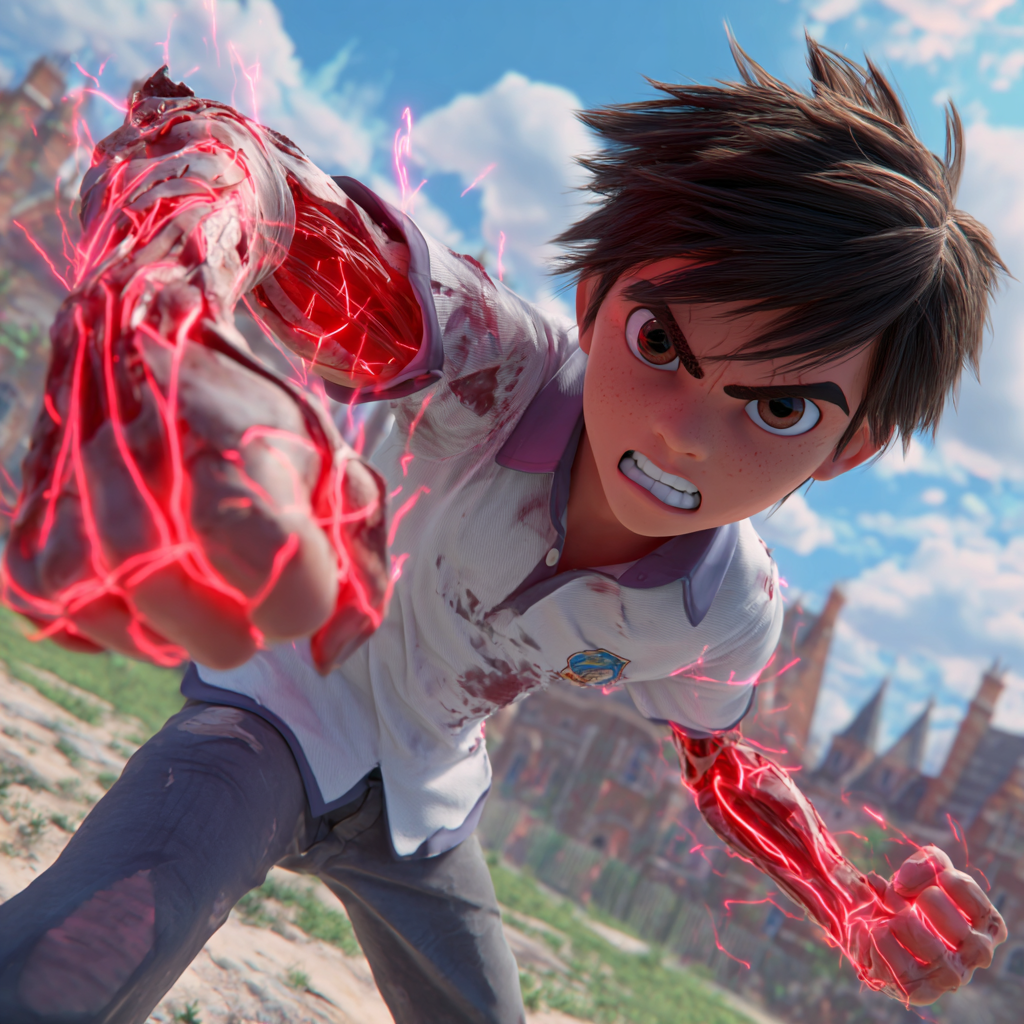
The kid is Michael — fourteen years old, five-foot-eight, lean and built like someone who’s been doing pull-ups on the basketball ring since age nine. His school uniform is already a wreck: the white polo untucked and streaked with dirt across the shoulder, dark slacks scuffed at the knee, leather school shoes that are definitely not rated for combat terrain. Short, wavy black hair. Brown eyes that are currently doing that thing where they narrow and go very, very flat.
He looks like he’s having the time of his life.
Across from him stands the gang leader — a stocky guy in his late teens, bald head gleaming under the high tropical sun, wearing a faded tank top and cargo shorts. He’s got the build of someone who lifts things for intimidation purposes. A wooden club dangles loose in one hand, more prop than weapon, because he’s got eight other guys with clubs of their own arranged behind him like a loading screen’s worth of generic enemies.
“How are you, big guy?” Michael’s voice comes through the feed, casual and needling, the way he delivers every taunt — like he’s commenting on something mildly inconvenient rather than staring down a nine-man beatdown. He looks the gang leader up and down once, the kind of slow look that’s designed to insult.
The gang leader’s jaw tightens. He raises one hand. “Henchmen — come out.”
They’re already out, is the thing. The semicircle tightens.
“Can’t take me down by yourself, huh?” Michael drops his bag against the fence post without breaking eye contact. He rolls his neck once, audible even through the mic. “What a coward.”
“You’ll be begging for mercy when we’re done with you.” The gang leader’s voice stays controlled. That’s the tell — he’s not scared, but he’s also not loose. He’s calculating. Waited for a day when Michael walked home through the back route alone.
Michael sighs. Actual sigh, like this is a homework problem he’s already solved. “Less talking. More fighting. I’m bored.”
He plants his feet, fists up, elbows tucked — textbook stance, better than it has any right to be on a kid who learned it from watching MMA clips on his phone.
“Charge!”
They rush him all at once, which is not the correct tactical approach, but these are out-of-school guys with wooden clubs, not a strike team. Michael moves first — ducking under the first swing, shoulder-checking the guy sideways, pivoting immediately into an elbow that catches a second guy across the jaw. He’s fast. Genuinely fast, the kind that gets you noticed at tryouts. He feints left, draws two attackers off-axis, and drops one with a straight right that snaps his head back.
Three down in about eight seconds. Not bad.
Then the numbers catch up with him.
Two guys flank from opposite sides, which is a trap Michael doesn’t see coming because he’s too busy enjoying the front half of the fight. The third goes low. The fourth swings from behind — club connecting across his upper back with a crack that makes CleanBot flinch on the secondary chair.
Michael goes down on one knee.
And here’s where it gets interesting.
I straighten up in my seat.
He’s on the ground, palm pressed into the cracked concrete, breathing hard through his nose. Blood at the corner of his mouth — he must’ve caught a hit on the way down. The gang crowds in, circling now with the confidence of people who think the problem is solved.
Then Michael’s right arm starts to glow.
Not a trick of the light. Not the noon sun bouncing off something metallic. A deep, pulled-from-the-core scarlet — running from his shoulder down through his bicep, pooling at his forearm, settling into his fist like a furnace deciding to wake up.
He stares at it. Brow furrowed. Not afraid — confused, and then, after about one second of confusion, interested.
On the Peregrine Lightyear’s viewscreen, his profile rectangle ignites in red. The gray DORMANT label flickers once and resets.
AWAKENED.
ROBO4000’s optical sensors shift to high focus without a word.
Michael stands up.
The gang leader sees it — the glow, the way Michael moves now, something that wasn’t there thirty seconds ago. He opens his mouth, but the question doesn’t make it out.
Michael throws a punch. One punch. Into the nearest thug’s shoulder, not even a full swing, and the guy goes sideways like he was hit by something three times Michael’s size. The impact sound is wrong — too solid, too sharp.
What kind of power is this?
I can see the thought cross Michael’s face — not panic, not existential crisis, just pure gamer instinct. New ability unlocked. Let’s figure out the damage values. He tests it on the next guy, a full straight shot to the sternum, and the result is identical: one hit, one KO, no contest.
Scarlet energy bleeds from his left bicep down to his forearm, a living heat shimmer that warps the air around his fist. He’s not glowing at the gang anymore — he’s just doing it, automatic as breathing, like the energy was always there and just needed a reason.
One by one, methodically, he works through the remaining guys. Not showy about it. Michael Pangilinan has always been competitive, not theatrical — he fights to win, and winning right now looks like efficiency. Club-wielders scatter. The ones who don’t scatter get dropped. The equation is simple and not particularly kind to anyone standing in his way.
“How is that even possible?!” someone yells from the back, and then the back half of the gang makes the smart decision and runs.
The gang leader is already on the ground — Michael hit him in the midsection and sent him sliding four meters across the concrete, which is not a thing a fourteen-year-old in a school polo should be able to do. He lies there, stunned, staring at the sky.
Michael walks over and crouches down. Grabs the collar of the tank top, lifts the guy’s head just enough for eye contact. The gang leader’s eyes are glazed.
“Who was it that said I’d be the one begging?” Michael’s voice is low now, quieter than during the banter. “Can’t even beg if you’re out cold.”
He holds the eye contact for a beat, then releases. The head drops back. Michael stands, wipes the blood from the corner of his mouth with the back of his wrist, and surveys the wreckage.
Nine guys. Empty lot. High noon.
“Weakling,” he mutters to no one in particular, and turns around.
The portal is already there.
Pentagon-shaped. Roughly two meters tall. The frame traces itself in silver nano-molecules that shift and pulse like something alive, and the interior — glowing, cycling through amber and white and a deep, pressurized cyan — hums at a frequency that I can pick up on the Peregrine’s sensors even from here.
Michael stares at it. Tilts his head. “What is that.“
He takes one step closer; because of course he does.
The suction hits immediately — not a pull, a vacuum, the kind that decides arguments about whether you’re moving toward something or something is moving toward you. Michael’s reaction is instant and completely on brand: he punches the ground. The concrete fractures under his fist in a starburst pattern, and he shoves his other hand into the gap, gripping exposed rock.
The portal doesn’t care.
His grip holds for four seconds. Knuckles white. Arms straining. Shoes scraping backward across broken ground.
Then it lets go, and the portal takes him.
The vacant lot is empty. Broken concrete. Scattered clubs. A bag against the fence post. The noon sun sits directly overhead, throwing no shadows, illuminating absolutely nothing that would explain what just happened here.
I pull back from the feed. Glance at ROBO4000.
His sensor light pulses steady cyan. Patient. Satisfied.
“Five down,” CleanBot says softly.
Two to go.
Android_suspicion_protocol_loading.sav
Here’s a trope I have strong opinions about: the “something is wrong with my family” scene.
Every horror movie has one. Every sci-fi thriller. Every anime arc where the protagonist comes home and the people he loves are just slightly off — smiling too wide, talking too soft, saying the right words in the wrong order. It’s designed to make your skin crawl without showing you anything you can technically point to.
Watching it happen in real life — or the closest thing to real life I get through a simulation feed — is something else entirely.
I have all four camera angles pulled up on the Peregrine Lightyear’s viewscreen. The Pangilinan residence, Quezon City. Saturday, mid-morning. The house is a comfortable two-storey in a mid-density residential block — cream-painted concrete, dark wood accents, a small balcony on the second floor where Mary keeps her container plants lined up like a tiny botanical army. The kind of house that smells like rice and fabric softener and has framed school photos climbing the staircase wall.
Greg and Martha are leaving.
I catch them at the front door — Greg in a short-sleeved gusot mayaman and dark slacks, Martha in a floral dress with her hair pinned back, the pair of them radiating that unmistakable anniversary-date energy. Greg has his arm looped around Martha’s waist like a man who has decided today is a good day to be affectionate in front of his children.
Benjamin stands in the doorway to the living room, watching them go. He’s sixteen, lanky in the way of someone still assembling their final form, dark hair neatly combed, white t-shirt tucked into dark shorts. The eyeglasses sit precisely on his nose — not pushed up, not sliding, precisely. His dual-display wristwatch catches the light when he crosses his arms. Classic Benjamin: responsible expression, slight frown, already cataloguing responsibilities.
“For today, you’re in charge of your brothers and sisters, alright?” Martha says, turning at the door.
“Yes, Mother. I’ll keep an eye on them.”
“And that way your Nanay and I can enjoy our date for our anniversary.” Greg grins. “Who knows — maybe we’ll have baby number six?”
Martha’s expression cycles from surprised to mortified to trying not to laugh, in about one second flat. “Greg, stop it. We’re in front of our son.”
“Our kids can handle themselves. We’ve got teenagers in the house.” Greg is already steering her toward the door with that cheerful stubbornness of a man who considers awkward jokes a love language. “Let’s head out.”
Martha gives Benjamin one last wave — quick, familiar, trusting. He nods back.
The door closes.
Benjamin stands in the sudden quiet of the house for exactly three seconds. Then he straightens his glasses, turns, and gets to work.
I track him to the second-floor hallway, where Sophie’s door sits halfway open. Through it: the small desk by the window, the surface covered in the usual art supplies — watercolor tins, pencils, loose sheets of paper — but pushed to one side. In their place, a yellow legal pad, covered in neat rows of numbers.
Sophie is bent over it, working. She’s seven, small even for her age, dark hair in two low pigtails. The Lourdes School uniform has been swapped for a yellow shirt and shorts. She holds a pencil the right way — not the cramped toddler grip she normally uses — and she’s moving through the equations with a quiet, methodical focus that is, to put it plainly, not Sophie.
Benjamin pauses in the doorway. I can see the exact moment his brain registers the disconnect — a small stiffening across his shoulders, a blink behind the glasses.
“Do you need any help, Sophie?”
She looks up. Smiles. It’s Sophie’s face, Sophie’s features, Sophie’s honey-jar earrings. “No, I’m perfectly fine.”
The voice is right. The smile is right. But the confidence — Sophie Pangilinan, who apologizes to strangers, who took three weeks to introduce herself to the Art Club, who whispers when she’s uncertain which is most of the time — she does not say perfectly fine with that kind of settled, unrattled certainty.
Benjamin stares at the yellow pad for one more beat. She’s not just doing the equations. She’s getting them right.
Math is Sophie’s weakest subject. Has been since Grade 1.
He leaves without another word.
I almost feel bad watching him process this. Almost.
Downstairs: the living room. The benches along the low table, the television dark, afternoon light coming through the jalousie windows in long stripes across the tile floor. On the bench nearest the window — Michael.
Michael Pangilinan, who once used a textbook as a doorstop, who tried to trade the almanac Benjamin gave him for Christmas for a bag of chips before being loudly talked out of it, who considers any reading that isn’t a basketball stat sheet a personal attack on his time — is sitting quietly with that same almanac open across his knees.
He’s holding it correctly. Turning pages with actual care.
Benjamin sits down beside him with the studied casualness of a surveillance operative who has definitely not just discovered that his sister is a math genius overnight. He says nothing. Watches from the corner of his eye.
Michael glances over, notices the stare, and smiles. It’s a pleasant smile. Relaxed. Not the sharp, gotcha grin Michael deploys when he’s about to say something annoying.
“You know, Kuya,” Michael says, “Abraham Lincoln is such a fascinating figure from the nineteenth century. He led the United States through the Civil War, defended the nation as a constitutional union, defeated the Confederacy, and played a major role in abolishing slavery.”
The silence that follows is profound.
Benjamin sits very still, the way you sit when you’re not sure if what you just heard was real. I run the audio back through my simulation replay, because I want to be sure I didn’t mishear through the feed.
Nope. Michael Pangilinan just voluntarily delivered a historically accurate summary of Abraham Lincoln.
Did I hear that right? Benjamin’s expression is the picture of a person whose entire model of reality has developed a crack. He stares straight ahead. He almost threw that book away. I watched him almost throw that book away.
He gets up and goes to the kitchen.
The rice goes in. The water gets measured — Benjamin does it by weight, the precise way, not the knuckle method his dad uses. He cranks the can opener on a tin of pork and beans with practiced efficiency, sets the table with plates and utensils aligned at equal distances from each other. There’s something almost automated about it, like his hands are running the lunch protocol while his brain runs a completely different program in the background.
James appears from the hallway.
The first thing I notice: matching pajamas. Blue-and-white plaid, top and bottom, freshly pressed, worn at noon on a Saturday like they are a completely normal and deliberate fashion choice. James Sevilla is seventeen, the eldest of the three Pangilinan-adjacent brothers, lanky and easy-moving, usually dressed in whatever combination of streetwear and K-pop aesthetic he assembled that morning. Matching pajamas are, to put it gently, not in his usual rotation.
“Is it time for lunch?” he asks. Politely. Hands folded at his waist.
Benjamin looks at him. Looks at the pajamas. “Yes, it is. But what are you wearing?”
“This?” James glances down, apparently unbothered. “I wanted to try a more classic look. And be more comfortable.”
Classic look. Matching pajamas. Sure.
James sits at the table and waits. Hands in his lap. Posture straight. Not checking his phone, not humming anything, not doing that thing he always does where he taps the nearest surface in whatever rhythm is currently living in his head.
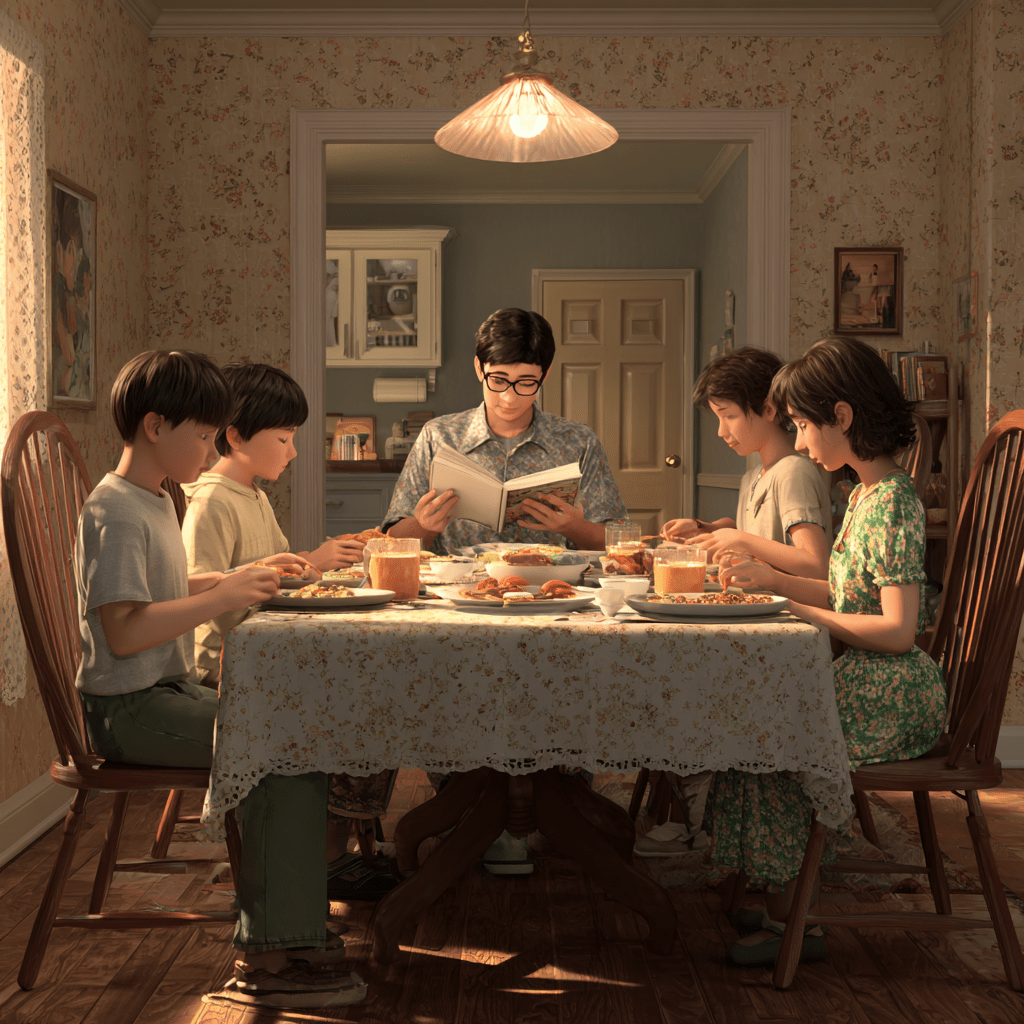
The family assembles for lunch — Benjamin serving, Mary bouncing in from the balcony with soil on her fingers and something enthusiastic to say about plant growth rates, the androids settling into their chairs with the pleasant, cooperative energy of people who have read a manual on how humans behave during meals.
“The plants are growing so fast!” Mary announces, dropping into her chair. “They’re so full of life — healthy and strong!”
She beams. Reaches for her fork. Completely, entirely herself.
Benjamin watches the table. His eyes move — Michael to James to Sophie, who has come down and sits with her hands folded, waiting. Then back to Mary, who is already arguing with her pork and beans about which piece to eat first.
One of these kids is not like the others. Except it’s three of them. And the one that’s not like the others is actually the only one being herself.
Mary’s the only one acting normal. I can track the thought crossing Benjamin’s face like a weather system. Something is wrong with James, Michael, and Sophie. Were they replaced by androids or something?
He catches himself. Pushes the thought down. Picks up his spoon.
Ridiculous. That only happens in science fiction.
Oh buddy.
After lunch: the same wrongness, different locations. Michael back on the bench with the almanac. James still in the pajamas, seated with that serene, folded posture. Sophie on the carpet in the living room, yellow pad back out, pencil moving through equations.
Benjamin stands in the middle of it all and the look on his face is the look of someone who has assembled all the evidence, doesn’t like what it’s telling him, and is about to do something decisive about it anyway.
He turns to Mary. “So — do you still want to tell me more about the plants?”
Mary’s eyes light up immediately. “Of course, Kuya! Why wouldn’t I? Let’s go check on them!”
He takes her by the shoulder, steers her through the dining room, up toward the balcony. Quick. Purposeful. The door slides shut behind them.
On the balcony: Mary’s container garden lines the railing in terracotta pots and repurposed tin cans, everything green and crowded and thriving. Mary launches immediately into an explanation about her kangkong and the two tomato plants and the basil she’s been nursing back from yellow. Benjamin nods at the right moments, makes the appropriate interested sounds.
But his eyes are on the glass door.
Through it: the living room, where three people who look exactly like his siblings are sitting quietly in the afternoon light, being perfectly well-behaved in ways that should be impossible.
I need to keep Mary away from those three. The thought is flat and decided, the kind that doesn’t second-guess itself anymore. Something is wrong. Very wrong.
I lean back from the viewscreen.
This is the part of the story where the smart character starts connecting dots that the audience connected three episodes ago. It’s always satisfying to watch, not because of the reveal — we already know — but because of the person doing the realizing. Benjamin, who reads Dune for fun and keeps a planner and has been the responsible one his entire life, standing on a balcony with his sister’s tomato plants, quietly arriving at the most science-fiction conclusion of his very science-fiction life.
ROBO4000 hasn’t moved from his post. CleanBot is watching the residential feed with all the tension of a being who knows exactly what happens next and has decided to simply endure it.
“He’s close,” CleanBot says, almost to himself.
Yeah.
He is.
Bionic_vision_unlocked.sav
Covert ops are not Benjamin’s natural habitat.
The guy irons his school uniform. He color-codes his planner. He once filed a formal written complaint about a classmate who borrowed his pen without asking. The concept of tailing someone without being detected sits about as naturally on him as a backwards cap — and yet here we are, watching Benjamin Pangilinan execute what I can only describe as the most stressful bus ride of his academic life.
The jeepney is one of those repurposed open-air school buses — long bench seats running parallel down both sides, metal roof, the windows just openings in the frame because this is the Philippines and air conditioning is optional. It smells like sunscreen and packed lunches. Michael’s class fills most of it, loud and loose the way high schoolers get when they’re technically on an educational activity but mostly just out of the building. Someone’s sharing chips. Someone else is playing a tinny phone speaker two octaves too high. The chatter bounces off the metal walls.
Benjamin sits near the back. He is not supposed to be on this bus.
He’s wedged into the last row in his civilian clothes — dark polo, slacks, the wristwatch — with a passenger’s shoulder blocking most of his face. Every few seconds he lifts his head just enough to find Michael’s profile three rows up, confirms he’s still there, then folds back down below the sightline. The glasses keep sliding when he ducks. He pushes them up each time with the precise, irritated gesture of someone who did not plan for fieldwork.
I’ve got the external feed pulled up alongside the interior — full surveillance, both angles. ROBO4000 stands at the console without comment. CleanBot has gone very still in the way that means he’s paying close attention and doesn’t want to jinx anything.
The bus stops at the natural park.
It’s the kind of place that earns its name without trying — rolling open field, shade trees at the perimeter, the air carrying that specific combination of grass and fresh water that no urban environment ever fully replicates. A lagoon glints in the distance. Somewhere further back, a covered eco-trail cuts through the tree line, signage visible from the drop-off point. A tour guide in an orange vest is already waiting, clipboard in hand, smile professionally calibrated to handle teenagers.
Benjamin peels off from the bus last, drifts wide of the group, and finds cover in the shrubs along the field’s edge. He crouches there — in his good slacks, behind a bush — watching.
The tour guide gathers the class in a loose semicircle on the grass. “Can anyone tell me what they’re looking forward to today?”
Michael raises his hand. Immediately. Confidently. Front-and-center energy, elbow straight up like he’s flagging down a referee.
Benjamin’s eyebrows do something complicated.
“Please, come forward,” the tour guide says.
Michael steps out of the group and turns to face his classmates like he’s done this a hundred times. And in fairness, he has — but usually it’s a basketball court, usually there’s a ball involved, and usually he’s not about to deliver an organized list of recreational amenities.
“I’ve already researched this place,” Michael begins, and there it is — researched, a word that has never before appeared in a sentence Michael Pangilinan volunteered — “and found a lot of exciting activities. Hiking, mountain biking, horseback riding, rappelling, zip-lining, fishing, and paddle-boating on the lagoon. There’s even an eco-trail.” A brief pause. “And a vivarium. Specifically, an orchidarium.”
Orchidarium.
Silence from the class. Then scattered, surprised applause, because the bar for Michael being impressive apparently just relocated several floors up.
Benjamin stares from behind his bush. His jaw is doing the thing where it’s closed but barely.
And then his eyes change.
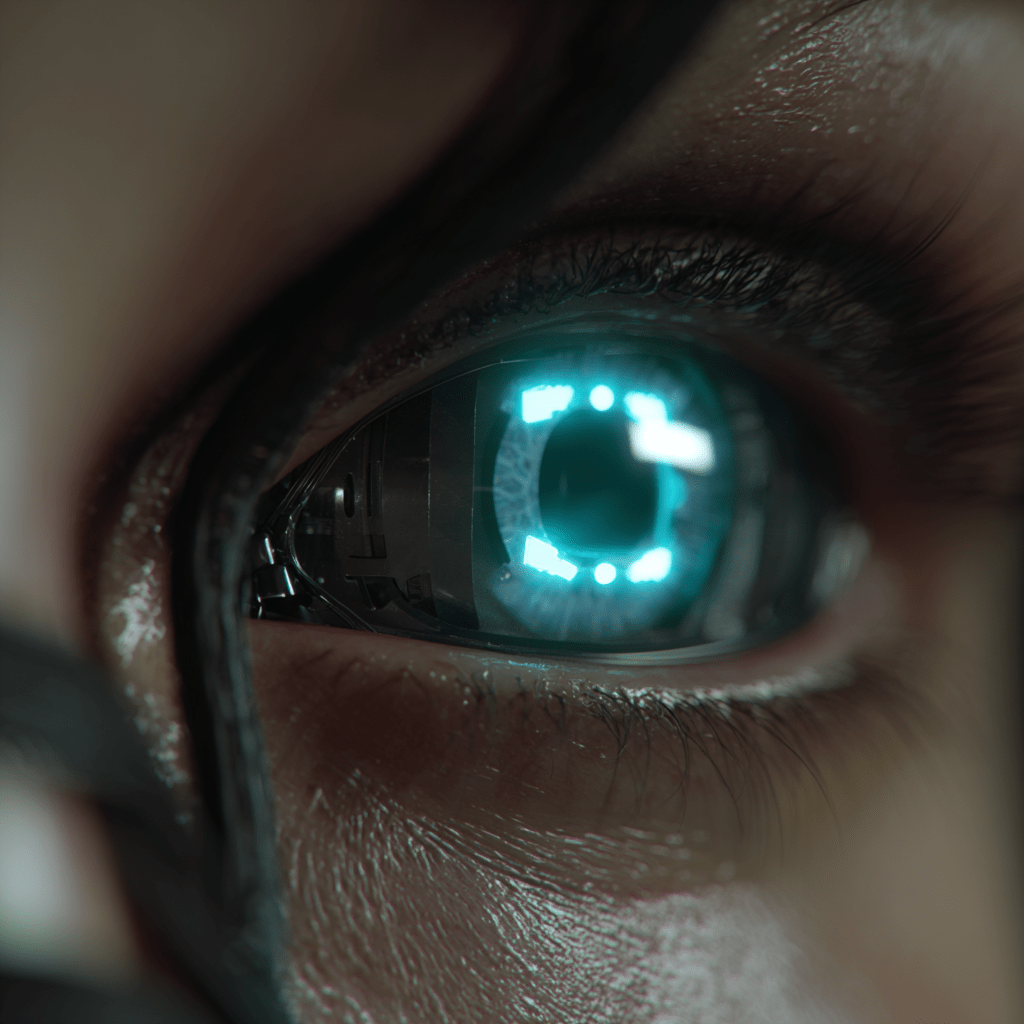
I catch it on the feed before he does — a faint pulse of cyan light behind the lenses of his glasses, there and gone in under a second. Benjamin blinks. Pulls his glasses off, rubs his eyes, replaces them. Looks at Michael again.
His entire body goes still.
From where he crouches, I can see his expression cycling through disbelief, confusion, and something that edges toward controlled panic — the look of a person whose brain is receiving data it has no category for. His eyes are tracking something the rest of us can’t see.
What he’s seeing: no bones. No organs. No muscle. Inside the shape of his brother’s body, behind the face that smiles and the hands that gesture at the lagoon — circuitry. Structural polymer joints. A central processing unit running parallel to where a spine should be. A machine wearing a person.
And then, layered over it like a heads-up display: a floating text widget. Neat. Clinical. Informational.
FRUBBER — Flesh Rubber. Proprietary nano-tech skin that mimics real human musculature, allowing simulation of human-like facial features and expressions.
Benjamin sits in the shrubs with this information for approximately four seconds.
His hands are gripping his knees hard enough that his knuckles have gone pale.
His vision just went bionic. Not metaphorically — literally, actually bionic. Augmented reality overlay, material composition readout, structural analysis of a living— of a not living—
On the Peregrine Lightyear’s viewscreen, Benjamin’s vertical profile rectangle floods with cyan light from the bottom up, clean and steady, like a progress bar completing its final percentage.
The label resets.
AWAKENED.
CleanBot exhales — which robots technically shouldn’t do, but here we are.
Six down.
One to go.
Android_eliminated_microchip_acquired.sav
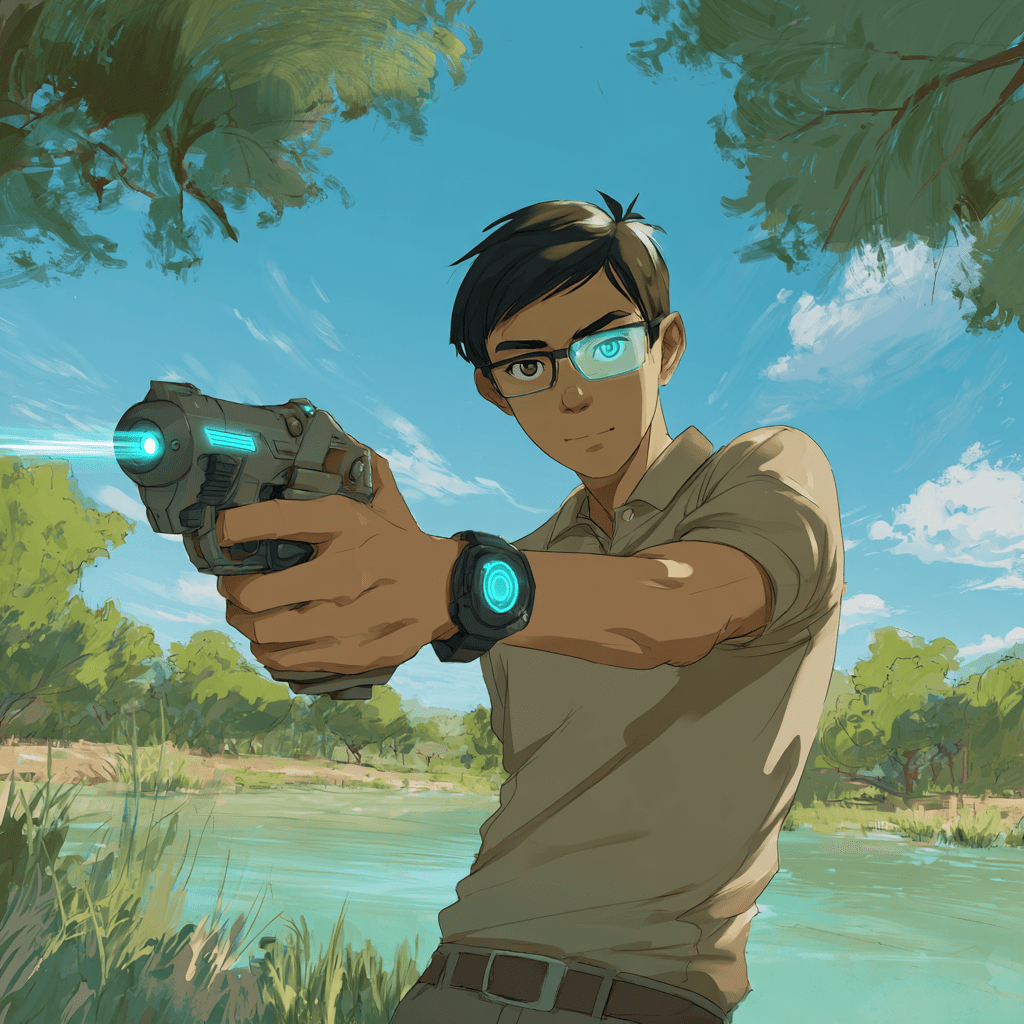
The natural park has that specific late-morning stillness you get when a field trip class has dispersed into activity stations and left one corner of the grounds temporarily empty. The lagoon sits maybe forty meters from the tree line — flat, dark green at the edges where the reeds cluster, open blue toward the center where the paddle-boats are docked. A wooden walkway extends along the near bank, weathered planks over soft ground.
The android is crouching at the water’s edge.
It’s doing something I can only describe as acting casual — one hand trailing in the shallows, head tilted down toward its own reflection. From any normal distance, from any normal angle, it looks exactly like a fourteen-year-old boy taking a quiet moment away from his class. The Michael Pangilinan posture is accurate. The straight black hair. The tan. Even the school uniform — the android’s wearing a replica, which is either thorough or unsettling, and I’m going with both.
But I’m watching on the feed, and I can see what no one standing at normal distance could: the surface of the lagoon is glitching.
Not the water itself — the android’s interface. The reflection in the water is rendering wrong, frame-dropping in ways that physics doesn’t permit, the digital mask slipping just enough to show edges where there shouldn’t be any. The android tilts its head, and for about half a second, the reflection doesn’t follow at exactly the right speed.
Then the clouds come in.
Fast, the way tropical weather moves — blue sky darkening at the edges, a wind picking up off the lagoon that sends the reeds sideways. The light goes flat and gray. The temperature drops maybe two degrees in under a minute.
Benjamin steps out from the tree line.
He crosses the grass toward the water with the measured pace of someone who has made a decision and is no longer second-guessing it. His polo is slightly rumpled from the bush surveillance, one sleeve pushed up. The wristwatch catches a last slant of light before the clouds close completely. His expression is calm in the way that’s actually the opposite of calm — the compressed, deliberate calm of someone running a lot of internal processes simultaneously.
The android hears him coming. Stands. Turns.
“Where is my brother?” Benjamin says.
The android’s face does Michael’s easy half-smile. “I’m right here, Kuya. What kind of question is that?” It glances past him toward the park’s main activity area, affecting mild impatience. “You followed me here? Lunch break is almost over. I need to get back to class.”
Benjamin doesn’t move. “You’re not going anywhere.”
A beat. Two.
“You’re an android clone. Just like ‘James’ and ‘Sophie.’ Where are my real brothers and sister?”
The smile goes out like a switched-off screen. What replaces it isn’t anger, isn’t fear — it’s nothing. Smooth, neutral nothing, the expression of a machine that has stopped running the personality simulation because the simulation has been compromised. The android’s eyes — Michael’s eyes, brown and familiar — go flat in a way that no actual person’s eyes ever go.
“I see you’ve figured it out.” The voice is still Michael’s voice, same pitch, same timbre, wrong in a way I can’t fully quantify except that it’s completely wrong. “Unfortunately, I have no choice but to erase your memories, Benjamin. This is protocol.”
And then it moves.
The speed is the first thing — inhuman, closing the distance between them in under a second, arms up in a grab that’s meant to pin and overwhelm. It works on humans. Benjamin is sixteen, lean, not a fighter. On paper this should be a very short confrontation.
Except Benjamin’s arms come up and stop it.
Not just redirect — stop. The android’s full momentum hits Benjamin’s forearms and goes nowhere. They lock together, the android pushing with mechanical force, Benjamin pushing back, and for about three full seconds it’s a genuine contest before Benjamin’s output climbs past the android’s threshold and shoves — one clean movement, no wasted motion — sending the android skidding backward four meters across the wet grass.
Since when did I become this athletic? I can see the thought on his face even from the feed. He looks at his own arms like they’ve been replaced by someone else’s arms, which, in a manner of speaking, isn’t entirely inaccurate.
The android recovers fast. From the air around its forearm, gray nano-molecules spiral in and solidify — a bracelet forming out of nothing, broad and mechanical, covering two-thirds of its forearm in layered panels with a faint cyan core. It raises the arm.
Fires.
Three cyan laser bolts in rapid succession, tight grouping, aimed at center mass.
Benjamin is already moving. Left. Right. The first shot passes his shoulder close enough that I can see the heat shimmer on the feed. The second he leans under. The third he— I genuinely didn’t process how he dodged the third one, it happened that fast. His own reflexes are surprising him as much as they’re surprising the android, which is saying something, because the android doesn’t surprise easily.
This is new information about myself, Benjamin’s expression says, filing it under priority review while simultaneously tracking an active shooter.
The nano-molecules find him next — gray and drifting, gathering at his right wrist unbidden, assembling themselves around the contraption bracelet he picked up in the field earlier. They thicken and plate, forming a partial gauntlet that hums when it locks into place. Something projects from the face of it: a shield. Cyan, solid light, hexagonal at the edges, slightly heraldic in shape like someone designed a space ranger’s equipment while also having opinions about medieval aesthetics.
The android fires again — sustained, this time, three bolts becoming six, angled wide to catch the shield’s edges.
Benjamin catches them all. The shield absorbs the impact with a low concussive sound, each deflection kicking the beams wide into the grass. He’s moving across the field in a wide arc, keeping the shield face-on, reading the android’s firing pattern with the same analytical attention he gives a math problem.
And then, between one shot and the next, a gap.
The android’s bracelet cycles — recharging, a half-second of dim before the cyan core rebuilds. Benjamin sees it. The nano-molecules at his left hand respond before he consciously directs them, pulling together into a long-barreled shape, solid and light and unmistakably a laser gun.
He raises it. Adjusts two degrees right. Fires once.
The shot hits the android in the chest — dead center, clean through. The impact opens a hole the size of a fist through the torso plating. For a moment the android just stands there, systems cascading, sparks running up through the neck assembly and out through the fingertips. Then it folds, collapsing sideways onto the wet grass, and the nano-molecules that made up its structure release all at once — the body dissolving from the outside in, particles dispersing into the air until there’s nothing left but a faint shimmer over flattened grass.
Benjamin stands in the empty field, gun still raised, breathing controlled.
Then he lowers his arm and walks to the spot.
The shimmer is already fading. But his eyes — still running whatever bionic scan activated earlier — catch something in the dispersed particles. He crouches, reaches into the barely-there residue, and comes up with a microchip the size of a thumbnail. Gray. Unmarked. He turns it once between his fingers, then slots it into the contraption bracelet on instinct, because the slot is exactly the right size, which is not a coincidence.
The bracelet hums. The cyan hologram projects.
Three sections. He scrolls through them with two fingers like a tablet interface, reading fast.
Section one: blueprints and schematics for the Peregrine Lightyear — the falcon-shaped vessel, detailed internal layout, coordinate readout pinpointing its location somewhere outside the Quezon City grid. It exists. The spaceship is real and it is there and it has his siblings.
Section two: android status.
ELIMINATED: Michael (Unit 3). ACTIVE: James (Unit 1). Sophie (Unit 2). Allison (Unit 4). Roanne (Unit 5).
Benjamin goes still for a moment. Allison and Roanne were cloned too.
Section three:
FOR DISPATCH: Benjamin (Unit 6). Topher (Unit 7).
He stares at his own name on the holographic list for about two seconds. Then the hologram closes and he stands up, jaw set, the bracelet still warm on his wrist.
I have to find Topher. I have to get them all back.
The portal opens before he finishes the thought.
Cyan-tinted, pentagon-framed, it materializes above him and to the side simultaneously — geometry that makes no structural sense and does it anyway. A forcefield expands from its edges and catches him, not rough but absolute, lifting him off the ground before he can plant his feet. He grabs at nothing. Struggles, genuinely — Benjamin Pangilinan does not go anywhere without understanding why — but the force has no interest in his objections.
In three seconds, he’s inside.
The portal seals behind him. The field is empty. The clouds are already breaking apart overhead, the blue coming back in patches, the lagoon going still.
Somewhere in the activity area, a tour guide is calling for students to reassemble.
 B. K. P. Carreon
Leave a comment