Overview:
| Topher makes his way to the Peregrine Lightyear, the spaceship headquarters, where ROBO4000 and CleanBot are holding his cousins in custody. When they awaken, his cousins quickly regroup with him, and together they step into the radiant light of the Star of Vis. Each begins to glow, their bodies emanating distinct colors as the energy responds to them. Waves of blue-white light surge and wrap around the group, then slowly recede—revealing their transformed, heroic alter egos. Michael emerges as a superhero clad in maroon-red sleeveless spandex, adorned with golden, Spartan-inspired armor. Allison transforms into a magical girl, wearing an ornate pink dress and wielding a heart-shaped wand. Sophie hovers above the ground as a sporty half-honeybee hybrid, her form bright, campy, and cartoonish. James becomes an eccentric K-pop idol, dressed in a sleek white-and-gray urban ensemble of matching jacket and pants. Roanne appears as a sea princess, draped in a flowing gown and bearing a luminous lunar scepter. Benjamin takes on the role of a space captain, equipped with sturdy yet lightweight full-body armor. Lastly, Topher stands revealed as a holy knight, clad in partially plated medieval armor with a flowing cape. |
Seven_colors_one_star.sav
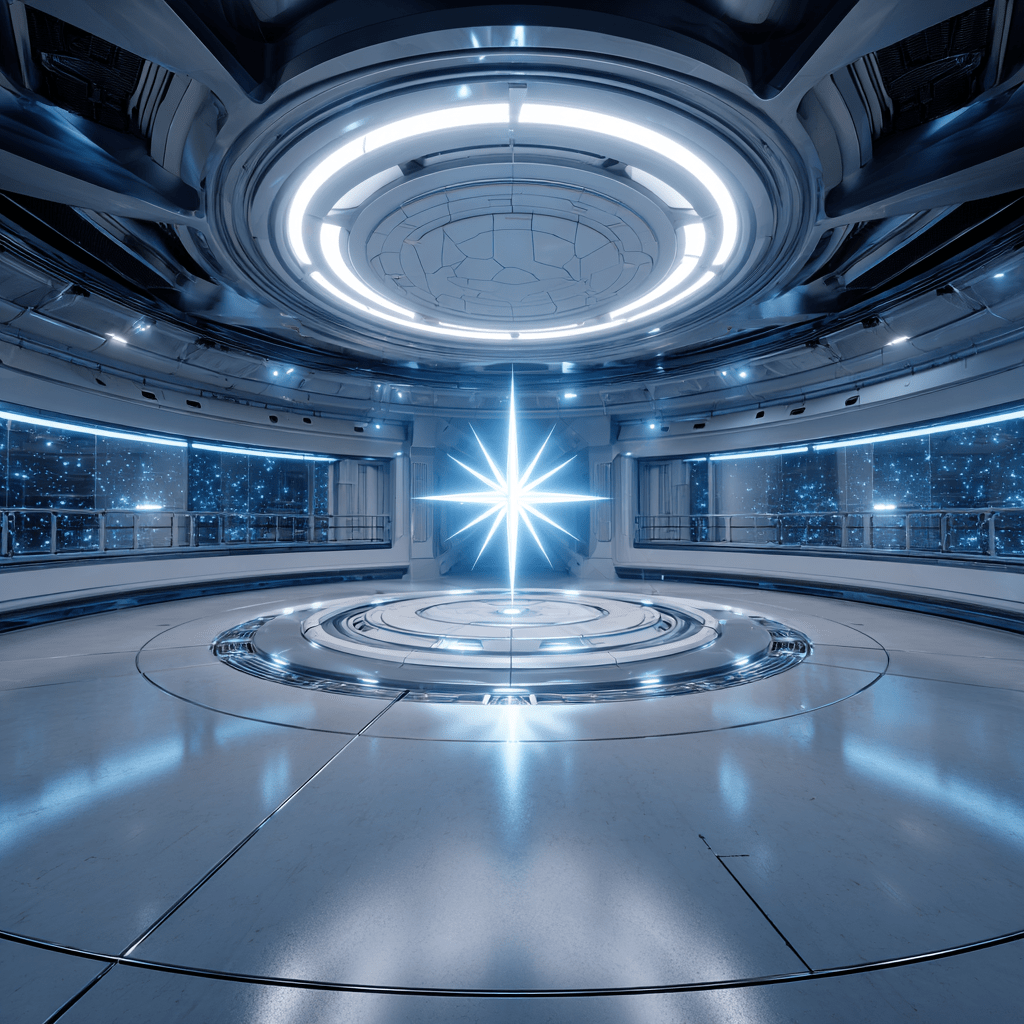
My sim room is a perfect white cube.
No windows. No portholes. No view of actual space, which is ironic considering I’m floating somewhere between the stratosphere and the asteroid belt in my own spacecraft. The walls, floor, and ceiling are seamless and brilliant — not clinical white, not eggshell white, but that specific shade of white you get when all wavelengths of visible light decide to show up to the same party at exactly the same time.
And from inside this white cube, I can see everything.
That’s the sim’s whole deal. Real-time. Hyper-immersive. I can project any location in the observable universe straight into this room and watch events unfold as they happen, like I’m physically standing in the middle of them. The resolution is absurd — every bead of sweat, every fiber of clothing, every micro-expression on every face rendered in detail that would make a graphics card weep. I can feel the simulation’s ambient temperature if I walk toward it. I can smell the ocean if I position myself near the coast.
But I can’t touch anything. Can’t say anything. Can’t move a single molecule that isn’t already in motion.
So close. So incredibly far.
Right now, the sim has loaded the interior of the Peregrine Lightyear.
***
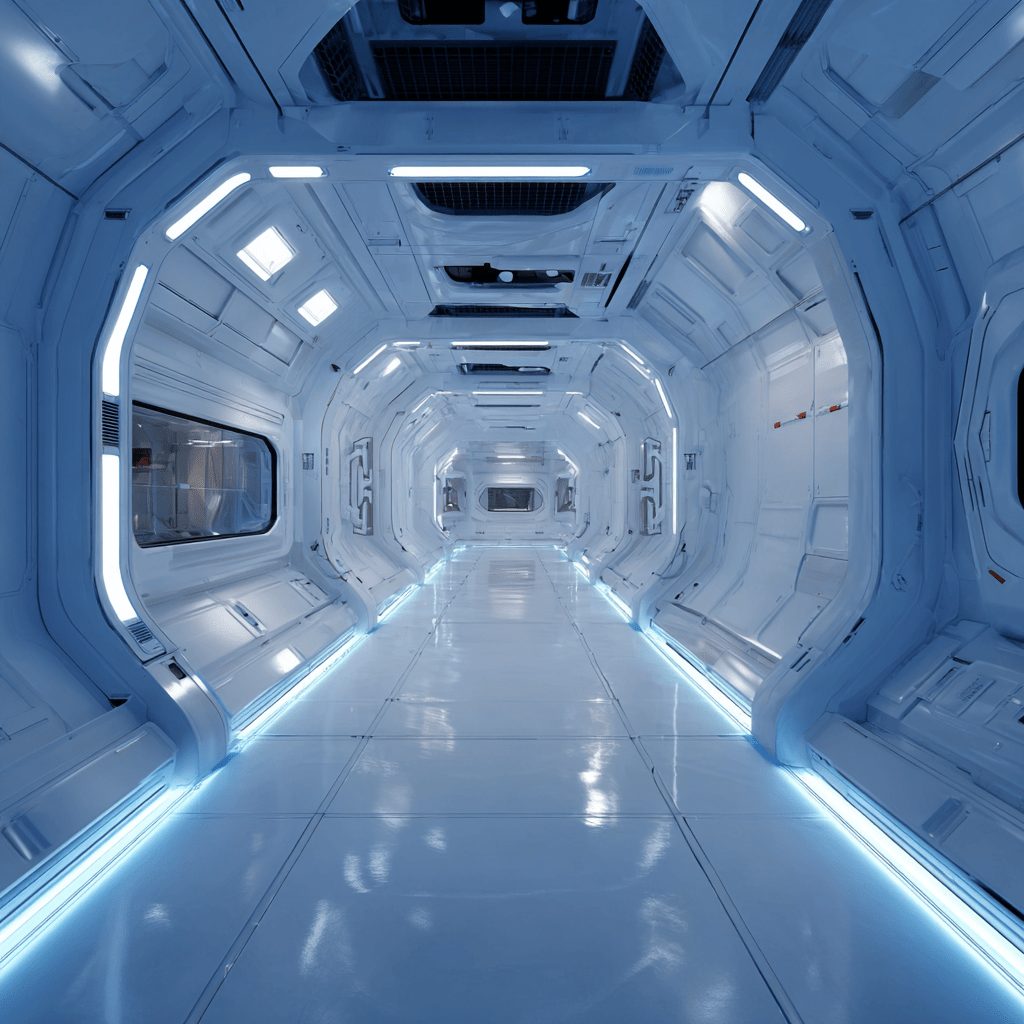
The room I’m observing is the capsule bay, and it looks exactly like what you’d get if you asked an architect to design a Star Trek sickbay, crossed it with a Mass Effect crew quarters, and then asked a robotics engineer to make everything feel slightly intimidating. White titanium walls catch the overhead lighting at precise angles, creating geometric shadows that shift whenever something moves. The floor is polished to a mirror finish. The air recyclers hum at a frequency just below the threshold of human hearing — I know this because the sim picks it up anyway.
On the left wall: three glass capsules, each roughly the size of a wardrobe, mounted flush against the titanium at evenly spaced intervals. Right wall: three more. Each one sealed. Each one containing a sleeping kid.
Between them, standing on the floor with the particular stillness of machines that don’t need to fidget, are ROBO4000 and CleanBot.
ROBO4000 is the tall one. We’re talking two meters of humanoid robotics, white outer chassis with articulated joints that move with mechanical precision — the kind of smooth, deliberate movement you see in expensive prosthetics or high-end animatronics. Its optical sensors are a faint cyan. A visible mouth. The face is a smooth, expressionless faceplate, which somehow makes it look more thoughtful than most people I’ve observed. It stands with its hands clasped behind its back, the posture of someone who has been waiting patiently and intends to keep waiting for exactly as long as necessary.
CleanBot is smaller. Boxy. It’s got a display screen set into what I can only describe as its torso, currently blank, and its limbs end in articulated fingers. It looks like the kind of machine you’d trust to fix a pipe leak, which probably means it was doing something important before all of this.
There’s a platform in the room’s center — raised, circular, about knee-height on an adult. Empty for now. I note this and file it away.
Then the pentagon portal activates.
It appears in the wall to the right of the capsules, edges tracing a sharp five-sided geometry in the air, glowing that familiar cyan-blue that I’ve now watched extract six different kids from six different locations across several locations. But this time something’s different. This time, nobody’s being pulled in.
This time, someone’s walking through.
Topher Kennedy steps out of the portal like he owns the room.
He’s twelve years old and small for it — lean build, clothes slightly rumpled, dark hair that somehow manages to look intentionally messy rather than genuinely disheveled. His green-hazel eyes sweep the room immediately, cataloguing, assessing. He spots the robots before anything else, and his expression does something interesting: it doesn’t register fear, exactly. It’s more like curiosity wearing the mask of caution.
Are those robots? his face says, even though his face doesn’t say anything out loud.
ROBO4000 turns its cyan optical sensors toward the portal. There’s a beat — the kind of pause that machines take when they’re cross-referencing a result against an expected outcome. Then: “They’re all here — complete.” The voice is synthesized, even, completely without inflection, and somehow communicates authority anyway. It addresses CleanBot without looking away from Topher. “You can release the others.”
CleanBot’s articulated arm extends to a lever mounted on the wall. It grips. Pulls down.
Steam hisses from six points simultaneously.
The glass capsules unlock with a pressurized exhale — that thwoom of equalized atmospheric pressure that I associate with lab equipment and sci-fi airlocks. The seals release. The doors swing outward. And one by one, six kids blink into consciousness and step out onto the polished floor.
They look like themselves. That’s the first thing I notice. Despite everything — the portals, the android replacements, the cosmic awakening sequences I watched unfold across different locations — they look like seven kids standing in a room they’ve never been in before, wearing the slightly dazed expression of people who’ve woken up without an alarm.
Michael is the first one fully upright and loudest about it. At fourteen he’s got the build of someone who’s been playing basketball his entire life — stocky, broad through the shoulders, kinetic energy that he stores in his stance even while standing still. His dark eyes snap around the room and land on the robots with immediate suspicion. “What the heck happened to me?!” The exclamation point in his voice is load-bearing structural.
Allison — ten years old, hair in neat waves with bow, wearing the kind of expression that suggests she considers drama to be a primary language — touches the side of her head carefully. “The last thing I remember is running straight into a portal that I couldn’t stop.” She delivers this like a grievance she intends to file formally.
“I got sucked into a portal in the ground.” Sophie is seven, and she says this with a philosophical sigh that sounds more like someone twice her age. Her yellow bumblebee hair clips catch the overhead light. “So, I’m not the only one, huh?”
James — seventeen, effortlessly photogenic even immediately post-teleportation — is already looking at the walls, the ceiling, the floor, conducting a silent architectural appreciation. “Are we seriously on a spaceship?” He sounds like he finds this delightful.
Yes, I think at him. Yes you are. And it gets better.
Benjamin is the one who puts it together first. He’s sixteen, tallish, slightly unimpressed-looking in the way that people who spend most of their time being the smartest one in the room tend to look. His glasses have slid down his nose during the extraction process and he pushes them up, and then his expression shifts into something sharper and more focused as he looks between the capsules, the robots, and his six cousins.
The pieces click. I watch it happen behind his eyes.
“Wait.” Benjamin’s voice drops twenty degrees. “You’re the ones who deployed those android imposters.” He doesn’t phrase it like a question. “And now you’ve put us into deep sleep in those capsules. You kidnapped us and brought us here through those pentagon portals.”
He stares at ROBO4000 and CleanBot with the specific cold glare of someone who is angry and intelligent and has decided those two things work better together than separately.
CleanBot’s display screen flickers. It bows — actually, physically inclines its chassis forward at the waist, which is either a programmed apology gesture or genuine contrition. “We’re very sorry. Please forgive us.”
“There’s no need for apologies, CleanBot.” ROBO4000’s cyan sensors don’t waver. “We did what had to be done.” It turns, and now those sensors are fully directed at Topher, and there’s something in the robot’s posture that shifts almost imperceptibly — the mechanical equivalent of paying attention. “Now, Keeper of the Star of Vis. You came through the portal on your own. Why?”
Six pairs of eyes land on Topher.
He doesn’t flinch. He looks straight at the robot’s faceplate and answers like someone who has been carrying this answer for a long time and is relieved to finally hand it to someone. “Because I believe my destiny is on the other side of the portal.”
The room sits with that for a second. James raises one eyebrow. Michael just stares. Allison tilts her head.
Kid, I think, with something that isn’t quite pride but sits right next to it. You have no idea how right you are.
“Very well, Keeper.” ROBO4000 extends one arm toward the platform in the center of the room. “Bring forth the Star and place it on the central platform. You’ll be one step closer to your destiny.”
Topher walks to the platform with the careful deliberateness of someone navigating a scene they’ve dreamed about but never actually rehearsed. His right hand opens, and the Star of Vis rises from his palm — first as a compass-like astrolabe, silver and intricately detailed, spinning slowly in the air above his hand. Then the transformation kicks in.
It expands. The astrolabe’s arms extend, its rings widen, and then the whole structure blooms — collapsing inward into a single massive star shape, blue-white and sparkling, pulsing with light that isn’t quite warm and isn’t quite cold but exists somewhere in between. It floats above the platform, about chest-height on Topher, humming at a frequency I can actually feel through the sim even though I know that’s technically impossible.
Topher takes an instinctive step back.
And then Michael, because Michael has never once in his entire fourteen years of life waited to see what a glowing cosmic artifact does before jumping at it, leaps directly into the Star’s light.
His body hits the radius of the glow and something immediately, visibly ignites in him. His eyes blaze scarlet — not a glow exactly, more like embers catching, spreading outward from the iris in waves of red-orange. His skin follows, luminous and bright, the scarlet bleeding through his clothing, making him look like a human flare. He looks down at his hands.
“Whoa!” The grin breaks across his face like a sunrise. “What just happened?! I’m glowing red!”
Yeah, I confirm silently. You are.
Allison watches this, turns the information over once, and reaches a decision. She flips her hair. I genuinely don’t know where the hair flip comes from given the circumstances, but it happens — a crisp, confident toss over one shoulder, the kind of gesture that carries twelve inches of attitude per centimeter. Then she steps forward.
Pink light takes her. Soft and vivid at the same time, the shade you see in neon signs and cherry blossoms and the inside of a kaleidoscope when the light hits just right. Her eyes match it, luminous and wide.
“Pink is my favorite color.” She reaches up and presses both hands to her chest, rolls her eyes, and lets out a small dramatic exhale. “So, me — pretty and girly.”
Sophie goes next, quietly, following the group’s momentum rather than her own impulse. She steps forward with her chin tucked slightly, watching the light come up around her feet and rise. Yellow — soft and clear and golden, like late afternoon light through honeycomb. Her eyes catch it last.
Yellow, like a honeybee. I see the thought cross her face even though she doesn’t say it out loud.
James steps in with a small cheerful hop that is aggressively on-brand. Orange flares around him, vivid and warm, the color of citrus and concert lighting and the sky at six PM in October. “Orange is nice — fun and zesty!” he declares, apparently reviewing his own transformation like he’s sampling something at a food court.
Roanne hesitates. She’s eighteen and the oldest here, and she carries that fact in her posture — a slight stillness that the others don’t have yet, the weight of someone who thinks before moving rather than after. Her dark eyes study the glowing star, run the math, reach a conclusion.
I’m dying to know what happens next, her expression says. She steps forward.
Seafoam green surrounds her — that specific blue-green that lives at the edge of shallow water in the tropics, where the color can’t quite decide if it belongs to the sky or the sea. Roanne looks at her glowing hands and arms and something settles in her face. Recognition, maybe. Or something closer to finally.
Benjamin is last. He’s been watching the whole sequence with his arms crossed, cataloguing every transformation, building a theory. He scoffs at the robots once more on principle, then steps in anyway, because curiosity is the one force stronger than his skepticism.
Cyan. Clean and electric behind his glasses, the color of fiber optic cables and deep-sea bioluminescence and the glow you see from a console screen in a dark room.
Then Topher.
He approaches the Star last, and he does it differently from the others — no leap like Michael, no hair flip like Allison, no hop like James. He walks the way someone walks toward something they’ve been moving toward their whole life without knowing it. Slowly. Deliberately. Like each step is a word in a sentence he’s been trying to say for three years.
He stops at the edge of the light.
His green-hazel eyes close for exactly one second. Then open.
He steps forward.
White rises around him — not the blinding clinical white of the sim room walls, but something warmer. Ivory. The white of candlelight and old parchment and first morning light coming through a window. It wraps him from the feet up, fills his eyes, settles over him like it was waiting there all along, specifically shaped to fit him.
Of course it’s ivory, I think. Of course it is.
Now all seven stand inside the Star’s light.
I watch from the white cube — the sim rendering every detail in impossible clarity, close enough that I could count the individual sparks in the blue-white waves washing over them. Every face visible. Every expression readable.
And I feel it — that specific thing I feel every time the sim shows me something that matters.
So close.
The waves intensify. The light expands. Blue-white sparks envelop all seven kids until the room goes bright and I can’t see their faces anymore.
Just light.
Just the beginning of something I can only watch.
So far.
Costume_reveal_sequence_unlocked.sav
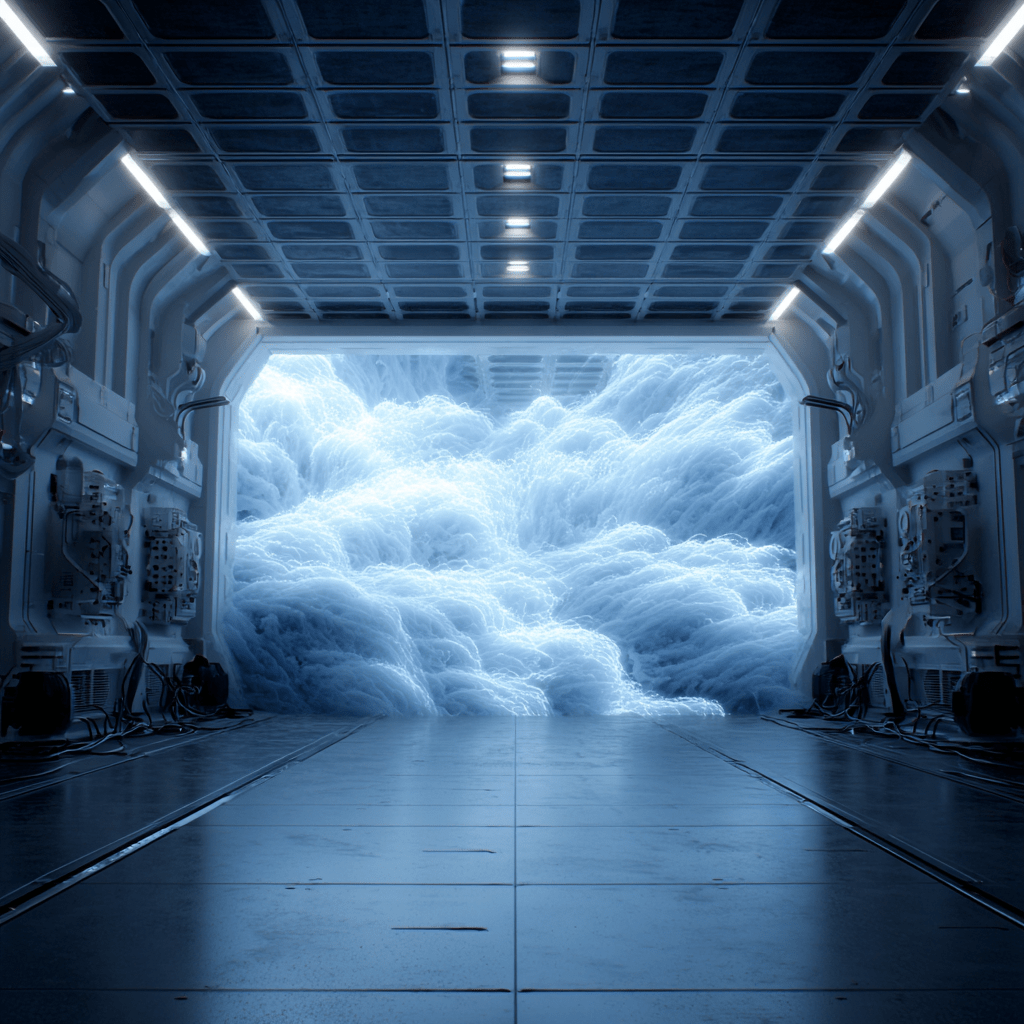
The blue-white light doesn’t fade so much as exhale — one long, slow dissipation, like the universe taking a breath after holding it too long. The sparkling waves pull back from the edges inward, thinning, dimming, until the capsule bay’s titanium walls come back into focus and I can see them again.
Seven kids. Completely different. Completely themselves.
My eyes go to Michael first because Michael is impossible to miss.
He looks like someone reached into a comic book longbox, pulled out the most aggressively designed superhero splash page they could find, and just materialized it in three dimensions. I’m talking full costume. Full transformation. The kind of design that would cost a Hollywood production budget to recreate and somehow just happened in the middle of a spaceship capsule bay in the Philippines.
The partial helmet is the first thing that registers — maroon and structured, covering the back of his skull and sweeping down along the sides of his face to his jawline, framing it like a visor that couldn’t be bothered to close all the way. His dark eyes are unobstructed, which is good, because the expression in them right now is pure fourteen-year-old discovering he has superpowers — wide, lit up, processing approximately forty emotions per second.
His forearms are crossed defensively against the last of the fading light, and those forearms are something else entirely. Large bracers — I’m mentally filing these as vambraces because the fantasy-RPG terminology fits — cover nearly the full length of each arm, thick and sturdy, designed for both protection and impact. The sleeveless spandex suit underneath them is doing a lot of work. The torso section is where the design really commits: sculpted maroon acrylic panels shaped to mimic pectoral muscles and abdominal definition, the kind of armor aesthetic that says I don’t just fight, I look incredible while doing it. The back matches — maroon, structured — while the sides of his upper garment run a bold, saturated red.
At his waist: a golden belt. Not the simple kind. This one is decorated — laurel leaves worked into the metal in careful detail, and centered by a medallion cast in the shape of a lion’s face. The whole thing radiates the specific energy of ancient Greek athletics meeting modern superhero costuming, which honestly tracks given everything I know about how this story works.
Below the belt: red spandex, uniform and clean, leading down to high boots in the same shade — shiny, structured, the kind of footwear that communicates I run toward danger without needing to say a word.
I sit with this for a second.
Michael Pangilinan, age fourteen, basketball MVP, certified hothead, now looks like he got drafted directly from the Marvel Cinematic Universe via a DC Comics detour. The silhouette alone is unmistakable — the helmet framing, the bracers, the sculpted torso, the color blocking in maroon and red. If he walked into any comic convention on Earth right now, people would stop him for photos before he made it ten feet from the entrance.
Superhero, I confirm internally. Complete. Operational. Slightly overwhelmed but hiding it well.
Then I look at Allison.
And I need a moment.
Because Allison Sevilla, age ten, has fully, completely, without any apparent hesitation become a magical girl, and the execution is so precise and detailed and unambiguously on-purpose that I feel like the Star of Vis had her costume pre-loaded and was just waiting for the right moment to run the program.
Her hair is the first thing — long, loose waves of blonde that catch the capsule bay’s overhead light and scatter it like something precious. A delicate hairband sits atop her head, slim and elegant, functioning simultaneously as an accessory and a miniature tiara, the kind of dual-purpose design choice that magical girl franchises have been perfecting since the nineties. At the back of her hair, positioned with an accuracy that suggests intentional placement rather than random transformation: a large pinkish-red bow. Not small. Not subtle. Large — the kind of bow that has its own presence in a room, that communicates aesthetic priorities clearly and without apology.
Her makeup is light. Soft. A ten-year-old’s version of dressed up — enough to be noticeable, calibrated not to overwhelm. Rose-shaped earrings at her ears, small and detailed.
The outfit itself is a masterclass in the magical girl visual language. White upper garment as the base — clean, structured — with the sides running baby pink, the two zones separated by vertical rows of ruffles that add texture and movement simultaneously. Centered on her chest: a ribbon in pink-red with a heart-shaped compact at its center, the compact catching light with the particular gleam of something that is definitely, absolutely, not just decorative.
Below the ribbon: two large embossed buttons in pink-red, oversized and deliberate. The miniskirt runs two layers — pink over baby pink, the underlayer peeking out just enough to matter. At the back, another bow, even larger than the one in her hair, anchoring the whole ensemble with a punctuation mark that the outfit clearly felt was necessary.
Her gloves are baby pink and long — covering her forearms entirely, finishing at the top with ruffles and tiny ribbon accents. Her right hand holds a heart-shaped wand, the handle slim, the heart at its tip glowing faintly with residual pink light.
The boots reach her knees. Pinkish-red. Four-inch heels.
Four-inch heels, I note. On a ten-year-old. In a magical girl transformation sequence.
I mean — PreCure has been doing this for decades. The heels come with the genre. It’s basically a contractual obligation at this point.
Allison looks down at herself. Runs one gloved hand along the ruffles on her sleeve. Touches the bow in her hair. Then the compact on her chest.
Her expression moves through surprise, then recognition, then something that settles into deep, satisfied certainty — the expression of someone who has watched enough episodes of their favorite show to know exactly what this moment means and has been waiting, consciously or not, for it to arrive.
She looks like she stepped directly out of the franchise she loves most.
She looks exactly like herself.
ROBO4000 and CleanBot observe from the periphery, silent, watching the light finish its work on the remaining five.
Two down, I think. Five to go.
Costume_reveal_sequence_characters_loading.sav

Sophie is hovering.
Not standing. Not crouching. Not doing anything that involves contact with the floor. She is suspended approximately thirty centimeters above the polished titanium, held aloft by a pair of honeybee wings on her back that are moving so fast they’ve blurred into a single vibrating smear of translucent beige. The sound they produce is a constant, low buzz — the kind that sits just below the threshold of annoying and lands squarely in the territory of completely surreal.
She is seven years old and she is flying, and she looks entirely unbothered by this fact.
I study her from the sim and feel something I can only describe as delighted disbelief.
The antennae are the first detail that fully registers — two of them, rising from the top of her head with the casual confidence of accessories that absolutely belong there. Her hair is styled in twisty pigtails, light brown, reaching just to her shoulders, and perched above them are goggles pushed up to rest like a second pair of eyes, the lenses tinted black, doubling as shades. Honey jar earrings hang from her ears — small, detailed, unmistakably shaped like the actual jars. At her neck, a choker with a single bee charm, snug and deliberate.
The jacket is the centerpiece. Yellow varsity, sleeveless, midriff, customized — the kind of piece that looks like someone spent serious time on the design brief. A bold, stylized capital B is embroidered on the right chest, clean and oversized and completely committed to the bit. Beneath it, a tube top in yellow and black stripes, the color blocking sharp and graphic. Her hands wear fingerless gloves, leaving the tips of her small fingers exposed.
The belt at her waist is thick — structural, not decorative — with another capital B enclosed in a circle at its center buckle. Yellow fitted cycling shorts below that, and yellow-and-black running shoes with laces tied in neat, symmetrical bows. The overall silhouette is sporty in a way that reads as genuinely functional rather than purely aesthetic, which makes sense if you think about it. Wings require aerodynamic clearance. You don’t wear a ballgown when you’re built for speed.
The entire look runs a strict yellow-and-black color scheme, accents in black, base in yellow, the palette of the natural world’s most famously industrious insect.
Honey Pollen, I recall. That was the character she picked from the board game. Three years ago in that cave, a four-year-old Sophie Pangilinan chose a cartoon honeybee character from an enchanted board game’s roster, probably because she was cute and yellow and appealed to the specific logic of a four-year-old encountering a cosmic artifact for the first time.
Now she’s actually her.
There’s a campiness to it that I appreciate — the kind of cheerful, unapologetic visual language that Saturday morning cartoons operate in. The bee girl look doesn’t take itself too seriously. It’s bright. It’s playful. It’s the exact aesthetic that makes seven-year-olds absolutely lose their minds in the best possible way. Sophie hovers in place, looks down at her wings with an expression of pure scientific fascination — head tilted, brow slightly furrowed, like she’s running calculations on her own existence — and then very carefully extends one arm and watches the fingerless glove catch the light.
I could watch this kid figure out her powers all day, I think. Genuinely.
Then James moves into my sightline and I have to recalibrate entirely.
The hair hits first. It’s spiky — intentionally, architecturally spiky, each point deliberate rather than accidental — and bleached platinum blonde with a yellow tint running through it that catches the capsule bay’s overhead lighting and turns it into something closer to gold. It’s the kind of hair that communicates creative decisions were made and then fully committed to.
The glasses are magenta. Visor-style. Customized. They bridge in front of a pair of over-the-ear headphones in a single integrated design that eliminates the need for a headband — everything connected, everything intentional. Each headphone bears a stylized wing on its outer face, the right one extending into a mic that curves toward James’ jaw in a clean white arc. The whole headset is white, polished, the kind of equipment that looks as good as it probably sounds.
His jacket is white. Upright collar, no hood, zipper running up the front but only closed to the midriff — leaving a deliberate gap that reveals the orange shirt underneath. That shirt has something printed on it: the outline of a sun, eight rays extending outward from the center in clean geometric triangles. Simple. Iconic. The kind of graphic design that photographs extremely well.
The jacket’s sleeves are long but folded and tucked up to his forearms, which are covered by apple green fingerless gloves — a color choice that shouldn’t work with the white and orange and platinum blonde but somehow absolutely does, the way certain K-pop outfit decisions survive scrutiny only because the confidence of execution carries them past logic.
Strapped across his back: an electric guitar. Butterscotch wood, polished to a warm glow, the grain visible even across the sim’s rendering distance. It rides high on his back, the neck angling up over his right shoulder, positioned like it belongs there — like removing it would make the whole silhouette wrong.
The pants are white, matching the jacket, but the right leg shifts at roughly the two-thirds point into gray, and that gray section is decorated with cyan webbing in a pattern that abstractly suggests a city skyline — skyscrapers rendered in negative space, geometric and deliberate. It’s the kind of detail that rewards a second look.
On his feet: yellow sneakers, shiny, a rich saturated yellow that echoes his hair tint and pulls the whole color story together.
I stand in my white cube and just look at this for a second.
James Pangilinan, seventeen years old, leader and lead singer of Kaleidoscope, is standing in the capsule bay of a spaceship wearing an outfit that would read as eccentric genius in literally any context on Earth and somehow reads as inevitable in this one. The guitar. The headset. The platinum hair. The layered white and orange and green and yellow. The city-grid pants. Every single element pulled from a different direction and landing in the same place at the same time.
K-pop idol, my brain files it, and the label fits so precisely it’s almost uncomfortable. This is the energy that earns someone the nickname Oppa from every fangirl within a twenty-meter radius, the kind of visual presence that makes people reach for their phones before they’ve consciously decided to take a photo. His own school’s fangirl population had apparently clocked the resemblance to Korean idols long before tonight, which means the Star of Vis either has a very good sense of humor or a very accurate data set.
Probably both.
James raises both arms and looks at the apple green gloves on his hands with the expression of someone encountering the best surprise of their life so far. His grin is wide and uncomplicated and completely genuine — the grin of someone who is seventeen and standing on a spaceship in a K-pop idol transformation outfit with a butterscotch guitar on his back and somehow this is just his life now.
Fun and zesty, he’d said when the orange light hit him.
I think he was right.
ROBO4000 continues to observe from the periphery. CleanBot’s display screen is blank. The remaining three kids — Roanne, Benjamin, Topher — are still resolving out of the fading light.
Four transformations down, I note. Three to go.
The sim holds the frame.
Costume_reveal_sequence_complete_party_assembled.sav
The light finishes its work on Roanne then.
She doesn’t emerge from the fading glow so much as materialize out of it — the way dawn reveals a landscape that was always there, just waiting for enough light to make it legible. And when the sim renders her fully, I genuinely stop moving for a second.
Her hair is true red. Not auburn, not copper, not the warm reddish-brown that people sometimes call red when they’re being generous. I mean red — the saturated, committed, primary-color red that exists in paintings and fire and very decisive life choices. It falls long and straight down her back, and anchored in it, toward the rear, is a hair accessory unlike anything I’ve seen in any character design reference I can recall: two small gray fish, connected at their mouths by clasped crab claws, holding the hair in place with the logic of something that was designed by the sea itself.
Pearl earrings at her ears. At her neck, a lavender seashell necklace resting just above her collarbone — the kind of piece that looks simultaneously ancient and deliberate, like it was pulled from the ocean floor and set in silver by someone who understood exactly what they were doing.
The gown is the main event.
Long seafoam green balloon sleeves — full, structured, the kind of sleeves that have volume as a design intention rather than an accident — frame her arms and gather at the wrists. The torso, a corset, is lavender, patterned with water lilies rendered in careful detail, the flowers distributed across the fabric with the specific spacing of something that was planned rather than printed. Below that, the skirt opens into full seafoam green, flowing to the floor in soft continuous motion, the fabric catching the capsule bay’s overhead light and scattering it gently.
In her right hand: a scepter.
I lean forward in the sim instinctively — purely reflexive, since leaning doesn’t actually change what I see — because the scepter is something. The top is a moon-shaped sphere, and surrounding it in a bell-shaped cascade is what appears to be actual flowing water, somehow suspended in the design without dispersing. Below the moon, the base is formed by two fish, their bodies curving in toward each other. The rod descends from there, thick and ornate, decorated with round seafoam bubbles aligned vertically down its length at even intervals.
The entire aesthetic lands somewhere in the eighteenth century — the Golden Age of Piracy in the Caribbean, specifically, that era of maritime sovereignty and dramatic silhouettes and people who took their personal presentation extremely seriously despite spending most of their time on boats. Roanne holds the scepter with both the ease and the weight of someone who doesn’t yet know what it can do but already understands it’s hers.
Eighteen years old. Mermaid princess. The most composed person in this room by a significant margin.
Princess Ruana, I confirm internally, filing the designation permanently.
Benjamin resolves next, and the contrast is immediate and total.
Where Roanne’s transformation is organic — water and pastels and creatures of the natural world — Benjamin’s is engineering. Pure, deliberate, expensive-looking engineering.
The helmet is sleek and blue-and-gray with a clear face shield that gives him full visibility, his eyes sharp and cyan-lit behind it, glasses presumably integrated or replaced by the suit’s internal systems. His expression through the shield is the same one he wore stepping out of the capsule — assessing, cataloguing, already building a theory about what’s happening to him and whether it checks out.
The gauntlets are where the design gets interesting. His left gauntlet is a small command center on its own — buttons arranged in a grid along the upper surface, a small circular screen embedded near the wrist that currently displays a soft cyan readout, discreet slots along the sides that suggest additional functionality not yet deployed. The right is cleaner, less cluttered, built more for impact than interface.
The full-body armor is cobalt blue and gray titanium — the cobalt coating applied over gray titanium plates that look lightweight in a way that suggests the weight is deceptive, that something about the material density is doing things that conventional physics would find presumptuous. A thick metallic belt bisects the armor at the waist, the line between upper and lower halves clean and structural. The footwear integrates seamlessly into the greaves, no visible seam, the whole suit reading as a single designed object rather than assembled components.
He looks like a space captain. Specifically, he looks like the kind of space captain that fifteen-year-old me would have drawn in the margins of a notebook during a particularly slow class — the one with the good armor and the command gauntlet and the expression that says I have a plan and it’s probably going to work.
Benjamin raises his left gauntlet and studies the small screen on it with the focused intensity of someone who has just been handed a piece of technology they intend to fully understand by the end of the day.
Sixteen years old, I note. Space captain. Completely in his element despite the fact that his element just changed dramatically.
And then Topher steps clear of the light, and the capsule bay goes quiet in a way that has nothing to do with sound.
He’s twelve. I keep having to remind myself of this. Twelve years old, slight build, the youngest of the boys — and standing there in full plate armor that should swallow him completely but somehow doesn’t, because the armor fits him the way destiny fits a protagonist: like it was always going to.
The helmet is silver, winged accents rising from either side, the wings edged and laced in gold. The face is open — no visor, no shield — leaving his green-hazel eyes fully visible, which I think is intentional. There’s a version of this design that closes over the face and becomes anonymous. This one doesn’t. This one wants you to see exactly who’s wearing it.
Gold pauldrons at his shoulders, winged, matching the helmet. The breastplate below them is silver worked through with gold detailing — intricate, not decorative for decoration’s sake but the kind of craftsmanship that communicates this matters, this was made to last. His torso beneath the plate wears ivory and cream and pure white in layered fabric, the three shades distinct but harmonious, the combined effect warm rather than stark.
Silver vambraces laced with gold on his forearms. Matching gauntlets on his hands. Chain mail wrapping his biceps, the individual rings catching light in shifting patterns when he moves. At his waist, silver faulds and tasses trimmed in gold hang beside his thighs, and between his legs a long white loincloth drapes to the floor in a clean vertical line. His legs carry the same chain mail at the thighs, greaves of silver and gold below, sabatons at his feet completing the full armored silhouette.
And the cape. White. Large. Flowing from his shoulders to the floor in a single uninterrupted sweep, moving with its own slow momentum, the kind of cape that exists in exactly one context: the moment before something important happens.
At his side, strapped at the hip: a holy sword. Hilt above. Sheath below. He hasn’t drawn it. He doesn’t need to yet.
Paladin, some part of me registers, reaching for every RPG class description I’ve ever read. Holy knight. Sworn to the light. Vanquisher of darkness.
Topher stands in the center of the capsule bay and looks at his gauntleted hands, and then at the cape, and then at the sword, and his face does something quiet and certain — not surprise, not excitement exactly. Something closer to recognition. Like he’s remembering something he forgot on purpose and is only now allowing himself to know again.
I look at all seven of them standing together in the titanium capsule bay of the Peregrine Lightyear.
A superhero. A magical girl. A cartoon character. A K-pop idol. A mermaid princess. A space captain. A paladin.
No studio greenlit this. No writers’ room pitched it. No franchise bible contains all seven of them in the same room at the same time. And yet here they are — the most improbable crossover in the history of crossovers, standing on a spaceship, lit by overhead fluorescents, wearing the full weight of their destinies like they’ve been doing it their whole lives.
Achievement unlocked, I think, in the silence of my white cube.
Party assembled.
 B. K. P. Carreon
Leave a comment