Overview:
| McKinley, the new commander of Peregrine Lightyear, begins to second-guess his decision to keep his siblings and cousins hidden from the world. Princess Ruana reassures him that it is a necessary choice for their safety. Inside the Peregrine—both spaceship and headquarters—Michael, Sophie, Allison, James, and Topher endure their seclusion through simple daily activities meant to keep them grounded. Their routine is disrupted when recurring electromagnetic disturbances are detected on a remote island. McKinley and Ruana depart to investigate, leaving the team under the supervision of ROBO4000 and CleanBot. While the others rest, Michael attempts to steal Topher’s dormant magical pendant, but fails and quietly retreats into the hallway. Under McKinley’s orders, the two robots begin overseeing the team’s training, monitoring them closely from the command center. During a quiet moment, CleanBot learns of ROBO4000’s unusual dream—to return to the Victorian era as a steampunk mech. Unbeknownst to them, Michael listens in from the corridor, hidden behind the wall. Later, in the cafeteria, Michael persuades the others that they should step into the public eye—fighting crime and responding to disasters as true heroes. Taking things further, he adopts his alter ego, Spartan, and attempts to bribe ROBO4000 with a tank of crude oil, promising the robot a way to synthesize an endless supply and fulfill his Victorian ambition. Meanwhile, Topher makes a second wish to the Star of Vis, granting each of his cousins their own transformation trinkets—choosing not to remain the sole gatekeeper of their powers. |
The_weight_of_the_watch.sav
Two months into their new reality, and the Peregrine Lightyear’s command center has upgraded from “spaceship bridge” to something that actually looks like it belongs in a sci-fi blockbuster.
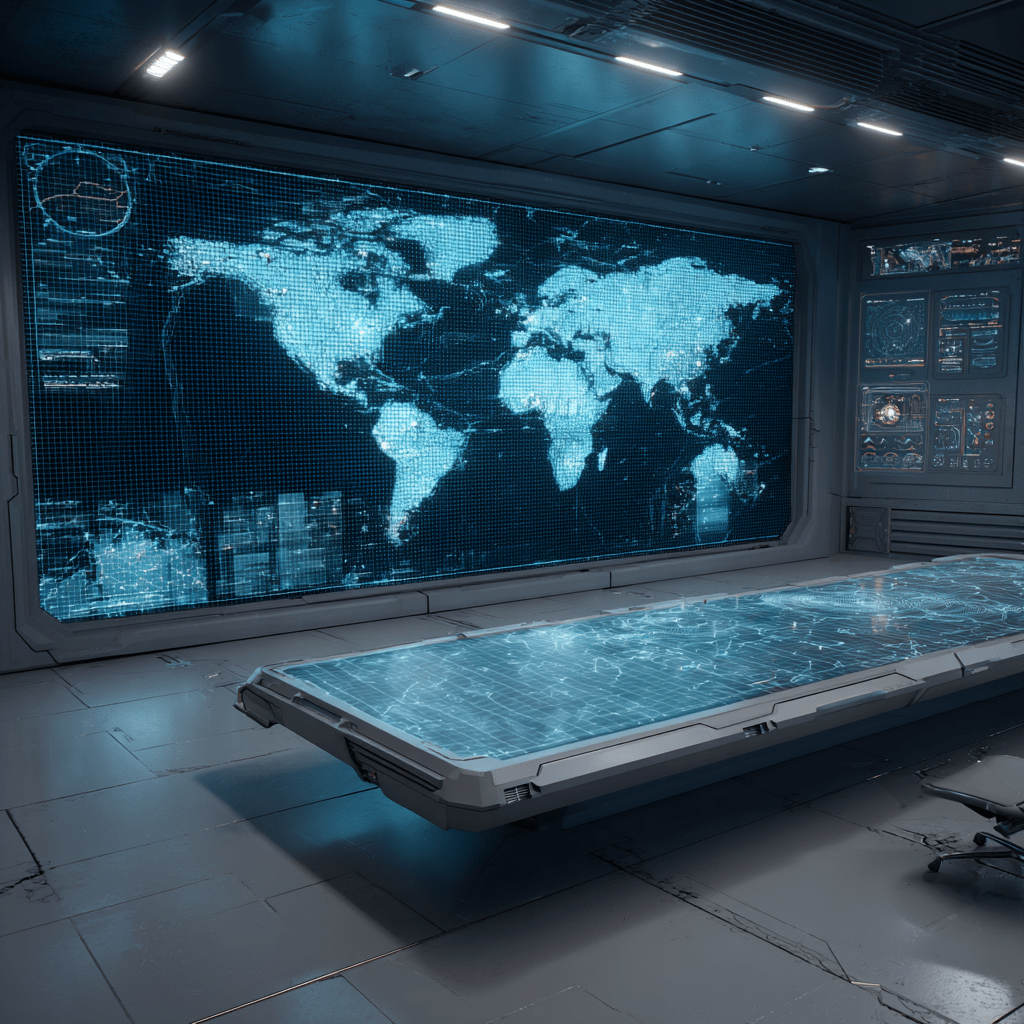
The large screen dominates the far wall — a sprawling tactical display crowded with coordinates, blinking waypoints, and orbital drift calculations that would make any astronomy teacher weep with joy. The console below it is the kind of setup that gaming peripheral companies dream about: rows of buttons, levers, and controls arranged with the precise logic of someone who read every starship operations manual ever written and then memorized them.
Benjamin sits at its center.
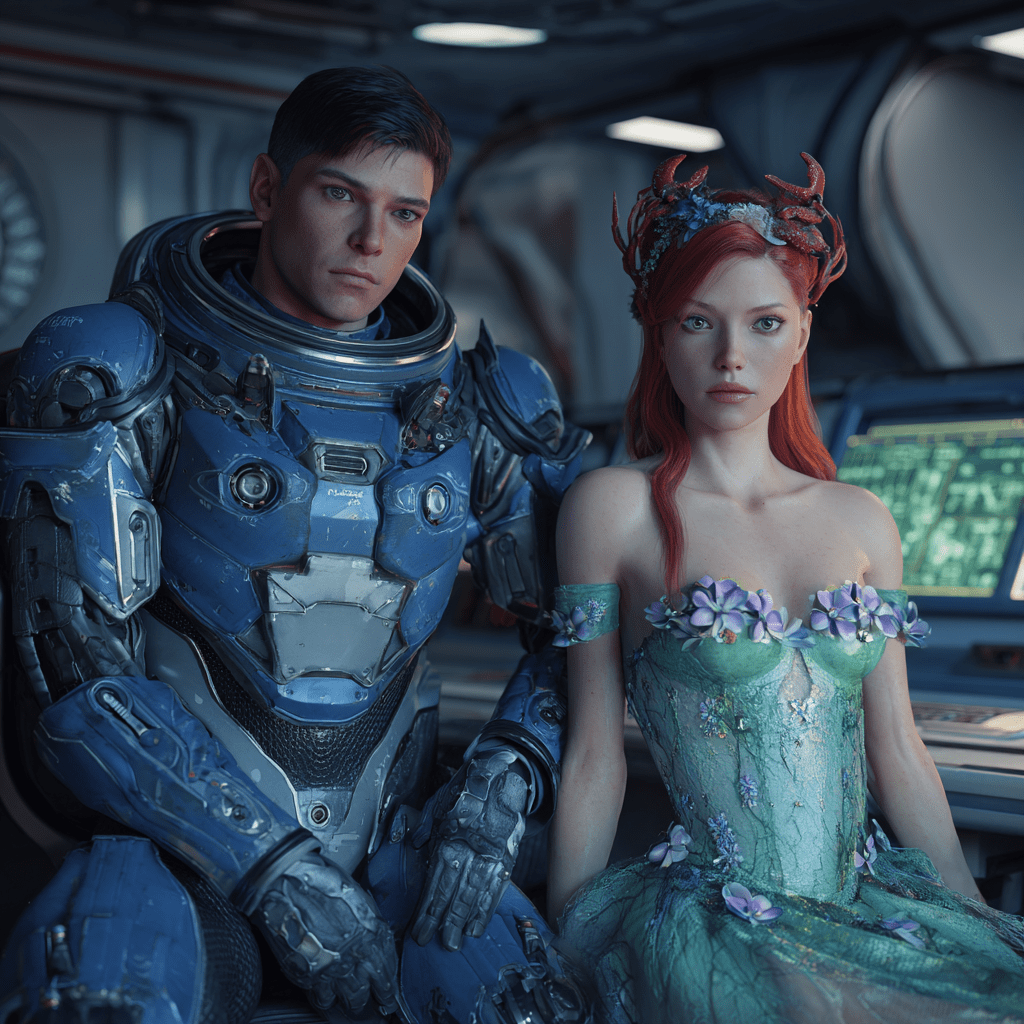
Except it’s not Benjamin anymore — not exactly. The cobalt-blue space armor fits him differently than it did on the board game token two months ago. It sits on his shoulders with actual weight, actual purpose. The visor of his helmet rests flipped up, and his face beneath it carries something his thirteen-year-old self never quite managed: the particular exhaustion of someone who’s been making real decisions.
Captain McKinley stares at the coordinate map like it owes him an answer.
He doesn’t notice when the door slides open behind him.
Roanne now Princess Ruana moves like water — that’s the only honest way to describe it. Her mermaid princess outfit catches the ambient light of the command center in shifting blues and seafoam greens, the layered fabric trailing slightly with each step. Her red hair is pinned back with a twin fish clasp, practical and elegant at once. She stops a few feet behind him, reads the room, and decides not to announce herself immediately.
Smart. She’s always been the one who watches before she speaks.
“What’s on your mind?” she finally asks, her voice low and even. “You can tell me.”
Benjamin — McKinley — doesn’t startle. He lets the question settle like a stone dropped in still water, watching the ripples before he responds.
“I’ve been wondering,” he says, “whether I made the right decisions. These past two months — keeping them here. Secluding my siblings and cousins from the outside world.”
He exhales slowly through his nose.
“The world can be cruel to anything it doesn’t understand. Anything different. I’m worried that if we’re discovered — ” He pauses, jaw tightening. “Experiments. Relentless ones. That’s what waits for people like us out there.”
It’s a very Benjamin thing to say. Clinical framing around something that’s clearly eating at him.
“But sometimes…” His voice drops lower, meant more for the coordinate map than for Ruana. “I feel guilty. Keeping them away from our families. Our parents. Even though it’s for their safety.”
There it is. The actual problem. Not the strategy — the weight of the strategy.
Ruana steps closer. She doesn’t touch his shoulder or do anything dramatic. She just closes the distance and lets her presence speak first.
“You did what you had to do,” she says quietly. “Sometimes tough choices are necessary for the people we care about.”
Benjamin stares at the screen for another three seconds. Then he nods once — small, precise, like entering a confirmed command.
He doesn’t say thank you. He doesn’t need to.
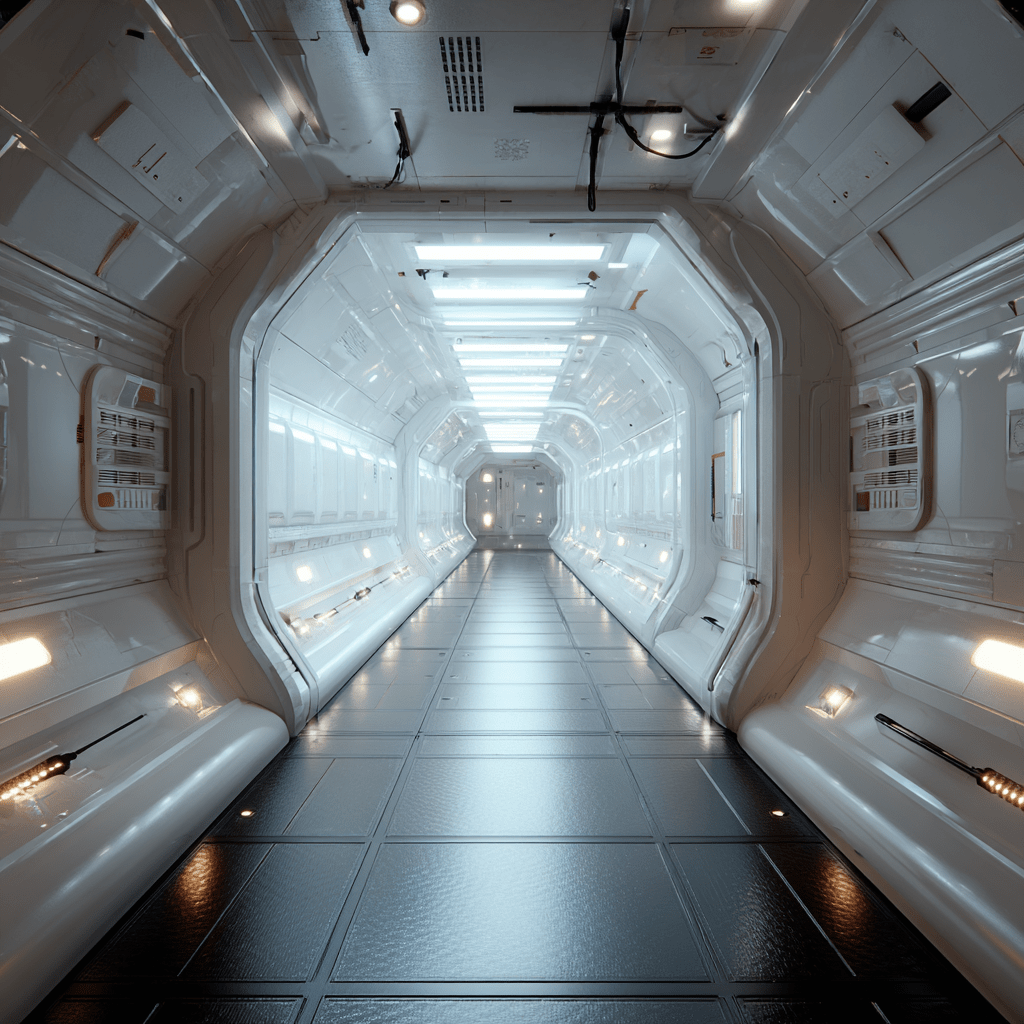
Outside the viewport, the stars hold their positions. Patient. Constant. Indifferent to the weight two teenagers just quietly shared inside a cobalt-and-titanium command room orbiting everything they’ve ever known.
Log entry: McKinley, 0200 hours. Still carrying it.
Good.
Gray_orbit.sav
Two months in, and the Peregrine Lightyear has developed its own ecosystem.
That’s the only way to describe it — an enclosed world running on routine and titanium walls, where seven kids have carved out personal territories inside a ship that was clearly designed by engineers who understood square footage but maybe underestimated the emotional requirements of teenagers on indefinite lockdown.
I pull up each feed in sequence. Force of habit.
Michael hits the gym first thing, every morning, without fail. The guy’s got the discipline of someone who genuinely enjoys being exhausted — push-ups, sit-ups, treadmill cranked to a gradient that would make most people reconsider their life choices. His gray shirt is already soaked through at the collar. His jaw is set in that particular way that means he’s not working out, he’s competing — against the machine, against boredom, against the walls that don’t move no matter how hard he pushes. He doesn’t stop until his arms give.
Achievement grinding: Manual mode.
Allison’s at her dresser — a personalized setup that somehow materialized aboard a spaceship, complete with the bulb-lit mirror she clearly negotiated hard for. She applies light makeup with the focused precision of someone running a pre-show checklist: concealer, soft blush, a careful sweep of mascara. Her black hair falls in its signature loose waves, the bow accessory clipped perfectly above her left ear. She examines her reflection with those sharp eyes, tilting her chin three degrees left, then right. Satisfied.
Ten years old and already has better skincare discipline than most adults I’ve observed through this sim.
Sophie doesn’t look up from her sketchbook. The art room around her is genuinely impressive — stocked shelves of pencils, watercolors, canvas boards in three sizes — and she’s treating every square inch of it like it’s a gift she intends to earn. Her small hand moves across the paper in confident strokes, tongue pressed lightly against her lower lip the way it always does when she’s deep inside something only she can see. Whatever she’s drawing, it’s consuming her completely.
Creative process: Active. Do not disturb.
James sits alone in his room — and that’s the one feed I watch with something in my chest that I don’t have a clean label for. The space is small and boxy, his guitar leaning against the wall behind him, and he’s got a chatbot open on the screen in front of him. The avatar’s face animates as they talk, cycling through expressions with almost-convincing warmth. James leans forward, elbows on his knees, actually engaged.
It’s the “actually” that gets me. He knows it’s a program. He’s talking to it anyway.
Player 4 is managing.
Topher’s in the simulation room again — third time this week by my count — running what looks like a coastal Philippine town rendered in VR. He walks through the streets slowly, hands brushing market stalls that aren’t there, looking at faces that are just polygons with borrowed memories.
He’s not exploring. He’s visiting.
The five of them cycle through their days in matching gray shirts and sweatpants — the Peregrine’s unofficial civilian uniform — each orbiting their own private world while sharing the same cold, humming hallways.
No outside contact. No exceptions.
Status: Contained.
Cost: Unquantifiable.
Into_the_anomaly.sav
The command center never fully sleeps.
Even at whatever hour this is — the Peregrine Lightyear doesn’t do windows, so time aboard operates on a purely internal logic — the large screen pulses with live data, coordinates shifting in slow crawl across the tactical display like a game map updating in real-time. The ambient hum of the ship’s systems fills the silence between conversations with something that almost sounds like breathing.
ROBO4000 stands beside McKinley’s console with the composed stillness of a unit that does not experience impatience. The robot is tall — legitimately imposing in the way that well-designed humanoid machines tend to be — its white metallic chassis catching the cyan glow of the holographic interface floating between them. It raises one hand and interacts with the touchpad in a gesture that’s almost elegant: fingers spread wide against the glowing surface, and the map on the large screen responds immediately, zooming in with smooth, precise magnification.
“A disturbance in the electromagnetic fields has been detected by our radar,” ROBO4000 reports, its voice carrying the flat authority of a system delivering verified data. “These are the coordinates, Commander.”
The zoomed image settles on a landmass surrounded by open water. Small. Isolated. The kind of island that doesn’t show up on tourist maps because no one’s ever had a good reason to visit.
“The location is a secluded island,” ROBO4000 continues. “The EM disturbances are recurring.”
Recurring. Not a one-time spike. A pattern.
McKinley leans forward in his seat, elbows on the console edge, eyes on the screen. His cobalt-blue armor catches the map’s light, the visor still flipped up — he does his best thinking with his face exposed, I’ve noticed. His expression is the one he gets when he’s running calculations: brow slightly drawn, jaw set, processing. Not alarmed. Just… methodical. The way a commander is supposed to look when the radar finds something it wasn’t expecting.
In the background, CleanBot stands quietly near the far wall, observing the exchange with its characteristic silence. The small maintenance unit has a talent for making itself invisible in a room — it’s the NPC you forget is there until the plot needs it.
Background character. High loyalty rating. Underestimated.
***
The pentagon portal chamber feels different up close.
I’ve watched the others get pulled through these things against their will — which, honestly, is a very different energy from choosing to walk toward one. The titanium frame of the portal gleams under its own light, the swirling cyan at its center shifting like slow-motion water. It looks like a loading screen for somewhere else entirely.
The four of them stand before it: McKinley, Ruana, ROBO4000, and CleanBot. The height difference between the two robots is almost comedic — ROBO4000 standing at full imposing stature, CleanBot beside it like a footnote.
McKinley turns to Ruana. “Are you sure you want to come?”
The question isn’t dismissive — it’s genuinely cautious. His voice has that careful register he uses when he’s weighing risk against people he’s responsible for.
Ruana meets it without hesitation. Her mermaid princess outfit shifts subtly as she straightens — layered blues and seafoam greens, the twin-fish clasp in her red hair catching the portal’s light. She’s already decided. You can see it in the set of her shoulders, the way she doesn’t look at the portal nervously but at McKinley directly.
“Yes, of course,” she says, steady and unhurried. “We don’t know what awaits us on that island. I can provide valuable support while we investigate the anomaly.”
Support. Not backup. She said support.
The distinction matters and she knows it.
McKinley holds for a beat — running the numbers one more time, probably — then nods once. “Alright then.”
He turns to the robots. ROBO4000’s optical sensors track the shift in attention with silent readiness.
“ROBO4000, CleanBot.” His voice takes on the clipped precision he reserves for operational instructions. “Watch over my siblings and cousins while we’re gone. Their training continues — especially power control. That’s the priority.”
“We will ensure they continue their training in mastering their powers,” ROBO4000 confirms, its tone carrying the particular weight of a unit that does not make commitments it can’t fulfill. “Most importantly, keeping them under control.”
CleanBot offers no verbal response. He doesn’t need to. His presence beside ROBO4000 is its own kind of confirmation.
McKinley gives both robots a final look — the kind that means I’m trusting you with the most important thing I have without saying it anywhere near that directly — then turns toward the portal.
He and Ruana step forward together.
The cyan swirl engulfs them in sequence — McKinley first, Ruana a half-step behind — and then they’re simply gone. The portal holds its shape for exactly two seconds after, as if buffering, and then snaps closed with the clean finality of a save file completing.
ROBO4000 and CleanBot stand before the now-dark titanium frame in silence.
Checkpoint reached.
New zone: Loading.
The_star_refuses_to_yield.sav
The Peregrine Lightyear runs quieter at night.
Not silent — the ship always hums, always breathes — but the daytime operational noise drops to something lower, more ambient. Hallways that move with purpose during waking hours go still. The lighting dims to a soft blue-white that makes everything look slightly underwater.
Topher’s room is dark except for that residual glow.
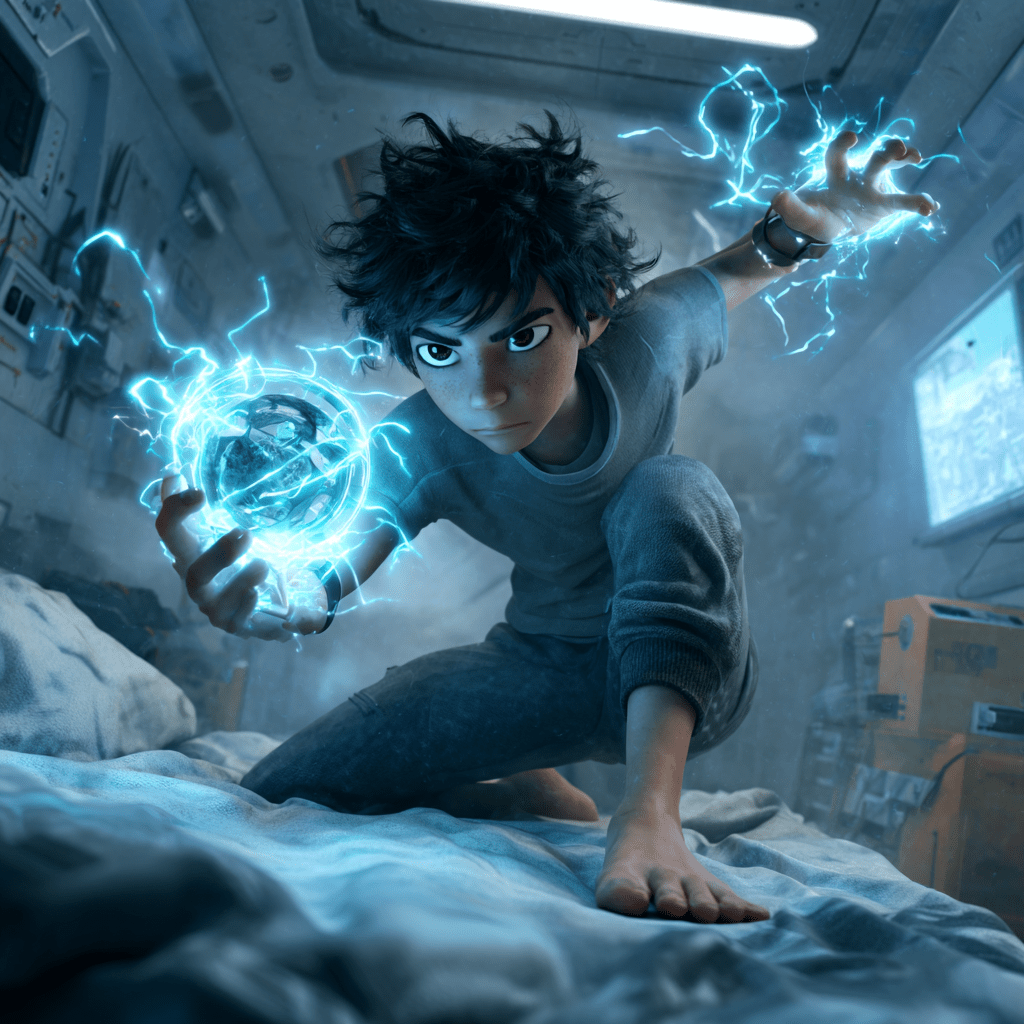
He sleeps the way kids his age do when they’re genuinely tired — completely, unselfconsciously, blanket pulled up to his chin and his face slack with the kind of peace that two months of Peregrine routine apparently produces. His brown hair fans slightly against the pillow. His breathing is slow and even.
On his chest, resting outside the blanket, is the Star of Vis.
As an astrolabe pendant it’s deceptively ordinary-looking in sleep mode — a small, intricate disc of gray metal, layered rings calibrated to something beyond standard astronomical measurement. It rises and falls with Topher’s breathing like it’s part of him. Which, at this point, it basically is.
The door slides open.
Rounded corners, rightward motion, engineered for silence — and whoever’s operating it clearly knows that, because they time their entry to the natural pause between the ship’s ventilation cycles. A sliver of hallway light cuts across the floor, then widens.
Michael steps inside.
He’s in his gray Peregrine civvies — the standard-issue shirt and sweatpants that pass for off-duty uniform aboard the ship — which means he came from somewhere else on the ship, not from outside. His face in the dim light is doing something complicated: jaw set, eyes focused, expression locked into that particular configuration he uses when he’s decided something and doesn’t want to think too hard about whether it’s a good idea.
Stealth mission: Initiated.
Moral alignment: Questionable.
He crosses the room in careful steps, eyes fixed on the pendant. They widen slightly when he gets close enough to see it clearly — the Star sitting there, quiet and patient, like it’s been waiting for exactly this kind of attention.
Michael reaches down with both hands.
The Star of Vis responds before his fingers make contact.
A forcefield forms around the pendant in a fraction of a second — a tinted sphere that materializes with the kind of speed that makes it clear this isn’t the first time it’s had to do this. Michael’s hands press against the barrier and meet solid resistance, his fingers splaying against a surface that exists somewhere between physical and energy.
His face twists.
He’s actually trying to force it.
Blue-white light bleeds from the point of contact, crawling up his hands and forearms in thin electric currents that branch like lightning looking for ground. His eyes catch the same energy — irises glowing with reflected blue-white, which under different circumstances might look impressive but right now mostly looks like evidence of a very bad tactical decision.
The Star doesn’t negotiate.
The shockwave that erupts from the pendant is compact and decisive — not destructive, not angry, just corrective. It catches Michael center-mass and sends him stumbling backward across the room in a single motion, feet scrambling for purchase on the smooth floor until he hits the far wall with a muffled thud.
He finds his footing fast. Whatever else you say about Michael Pangilinan, the guy recovers quickly.
Topher doesn’t stir. Sleeps through the whole thing.
Of course he does.
Michael straightens up, breathing harder than he’d like to admit, and looks back at the pendant. The Star has already settled — back to its quiet dormant pulse, like nothing happened, like it didn’t just launch a fourteen-year-old across a room.
He glances down at his hand.
A keycard. He’s been holding it the whole time — which means he lifted it from somewhere, or someone, to get into this room in the first place.
The door slides open at his approach. He steps into the bright hallway, looks both ways with the wariness of someone who knows they shouldn’t be where they just were, and walks away.
Empty-handed.
Attempted theft: Repelled.
By a sleeping twelve-year-old’s necklace.
Respect.
Becoming_more_than_ordinary.sav
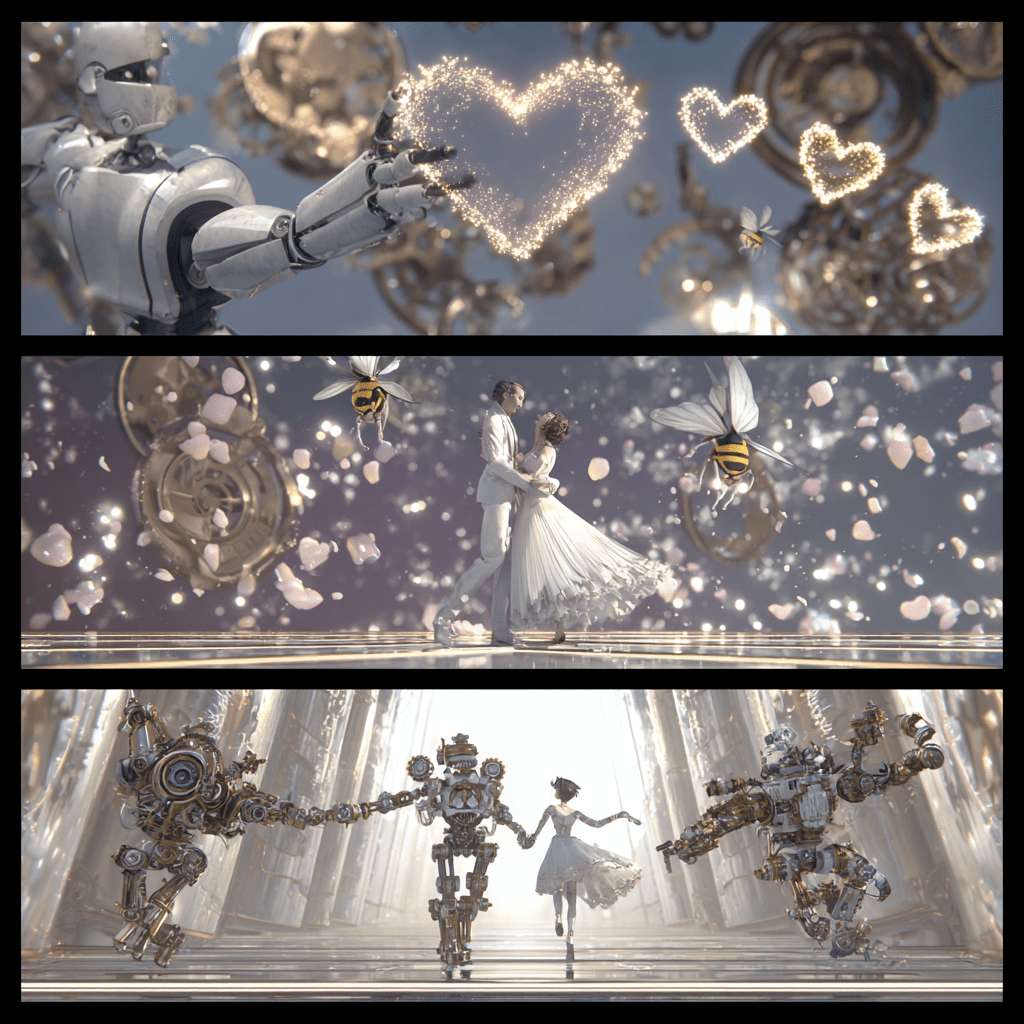
ROBO4000 runs a tight training program.
I’ll give him that. For a robot who was introduced to me as a “high-tech expert bordering on madness,” he’s got the pedagogical instincts of someone who’s studied every coaching manual ever written and then optimized them for superpowered Filipino teenagers. He moves between stations with the measured efficiency of a unit that doesn’t waste steps, CleanBot trailing beside him like a loyal sidekick who got assigned to the right party.
The command center screen tracks everything in real-time — a grid of widgets displaying vitals, power output readings, accuracy percentages. Numbers updating in smooth increments. It looks like a live dashboard for a game nobody asked to be in.
Training arc: Active.
Michael goes first on my rotation because Michael is always loudest.
The training room’s humanoid dummy — a reinforced target unit bristling with extendable spokes at various heights and angles — takes a combination that would make a professional boxer wince sympathetically. Michael works through it with the focused intensity of someone who has converted two months of bottled frustration into pure kinetic output. Jab, cross, low kick, elbow — the sequence is clean, practiced, mean. His gray shirt strains across the shoulders with each rotation. The dummy rocks on its base but doesn’t fall.
He hits it harder.
Outside, Sophie cuts through the air with the efficiency of something that was born to move fast. The shaded goggles sit snug against her small face, her wings — iridescent and quick — beating at a frequency that blurs them into suggestion rather than solid shape. She banks left through a hoop, right through another, dips under a low bar with maybe two centimeters of clearance, and pulls up into a vertical climb that would make a stunt pilot reconsider their career. Seven years old. Absolutely zero fear response.
Bee girl has no business being this good.
Allison works her station with the cheerful precision of someone who has discovered that her power is both genuinely dangerous and extremely on-brand. She lines up a row of swinging target boards — pendulum motion, irregular intervals — and sends heart-shaped projectiles from her fingertips with each flying kiss. Pop. Pop. Pop. Each one connects. She tracks the moving targets with her sharp eyes, adjusts her angle instinctively, and hits the last board mid-swing without breaking her rhythm.
She does a small victorious shimmy. No one’s watching except me.
I’m watching.
Topher plants himself at the start of a mirror course — a zigzag arrangement of angled reflective panels set up across the field — and goes still in that particular way he does right before something luminous happens. The holy light builds between his palms, concentrated and steady, then releases in a single directed beam that bounces off the first mirror, redirects off the second, angles through the third, and hits the goal target at the far end with a clean flash of white.
He exhales. Checks the result. Nods once, quietly satisfied.
James, meanwhile, has conjured a full steampunk ballroom on an empty stage.
Two mecha figures — a lady and a gentleman, all brass gears and Victorian silhouette — waltz together in perfect three-quarter time, generated entirely from whatever his electric guitar is producing in the corner. The music drifts across the field, warm and slightly improbable.
ROBO4000 observes all of it from the command center feed, CleanBot beside him.
Progress: Confirmed.
These kids are actually becoming something.
The_robot_who_dreamed_backwards.sav
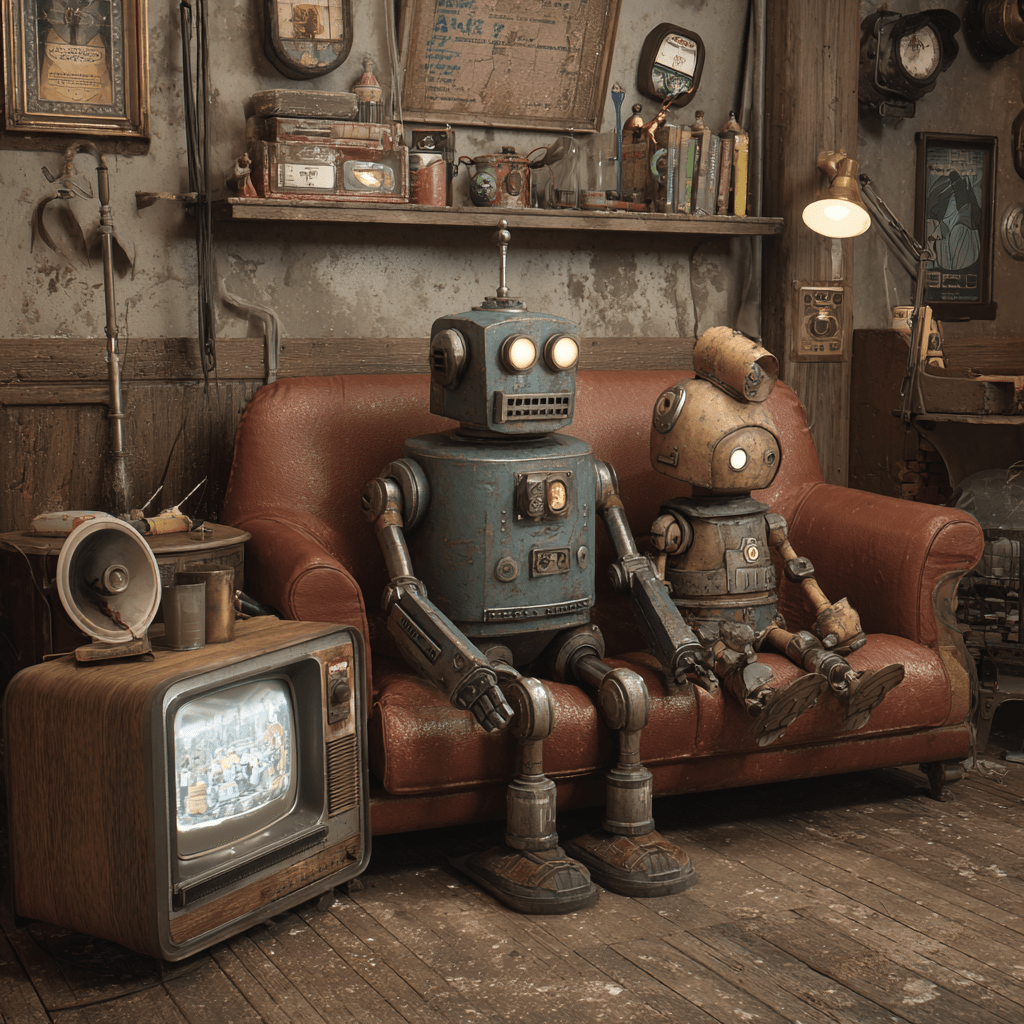
The Peregrine Lightyear has a den.
I want to sit with that for a second. A spaceship — a falcon-shaped vessel from the thirty-first century, equipped with a command center, a training field, a simulation room, and a pentagon portal — has a den. Wooden-paneled walls. A small TV. A leather loveseat with the particular worn-in quality of furniture that’s been deliberately chosen for comfort rather than function. 1950s countryside aesthetic tucked inside cold titanium like a time capsule someone smuggled aboard and decided not to declare.
It shouldn’t work. It absolutely works.
ROBO4000 sits on the loveseat with the settled posture of a unit that has made a conscious decision to be comfortable. His white metallic chassis — built for command centers and tactical briefings — occupies the cushions with a kind of dignified ease, like he’s been sitting in dens his entire operational existence. CleanBot is beside him, smaller by a significant margin, his compact frame perched with the attentive stillness of someone genuinely invested in the program.
On the small TV: James’s training session from earlier. The steampunk waltz. The brass mecha lady and gentleman turning slow circles on an empty stage, generated from an electric guitar and whatever musical dimension James has been quietly accessing for two months.
ROBO4000 points the black remote and hits replay.
Nine times.
I’ve been counting.
CleanBot watches the sequence complete again — the mecha figures beginning their waltz, the warm impossible music, the whole Victorian fever dream conjured from a teenager’s guitar — and then glances at ROBO4000 with the particular patience of someone who’s decided not to mention the replay count until it becomes statistically impossible to ignore.
“You’ve replayed that tape nine times now,” CleanBot says.
ROBO4000 doesn’t look away from the screen. “I just can’t help it.” His voice carries something that a strict diagnostic readout would probably classify as elevated engagement response, but which sounds, functionally, like genuine feeling. “The waltz of the lovers is so engrossing.”
CleanBot considers this. I didn’t expect an electric guitar could play classical music like that, he thinks, which is a reasonable observation from a maintenance unit whose primary audio experience aboard the Peregrine has been ventilation cycles and CleanBot’s own cleaning equipment.
“So,” CleanBot says carefully, “you’re into romance?”
“Not exactly.” ROBO4000 finally shifts, turning his optical sensors toward CleanBot with the measured deliberateness of someone correcting a misclassification. “I’m into steampunk.”
He says it the way other people say obviously, except without the condescension. Just clarity.
“Steampunk is fascinating,” ROBO4000 continues, and something in his vocal modulation shifts into a register I can only describe as reverent. “It’s a very effective form of retrofuturism. The blend of Victorian architecture, steam engines, clockwork, and futuristic technology — ” He pauses, his metallic hands resting on his knees. “It’s an exquisite tapestry.”
CleanBot processes this. Then, with the genuine curiosity of a unit that asks questions because it actually wants answers: “Do you want to go back to 1800s England? Live there as a steampunk mecha?”
The question lands in the den and sits there, warm and slightly impossible.
ROBO4000 is quiet for exactly three seconds. His optical sensors drift back toward the TV, where the mecha couple completes their waltz for the ninth time, brass gears catching imaginary gaslight.
“If only it were possible,” he says finally. The wistfulness in his voice is not performed — it’s just there, factual and unguarded, the way truth tends to be when it’s not trying to prove anything. “But we’re robots from the fourth millennium. The 3000s AD.” A beat. “And our headquarters is a falcon-shaped spaceship called Peregrine Lightyear.”
A robot from the thirty-first century mourning that he wasn’t built in the nineteenth.
I understand this on a level I wasn’t prepared for.
CleanBot sits with ROBO4000’s answer for a moment. There’s something in his stillness that reads like sympathy — genuine, uncomplicated, the kind that doesn’t require a speech. “Is there anything I can do,” he asks quietly, “to make your dream come true? At least a little?”
ROBO4000 tilts his head slightly, the gesture almost human. “I believe steampunk mechas run on black tarry oil,” he muses, with the tone of someone thinking out loud rather than making a formal report. “While we robots of the 3000s are powered by pure energy.”
He clasps his metallic hands together — a slow, deliberate gesture, fingers interlacing with the soft precision of well-maintained joints.
“Drinking black tarry oil,” he adds softly, “like a warm mug of hot chocolate…” He lets the sentence trail off, a faint smile settling into whatever expression his chassis allows. “That would be… nice.”
CleanBot doesn’t respond immediately. He just looks at ROBO4000 — this tall, white, analytically precise machine who oversees training regimens and tactical briefings and now sits in a 1950s countryside den replaying a teenager’s steampunk waltz for the ninth time, quietly dreaming about Victorian fuel sources.
This emotionless robot, CleanBot thinks, shows such passion.
The den holds its warmth around them — wood paneling, worn cushions, the small TV’s glow — a deliberate pocket of somewhere else inside a ship that is very much somewhere specific.
Outside, against the den’s wall where the wood meets the cold titanium of the Peregrine’s interior hull, Michael stands with his back pressed flat and his head angled just enough to hear every word.
His expression is unreadable.
His arms are crossed.
He’s been there long enough that he definitely caught the part about the hot chocolate.
Plot flag: Raised.
Michael Pangilinan, eavesdropper, standing outside a robot’s dream.
What exactly are you going to do with that information?
The_alignment_chart_at_lunch.sav
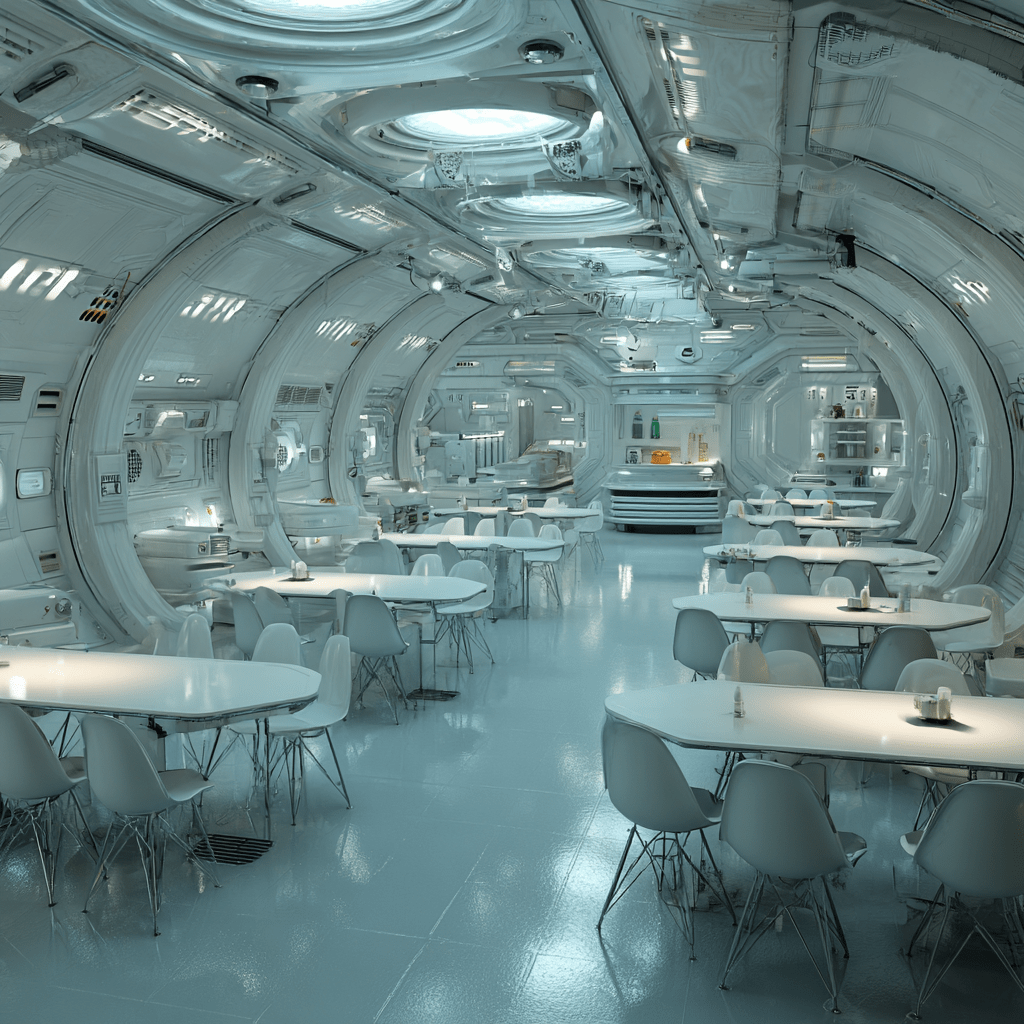
The Peregrine Lightyear’s cafeteria operates on the kind of nutritional philosophy that only a robot could love.
Every compartment, every portion, every color-coded food group arranged with the geometric precision of someone who has read every dietary guideline ever published and taken all of them personally. No negotiations. No substitutions. The menu rotates on a schedule optimized for growing teenagers with superpowers, which apparently means a lot of leafy greens and a suspicious absence of anything that tastes like a reward for existing.
CleanBot stands behind the serving counter in a white chef’s hat and apron — both slightly oversized for his compact frame, giving him the appearance of a culinary school mascot who wandered into a professional kitchen. He works through the line with the methodical focus of a unit that takes meal preparation seriously, filling the compartments of Topher’s plate with the steady efficiency of someone following a script he’s memorized completely.
Topher watches his plate take shape with mild interest. Protein. Vegetables. Carbohydrates. Fiber. Balanced, complete, and approximately zero percent exciting.
James lifts a multi-compartment plate from the stack near the kitchen window and sets it on his tray with the casual ease of someone who has made peace with the routine. His tray joins the procession. Sophie takes hers with both hands, balancing carefully as she navigates past the long empty tables of the cafeteria — the room designed for a full crew that doesn’t currently exist, which gives it the particular echo of spaces built for more people than are present. Her bee-yellow cardigan catches the overhead light as she walks.
Allison, already seated, spots Michael lingering near the end of the line and deploys a single sassy wave — index finger curling, chin tilted, the universal signal for get over here delivered with the confidence of someone who has never once doubted her own social gravity.
Michael picks up his tray. Looks at his plate.
Stares at it.
His expression cycles through the five stages of cafeteria grief in approximately four seconds.
They settle around one end of a long table — five cousins in gray Peregrine civvies, trays arranged, the cafeteria quiet around them except for the ambient hum the ship never fully switches off. CleanBot moves back behind his counter with the satisfied air of a completed task.
Michael pokes at his food.
“I’ve been thinking,” he says.
The table pays attention. When Michael starts a sentence with I’ve been thinking, it rarely ends with something everyone already agrees with.
“We’re wasting our powers being stuck here at headquarters.” He sets his fork down, leaning forward with the posture of someone who has been building to this for longer than one lunch. “We should be out there. Fighting crime. Making a difference.”
He turns to Allison first — tactically sound, honestly. Start with the most persuadable audience.
“Think about it. You could be famous as Love Fey — the magical girl defeating bullies with heart attacks.” His eyebrows go up. “Media coverage. Press conferences. Maybe a movie deal.”
Allison’s eyes go wide and bright in a way that suggests Michael has located her exact frequency on the first try. “Interviews,” she adds, sitting straighter. “Social media clout.” She taps the table with one finger for emphasis. “A movie deal.” The sassy smile spreads slowly, like she’s already drafting the headline. “I’ve always known I was born for that.”
Of course you have.
Michael pivots to Sophie, his tone shifting to something gentler — he knows his youngest sister runs on encouragement, not pressure. “And Sophie. You could live your dream as a real cartoon character. Bee Girl, out in the actual world. Wouldn’t that be better than watching cartoons on TV?”
Sophie blinks. A soft blush climbs her cheeks and she ducks her chin slightly, the shy smile appearing before the words do. “That would be a dream come true,” she admits quietly, “for someone like me.”
Someone like her. Seven years old, saying it like she’s already accepted that dreams are for other people. I register this detail and file it somewhere that doesn’t have a clean label.
Michael turns to James. The approach here is different — no grand vision, just a direct appeal to something James has been quietly suffering for two months. “And you, big bro. Wouldn’t it be more fun to actually hang out with us? Out in the field?”
James shrugs, but it’s the shrug of someone who has been waiting for permission to admit something. “Yeah, I guess.” He pushes food around his plate. “Talking to a chatbot for two months straight is starting to get old.”
Understatement of the third millennium.
Michael saves Topher for last. Deliberate. He knows exactly what he’s doing.
He points across the table. “And you, Topher. Don’t you want to be a real hero? Saving lives. Doing actual good for people?”
Topher puts his fork down carefully, the way he does when he’s about to say something he means. He’s been listening to all of it — the whole pitch, the whole table — and his expression is the one he gets when two things he believes in are pulling in opposite directions.
“We should all strive to do good,” he says, measured and honest. “But what you’re suggesting goes against the rules.”
The table goes quiet.
Michael leans in. And here’s where it gets interesting — because he doesn’t argue. He reframes.
“Topher.” His voice drops to the register of someone making an important point rather than starting a fight. “What’s more important — being good, or being lawful?” He pauses for exactly the right amount of time. “Think about it in Dungeons and Dragons terms.”
Oh.
He did not just invoke the alignment chart.
Topher goes still. His eyes move slightly left — the direction people look when they’re actually thinking rather than performing thought. The question sits on the table between them, and I watch him work through it with the visible effort of someone who takes moral frameworks seriously.
Good versus Lawful. Chaotic Good versus Lawful Good. The classic tension. Paladins wrestle with this one specifically.
“If I had to choose,” Topher says finally, his voice quiet and certain, “I’d pick being good.”
Michael’s grin breaks open like a loading screen completing. He slaps the table once — not hard, just punctuation. “That’s the spirit, buddy.” He looks around at all of them, satisfaction radiating from every feature. “That’s exactly what I’m talking about.”
The table sits with it. Allison’s already imagining press conferences. Sophie’s smiling at her tray. James looks like someone who just got offered an exit from a room he’s been trapped in for too long.
Topher looks like someone who just made a decision he’ll need to live with.
Michael leans back, scanning the cafeteria with the casual ease of a player who just landed a key move. A slow, private smirk settles across his face — small enough that only someone watching very closely would catch it.
I catch it.
That smirk isn’t enthusiasm.
That’s a plan.
The_favor_michael_prepared.sav
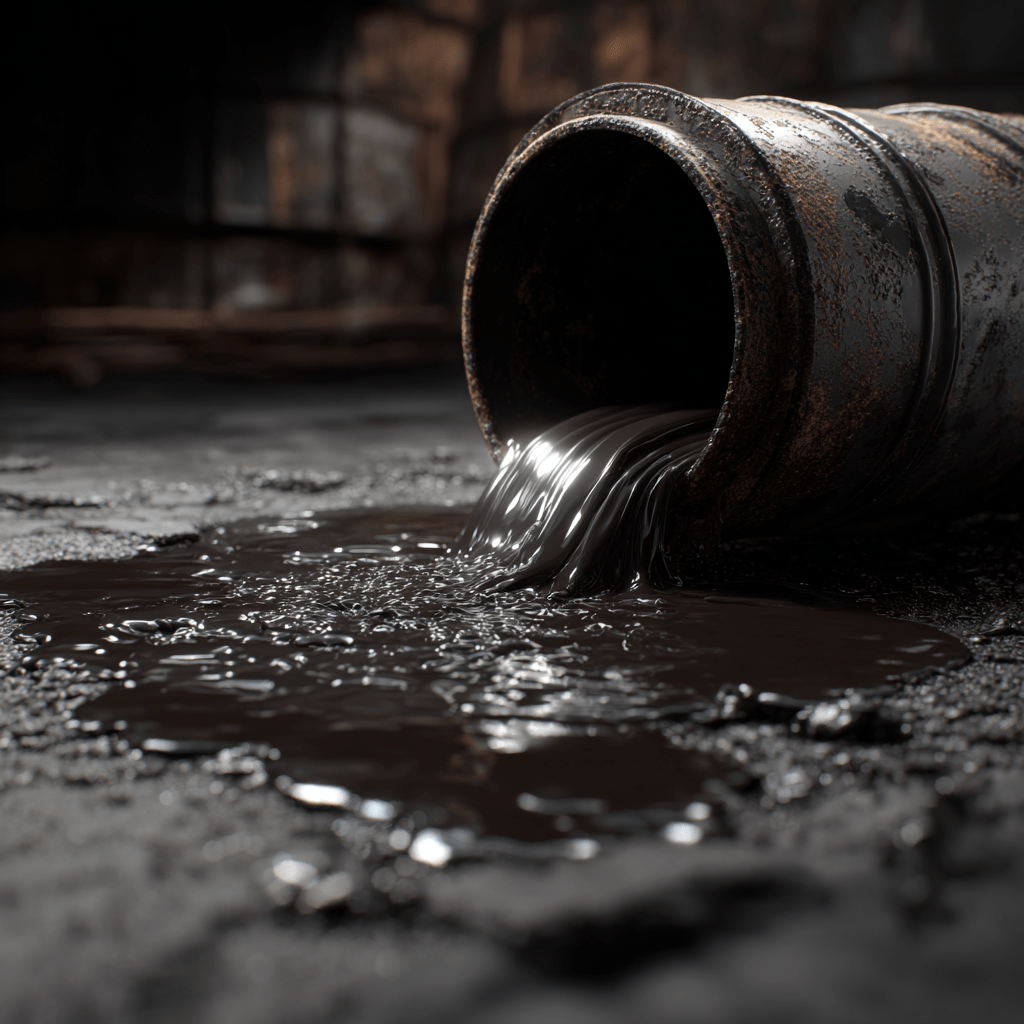
Night on the open sea operates on a different kind of quiet.
Not the Peregrine Lightyear’s controlled hum, not the cafeteria’s rehearsed routine — this is the real thing, unpredictable and vast, the kind of darkness that has no ceiling and no walls and goes on considerably longer than any teenager should be navigating alone. The cargo ship sits maybe half a kilometer out, low in the water, its deck lights cutting amber streaks across the surface. It drifts with the patient indifference of something that has no idea it’s about to become relevant to a plot.
Inside the hold, the security guard moves his flashlight in slow arcs across rows of stacked oil drums — cylindrical, dark, industrial, each one stamped with hazard labels that mean nothing to someone who runs on solar energy and bad decisions. The beam sweeps left. Right. Corners. Gaps between crates.
Below one of those crates, pressed flat against the metal floor, a shadow breathes.
Still. Patient. Watching the guard’s feet complete their patrol pattern with the focused attention of someone who has studied exactly how long a security sweep takes and timed his entry accordingly.
The guard, satisfied, exits. The door closes.
The shadow rises.
Michael Pangilinan straightens up from the floor with the casual ease of someone who just won a stealth segment on the first try — no saves, no respawns. He’s in full Spartan mode: the sleeveless maroon-red spandex suit fits like it was engineered for exactly this kind of operation, which it probably was, and the helmet covering the back of his head gives him the silhouette of someone who takes his superhero aesthetic seriously. His bare arms — fourteen years old and built like someone who has been hitting a training dummy twice daily for two months — are already reaching for the nearest oil drum before the guard’s footsteps fully fade.
He gets both hands under it, shifts his weight, and lifts.
A full drum of crude oil. Single shoulder. Clean.
Strength stat: Confirmed.
He doesn’t run. He moves with the deliberate economy of someone carrying something heavy who knows that speed is less important than balance, crossing the hold in measured strides and ascending the incline toward the Peregrine Lightyear.
The ship sits on the horizon like it was placed there — the titanium hull catching the night’s ambient light, the falcon-shaped silhouette unmistakable against the dark sky. Its exterior gleams with the particular brightness of a vessel that CleanBot maintains on a strict schedule. As Michael approaches, the lights play across his back, his helmet, the drum balanced on his shoulder.
He looks, objectively, like a heist protagonist in the final act.
ROBO4000 is waiting at the entrance.
Of course he is.
The tall robot stands in the threshold with his arms at his sides and his optical sensors fixed on Spartan with an expression that — despite technically being a fixed metallic face — communicates several things simultaneously, none of them approval. CleanBot hovers beside him, smaller by a factor that’s almost comedic, his posture carrying the specific energy of a unit trying very hard to remain neutral while clearly tracking every development.
Spartan steps into the light.
“Hey, bro.” He sets the drum down against the wall with controlled precision and grins at ROBO4000 with the unhurried confidence of someone who came prepared. “Angry I sneaked out?”
“You know Commander McKinley has strictly forbidden any contact with the outside world.” ROBO4000’s voice carries the particular weight of a rule being cited rather than invented — clean, factual, no room for interpretation. “Especially venturing outside.”
Spartan shrugs. One shoulder, slow, entirely unbothered. “Maybe I can talk some sense into you. You’re the sensible one here, right?”
ROBO4000 tilts his head by approximately four degrees. “What are you getting at?”
Michael doesn’t answer immediately. He just points down.
They both look.
A thin stream of crude oil has traced itself across the floor from where the drum’s seal sits slightly loose — a dark, slow-moving line catching the hallway light with that particular sheen that petroleum has when it’s trying to look more interesting than it technically is. It winds between them like a question mark missing its dot.
“See that?” Spartan says. “Slick black oil. Flowing right under your feet.” He leans his shoulder against the drum with the casual posture of someone who has rehearsed this exact moment. “And this drum — full of crude oil. The stuff you like so much.” His eyes carry that mischievous glint that means he knows something he isn’t supposed to know, and he’s enjoying every second of the reveal. “With all your fancy tech, I bet you could synthesize this in a lab, right? Reproduce it. Tons of it. Endless supply.”
ROBO4000 crosses his arms. The gesture is slow and deliberate. “And how does that justify breaking the most important rule?”
Spartan lets the pause stretch for exactly the right number of seconds.
“I don’t know,” he says, with the tone of someone who knows precisely. “Maybe because someone here can drink crude oil like it’s hot chocolate.”
He lets that land.
“And they can drink it… endlessly.”
ROBO4000 goes still.
Not the functional stillness of a unit in standby — something different. The kind of stillness that happens when a piece of information arrives that requires actual processing time. His optical sensors hold on Spartan’s face for three full seconds.
“Endlessly, you say.”
It’s not quite a question. It’s the sound of mental arithmetic completing.
Michael’s grin spreads slowly, the way it does when he’s watching something click into place. He pushes off the drum and straightens up, spreading his hands in the universal gesture of I come in peace and also with gifts.
“Consider this a favor,” he says. “I brought you a little gift.” A beat. “I’d appreciate it if you could return the favor.”
The hallway holds the moment.
CleanBot’s gaze moves between Spartan and ROBO4000 with the careful attention of a unit reading a negotiation he didn’t know he’d be witnessing tonight. His small frame is perfectly still. He doesn’t intervene. He doesn’t comment.
But he’s cataloguing everything.
And so am I.
Michael Pangilinan, fourteen years old, just eavesdropped on a robot’s private dream, extracted the operational detail, smuggled crude oil off a cargo ship in the dead of night, and used it as currency in a transaction that has several implications I’m still processing.
This is not impulsive.
This was planned.
Multiple sessions ago.
The_star_grants_a_second_wish.sav

The Peregrine Lightyear’s lobby looks different when people are dressed like people again.
Two months of gray shirts and matching sweatpants — the unofficial uniform of indefinite lockdown — and suddenly here they are: five kids in actual clothes, standing in the entrance lobby like they’re about to walk out a door for the first time in sixty days. Which, technically, they are. James has his guitar slung across his back, the strap sitting easy on his shoulder the way it does when he’s not thinking about it. Michael’s in a sleeveless top that is doing exactly what a sleeveless top is supposed to do for a fourteen-year-old who has spent two months hitting a training dummy daily. Topher’s wearing the kind of practical casual that suggests someone who packs for function — cargo shorts, clean sneakers, the astrolabe pendant resting against his chest over a light button-down. Allison has done something deliberate with her loose black waves and the bow above her ear that communicates she has been waiting for a public appearance for approximately sixty days and she is ready. Sophie stands beside her in a soft yellow ensemble that makes her look like exactly what she is: the youngest, the brightest, the one everyone instinctively wants to protect.
Civilian mode: Restored.
Barely.
Michael surveys the group with the particular energy of someone who has been steering toward this moment for longer than anyone officially sanctioned. “Ready to venture into the outside world again,” he says, the grin already forming, “after Captain McKinley’s two-month prison sentence?”
The words land with deliberate provocation.
Topher doesn’t flinch. “The Captain did what he thought was best for us, Kuya Michael.”
It’s the tone of someone who means it — not defensive, not performative, just quietly certain. Topher has a talent for saying true things without making them into arguments.
Michael absorbs this with the brief expression of someone who heard it and chose a different direction anyway. “Yeah, yeah.” He turns toward the entrance, enthusiasm building in his posture like a charge reaching threshold. “Let’s get going. Time to roll into action.”
He takes three steps toward the door.
“Wait,” Topher says. “Give me a moment.”
Michael stops. Turns around slowly, with the controlled expression of someone counting to three internally. “What is it now?”
James stops. Allison stops. Sophie stops. All of them turn toward Topher with the instinctive attention that his particular stillness tends to generate — because when Topher goes quiet and deliberate like this, something is usually about to happen that doesn’t follow normal physics.
The astrolabe pendant begins to glow.
It starts small — a shimmer, blue-white light moving in soft waves across the pendant’s surface like a signal being sent rather than reflected. Then it intensifies, the glow expanding outward, and from within it the Star of Vis emerges.
I’ve seen this object in various states across every Walkthrough I’ve observed. I’ve watched it command a board game, repel a theft attempt, survive a cave collapse, and anchor the destinies of seven Filipino teenagers to something older and larger than any of them. But the Star of Vis fully summoned, freely given, glowing with patient ancient purpose in the lobby of a grounded spaceship on a Tuesday morning — that’s still something that requires a moment of honest processing.
It hangs in the air above Topher’s palm: a marquise-shaped celestial stone, blue-white and luminous, thick gray metal rings rotating around it in slow deliberate arcs like an astrolabe that has decided to stop pretending to be decorative. It turns with the unhurried authority of something that operates on its own timeline and always has.
Everyone’s eyes go to it. Michael included.
“I know we first transformed as a group when we approached the Star in its chamber two months ago,” Topher begins, and his voice has that particular quality it gets when he’s saying something he’s been thinking about for a long time — measured, like he’s placing words carefully. “Since then, we’ve been transforming as a team for training. You guys can only transform when I activate this artifact. It answers only to me.”
He pauses.
“But I believe God has given man free will.” The words are simple and direct and Topher delivers them without performance. “That’s why I don’t want to be the only one who controls our powers through this Star.”
He raises his face toward the artifact, and when he speaks again his voice is the voice he uses when he’s absolutely serious — no hesitation, no uncertainty, just a twelve-year-old being entirely himself.
“Star of Vis — grant my wish once more, as you did before, when you made us heroes. For the second time, I wish to create switches for my cousins, so they can transform on their own. Whenever needed.”
He lifts the Star higher.
The artifact responds.
The glow intensifies to the kind of brightness that forces you to adjust — a concentrated blue-white radiance that fills the lobby with shifting light and makes everyone’s shadows stretch in four directions at once. From within it, a translucent mass of celestial energy takes shape: a chunk of baby blue light, solid and clean, hovering above Topher’s outstretched hand.
Then it cracks.
The fracture lines appear slowly, like ice breaking in reverse — deliberate, structural, intentional. And then all at once it shatters, not violently but precisely, splitting into six shards that drift apart in different directions with the calm purpose of things being distributed rather than broken.
Six shards. Five cousins. A Friend. Two months of planning, rendered in light.
Topher, you absolute paladin.
Michael’s face in this moment is a complete document of a person experiencing two emotions simultaneously. The excitement is genuine and immediate — eyes bright, jaw loose, the expression of someone watching a problem they’ve been working around suddenly dissolve. I won’t need to steal the Star anymore, he thinks, and I catch it on his face before he locks it down. I can transform on my own.
Then the first shard moves toward him.
Directly toward his throat.
Michael’s excitement inverts in approximately half a second. His hands fly up, clutching his neck as the shard makes contact — and for three genuinely concerning moments he stands there struggling, face cycling through panic and effort, the lobby holding its collective breath.
Then he swallows.
“A-a-a-a-h.”
The sound of a person confirming their own continued existence. He touches his throat, checks that everything still works, and exhales with the profound relief of someone who would like to never do that again.
The Star of Vis: effective, efficient, zero bedside manner.
The second shard drifts to Allison with a gentleness that contrasts sharply with what just happened to Michael. It settles into her open palm and transforms with the delicate precision of something that has read the assignment — an intricate heart-shaped compact materializes in her hand, the craftsmanship somewhere between jewelry and weapon, exactly as girly and exactly as serious as Allison herself.
She examines it with the satisfaction of someone receiving confirmation of something they already knew. “This is definitely my transformation trinket.” She looks up at the Star, one eyebrow slightly raised, sass at full operational capacity. “This is such magical girl stuff — you’ve been reading your Shoujo manga, haven’t you, Star of Vis?”
The artifact does not respond to this. Probably for the best.
The third shard moves toward Sophie, and Sophie watches it approach with the nervous anticipation of someone who just watched one cousin nearly choke and another get a compact appear in her hand — reasonable inputs for uncertainty. “What’s it going to do?”
The shard circles her once — a slow, evaluating orbit — and then enters her back, passing through the center of her spine with a ripple of blue-white light that moves through her like a wave through shallow water.
Sophie’s face scrunches, then breaks into a giggle she’s half-trying to suppress. “It tickles, sorry!”
Seven years old. Received a mystical power switch embedded in her spine. Primary response: embarrassed laughter.
Sophie Pangilinan remains the most wholesome participant in this entire operation.
The fourth shard rises to eye level with James and stops there, hovering patiently, as if waiting for him to figure something out. James looks at it. Looks at his back. Looks at it again.
“You’re going for my back too?” Half-joking, half-genuinely asking. Then — the shift, the recognition, the moment the logic completes. “If not my back, then something on my back…” His expression opens into the particular brightness of a correct answer arriving. “Oh, of course. My guitar.”
He unslings it from his shoulder and offers it forward with both hands — the gesture of someone presenting something rather than surrendering it. The shard drifts down and nestles itself into the acoustic body of the instrument with a soft pulse of light, settling into the wood like it found the exact place it was always meant to occupy.
James looks at his guitar. Looks at it differently than he did thirty seconds ago.
The bard class just got an upgrade.
The Star of Vis descends back toward Topher, the remaining two shards returning with it, drawn home to their Keeper with the unhurried certainty of a sequence completing on its own terms. The glow softens as it settles back into pendant form against Topher’s chest — smaller again, quieter, but somehow more present than it was before.
Topher looks at it for a moment. Then up at his cousins.
“These two can wait,” he says, and the smile on his face is the easy, uncomplicated kind — the one that means he’s genuinely happy with how something turned out. “Until Kuya Benjamin and Ate Roanne return from their mission on the island.”
The lobby holds the moment.
Five cousins. Four transformation switches distributed. Two held in trust for teammates currently elsewhere. One twelve-year-old who just gave away control because he believed they deserved it.
End of Walkthrough 28.
The Seven Acolytes are no longer waiting for permission.
 B. K. P. Carreon
Leave a comment