Overview:
| Allison overrides the command center—ignoring CleanBot’s protests—to manage the social media accounts of her alter ego, Love Fey. Topher pulls her away before things escalate, and together they step onto the deck of their headquarters, transforming into Ser Cerulean Arlentis and Love Fey. Their first call comes fast: a malfunctioning LRT train speeding out of control. Working in sync, they bring it to a halt and evacuate the passengers safely. No time to rest—another alert hits. A tenement is engulfed in flames. On-site, Love Fey handles the chaos outside, dispersing looters and keeping the crowd under control. Inside the inferno, Cerulean pushes through heat and smoke to rescue a trapped man, shielding him with his power and purifying the air so he can breathe. As the fire rages, a Pegasus-like beast appears, joining Cerulean in dousing the blaze until the flames are finally subdued. In the aftermath, reporter Becky Davis arrives on the scene, going live as she interviews Love Fey and Cerulean about the rescue and the mysterious creature that aided them. |
The_pr_department_of_one.sav

The white cube knows how to set a scene.
One moment it’s the cave where the board game ended everything, the next it’s the rolling fields where Michael punched a crater into the earth, and right now it’s deposited me here — the Command Center of the Peregrine Lightyear, cool and humming with the particular quiet energy of a ship that’s technically grounded but refuses to act like it. Titanium walls catch the ambient glow of a dozen cyan readouts. The big screen pulses with a soft, rhythmic blue — a living dashboard, always monitoring, always waiting.
And right in front of it, occupying the central console like she owns the deed, is Allison Sevilla.
She’s ten years old. That’s worth saying upfront, because everything about Allison projects an authority that usually takes people fifteen more years to develop. Long dark hair falls in loose waves around her shoulders — not pinned, not braided, just loose and effortlessly glossy, the kind that belongs in a Palmolive ad, which, technically, it has. Her bright brown eyes are fixed on the projected keyboard in front of her, the kind that doesn’t physically exist but glows cyan against the navy surface of the console with every keystroke. Her posture is impeccable. Her jaw is set. A small pink bow sits in her hair like a punctuation mark at the end of a very confident sentence.
She’s typing fast.
CleanBot — the short, round-headed robot who manages to look both competent and perpetually nervous — is perched on the right edge of the keyboard projection. He watches her work with the energy of someone who knows something’s slightly off but hasn’t figured out exactly how to say it.
“Are we sure this is okay?” he asks.
“Why not? I’m just creating a Twitter account for my alter-ego, Love Fey,” Allison replies. She doesn’t look up. Her fingers don’t slow.
CleanBot shifts on his perch. “I mean — you’re setting up a personal social media account. In the Command Center. That doesn’t exactly sound like authorized business.”
“This is official business, CleanBot.” Now she does look up, and the look she gives him would make a fully grown adult reconsider their position. “It’s called PR. Public relations. Even as heroes, image matters.”
CleanBot opens his mouth. Closes it. He is learning, in real time, what Enrico Sevilla presumably learned a long time ago: there is no winning a debate with Allison when she’s already decided she’s right.
She swivels the projected display toward him — or at least in his general direction — and her whole face shifts into something luminous. Pure, unguarded delight.
“Look at this picture I took yesterday in my magical girl dress.”
I look too. I can’t help it. The photo is — objectively — excellent. Love Fey stands mid-pose against a backdrop of red hearts on pink, the heart wand raised in one gloved hand, blonde waves caught mid-bounce, one eye closed in a wink while two fingers flash at the camera. The hip tilt is precise. The pout is precisely calibrated between cute and lethal. The tiara sits perfectly level despite the fact that she clearly just landed from something.
“Come on — look how I flashed two fingers, winked, and pouted. It’s the perfect mix of cute and sassy. Not to mention the hip tilt, and those red hearts on a pink backdrop? Flawless.”
She’s not wrong. As someone who has watched every sentai, magical girl, and idol anime in the playbook, I can confirm: this is textbook genre execution. She even got the lighting right. The girl is ten years old and already understands visual branding better than most adults with marketing degrees.
“I just need to crop it for the profile picture — and done!”
She leans back a fraction, satisfied in the way only a person who has just completed a mission they believed in completely can be satisfied.
CleanBot is not done. “Won’t your account be traceable back to the spaceship?”
“Nope. Your network is encrypted. It’d be nearly impossible to trace the IP address back here.” She waves one hand — dismissive, breezy, utterly confident. The gesture of someone who has already done her homework.
CleanBot processes this. He cannot refute it. He is a robot with access to the ship’s entire technical database, and she has, apparently, already checked his own network security before he thought to ask. He settles back into silence, which is the only rational response.
Footsteps at the entrance.
Topher Kennedy steps into the Command Center — twelve years old, Filipino-American, the kind of quiet warmth that fills a room without announcing itself. He’s dressed simply: plain t-shirt, comfortable shorts, running shoes with the laces still slightly loose. His dark hair is a little disheveled, the way it always is. His eyes, when they find Allison, are fond and unhurried — the particular look of someone who knows exactly who they’re dealing with and finds it more endearing than exhausting.
“It’s time, Allison. We have to leave.”
“Oh, is it?” She doesn’t rush. She’s Allison. “Well — before we go — can I get a picture of you and CleanBot for the public page I’m setting up for the team?”
Topher blinks once. Considers. “Sure, why not? Come on, CleanBot — let’s make this a good memory.”
CleanBot hops down from the console with the careful dignity of someone very small who wants to appear very measured. He takes his position beside Topher. Topher drops one hand to his side, squares his shoulders slightly, and then grins — and it’s one of those grins that doesn’t have any strategy behind it. Bright. Open. The kind of smile that makes rooms feel warmer without meaning to.
Allison raises her silver camera. “One, two, three — say cheese!”
“Cheese!” — boy and robot, perfectly in sync.
The shutter clicks.
Allison lowers the camera and studies the image on the small screen. The expression that crosses her face is subtle — quieter than her usual confidence. Something between recognition and surprise, the way you look at something when it catches you off guard without trying.
I’ve never seen a boy smile so warm and bright.
She doesn’t say it out loud. She doesn’t have to.
I watch from the white cube, a universe away from the Peregrine’s Command Center, close enough to see every pixel of that photo. And I think: yeah. I know exactly what she means.
Morphin_time_on_the_roof_deck.sav
Morning on the roof deck of the Peregrine Lightyear.
The sky above is the particular shade of blue that only exists right after sunrise — pale at the edges, deeper toward the center, the kind that looks like the game hasn’t fully loaded yet. The air carries that coastal saltiness that the ship has never quite shaken, even grounded this far from open water. The deck itself is smooth titanium, cool and clean underfoot, and right now it belongs to two kids who are about to do something that would make every Saturday morning cartoon cry actual tears of joy.
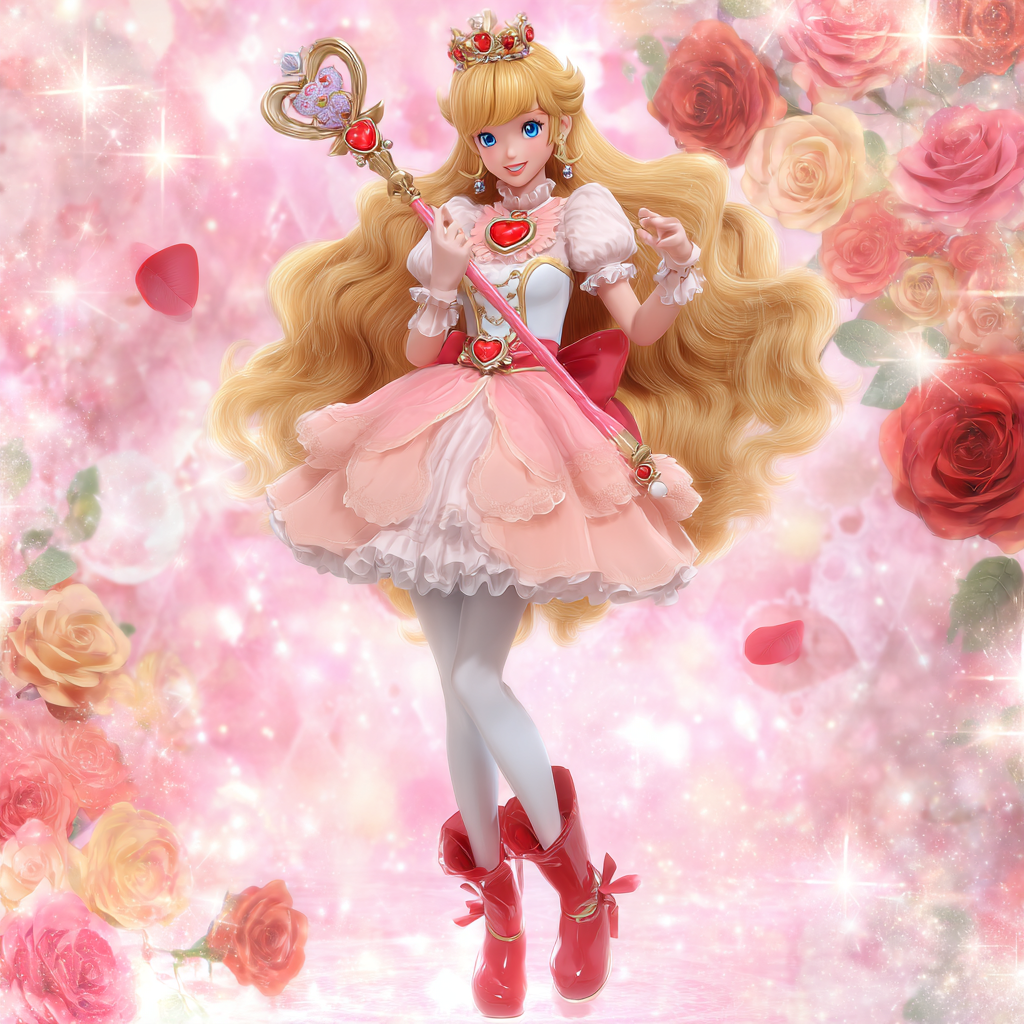
Allison stands on the left side of the deck. Twelve seconds ago she was just a ten-year-old girl with immaculate posture and an expression that dared the universe to disappoint her. Her black hair falls in loose waves past her shoulders, catching the early light the way hair does in shampoo commercials — which is not an accident, because this girl has been in shampoo commercials. She’s wearing regular clothes right now: a neat little blouse, a small pink bow clipped into her hair, white sneakers. She looks like she’s about to go to a friend’s birthday party and fully intends to be the best-dressed person there.
Then she reaches into the small bag at her hip and produces the compact.
It’s heart-shaped, ornate, the kind of object that looks like it was designed specifically to be held with both hands and spoken to seriously. The surface catches the light and throws it back pink. Allison holds it up between her palms, closes her eyes for exactly one second — not dramatic, just focused, the way athletes close their eyes before a free throw — and then opens them.
“Fairy Power, make-up!”
She caresses the compact gently, and it responds like it’s been waiting for this exact moment its entire existence. Pink rays spill out from the casing in soft, pulsing waves. The air around Allison shifts — there’s no other word for it. It just shifts, like the atmosphere has agreed to cooperate.
A ribbon of pink-to-red light materializes around her left forearm, spiraling in slow loops, trailing little sparkling red hearts that pop and dissolve like soap bubbles. The ribbon tightens, glows, and then — gone. In its place: a long baby pink glove, ruffled at the top, fitted perfectly to the elbow. The same sequence plays out on her right arm. Left, then right. Mirror image. Textbook transformation protocol.
Then the ribbon finds her legs.
It curls upward from the ground around her left knee in a slow spiral — hearts spinning, pink deepening into red — and when it clears, there’s a high boot underneath. Rose-colored, knee-high, with a heel that has absolutely no business being on the feet of a ten-year-old but somehow looks completely correct. Right leg next. Same effect. Same result.
The compact drifts upward on its own and settles against the center of her chest like it belongs there, which it does. Allison’s silhouette begins to shift in pulses of technicolor — pink, orange, yellow, back to pink — as the ribbon lassos multiply, wrapping around her torso in quick overlapping spirals. They unwind to reveal a white top with petal-shaped sleeves and baby pink side panels, two small buttons near the collar. Then the waist. Multiple lassos at once, spinning together, hearts overlapping, and beneath all of it, a two-layered skirt blooms into existence — deeper pink on top, baby pink underneath, flaring just above the knee.
Allison turns gracefully to the left. As she turns, a bow materializes in her hair — the same pink-red as the boots — and a matching ribbon ties itself at the back of her skirt in a large, perfect knot.
Then her face. A soft pink glow settles over her features like a filter switching on. A tiara appears, golden and heart-centered, settling into her blonde waves without disturbing a single strand. Small rose-shaped earrings at each ear. The faintest touch of lip color, a pink so soft it reads more like sunlight than makeup. And light makeup — barely there, but precise.
She raises one arm, spins once on her heel with the kind of practiced grace that comes from watching the same genre of anime approximately ten thousand times, and lands in her final pose: arms crossed at the chest, one leg stepped forward, chin up, blue eyes bright with full confidence.
“Love Fey! The Mage of Love and Beauty!”
Yeah. I lean against the white wall of the sim room. That’s a transformation sequence.
On the right side of the deck, Topher hasn’t moved during any of this. He’s been standing with his hands at his sides, watching Allison with the patient expression of someone who’s witnessed this before and finds it genuinely cool every time. He’s twelve, slight, dark-haired, wearing a simple white shirt and shorts. There is nothing about his current appearance that suggests what’s about to happen.
He brings his right hand up slowly.
Four fingers together. Thumb folded at a right angle — the classic sign, the one that’s older than anything else on this roof deck. His eyes settle somewhere in the middle distance, focused inward.
“In nomine Patris.”
His hand traces upward from his chest, and where his fingers pass, warm white light follows — not electric, not neon, something older and quieter. A glowing arm of a crucifix extends northward, steady and clean, like it was already there and he’s just making it visible.
“Filii.”
His hand moves downward. The southern arm of the cross extends, matching the first. The light is ivory at the edges, warming toward gold at the center.
“Et Spiritus Sancti.”
Both hands now — left extending west, right extending east, both holding the same sign, index and middle fingers raised, ring and pinky fingers folded and held by the thumbs. The two lateral arms of the cross complete the shape. Four cardinal points, glowing softly in the morning air, suspended around him in a perfect geometry.
Topher brings his hands together.
The four points of light converge. They merge at the center of his chest in a single shining ivory cross that pulses once — twice — and then the world around him goes white.
Angelic feathers appear from nowhere, dozens of them, swirling upward around his figure in a slow vortex. They’re not falling. They’re rising, as if gravity lost interest. White light and gold light alternate in quiet flashes that don’t blind so much as they illuminate — everything around Topher becomes briefly, perfectly clear before settling back to normal.
When the sequence ends, the feathers drift outward and dissolve.
The paladin stands where the twelve-year-old was.
The armor is silver and gold, plate over plate, fitted to a frame that carries it with more ease than it has any right to. A winged helmet sits on his head, the wings silver, extending backward and slightly upward. At his right hip, a holy sword — unsheathed now, the blade catching the morning sun and throwing back a clean white gleam. His left arm carries a heraldic shield, the face bearing a device I can’t fully read from this angle but which manages to look both ancient and completely serious. Draped from his shoulders: a white cape, long and immaculate, moving slightly in the coastal breeze.
He raises the sword to a guard position, left arm with the shield braced forward. He angles slightly to the right, facing forward.
They stand together on the roof deck. Allison on the left — arms crossed, one leg forward, tiara catching the light, the heart wand appearing in her right hand as if it’s always been there. Topher on the right — blade raised, shield forward, white cape settling at his heels. Behind them, the morning sky has gone full blue.
I stay very still in the white cube.
So close, I think, and so far.
There’s something about watching two kids stand like that — like they know exactly what they are, like the weight of it landed on them and they just… decided to carry it — that makes the sim room feel smaller than usual. The walls don’t move. The light doesn’t change. I am exactly where I’ve always been: watching through the glass of a story I can observe but never enter.
The wind crosses the roof deck.
Neither of them moves.
The tutorial’s over, I tell myself. This is the main quest.
The_train_that_forgot_how_to_stop.sav

The sim shifts, and suddenly I’m at an LRT station somewhere in Metro Manila.
The white cube does this — locks onto a new coordinate and just drops me there, no warning, no loading screen. One moment I’m on the roof deck of the Peregrine watching two kids transform into something legendary, and the next I’m here: fluorescent lighting, gray platform tile, the faint smell of machine oil and crowd. The kind of place that exists in every major city on the planet in slightly different configurations but always with the same essential energy — organized chaos running on a very tight schedule.
It’s peak hour. I can tell by the compression. People stand shoulder to shoulder on the platform in that particular way that Metro Manila commuters have perfected over decades — not aggressive, not hostile, just efficient, the way a community figures out how to share a finite space with maximum cooperation. A security guard near the turnstiles holds a loudspeaker loosely at his side, its occasional crackle of reminders keeping the flow moving. Businesspeople in collared shirts. Students with backpacks half their body weight. A grandmother holding a tote bag in both hands like it contains something irreplaceable, which it probably does.
The train arrives on schedule. Passengers board with practiced speed. The doors close. The train pulls away.
Normal, I note. Completely, boringly normal.
Except it isn’t, quite. The first sign is subtle — a brief bump, the kind that makes passengers grab the nearest pole and exchange brief, questioning glances before deciding it was nothing. Then a slowdown. Then an abrupt stop that throws everyone forward a few centimeters and produces a collective sharp intake of breath before the train resumes its pace and everyone decides, communally, that they’re fine.
They are not fine.
The next station appears on the horizon of the elevated track — a fresh crowd visible on the platform, orderly, waiting, doing everything right. The train does not slow. The train does not prepare to stop. The train barrels through the station at full speed, and I watch the faces on the platform shift in real time from anticipation to confusion to something much closer to alarm. The security staff below look up. The passengers inside grab whatever’s within reach.
The station after that — same thing. And the one after that.
Inside the compartment, the realization moves through the crowd like a slow wave. You can see it travel from face to face — the moment each person individually processes that the train isn’t going to stop at any station, that something has gone very wrong, and that the walls of this metal tube are currently the only thing separating them from the elevated tracks sixty feet above street level. Some grip the poles until their knuckles go pale. Others slide down into their seats with the particular stillness of people trying very hard not to spiral. A few are already on their phones — whether calling someone or filming, I can’t tell from here.
An elderly man near the front of the compartment has had enough.
He’s small, compact, with the short white hair and compressed jaw of someone who has navigated bureaucratic failure too many times to remain calm about it. He pushes through the crowd to the operator’s cab with the focused determination of a man who believes firmly that someone should be held responsible for this. He grabs the door and wrenches it open.
“Are you out of your mind, young man?! Why aren’t you stopping?!”
The operator is young — maybe twenty-two, twenty-three — and the look on his face is not the look of someone who made a bad decision. It is the look of someone who has tried everything they know how to try and run completely out of options. His hands are on the controls and the controls are not responding and he knows it and now this elderly man knows it too.
“I’ve lost control!”
The old man stares at him. “Did I hear you right?!”
He heard him right.
Then the train lurches — a full-body jolt that sends every standing passenger stumbling, that knocks a backpack off someone’s shoulder and sends it sliding across the floor, that produces a sound from the crowd that isn’t quite a scream but is the room-temperature cousin of one. The speed increases. The elevated track stretches ahead, and the next station is coming up fast, and after that there’s a curve, and after the curve —
Through the windows, passengers start pointing.
Outside, floating alongside the elevated track, there are hearts. Giant, shimmering, hot-pink hearts — each one maybe the size of a sedan, glowing at the edges with that particular magical-girl luminescence that sits exactly between beautiful and completely surreal. They’re positioned against the train’s forward momentum like invisible hands pressing back, and as I watch, the nearest one absorbs the impact and pulses, and the train shudders and marginally, measurably slows.
On the track surface below the train, stepping carefully from sleeper to sleeper with the focused expression of someone doing extremely precise math in real time, is Love Fey.
Allison Sevilla. Ten years old. Pink boots. Tiara catching the afternoon light. The heart wand raised in both hands, her blonde waves pulled back slightly by the wind she’s generating, her blue eyes fixed on the front of the train with an intensity that I would describe, charitably, as “do not get in my way right now.” She’s guiding the hearts manually, each one materializing from the wand tip and expanding outward before pressing back against the train’s momentum like a series of increasingly confident objections.
It’s working. Slowly. The train is decelerating, but slowly — like trying to stop a bowling ball by stacking pillows in its path. She’s running out of track.
Then Cerulean drops in from above.
He lands on the track ahead of the train — white cape catching air, silver-gold armor catching everything else, holy sword sheathed, both hands raised with palms forward. What comes out of them isn’t light, exactly — it’s more like the idea of light made physical, that warm ivory glow that doesn’t flash so much as it holds. Force fields bloom outward from his palms, layered and overlapping, each one pressing back against the train’s remaining momentum.
They struggle. I can see it — the fields flex, bend, push back harder. His boots leave grooves in the track surface as the force transfers through him.
Then the train stops.
Full stop. Complete stop. At the platform of the next station, close enough that the waiting crowd can see exactly what just happened, close enough that the phones are definitely out now.
A beat of total silence.
Achievement Unlocked: Runaway Train, Contained.
Flying_kisses_no_mercy.sav
The sim doesn’t ease me into this one.
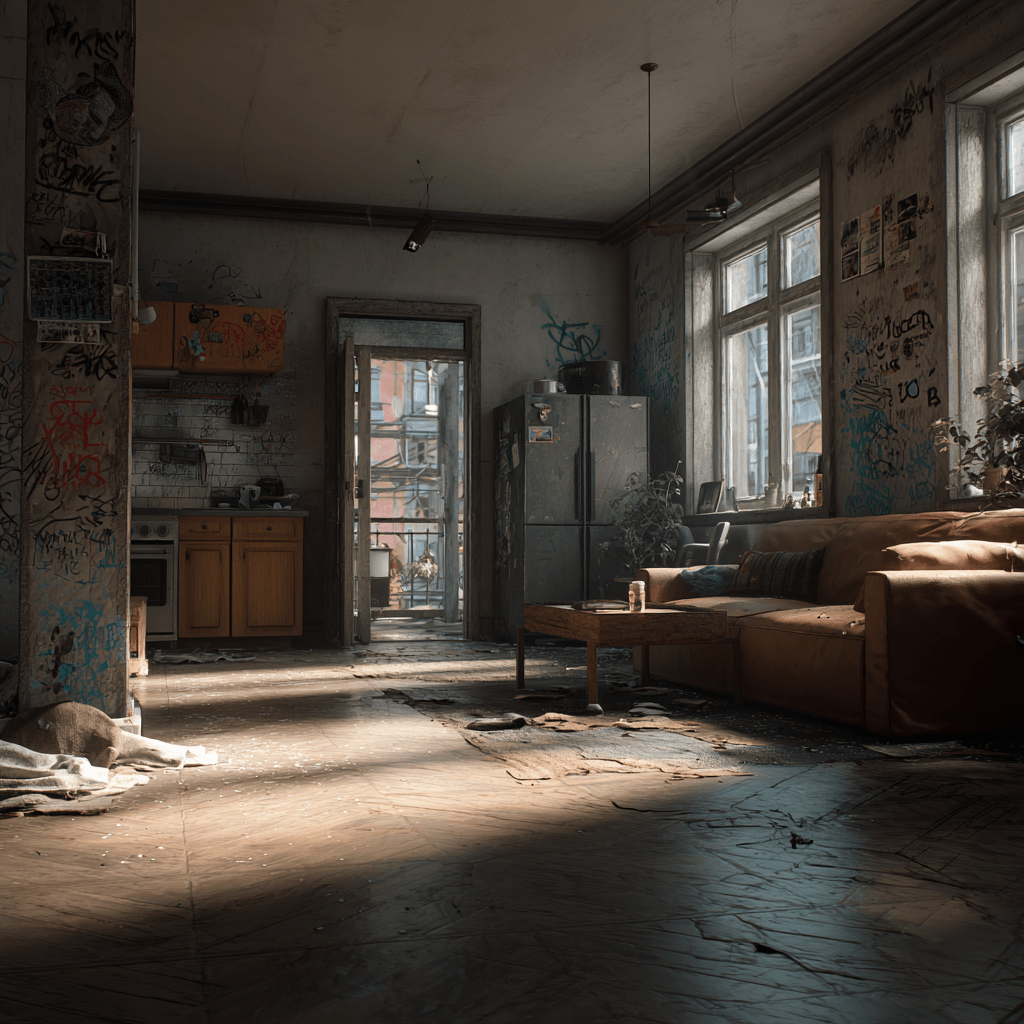
One second I’m watching the LRT platform crowd process what just happened, and the next the white cube has relocated me to the base of a four-story tenement building that is, to put it plainly, on fire. Not “small kitchen incident” fire. Not “someone left the stove on” fire. The real kind — orange and roaring, punching through windows on the second floor and climbing fast, black smoke billowing upward in thick columns that smear the afternoon sky the color of a bruise.
Tenants pour out of every exit available to them. A woman in a daster clutches a plastic bag of documents to her chest. A teenage boy has a school backpack on and is carrying a smaller kid — maybe his brother — under one arm. An elderly man moves slowly enough that two younger neighbors flank him automatically, matching his pace without being asked. People shout names across the courtyard. Someone’s trying to drag a plastic water drum toward the building and the math on that particular plan is not great, but I respect the instinct.
The smoke is everywhere. It settles low and moves with the crowd like it’s following them personally.
And then, in the middle of all this — movement that’s going the wrong direction.
Three men, arms full of other people’s things, are backing out of a ground-floor unit that clearly doesn’t belong to them. Electronics. Clothing. A small appliance still in its box. Their leader is broad, unhurried, wearing the expression of someone who has decided that chaos is an opportunity and is very pleased with his own cleverness. Behind him, his two associates are already arguing over who carries what.
They make it approximately four steps into the courtyard before a voice cuts through the noise.
“Bullies, repent and retreat this instant!”
Love Fey lands in front of them.
She didn’t walk up. She landed — both boots hitting the courtyard tile with a sharp double-click, the heart wand already raised, blonde hair settling around her shoulders like punctuation. She’s ten years old and she is radiating the particular energy of someone who has zero patience left and unlimited willingness to act on it.
The leader looks at her. Takes in the pink dress, the tiara, the wand. Grins.
“What can a girl in a costume for a children’s party do against us?” He actually laughs. Full, loud, self-congratulatory. His associates join in.
Oh no, I think. Oh, these guys have no idea.
Love Fey’s smirk is small and precise and deeply unimpressed. “What can I do?” She tilts her head exactly one degree. “Something like this — Flying Kisses!”
The wand comes up. She blows — a single, graceful exhale — and what leaves her lips is not air. It’s a flurry of red heart-shaped projectiles, each one the size of a fist, each one sparkling hot pink at the edges, each one moving with the kind of purpose that suggests they have been waiting for exactly this target. They hit in rapid succession — center mass, one after another — and the looters drop like someone hit the off switch. By the time the last one lands, the courtyard tile around them is covered in rose petals and fully bloomed roses, which is genuinely the most stylish way to get knocked unconscious that I have ever witnessed.
Two bystanders nearby stare. One grabs the other’s arm.
“Brute Beauty!” Both cried at the same time.
Yeah, I think. That’s exactly right.
The_boy_who_walked_into_the_fire.sav
While Love Fey is handling the courtyard situation with extreme prejudice, the sim pulls my attention to the building itself.
Inside the tenement, the fire has been busy.
The hallway on the second floor is a tunnel of heat and orange light, every surface either burning or about to be. Ceiling plaster has come down in chunks. A wooden door to the left is fully engulfed — the frame, the hinges, all of it. The air itself seems angry, thick with smoke and the particular smell of a building losing its structural argument with combustion. Heatwaves distort everything past ten feet, making the far end of the corridor ripple like bad graphics on an underpowered console.
And moving through all of it, somehow, is a man.
He’s middle-aged, stout, wearing a white button-down shirt that is no longer white — soot-gray at the sleeves, ash-streaked across the chest, a long dark smear running from his collar to his shoulder that I don’t want to look at too closely. He’s pressed a damp hand towel against his mouth and nose with one hand and is using the other to brace against the wall as he limps forward. His eyes are streaming — from smoke or from something else, impossible to say. Every step looks like a negotiation between his body and the floor, which is not fully trustworthy anymore.
He’s not going to make it to the stairs on his own.
The ceiling above him groans. A burning plank — long, thick, already broken free of its support beam — begins to fall.
Then a dome of light appears between the plank and the man.
The plank hits the forcefield and bounces sideways harmlessly, shedding sparks and embers that spiral away from the bubble’s surface like they’ve been redirected by something politely but firmly insistent. The dome is warm white at the edge, ivory at the center, and it holds with the quiet certainty of something that was built to hold.
Inside it, the man staggers to a stop, staring.
Cerulean Arlentis steps through the smoke.
He’s twelve years old inside that armor, but the armor doesn’t look twelve. The silver-and-gold plate catches the firelight and throws it back amber, the winged helmet framing a face that is calm in a way that takes actual effort to maintain when the building around you is actively collapsing. His white cape is tucked back over one shoulder, away from the nearest flame. His holy sword is sheathed — this isn’t a fight, it’s a rescue, and he knows the difference.
He puts one gauntleted hand on the man’s shoulder to steady him.
“Are you okay, sir?”
The man stares at him for a full second — at the armor, the wings on the helmet, the forcefield still humming overhead — and then something in his expression just gives, the way people’s faces do when relief hits them faster than they can process it.
“Thank you, boy,” he manages. His voice is rough with smoke. “I owe you my life.”
“I need to get you out of here,” Cerulean says, already scanning the room. His eyes move with the focused efficiency of someone running a real-time threat assessment, which is exactly what he’s doing.
Both hands come up, palms forward. Waves of shimmering ivory light pulse outward from them — slow, steady, rhythmic, like the building’s own heartbeat if the building had decided to heal instead of burn. Where the light touches flame, the flame recedes. Not violently, not with any drama — it just goes, the way lights go out when you flip a switch. White-gold ripples spread through the smoke, and the smoke thins, and the air becomes something a person can actually breathe again.
The man inhales. Properly, fully, for what might be the first time in several minutes.
Cerulean releases the forcefield and gets an arm under the man’s shoulder, and they move toward the stairwell together — the paladin matching his pace, taking the weight, navigating around debris with steady, unhurried steps. They emerge onto the roof, and Cerulean gets the man to a safe section of the ledge and turns back to look at the building.
The fire is still going. Two floors of it, smoke still rising, the courtyard below still loud with voices.
“This isn’t enough,” he says quietly. “The fire needs to be completely extinguished.”
How, I’m thinking. You’re one twelve-year-old with holy light and no water source.
Then the horse lands on the rooftop.
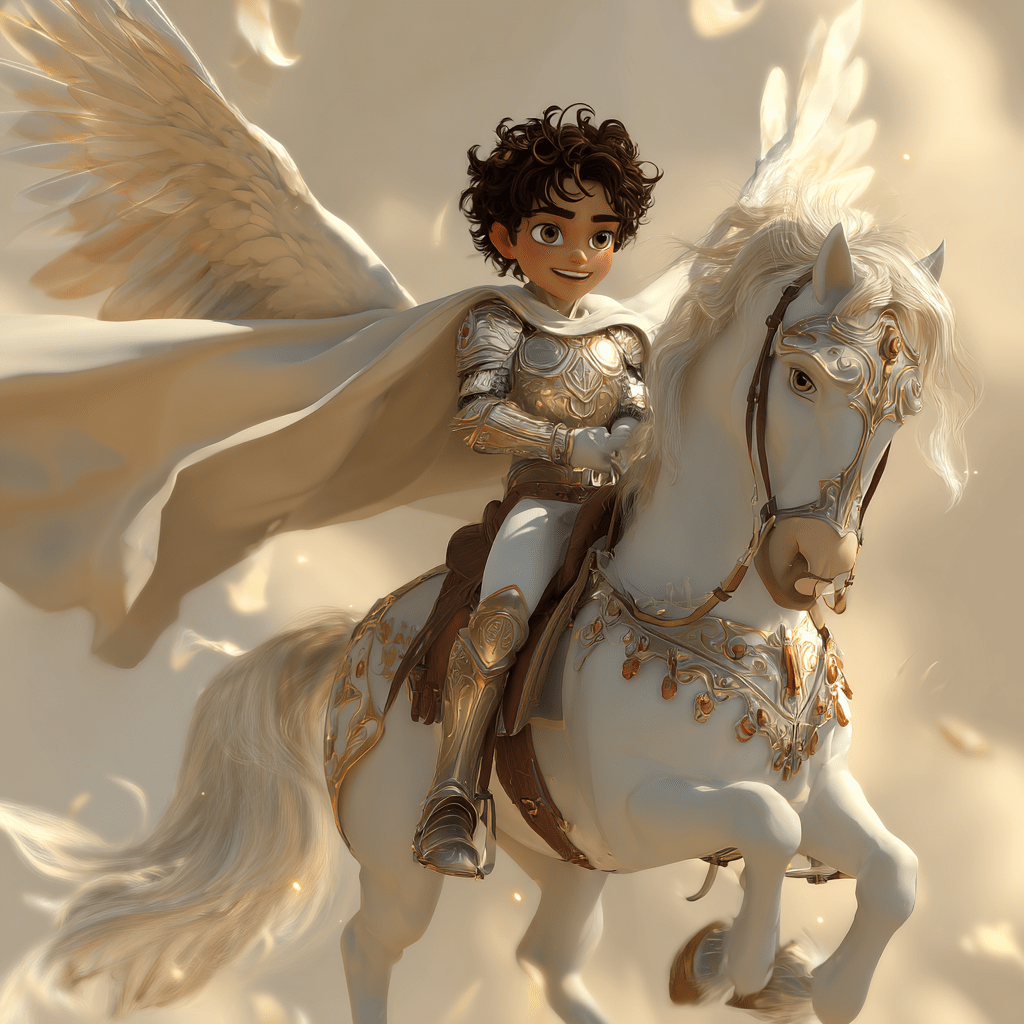
It drops from somewhere above the smoke line — enormous, white, wings folding as its hooves find the roof surface with a sound like a single clean drumbeat. The wingspan, even folded, is wider than a sedan. The coat is pure white except where the light catches it at certain angles and it becomes something closer to luminous. The mane moves in a wind that isn’t quite coming from any particular direction. The eyes are dark and calm and absolutely, unmistakably aware.
A Pegasus.
An actual, no-qualifications-required, mythological divine steed Pegasus. Standing on a tenement rooftop in Metro Manila.
Cerulean stares at it. “A Pegasus?”
The horse holds his gaze. There’s no other word for it — it holds his gaze, steady and patient, with the expression of something that has been waiting and is not in a hurry but would like to proceed.
“Are you saying you can help?” Cerulean asks.
The Pegasus doesn’t answer. It doesn’t need to. It simply adjusts its stance — an almost imperceptible shift, a subtle lowering — and the meaning is clear.
“I need to ride you,” Cerulean realizes.
He climbs onto the Pegasus’s back, settles between the wings, and the horse launches.
They go up — straight up, no runway, just pure vertical lift — and then bank hard into a spiraling arc over the building. White-golden light pours from the Pegasus in their wake, trailing behind them like a comet tail, and wherever it sweeps across the tenement face below, the fire answers it the same way the fire answered Cerulean’s hands inside — by simply stopping. Floor by floor, window by window, the orange light goes out.
They complete the spiral. The building is dark. The smoke is already beginning to thin.
“That was one thrilling ride, buddy,” Cerulean says, grinning under the helmet.
The Pegasus neighs — bright, sharp, genuinely delighted — and banks into a long, lazy glide above the clearing sky, wings spread full.
I stay very still in the white cube.
So close.
The_scoop_nobody_asked_for.sav
Cielo descends first.
The winged pony drops out of the cleared sky in a long, unhurried arc — white wings angled back, hooves finding the rooftop of the adjacent apartment building with the same light, precise contact as the first landing. Up close, in the sim’s full resolution, I can see what I couldn’t fully clock from the ground: Cielo is pony-sized, compact, built more like something that belongs in a nativity painting than a Greek myth. The wings are the real statement — broad and white and feathered, folding inward now with a slow, deliberate grace that has nothing animal about it. The eyes are the giveaway too. Dark, settled, watching Cerulean dismount with the patient attention of something that understands exactly what just happened and considers it a good outcome.
Not a monster. Not a horse. Something else entirely.
Cerulean swings down from Cielo’s back and lands cleanly, one hand briefly resting on the pony’s neck — a small, wordless acknowledgment — before he steps forward and scans the rooftop. The silver-and-gold armor is smudged with ash at the knees and forearms. The white cape has a gray streak across the lower hem. He looks like someone who was just inside a burning building, which is because he was. His posture is steady. His breathing is controlled. He is twelve years old and he is holding himself together with both hands and doing a very good job of making that invisible.
Then Love Fey arrives.
She comes over the rooftop edge at speed — boots hitting the surface in that same double-click landing — and her face tells me everything before she opens her mouth. The composed magical girl expression from the courtyard is completely gone. What’s underneath it is just Allison: brow furrowed, eyes bright, lips pressed into a line that’s doing a lot of work to hold back something bigger. She spots Cerulean and crosses the rooftop in about four steps.
“I thought you were gone! I couldn’t find you in the fire,” she says, and her voice has that particular texture of someone who has been frightened and is now furious about having been frightened.
Cerulean turns to face her. The smile that crosses his face is immediate and warm and completely unguarded — not the reassuring-the-civilian smile from inside the building, something more personal than that.
“I’m alive and okay, as you can see,” he says. “There’s no need to worry anymore.”
“I’m so glad!”
She hugs him. Full, tight, both arms — the kind of hug that’s really an argument, that’s saying don’t you ever do that again in a language that doesn’t need words. The heart wand is still in one hand, sticking out at an angle. The tiara is slightly askew from the rooftop landing. Cerulean’s arms come up and close around her shoulders, and he pats her head once, carefully, with one gauntleted hand.
“It’s alright now,” he says quietly. “No need to cry.”
From my position in the white cube I watch this and feel the specific weight of the distance between us — the sim room walls, the vacuum of space, the unbridgeable gap between observer and observed. So close, I think. And so far.
I almost miss the woman with the camera crew.
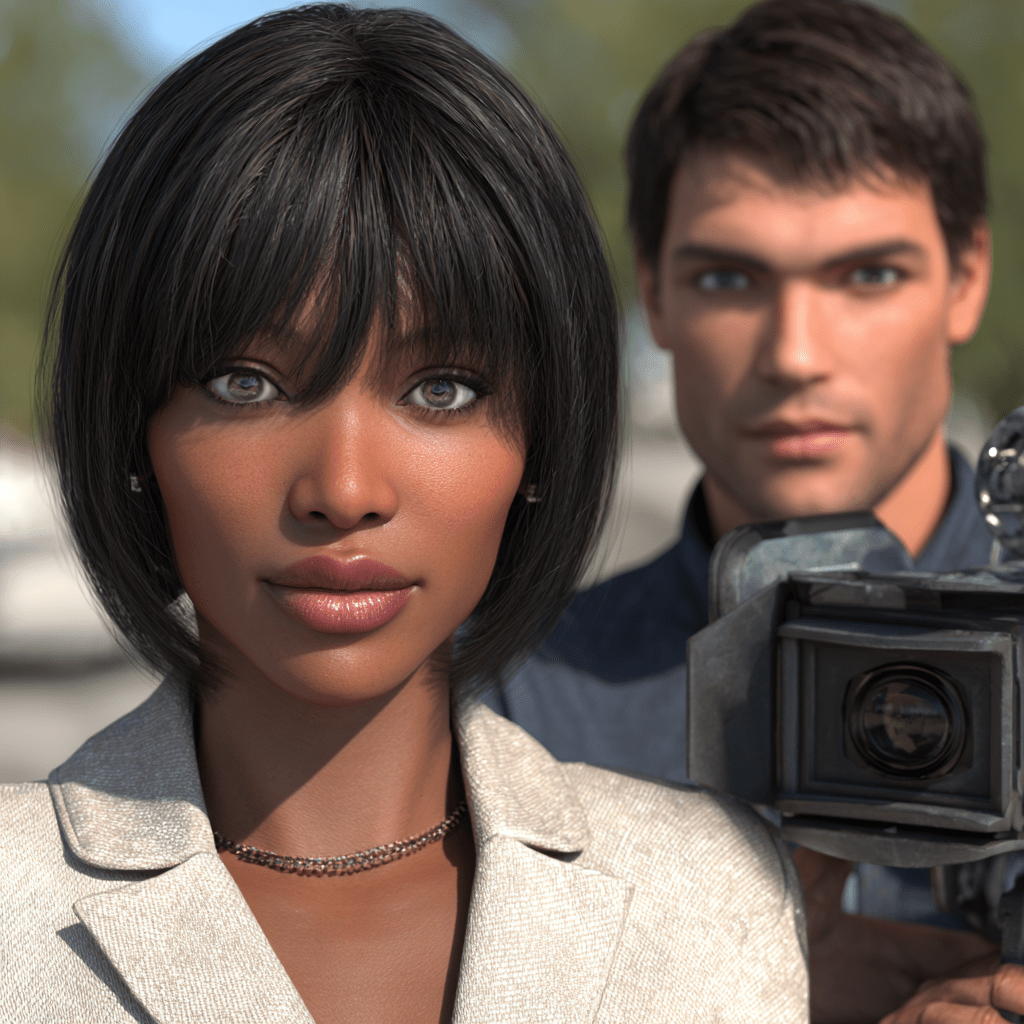
She’s positioned herself at the far edge of the rooftop and she is vibrating with barely contained professional excitement. Stout frame, bob-cut hair framing a round face, and wearing — I have to look twice — what can only be described as a cowgirl-inflected blazer situation, the kind of outfit that communicates “I take my job seriously and also I have a personality.” Beside her, a young cameraman with an objectively very good jawline has the camera already up and running. She bites her knuckle. Her eyes have gone soft and slightly unfocused.
She has completely misread this scene.
“Come on,” she stage-whispers to the cameraman, gesturing urgently. “This is a scoop!”
On the rooftop, the hug ends. Cerulean steps back slightly and takes both of Love Fey’s hands in his, which does absolutely nothing to correct Becky Davies’s interpretation of events.
“I’ll always protect you and be by your side,” he says, with the earnest directness of someone who means every word and has not considered for one second how this looks on camera. “You’re the sister I never had.”
Allison’s expression shifts — the last of the worry dissolving into something genuinely bright. “Thank you. That means so much to me.” She squeezes his hands once. “To me, you’re the brother I always wished for.”
Becky actually sighs.
“Am I interrupting something?” she asks, waltzing into the scene with the cameraman close behind, zero hesitation, microphone already extended. She has the energy of someone who has found exactly what she came for and intends to make the most of it. “I’m Becky, by the way. Becky Davies — the new and upcoming reporter from ABS-CBN. Ever beautiful!”
Her cameraman’s expression remains professionally neutral. Just barely.
“I see,” Becky says, drifting slightly, her gaze moving between the two heroes with a warmth that is heading somewhere neither of them is going to enjoy. “A little couple in love—”
“Ew, gross!” Love Fey recoils like she’s been offered something deeply unpleasant. The magical girl composure evaporates completely. “We’re first cousins, you know.”
The effect on Becky is immediate and severe. Her face contracts — a full-face grimace, every feature pulling inward simultaneously — in the specific expression of someone who has just said something embarrassing on live camera and knows it and cannot unknow it. It is, and I say this with complete sincerity, sourer than paksiw. Her cameraman — Gido, I’m going to call him Gido, he has that energy — grins. Slowly. Sarcastically. He was waiting for this.
“It’s okay, Ate Becky,” Cerulean says, with the forgiving smile of someone who grew up as an altar server and has genuinely internalized the concept of grace. “Everyone makes mistakes. Our moms are really close, so maybe that’s why we—”
Love Fey moves fast.
A small heart construct materializes from nowhere — soft, pink, bouncy — and she places it directly in front of Becky’s face, gently blocking the camera’s line of sight to Cerulean’s mouth. Then she puts her own hand firmly over Cerulean’s mouth and turns to look at him with an expression that communicates, without any ambiguity whatsoever: stop talking right now.
“Do you really want to give away our identities that badly?” she whispers, the words coming out with the precision of someone choosing each one very deliberately.
Cerulean’s eyes go slightly wide above her hand. Message received.
Love Fey lowers the heart construct, straightens up, and turns back to Becky and Gido with a transition so smooth it should be studied. “We’re not talking about our moms.” She produces the wand again and tilts it at a professional angle, which somehow communicates press conference despite everything. “8888-8888. That’s the hotline for our spaceship, the Peregrine. Our housekeeper robot, CleanBot, will answer. You can schedule interviews or press conferences with him.” A brief pause. “I’m personally open to movie auditions and casting calls.”
Becky’s grimace evaporates. Her hand is already moving — she’s jotting the number down on a small pad she’s produced from somewhere, with the intensity of someone transcribing classified information.
Beside her, Gido stares at the number she’s writing. 8888-8888. He keeps his expression neutral. He does not say what he is thinking, which is that he has already memorized it.
From the street below, the sound of approaching sirens reaches us — the deep, steady blare of fire brigade trucks, the shorter beeps of paramedic vehicles, tires on pavement, the organized noise of emergency services arriving to deal with the aftermath of something that has already been handled. Red and orange light sweeps the underside of the clearing smoke.
On the rooftop, Cielo shifts — wings adjusting, dark eyes moving calmly from the arriving vehicles to Cerulean to Love Fey and back, reading the situation the way Cielo reads everything: quietly, completely, without any indication of what it concludes.
The fire is out. The man in the white shirt is safe. The looters are horizontal in a bed of roses. The train is stopped.
Quest complete, I tell myself, from inside the white cube, from very far away.
Main characters: 1, Metro Manila: 0.
 B. K. P. Carreon
Leave a comment