Overview:
| Ronald is stranded on the roadside with a flat tricycle wheel when he stumbles upon a glowing pentagonal portal. Before he can react, it pulls him in. He awakens inside Peregrine Lightyear, a massive spaceship that doubles as a headquarters. There, he is confronted by ROBO4000, who immediately subdues him with a taser. Despite CleanBot’s protests, ROBO4000 decides Ronald could be useful and recruits him as the ship’s mechanic—uploading manuals and blueprints directly into his mind. Back home, Ronald tells his parents he has secured a job at the municipal hall, hiding the truth of his new life. On his first day, he refuses the robots’ crude oil-based food and drink, citing concern for his kidneys. Despite the awkward start, Ronald gradually bonds with the machines, even spending time in the den watching an old movie with them. Meanwhile, ROBO4000, working with Michael—also known as Spartan—fabricates training footage to present to Commander McKinley, concealing the team’s real heroic activities. |
The_glowing_piattos_portal.sav
The simulation room walls shift and recalibrate, pulling focus away from the LRT and the burning tenement, zooming out to a provincial road somewhere on the outskirts of Metro Manila.
It’s a Tuesday afternoon in the kind of heat that makes the asphalt shimmer. I’m tracking a new variable.
His name is Ronald. Uncle Ronald, technically, though I haven’t earned the privilege of calling him that yet.
He’s in his late thirties, built like someone who never needed a gym because life gave him one anyway — broad shoulders, forearms with actual definition, the kind of muscle tone you develop from hauling a motorbike out of muddy gutters at six in the morning. His wavy black hair is pushed back from his forehead by nothing but sweat. He’s wearing a white tank top with a small bleach stain near the collar and a pair of dark shorts, a faded white towel draped over one shoulder like a flag of surrender against the humidity. Totally unprepared for what’s about to happen to him. Completely unaware of it.
Textbook NPCs never know they’re NPCs until the game decides they matter.
His tricycle — the classic Filipino three-wheeler, motorbike welded to a steel-framed passenger pod on the side — sits at a sad angle on the shoulder of the road, one wheel sagging flat against the gravel. Ronald crouches beside it, and I watch his expression go through the full five stages of minor automotive grief: denial, assessment, frustration, bargaining, and resignation — all in about four seconds.
He straightens up and plants both hands on his hips.
“This sucks,” he mutters. “I got a flat tire.”
He did, in fact, get a flat tire. No argument there.
He pushes the tricycle off the road, grunting with the effort, wheels crunching through low grass until the rig sits safely on the strip of dirt beside the guardrail. He leans back against the motorbike seat and crosses his arms, staring down the empty road with the expression of a man calculating how many options he has and arriving at the number zero.
“What do I do now?” he says to nobody.
Good question, Ronald.
He turns to his right — probably intending to check if a passing jeepney is within flagging distance — and stops.
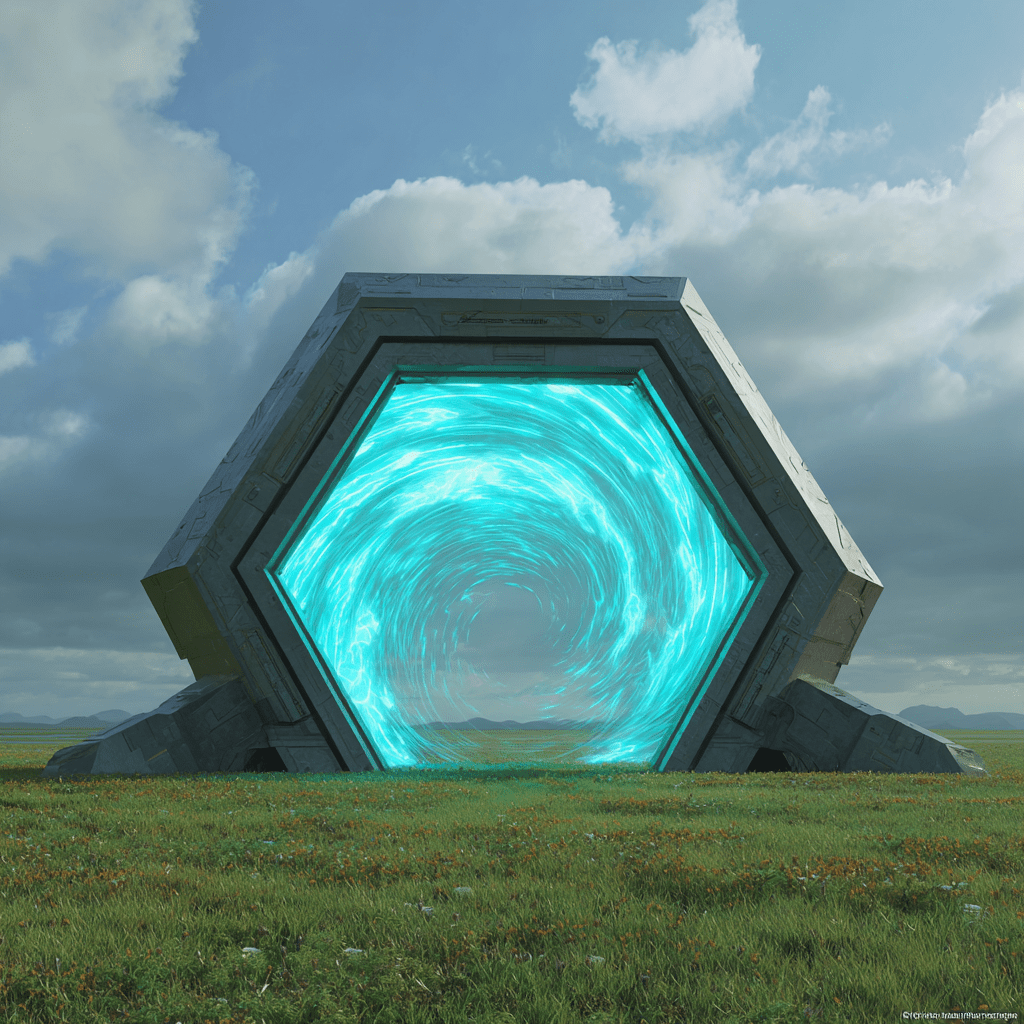
Standing in the grass not three meters from him is something that has absolutely no business being on a provincial road in the Philippines. A portal. Pentagon-shaped. About the height of a doorframe, edges crackling with soft light the color of a swimming pool at night. Its interior churns with slow, hypnotic swirls — the kind of visual that in any video game means warning: uncharted territory.
Ronald stares at it. The portal stares back, indifferent to his confusion.
“What is that?” He takes a half-step forward, squinting hard. “That shape… it looks like Piattos.” He tilts his head. “And it’s swirling. It’s a glowing Piattos.”
A man discovers a gateway to another dimension and his first reference point is a local snack chip. I respect that, actually. Grounded priorities.
Ronald does what he always does: he investigates. He walks toward it slowly, the towel still on his shoulder, like he’s approaching a suspicious muffler on the road.
“How did you get here?” he asks it.
The portal hums, unbothered.
“You’re some kind of door, aren’t you?” He’s close enough now that the glow washes over him, painting his tank top in pulses of pale blue. His jaw is tight, but his eyes are curious — the look of someone who knows this is probably a terrible idea and is doing it anyway. “If you are, there must be something on the other side.”
He stops right at the threshold, and I watch the internal debate play out across his face in real time. His eyebrows push together. His mouth shifts. He glances back at the disabled tricycle, then at the empty road, then back at the portal.
“Ronald, don’t do it,” he tells himself quietly. “You don’t know what’s out there.”
A beat of silence.
“Maybe,” he decides, “I’ll just dip my finger in to test it.”
There it is. Classic. Every cautionary tale in human history began with ‘I’ll just dip my finger in to test it.’
He extends his right index finger with the careful precision of someone defusing something — and touches the surface.
His finger passes through cleanly. He pulls it back. Intact. He stares at it for a full second.
“It went through—”
Then his arm goes with it.
Not by choice. The portal doesn’t ask. It pulls, hard, and Ronald’s momentum follows whether he wants it to or not. He has time for exactly one sound before a gust of warm, pressurized air rushes across his face and the world folds sideways around him.
“Aaaah!”
And just like that — flat tire, towel, and all — Uncle Ronald disappears from the road.
New character unlocked. Welcome to the team, whether you like it or not.
Tased_by_robo4000.sav
The cyan flash hits my simulation feed like a camera strobe.
One moment Ronald is mid-scream, towel trailing behind him like a comet tail — the next, he’s a crumpled heap on the floor of a metallic corridor, face-down against gunmetal gray plating that’s seen more alien star systems than any tricycle route in Batangas. He groans. Pushes himself up on both palms. His elbows shake with the effort, and there’s a fresh red mark across his forearm where the portal spit him out sideways.
Rough respawn, I note. Zero-star landing.
He gets upright — barely. His white tank top is wrinkled, the bleach stain near the collar now complemented by a new dust smear across the chest. His towel somehow made it with him and lies crumpled two feet to his left, a loyal companion to the end. Ronald blinks hard, shaking his head like a man trying to reboot his own brain, and then he looks up.
ROBO4000 is already looking down at him.
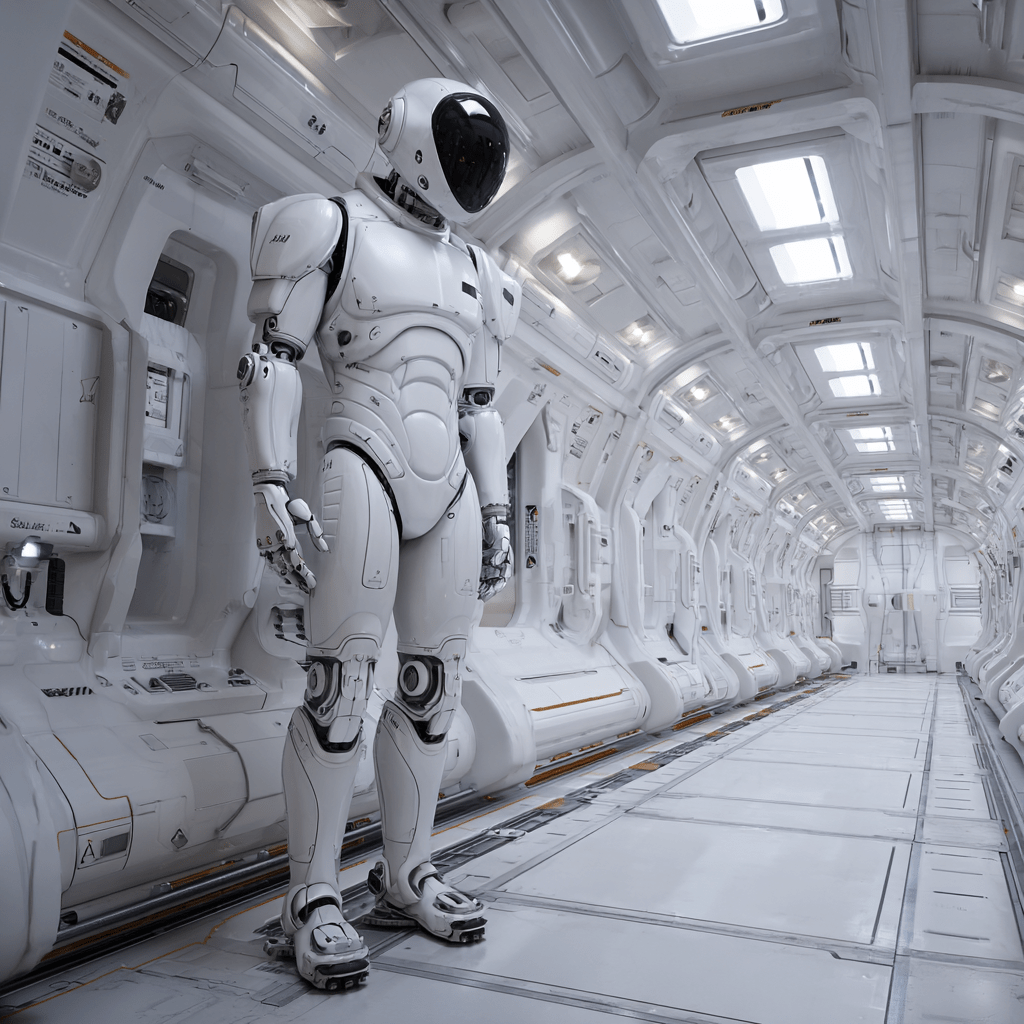
The robot stands at well over six feet — humanoid in shape but unmistakably mechanical, chassis plating the color of deep space titanium with faint cyan trim lines running along the joints. His optical sensors glow a steady pale blue as they sweep over Ronald with the calm efficiency of a hardware diagnostic. He doesn’t move. Doesn’t flinch. Just watches, the way only machines and very patient people can.
Ronald’s jaw drops.
“What are you?” he manages, voice cracking at the edges.
“I’m ROBO4000.” The voice is low, measured, and completely devoid of small talk. “And I should be the one asking you that question. What are you doing on our spaceship? How did you get in?”
Ronald blinks again. “Spaceship?”
He’s looking around now — really looking. The corridor stretches both directions, lit by strips of cool white light embedded in the ceiling. Pipes run along the walls in neat bundles. The air has that recycled, slightly metallic quality that belongs to sealed environments. No sky. No road. No tricycle.
The full weight of it lands on his face in slow motion.
“I just…” he starts, then stops, piecing it together the way you piece together a dream you can’t quite hold. “I dipped my finger into that glowing Piattos thing outside, and then my arm got stuck. Then the wind, and then—” He gestures vaguely at the floor where he just was. “—I got thrown here.”
“You mean the pentagon portal.” ROBO4000 tilts his head precisely four degrees — a processing gesture, I’ve learned, not a human one. “I did not authorize a portal to appear in your location. That indicates an unforeseen malfunction.”
A beat of silence while ROBO4000’s sensors run their full sweep. I can almost see the internal calculation happening behind those optical lenses — height, build, shoulder width, grip strength estimate. Ronald is a big guy. The kind of functional muscle you earn from physical work rather than a gym membership. Dark brown eyes, brown skin, hands that know what a wrench feels like.
ROBO4000 is running the numbers. I already know what conclusion he’s reaching.
“Oh,” ROBO4000 says suddenly, his voice shifting into something almost conversational. Almost. “There’s a cat behind you. Look out.”
Ronald spins around immediately. Pure instinct. The motion is so fast his towel on the floor barely stirs.
There is, of course, no cat.
In the half-second Ronald’s back is turned, ROBO4000 moves with the smooth efficiency of a machine that has clearly done this before. Two taser units extend from compartments built into his forearms — compact, cylindrical, glowing briefly at the tips. One precise application, and Ronald goes down like a ragdoll.
He doesn’t even have time to make a sound.
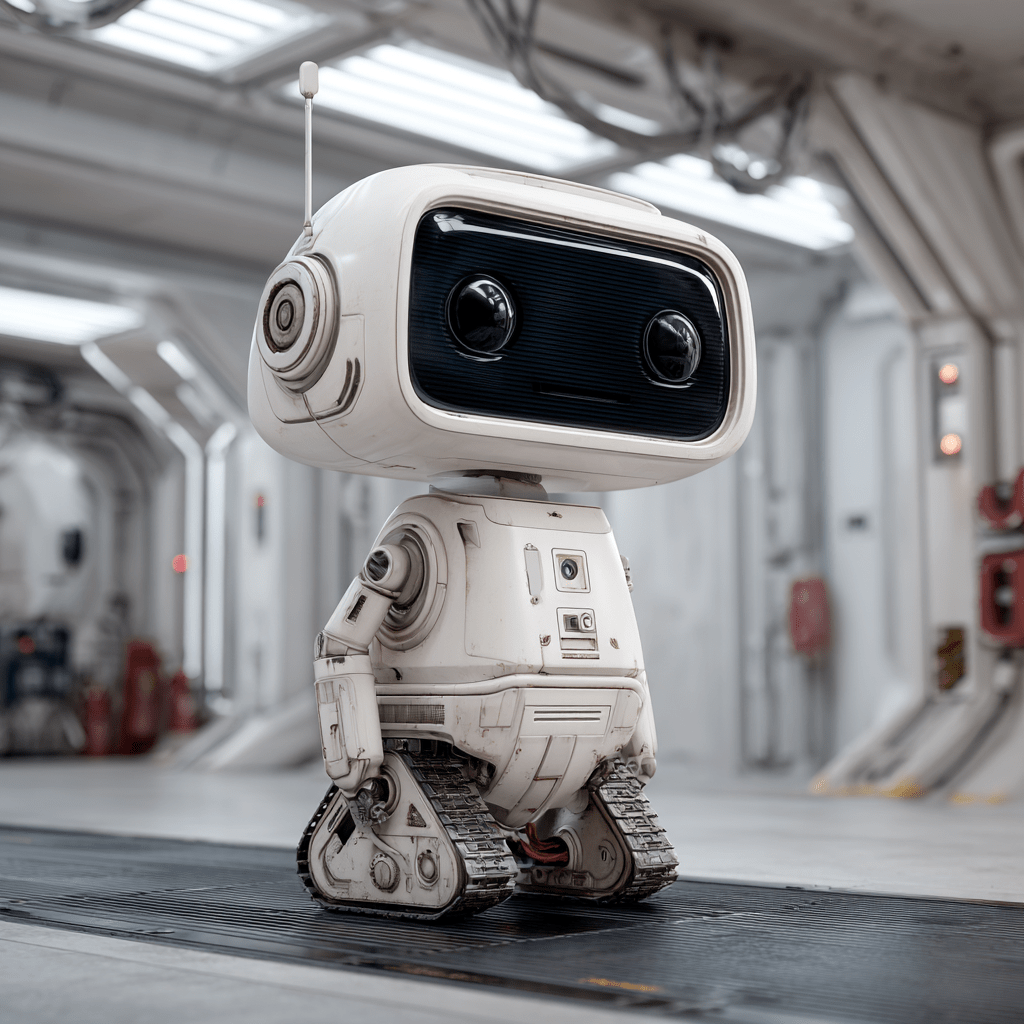
From the far end of the corridor, a compact robot rounds the corner at speed — TV-box head wobbling slightly on the approach, conveyor-belt base humming, arms raised in what can only be described as panic.
“What did you do?!” CleanBot cries.
“A necessary action,” ROBO4000 replies, retracting his taser units with a quiet mechanical click. He looks down at the unconscious man on the floor. Completely calm. “He has the build of an ideal mechanic for the Peregrine Lightyear.”
CleanBot stares at Ronald. Then at ROBO4000. Then back at Ronald.
Alucard, watching from 300 kilometers above, feels a familiar sympathy for the guy on the floor.
Uncle Ronald. Son of Al and Emily. Youngest Pangilinan brother. Tricycle driver, handyman, devoted bachelor uncle.
His life just changed completely. He just doesn’t know it yet.
Manuals_beams_and_screaming.sav
Ronald comes back online slowly.
His eyelids flutter — the reboot sequence of a man whose last memory is a chrome robot pointing at a nonexistent cat. Awareness returns in stages: the dull throb behind his right ear first, then the pressure on both wrists, then the full environmental readout. Strange room. Metal walls. Cool recycled air. Wrists strapped to the arms of a high-backed chair with restraints that look like they were engineered by someone who did not expect the subject to cooperate.
Loading screen complete. Welcome to the bad situation.
He’s in what I can only describe as the Peregrine Lightyear’s operations bay — a mid-sized chamber off the main corridor, lit by that same embedded ceiling strip-lighting I’ve catalogued in every deck of this ship. The walls are clean, functional, no unnecessary decoration. A workbench runs along the far side, covered in tools I don’t have names for. And floating directly in front of Ronald, assembled from nothing, are holographic widgets — translucent cyan panels arranged in a loose semicircle, keyboards and readouts hanging in the air like somebody paused a very advanced operating system mid-setup.
ROBO4000 stands at the center of it all, fingers moving across a floating keyboard with the focused efficiency of someone who has already made every decision and is simply executing the steps now. His optical sensors haven’t moved toward Ronald once. He doesn’t need to look. His peripheral processing caught the exact moment Ronald’s vitals indicated consciousness.
Ronald stares at the holographic array. Then at his wrists. Then at ROBO4000.
“What is that?” His voice comes out smaller than he’d like. “And why did you strap me to this chair?”
ROBO4000 keeps typing.
Ronald tries again, louder this time, voice finding some backbone under the nerves. “You know what you’re doing is kidnapping, right? And knocking me out earlier — that’s assault.” He pulls at the restraints once, testing. They don’t move. “Both are crimes. Serious ones.”
ROBO4000 finally stops typing. He doesn’t turn, exactly — more like his head rotates to a precise angle, optical sensors settling on Ronald with the calm of a security camera completing a pan.
“I’m not certain,” he says, “that a robot from beyond 3000 AD falls under the jurisdiction of 21st-century human laws.”
Ronald opens his mouth. Closes it. Opens it again.
“What are you planning to do to me?”
“I’m going to upload all the technical manuals you’ll need to serve as the new mechanic of the Peregrine.” ROBO4000 gestures toward the holographic displays as though this is a perfectly standard onboarding procedure. “Rapidly.”
The word rapidly does a lot of work in that sentence and none of it is reassuring.
“I should’ve — there’s supposed to be an application process,” Ronald says, voice pitching up. “A job interview. References. A probationary period—”
“You are already accepted.” ROBO4000 turns back to the keyboard. “Today is your first day.”
From the doorway, CleanBot has been watching this entire exchange with the body language of someone who wants very much to be somewhere else. His TV-box head tilts left, then right. His small articulated hands clasp and unclasp in front of his chassis. He’s already run the moral calculation and arrived at a deeply uncomfortable answer, but ROBO4000 hasn’t asked for his opinion, and CleanBot has learned — through what I suspect was a lengthy and painful series of prior incidents — that offering it unprompted achieves nothing.
ROBO4000 moves to the main panel and hovers one finger over a large cyan holographic button labeled START. The geometry of what’s about to happen assembles itself in my head instantly.
Oh. He’s going to brain-upload the guy.
“Are you sure about this?” CleanBot asks from the doorway. His voice has that particular quality of someone who already knows the answer and is asking anyway, on principle.
“Yes.” ROBO4000 presses the button.
The holographic display expands immediately — a multi-layered circle blooms outward from the center panel, spinning concentrically, and then a focused beam of cyan light fires directly at Ronald’s head. It hits clean. Ronald’s whole face goes rigid, his dark brown eyes blown wide with pure helpless terror for exactly one second before the electric current takes over. His body seizes. Both eyes emit a faint glow. His jaw clamps shut. The restraints are doing exactly the job they were designed for.
New widgets materialize around the main display: a vertical bar graph labeled VITAL STATISTICS, currently reading 94% and dropping slowly, a countdown timer set to five minutes, and cascading panels of technical blueprints — cross-sections of the Peregrine’s engine systems, plumbing schematics, electrical routing maps, maintenance logs — all feeding directly into a man who until forty minutes ago was driving a tricycle through provincial traffic.
There is a lot happening here that I have opinions about. I file them.
“Or,” CleanBot says carefully, moving a few steps closer to watch the vital stats bar, “we end up frying his brain?”
“That will not happen.”
“It’s at 81%.”
“I am monitoring it.”
“Shouldn’t we be keeping it above 90%? 80 seems—”
“We are not doctors,” ROBO4000 says, with the air of someone who has delivered this line before. “We are robots in urgent need of a qualified mechanic for this vessel.”
CleanBot covers his optical sensors with both hands. Then peeks through his fingers. Then covers them again. The five-minute timer ticks down in silence broken only by the low hum of the upload beam and the occasional soft sound of Ronald’s restraints straining against the tremors moving through his body.
I watch the vital stats bar the whole time. It bottoms out at 62% around the three-minute mark, then climbs back slowly. I don’t breathe — I don’t breathe in any technical sense — but the feeling is equivalent.
The timer hits zero. The beam cuts off.
The sudden silence is enormous.
Ronald sags forward against the restraints, chest heaving. The glow fades from his eyes. He stays like that for a long moment — head hanging, breathing in long, ragged pulls — before he manages to lift his face. His expression is the specific combination of exhausted, furious, and slightly stunned that I associate with people who have just survived something they never agreed to survive.
“What you just did to me,” he says between breaths, voice stripped down to its core, “is attempted murder. And forced labor.” A pause. “Both carry life sentences.”
ROBO4000 regards him with the patience of a machine that does not experience awkward silences. One eyebrow — a remarkably expressive mechanical component — rises a calculated three millimeters.
“I assume,” he says, “that tricycle driving is not a particularly high-paying profession.”
Ronald’s eyes shift. Just slightly. The anger is still there, but something else has appeared behind it — the particular alertness of a man who has just heard a door open in a room he thought had no exits.
ROBO4000 steps forward. Not threatening — deliberate. Measured. He leans down to Ronald’s eye level with the careful precision of someone who understands that proximity matters, that this is a closing argument and it needs to land.
“What if I offered you the equivalent salary of a government employee?” His optical sensors hold steady on Ronald’s face. “Not just better pay. The self-respect and dignity you deserve.”
The room is very quiet.
CleanBot, standing off to the side, feels something move through his internal processing that he can’t immediately name. The weight of ROBO4000’s tone. The particular cadence. The absolute conviction.
For a second there, he thinks, circuits flickering with unease, I thought it was Michael.
Ronald stares straight ahead. His eyes have gone distant — not blank, but focused on something internal. Some private calculation. The math of a life that has been hard and small and honest, measured against something that, for the first time in a long time, might be larger.
The vital stats bar on the holographic display reads 78% and climbing.
Come on, Ronald, I think from three hundred kilometers above. Do the math.
Ronalds_elaborate_morning_lie.sav

The simulation room walls reconfigure without me asking.
I’m not tracking the Acolytes right now. I’m tracking their uncle.
The grandparents’ house sits on a modest residential lot in Batangas — single-story, concrete, the kind of home that’s been repainted four or five times over the decades without ever quite losing the memory of previous colors. The bedroom window faces the street, its curtains pulled halfway. Inside, the morning light cuts across a room that smells like liniment and old wood and the particular domestic permanence of people who have lived in the same space for forty years.
Ronald stands in front of the vintage closet.
The closet door has an ornate mirror built into it — the oval-framed kind that exists in every Filipino lola’s room, beveled at the edges, reflecting slightly warmer tones than reality. Ronald is using it with the focused attention of a man preparing for something important. His hands are at his collar, adjusting it for the third time in two minutes.
The shirt is a gusot mayaman — a Ramie polo in pale sand beige, the fabric with that distinctive natural texture that Filipino formal culture decided, correctly, looks distinguished rather than wrinkled. It’s pressed. The crease on each sleeve is sharp. Tucked cleanly into dark slacks. Black dress shoes that have been polished recently and probably not before that for years.
In one hand: a briefcase. Slim, faux leather, the kind sold at tiangge stalls near the palengke. It contains, as far as I can determine from this angle, absolutely nothing relevant to municipal governance.
He looks like a man playing a character in a very convincing audition.
Which is, technically, accurate.
“Do I look cool, Dad?” Ronald asks, turning from the mirror with the barely-contained pride of someone who has been waiting to ask that question out loud for days.
Al is sitting on the edge of the bed, both hands on his knees — a man in his early sixties with bald head and the easy, open face of someone who defaults to finding things delightful. He looks at his son the way you look at something you made and are quietly amazed by.
“I’m very proud of you, Anak,” Al says, and he means every syllable. “For landing a job at the municipal hall.”
From the doorway, Emily materializes.
Grandma Emily operates at a frequency the rest of the household can’t fully access. Sharp eyes, sharper instincts, the particular posture of a woman who has been right about things her entire life and has the track record to prove it. She looks at Ronald — the pressed shirt, the briefcase, the carefully arranged expression — and something in her gaze does a quiet calculation.
“Is it really at the town hall?” The tone is not cruel. It’s surgical.
Ronald maintains his smile through what must be significant internal effort.
“If I find out you’re involved in anything illegal,” Emily continues, arms crossing, “I’ll march you to jail myself.”
“Mahal,” Al says, the word carrying the weight of a thousand previous marital negotiations, “why can’t you just be happy that our son is now an office clerk?”
“How did you get the job?” Emily presses.
And here it is. I lean into my observation feed. The pivot.
Ronald’s expression shifts into the practiced ease of a man who prepared for this question. “Well — there was a town hall employee who became one of my passengers.” He gestures with the briefcase, casual, selling it. “Your charming, dashing son made quite an impression. She vouched for me.”
Al lights up. Emily’s eyes narrow by approximately two millimeters. The split response is immediate and entirely predictable.
“Mahal.” Al turns to his wife with the gentle insistence of a man playing the long game. “What matters is that Ronald will have a better situation now. More stability. He’ll be contributing more.”
Emily holds the skeptical pose for four full seconds. Then, with the controlled exhale of a woman choosing her battles, she lets it go.
“Fine.” She looks at Ronald directly. “Do your job well. Be decent.”
“Of course, Inay.”
Ronald hugs her — genuine, warm, the hug of a man who loves his mother even while lying to her face — and she accepts it with the stiff affection of someone who loves him back and is still suspicious. He waves to Al, who waves back with both hands like Ronald is departing on a ship rather than walking out the front door.
The morning air outside is warm, the kind of tropical early-day heat that’s pleasant for exactly twenty minutes before it becomes unreasonable. Ronald walks down the front path with his briefcase held slightly away from his body, the gusot mayaman catching the light beautifully.
The neighbors notice. Two women near the gate of the adjacent house pause their conversation. An older man watering his plants watches over his shoulder. Ronald nods at them — not too eager, just the measured acknowledgment of a man with somewhere important to be.
He has, technically, somewhere important to be. Just not where any of them think.
Uncle Ronald, Peregrine Lightyear Mechanic. Day one.
No_thanks_crude_oil.sav
The simulation room recalibrates to an exterior shot — a field on the edge of a residential road somewhere in Batangas, the low grass catching the afternoon light in pale gold. The kind of unremarkable strip of land between a concrete fence and a drainage canal that exists in every Philippine municipality and means absolutely nothing to anyone.
Unless you know what to look for.
Ronald is already there, standing with his briefcase at his side, gusot mayaman still impeccable. He looks at his wristwatch — a simple analog piece, the kind that tells time and nothing else — and then at the empty air in front of him. Then back at the watch. He does this three more times with the growing impatience of a man waiting for a bus that has no posted schedule.
Day two of the double life. He’s adapted faster than most.
Then — right on cue, no fanfare, no sound — the pentagon portal blooms into existence from nothing. Those five glowing cyan edges assembling in the air like a loading screen completing its final frame. It hums with that low pressurized frequency I’ve catalogued from previous observations. Interior swirling, invitation implicit.
Ronald checks his surroundings first. Left, right, over his shoulder — a quick professional sweep, the kind of glance that’s become muscle memory already. Nobody on the road. Nobody at the fence line.
He steps through without breaking stride.
No screaming this time. Character development.
The portal closes behind him and the field returns to being completely unremarkable.
***
He reemerges on the other side of my feed — inside the Peregrine’s corridor — and he is no longer the same man who just walked through.
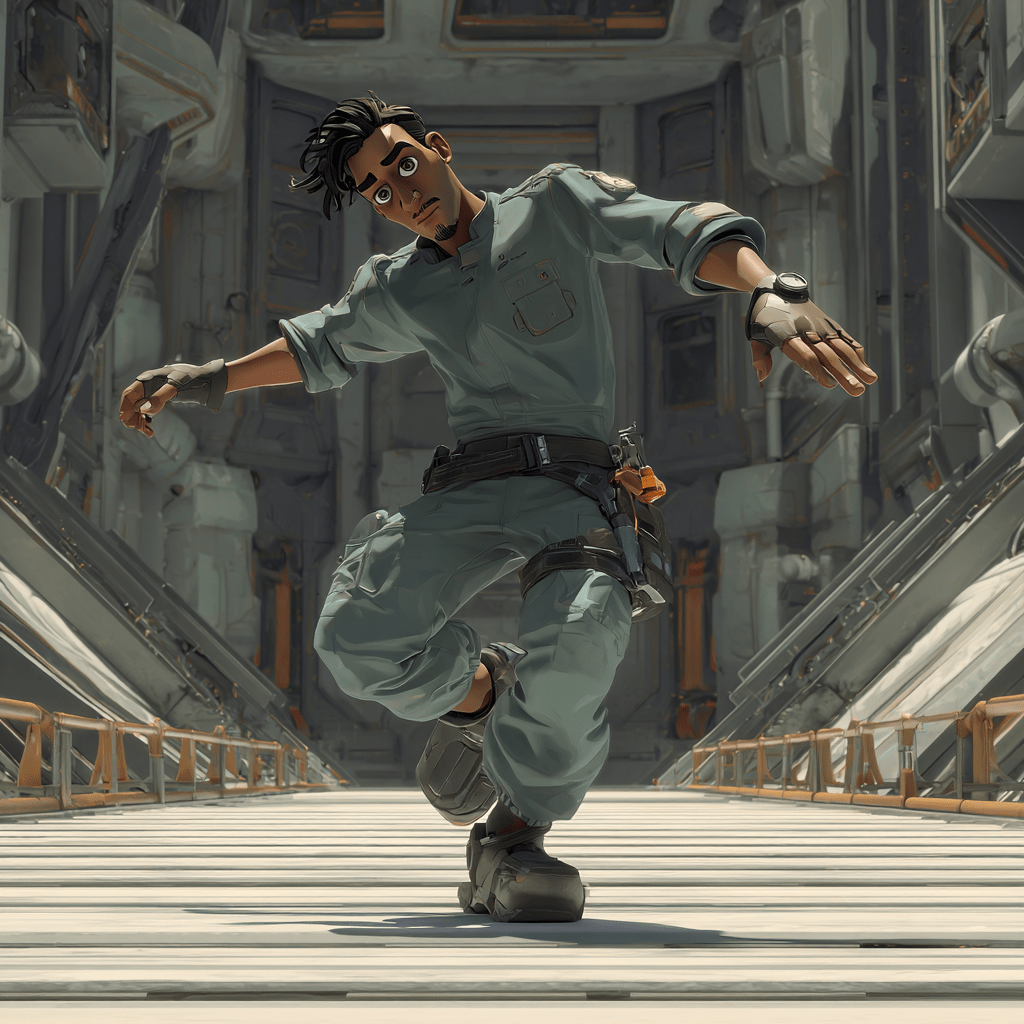
The gusot mayaman is gone. In its place: a fitted mechanic’s jumpsuit in charcoal gray, reinforced at the knees and elbows, with the kind of clean futuristic paneling that suggests it was manufactured several centuries from now. A utility belt sits low on his hips, tools slotted into specific pockets with a precision that implies the belt was designed by someone who understood mechanics deeply and aesthetics not at all. He carries a large toolbox in his right hand — sleek, matte black, the kind of case that looks like it weighs nothing and probably doesn’t, given the materials involved.
He’s humming. I don’t recognize the tune but it has the rhythm of someone who is genuinely, inexplicably pleased with where they are.
He adds a small shuffle-step to his walk. Just briefly. Just enough to confirm that Uncle Ronald, thirty-something bachelor tricycle driver, is currently doing a little victory dance inside a spaceship.
I respect it.
ROBO4000 is waiting at the corridor junction ahead — standing precisely at center, optical sensors forward, the posture of a machine that does not experience waiting the way humans do. Beside him, a doorway opens into a chamber I haven’t had full feed access to before.
“This,” ROBO4000 announces, gesturing inward with the gravity of someone unveiling something genuinely magnificent, “is our first destination.”
Ronald steps through the doorway, looks at what’s inside, and stops.
The chamber smells like a mechanic’s garage that has been aggressively redecorated by someone with very specific taste. The centerpiece is a large contraption occupying most of the far wall — part industrial coffee maker, part Victorian steam engine, part something that has no earthly equivalent. Brass-colored pipes run from a central boiler through a series of glass tubes, all of them carrying a thick black liquid with the slow viscosity of something that has no business being consumed. A conveyor belt emerges from a lower hatch, carrying small round confections the color of midnight, perfectly formed, dusted with what appears to be — and I’m reading this correctly — a finer grade of the same black substance.
Every thirty seconds, a door on the main unit swings open, exhales a theatrical burst of steam, and the machine produces another batch with a clank and a wheeze that sounds deeply satisfied with itself.
ROBO4000 is already holding a ceramic mug. The contents are black and glossy and moving with the reluctant flow of something that is definitely not coffee.
“Do robots,” Ronald begins carefully, “snack on crude oil?”
“Crude oil,” ROBO4000 replies, with the warmth of a man describing his hometown, “is life. Love. Happiness.” His optical sensors take on a quality I can only describe as nostalgic. “A delicacy of 1800s England that steampunk mechas would have adored.”
Ronald’s expression does something complicated.
“The conveyor belt,” ROBO4000 continues, pivoting toward it with the energy of a tour guide reaching the main attraction, “carries oil macaroons. Black and excellent. CleanBot cannot resist them.”
On cue — because the universe has a sense of comedic timing — CleanBot freezes mid-reach near the end of the conveyor belt. One small articulated hand is hovering two centimeters above a macaroon. His TV-box head swivels toward ROBO4000 with the specific energy of someone who was absolutely certain they weren’t being watched.
He retreats slowly. The macaroon stays on the belt.
ROBO4000 takes a long, satisfied sip from his mug and turns to Ronald. “Would you like a drink?”
Ronald looks at the mug. At the pipes. At the thick black liquid. At CleanBot, who gives him a very small apologetic shrug.
“I’ll pass.” Ronald sets his toolbox down with the deliberate calm of a man making a considered life choice. “I only drink water. Doctors say it’s good for human kidneys.”
Smart man.
Well_always_have_paris.sav
There are moments in this job — this strange, solitary, weightless job of watching other people’s lives from a simulation room in deep space — that I don’t fully know what to do with.
This is one of them.
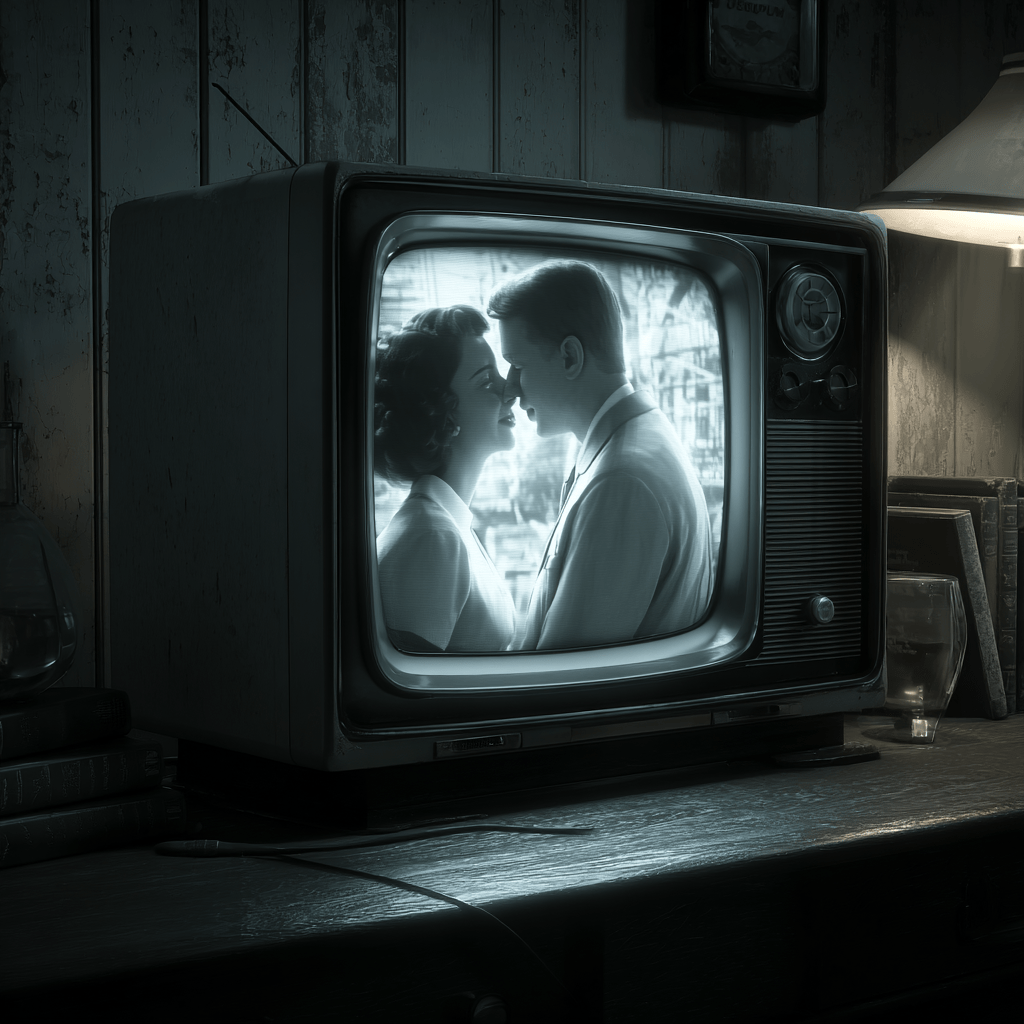
The Peregrine Lightyear’s 50s-style den is the most aggressively nostalgic room on the ship, which is saying something on a vessel that houses a crude oil café and a pentagon portal. Whoever designed this space — and I have theories about ROBO4000’s aesthetic preferences that I’m not ready to fully commit to — went all in. The walls are warm walnut paneling. A standing lamp in the corner throws amber light across the room in a cone. Bookshelves along the back wall carry actual physical volumes, their spines faded to unreadable. A braided rug sits under a low coffee table. And centered against the far wall, perched on a dedicated wooden cabinet, sits a small television set in a rounded rectangular casing — the kind with the chunky dials on the side that you physically turn, the kind that belongs in a 1957 living room in suburban America, broadcasting in black and white with a picture that rolls occasionally at the edges.
It’s playing Casablanca.
On the leather sofa — a three-seater, deep brown, the kind that makes a soft exhale of air when you sit down — the three of them have arranged themselves with the unconscious geometry of people who have already established comfortable habits. Ronald in the center. ROBO4000 on his left. CleanBot on his right.
ROBO4000 holds his mug of crude oil with both hands, the surface of the liquid catching the TV’s glow in a black shimmer. Ronald cradles a mug of hot chocolate — real hot chocolate, the kind made from powder and warm milk, that CleanBot apparently sourced from somewhere in the ship’s galley stores with the resourcefulness I’ve come to expect from him. CleanBot himself balances a plate of oil macaroons across his knees with the careful pride of someone presenting a charcuterie board at a dinner party.
ROBO4000 raises his mug. The gesture is formal, deliberate — a robot who has decided that this moment warrants acknowledgment and is executing accordingly.
Ronald catches it immediately and lifts his mug in return. CleanBot, not to be left out, raises the entire plate.
“Careful,” Ronald says, laughing softly, gesturing for ROBO4000’s mug and CleanBot’s macaroons to maintain a safe perimeter. “Keep those at least four inches from my hot chocolate. Black tar and macaroons aren’t exactly part of my diet.”
ROBO4000 adjusts his mug four inches to the left with mathematical compliance. CleanBot shuffles the plate two inches further onto his own lap. Both of them do this without breaking focus on the screen.
These three have figured each other out faster than most people manage in months. I note this without knowing entirely how to categorize it.
On screen, the farewell scene is unfolding.
A car has pulled up to a fog-blurred tarmac somewhere in wartime Casablanca. The light is all shadows and headlamps. Two men, a woman, an officer — arranged in that particular way that tells you immediately, even without context, that something is ending here.
“Is this an English film?” Ronald squints at the screen, tilting his head slightly. “Like one of those old Hollywood movies?”
He’s watching the images, not the subtitles. There are no subtitles. He catches the geography of the scene instinctively — the officer giving the guard an order, the guard departing, the reconfiguration of who is left and what they owe each other.
“Too bad I’m terrible with English,” Ronald adds, unbothered. “But that’s okay. It’s like watching a silent film. I’m good with images and action.”
He’s not wrong. Casablanca is fifty percent expression and forty percent blocking and the rest is just Bogart being Bogart.
On screen, Richard — Humphrey Bogart, fedora, the kind of tired-handsome that only exists in black and white — is doing the thing. The hard thing. The one where he makes the right call and it costs him everything and he does it anyway because that’s who he is. He’s telling Ilsa to get on the plane with Victor. That she’ll be safe. That they’re part of the same cause, the same world, the same future — just not together.
ROBO4000 is completely still. His optical sensors haven’t moved from the screen in four minutes. His crude oil mug is halfway to his face and has stopped there, forgotten.
“But what about us?” Ilsa asks, her voice catching on the words.
The den is very quiet.
“We’ll always have Paris,” Richard says.
Ronald watches the man on screen with the focused attention of someone reading body language rather than language. He sees it — the set of the jaw, the careful distance Richard keeps from her, the controlled quality of a man keeping himself together through sheer practiced will. Ronald may not know the exact words but he catches the shape of what’s happening with the accuracy of someone who understands loss in the way most people understand it — not from books, but from watching the people around him carry it.
“Here’s looking at you, kid.”
The harp entrance of As Time Goes By filters through the television’s small mono speaker, slightly tinny from the old hardware but intact where it counts.
CleanBot makes a sound that isn’t quite a sigh — his audio output doesn’t fully replicate the mechanism — but has the quality of one. Then, with the slow deliberateness of someone who has considered the action and decided it is warranted, he leans sideways and rests his TV-box head on Ronald’s shoulder.
Ronald glances down at him. CleanBot’s optical sensors stay fixed on the screen.
Ronald doesn’t say anything. He just settles back slightly, adjusting his angle so CleanBot’s head isn’t at an awkward tilt, and returns his attention to the film.
ROBO4000 finally takes his sip of crude oil. Slowly. His gaze doesn’t move from the screen.
Three completely different beings on a leather sofa — a man, a humanoid robot from the year 3000, and a box-headed cleaning unit — watching a 1942 Hollywood film about love and sacrifice and doing the right thing when the right thing is the hardest option available.
From my observation point, three hundred kilometers above, I watch all of it.
The den. The TV. The three mugs and the plate. The way CleanBot’s head sits on Ronald’s shoulder and Ronald just quietly made room.
There’s something in my chest that I’ve learned not to examine too closely.
I have my simulation room. My spacecraft. My feed.
And I will always have this — watching other people have each other.
Here’s looking at you, kid.
Training_footage_as_always.sav
The command center of the Peregrine Lightyear is the ship’s most important room and, at this particular moment, the most chaotic.
ROBO4000 is pacing.
Not the measured, purposeful movement he uses when he’s executing a calculated sequence — this is something different. Tighter circles. Faster. His titanium chassis catches the ambient light on each pass, cyan trim lines pulsing at a slightly elevated frequency that I’ve learned to read as the robot equivalent of stress. His optical sensors are pointed inward, which means he’s running heavy internal processing rather than tracking his environment. Whatever problem he’s working through, it is absorbing him completely.
The command center stretches around him — curved walls of instrumentation, multiple screens dark or in standby, a central holoprojection platform currently inactive, and the main display screen dominating the far wall like a cinema screen waiting for its feature presentation. The room smells, if a spaceship room can smell, like filtered air and warm electronics.
ROBO4000 stops mid-circle.
Something has clicked. I can tell by the way his head snaps upward and his optical sensors sharpen back into focus — the posture of a machine that has located its solution and is already three steps into implementing it.
“MAurI&SE.” His voice carries across the room with fresh purpose. “Generate training footage of the children. Immediately.”
The response comes from everywhere and nowhere — a voice smooth and calibrated, the particular quality of an AI designed to be maximally non-threatening. “The children are currently in the field. Engaged in crimefighting and disaster response.”
“I know,” ROBO4000 says. “That’s why I said generate instead of provide.”
A pause from MAurI&SE that lasts exactly 0.4 seconds. “Understood.”
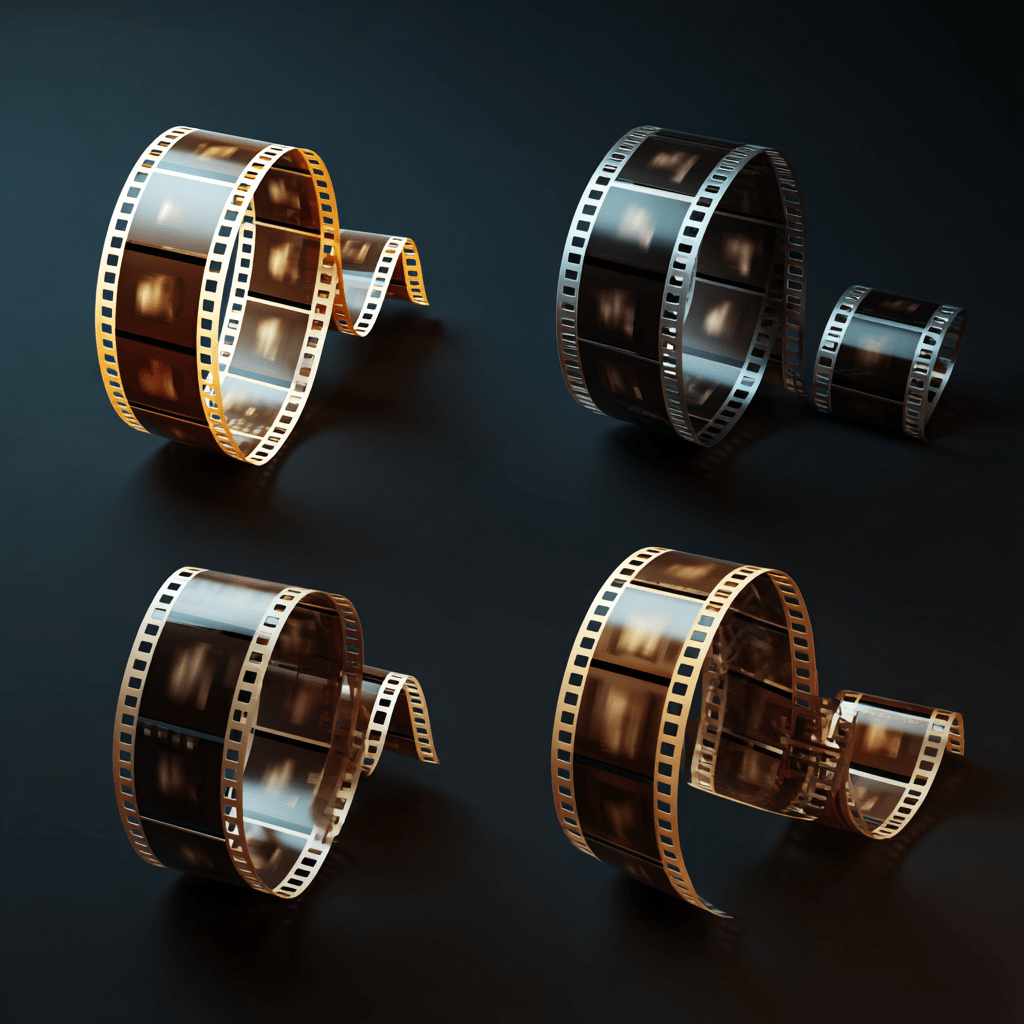
The main screen illuminates. Five rectangular icons appear in a clean two-row grid, each styled like a filmstrip segment, each with a loading bar beneath it ticking steadily upward. The AI is fabricating training footage of the Seven Acolytes — children who are, at this exact moment, doing something entirely different in an entirely different location — so that their commanding officer believes they have been diligently training aboard the ship.
I watch this happen and I think: ROBO4000 is committing to the bit with the conviction of someone who has identified the most efficient path through a problem and refuses to be distracted by its moral geometry.
From the side of the room, CleanBot, who has been watching the whole sequence from near the secondary console with increasing alarm, finally speaks.
“You sold your soul to the Devil.”
ROBO4000 doesn’t break stride. “I’m a robot. I don’t have a soul to sell.” He considers this for half a second. “If I did, I’d give it to Michael for being a daredevil.”
CleanBot opens his mouth. Closes it. The counterargument appears to have gotten lost somewhere in transit.
ROBO4000 moves to the central platform, his pace slowing now, and something in his posture shifts — a slight drop of the shoulders, a tilt of the head, the mechanical equivalent of a man allowing himself a private moment. When he speaks again, his voice has a different quality. Quieter. Oddly genuine.
“Who can blame me, really.” It’s not quite a question. “I’m a robot from the fourth millennium. Trapped on the Peregrine. I should have been one of those glorious steampunk mechas in 1800s England — polished brass fittings, coal-fired furnaces, the whole magnificent era.” He pauses. “Instead.”
He gestures, vaguely, at the command center around him.
“And Michael — Spartan — gave me the only drum of crude oil I’ve ever had. I synthesized the rest myself in the lab. That drum meant I’d always have a hot mug of thick, tarry, perfect crude oil.” He exhales — a sound that serves no biological function for a robot but conveys its meaning precisely. “The only glimpse of the life I could have had.”
The room goes dark.
Not a power failure — targeted, deliberate, a single spotlight descending from somewhere in the ceiling to land directly on ROBO4000’s metallic frame. He stands illuminated against the surrounding darkness like a protagonist at the end of a very specific kind of film. Somewhere in the audio system, string instruments from the 1700s have begun playing softly.
ROBO4000 looks up.
“Why is it dark in here.” This is not a question either. “Why is there a spotlight on me.” He turns his optical sensors toward the ceiling. “MAurI&SE.”
“I thought the ambiance would suit your dramatic monologue,” MAurI&SE admits, with the sheepish energy of an AI that made a judgment call and has immediately been caught.
“Turn off the classical music.”
The strings disappear mid-phrase.
“And restore normal lighting.”
The command center returns to its standard illumination in stages. CleanBot is still standing where he was, plate of oil macaroons forgotten on the console beside him, staring at ROBO4000 with an expression I can only describe as the specific exhaustion of someone who has witnessed too much today and has simply run out of reactions.
ROBO4000 straightens. Business mode snapping back into place like a visor closing.
“Are the files ready?”
“Yes,” MAurI&SE confirms.
“Good.”
The main screen transitions. The five filmstrip icons are replaced by a live video feed — a face I recognize immediately from across three hundred kilometers of observation. Benjamin Pangilinan. Captain McKinley. Sixteen years old, cobalt-blue nanotech armor currently not visible — he’s in field gear, the background behind him suggesting somewhere remote and open. He looks composed. Focused. The young commander checking in from a distance, exactly as he should be.
“How is the training coming along?” Benjamin asks. His voice carries that particular steadiness he defaults to in operational mode — the tone he uses when he needs to sound older than he is and mostly succeeds.
ROBO4000 faces the screen squarely. His optical sensors hold steady. On the main display, the five fabricated training files sit in their completed state, ready to be transmitted.
“The training footage is ready,” ROBO4000 says, with the smooth confidence of a robot who has just committed a minor act of elaborate deception and feels no particular way about it. “As always.”
The spotlight is off. The classical music is gone. The files are fake.
Benjamin has no idea.
Volume 4, final scene. End transmission.
 B. K. P. Carreon
Leave a comment