Overview:
| Thalia applies Allison’s makeup backstage as the mall children’s show prepares to begin. When her mother and their maid, Morissette, step away to use the restroom, Allison seizes the chance to sneak off in search of her celebrity crush. Onstage, Allison finds herself mesmerized by DJ Robin while performing in the show. Suddenly, disaster strikes—the stage spotlights come crashing down. In an astonishing turn of events, a giant glowing heart bursts from Allison’s palm, catching the falling lights and redirecting them safely away from the audience. As spectators raise their phones in shock and excitement, Allison panics and dashes back toward the backstage area. Unwittingly, she sprints straight into a futuristic pentagon-shaped portal that materializes in her path—and vanishes. Elsewhere, Topher feeds his dog, Hunter, and recalls how, when Hunter was still a pup, he once guided rescuers to him. Meanwhile, in his school’s music room, James strums his guitar and discovers he can create vivid illusions. His music weaves living images of youth skateboard culture, splashing across walls like animated graffiti and street art. Rowan witnesses the phenomenon and rushes to tell the rest of the band. But when they return to see it for themselves, James is already gone—pulled into the same mysterious pentagon portal. |
Backstage_glamour_pre_transformation_witness_clearance.sav
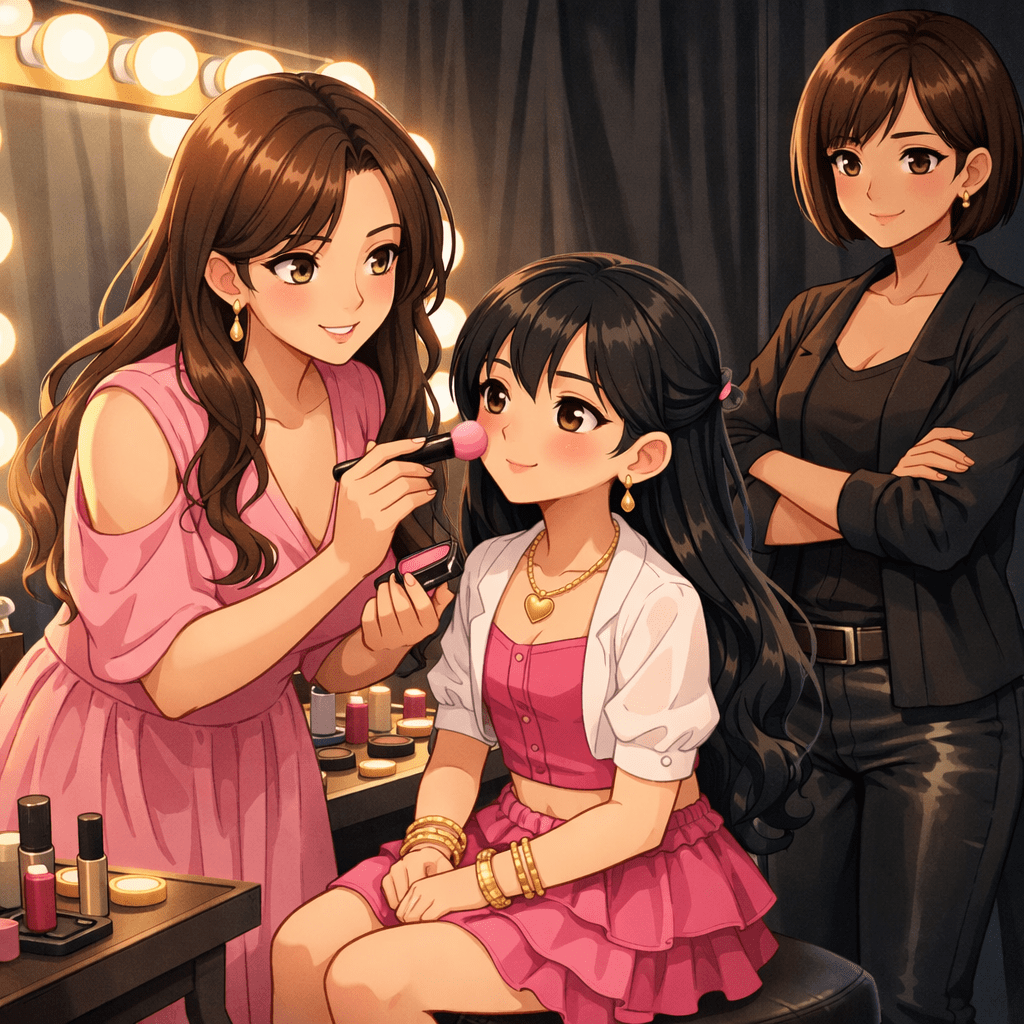
The backstage area looks like someone designed it using the “moody dramatic lighting” preset from every fashion reality show ever created. Black cloth drapes the walls with the kind of deliberate aesthetic that screams “we’re serious about our children’s fashion presentation,” creating shadows that would make a film noir cinematographer nod in professional approval.
A large mirror dominates the space, its frame studded with glowing bulbs that create that classic Hollywood vanity setup—because apparently even kids’ fashion shows require the full starlet treatment. The lighting casts a warm glow across the dresser below, where makeup tools scatter across the surface with the organized chaos of someone who knows exactly where everything is despite the apparent disorder.
I observe Allison gazing at her reflection with the focused intensity of someone who’s been training for this moment her entire ten-year-old life. The girl’s got that natural model confidence that probably started developing around the same time she learned to walk. Her black hair catches the bulb-light perfectly, creating the kind of visual effect that photographers spend hours trying to capture.
Behind her, Thalia works with the steady precision of someone who’s spent years perfecting the art of cosmetic application. The woman moves her brush across Allison’s cheek with surgical accuracy, adding just enough blush to create that “naturally rosy” effect that’s actually anything but natural.
“Just a subtle touch,” Thalia says, her voice carrying the confident authority of a professional who knows her craft inside and out. “It’ll bring out the softness in your makeup. After all, you’re the star of a children’s fashion show.”
Star. The word choice feels weirdly prophetic given what’s about to happen to this kid, though obviously Thalia has no clue she’s literally applying makeup to someone who’s destined to become a magical girl warrior. Sometimes the universe has a really specific sense of irony about these things.
Morissette leans casually against the dresser’s right side, watching the makeup application process with the kind of genuine admiration that suggests she’s not just being polite—she’s actually impressed. The maid’s position creates this interesting tableau where Allison sits center stage with her support crew flanking her like backup dancers in a music video.
“Madam, you really know your stuff,” Morissette offers, her tone mixing professional respect with authentic appreciation.
“Of course!” Thalia responds with a sassy grin that probably runs in the Sevilla family genetics. “What kind of beauty salon owner would I be if I couldn’t make my own daughter look beautiful?”
The logic tracks. If you can’t apply makeup to your own kid, you probably shouldn’t be running a business that specializes in making other people look good. Basic credibility requirements.
But then Thalia’s expression shifts with that sudden recognition that happens when your body sends urgent biological notifications that cannot be ignored. “Hold on—I think I need to use the restroom.”
Classic narrative setup. I can already see where this is going.
“Actually, Madam, me too,” Morissette chimes in with a sheepish grin that suggests she’s been holding it for a while but didn’t want to interrupt the important makeup application sequence.
Thalia playfully rolls her eyes with the exasperated affection of someone who’s had this exact interaction pattern repeated multiple times. “You’re always copying me, even when it comes to bathroom breaks.”
“Imitation is the sincerest form of flattery, Madam,” Morissette shoots back, deploying the kind of witty response that demonstrates why she’s more than just hired help—she’s basically part of the family dynamic.
Thalia shakes her head, amusement clear in her features. “Alright, fine. Come with me, Morissette. Allison, stay here and wait for us. We’ll be quick.”
Famous last words before a transformation sequence.
They exit stage left with a parting wave, leaving Allison alone in the dim backstage area like the setup for every supernatural awakening scene ever written. The convenience is almost suspicious—like the universe just cleared the room of witnesses so the magical girl origin story can proceed without complications.
Left alone at the dresser, Allison glances toward the restroom direction with the sly expression of someone who’s been waiting for exactly this opportunity. Her face shifts into that look kids get when adults leave the room and they can finally do whatever they’ve been planning.
Good, they’re gone, I can practically hear her thinking. Now I can do my thing.
The smirk on her face carries that perfect blend of mischief and determination. She’s clearly got an agenda that doesn’t involve sitting quietly and waiting for her mother and their maid to return from what will inevitably be an extended bathroom visit—because restroom lines at fashion shows are basically dimensional portals where time moves differently than in normal reality.
Besides, everyone knows that public restroom queues at events operate on their own special physics. Two women going together? They’ll be gone for at least ten minutes, possibly fifteen if they encounter anyone they know and start chatting. It’s like a universal constant.
Which means Allison has a window of opportunity here.
The backstage shadows seem to deepen slightly, creating that atmospheric shift that happens right before something significant goes down. The mirror’s bulbs cast her reflection in sharp relief, illuminating a ten-year-old girl who has no idea she’s about to cross the threshold between ordinary kid and magical warrior.
But I know. I’ve been watching these cousins long enough to recognize the pattern. This is how it starts—alone in a quiet space, with just enough privacy for cosmic forces to make their move without causing mass hysteria among civilian witnesses.
The magical girl transformation sequence is loading, and Allison Sevilla is about to discover that her dreams of becoming like her Pretty Cure heroines weren’t just childhood fantasy—they were destiny broadcasting its arrival notification.
Achievement approaching: From Fashion Show to Magical Show.
The universe has impeccable timing, even if its methods involve suspiciously convenient bathroom breaks.
Backstage_to_center_stage_magical_girl_activation.sav
Allison moves through the backstage hallway like she’s executing a stealth mission in Metal Gear Solid, her footsteps quick and precise against the floor. The black cloth draping the walls creates perfect cover, transforming the corridor into a shadowy passage that would make any infiltration specialist proud.
Her heart hammers against her ribcage with that adrenaline rush that happens when you’re doing something you’re definitely not supposed to be doing but can’t resist anyway. The thrill of breaking the “stay put” rule radiates through her expression—part excitement, part nervousness, entirely ten-year-old rebellion wrapped in designer children’s fashion.
She reaches the corridor’s end where a black curtain separates backstage darkness from the bright performance space beyond. Her fingers carefully part the fabric just enough to create a viewing gap, and she peers through with the focused intensity of someone accessing forbidden content.
Yes, I did it!
The triumphant thought practically radiates from her face. This might seem like a minor accomplishment in the grand scheme of cosmic destiny, but right now, successfully sneaking away to watch her celebrity crush host a fashion show feels like a major victory. Sometimes the small wins matter most before the universe drops life-changing supernatural abilities into your lap.
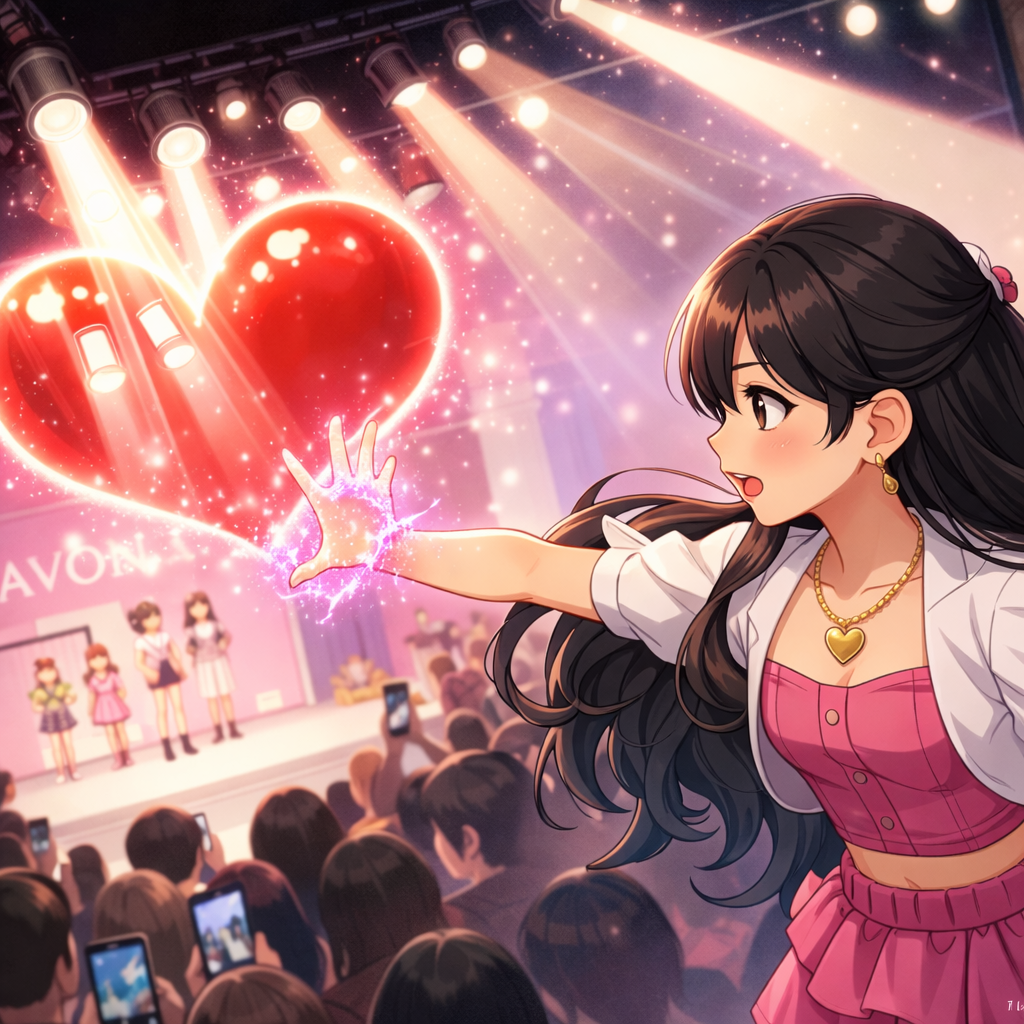
The stage spreads out before her like a premium live event, complete with professional lighting and staging that suggests Avon’s marketing budget doesn’t mess around when it comes to promoting their kids’ collection. The setup looks slick—runway extending into the crowd, strategic spotlight positioning, the whole commercial presentation package.
Center stage stands Robin Dominguez, microphone in hand, working the crowd with the practiced charisma of someone who’s made a career out of public performance. DJ Robin—as he’s professionally known—looks exactly like the kind of celebrity host who would make ten-year-old girls develop intense parasocial attachments. The guy’s got that perfectly styled hair, confident stage presence, and communication skills that probably started developing around the same time he learned to talk.
Handsome, charismatic, and genuinely good at his job—the complete package that explains why Allison’s currently risking maternal wrath just to watch him work.
“Hello folks,” DJ Robin’s voice projects through the sound system with professional clarity. “Welcome to Avon’s Kids’ Collection!”
The mall’s center erupts with cheers and applause that echo through the multi-story space like stadium acoustics. The audience sits in neat rows separated by a central aisle, creating that classic fashion show configuration where everyone gets optimal viewing angles of the runway action.
Young models—boys and girls paired up in coordinated outfits—strut down the ramp with varying degrees of confidence and coordination. Some move with natural grace while others clearly received extensive coaching on how to walk properly without tripping. The stylish children’s attire catches the spotlight perfectly, creating the kind of visual appeal that makes parents immediately calculate how much they’re about to spend.
Allison gazes at DJ Robin with dreamy intensity, her expression shifting into that classic celebrity crush mode where rational thinking temporarily exits the building. It’s great that I’m in the second batch. I still have time to enjoy watching my celebrity crush, DJ Robin.
The kid’s got her priorities sorted—supernatural destiny can wait a few more minutes while she appreciates premium eye candy doing his professional hosting thing.
Meanwhile, back at the dressing room, the inevitable parental discovery sequence initiates.
Thalia and Morissette return to find the space Allison-free, which triggers the exact reaction you’d expect from a stage mom who’s just realized her star model has gone AWOL minutes before her scheduled appearance.
“Where could she have wandered off to?” Thalia’s frustration carries clearly in her voice, mixing maternal concern with professional anxiety. “She’s up in 10-15 minutes with the second batch!”
The timing pressure is real. Fashion shows run on tight schedules, and missing your cue because you were sneaking off to watch the host would definitely qualify as a career-limiting move for a ten-year-old model.
“Let me find her for you, Madam,” Morissette offers with the quick efficiency of someone who’s learned to handle crisis management as part of her job description.
“Fine, but make sure you’re both back within ten minutes,” Thalia agrees, her annoyance clear but controlled. She’s probably mentally calculating exactly how much trouble Allison’s going to be in once they locate her.
Morissette hurries off on her search-and-retrieve mission, leaving Thalia to stress alone in the dressing room.
“I will go nuts with that child. The stress, my beauty.” Thalia talks to herself.
But then everything changes.
The spotlight bridge—a metal structure suspended between two posts above the audience—begins to fail with the kind of catastrophic mechanical timing that only happens when the universe needs to create an emergency situation that requires supernatural intervention.
Metallic groaning fills the space as structural supports give way. The bridge tilts at an angle that screams “imminent disaster,” and the heavy spotlights mounted on it start their deadly descent toward the crowd below.
Panic ripples through the audience in waves. People scream, scramble, try to move away from the falling equipment that’s about to turn this children’s fashion show into a tragedy. Parents grab their kids, audience members shove toward exits, chaos unfolds with the speed of genuine terror.
This is it. This is the moment.
From her position behind the curtain, Allison’s instinct overrides conscious thought. Her palm extends toward the falling lights like she’s practiced this move a thousand times in her imagination while watching Pretty Cure transformation sequences.
A glowing heart shoots from her hand.
Not metaphorically. Not symbolically. An actual luminous pink heart manifests from her palm and launches into the space above the audience like a magical projectile programmed with rescue protocols.
The heart expands mid-flight, growing from hand-sized to massive in seconds. It swells until it’s large enough to catch the entire spotlight bridge, stopping the collapse with the kind of impossible physics that only work when magical girl powers activate for the first time.
The collision creates a visual spectacle—tons of metal equipment suspended by a giant glowing heart hovering in mid-air above terrified spectators. Screams echo through the mall as half the audience flees in pure panic while others freeze, mesmerized by the enormous floating heart that just prevented disaster.
Did that heart just come from my palm?
Allison’s shock registers clearly in her wide eyes and slack-jawed expression. Her brain struggles to process what her body just did automatically. The cognitive dissonance between “normal girl watching fashion show” and “person who just manifested a giant magical heart from their hand” creates a mental traffic jam that requires immediate processing power.
Focus, Allison, you can’t hold this any longer!
The strain shows in her trembling arm, sweat beading on her forehead, the physical exertion of maintaining a magical construct she has zero training for. This is like being thrown into a boss fight with no tutorial—pure instinct versus impossible circumstances.
With determination born from desperate necessity, Allison pushes. Not physically—though her hands gesture like she’s shoving something heavy—but with whatever supernatural force just activated inside her. The giant heart responds to her will, moving the captured spotlights away from the crowd in a controlled descent.
The equipment crashes to the ground backstage with thunderous impact, sparks flying as metal hits concrete in the empty area where no one will get hurt. The heart dissipates like special effects fading after their dramatic purpose is fulfilled.
Several onlookers catch Allison’s gesture through the parted curtain—her hands extended, face intense with concentration, clearly controlling the phenomenon everyone just witnessed. Phones rise throughout the remaining crowd, cameras capturing the entire incident with the modern reflex that says “if it’s not recorded, did it even happen?”
ON THE PEREGRINE SPACESHIP
The command center exists in its usual state of automated monitoring, systems tracking the seven Acolytes with mechanical precision. The large screen displays their status profiles in neat rectangular grids—most still gray with DORMANT labels indicating powers that haven’t manifested yet.
But then Allison’s profile flickers.
The gray rectangle floods with pink light, the color shift dramatic against the surrounding dormant panels. Her status label changes in real-time text that updates with satisfying digital precision: DORMANT → AWAKENED.
The third Acolyte has activated.
The magical girl archetype has joined the party roster. Love-based powers are now officially online and combat-ready.
BACK AT AVON’S KIDS’ COLLECTION
The aftermath settles like dust after an explosion. Emergency protocols activate—security rushes in, event staff try to manage the chaos, DJ Robin attempts crowd control with varying success. The fashion show has officially been interrupted by supernatural phenomena, which definitely wasn’t on the event planning checklist.
And somewhere behind a black curtain, Allison stares at her palm with the kind of existential confusion that happens when your body just revealed capabilities that shouldn’t be possible according to every law of physics you’ve been taught.
The transformation sequence has triggered. The magical girl origin story has begun.
Achievement Unlocked: Heart Attack Defense Protocol.
Three down, four to go.
Portal_extraction_magical_girl_teleportation_protocol.sav
At this rate, I’m going to be busted.
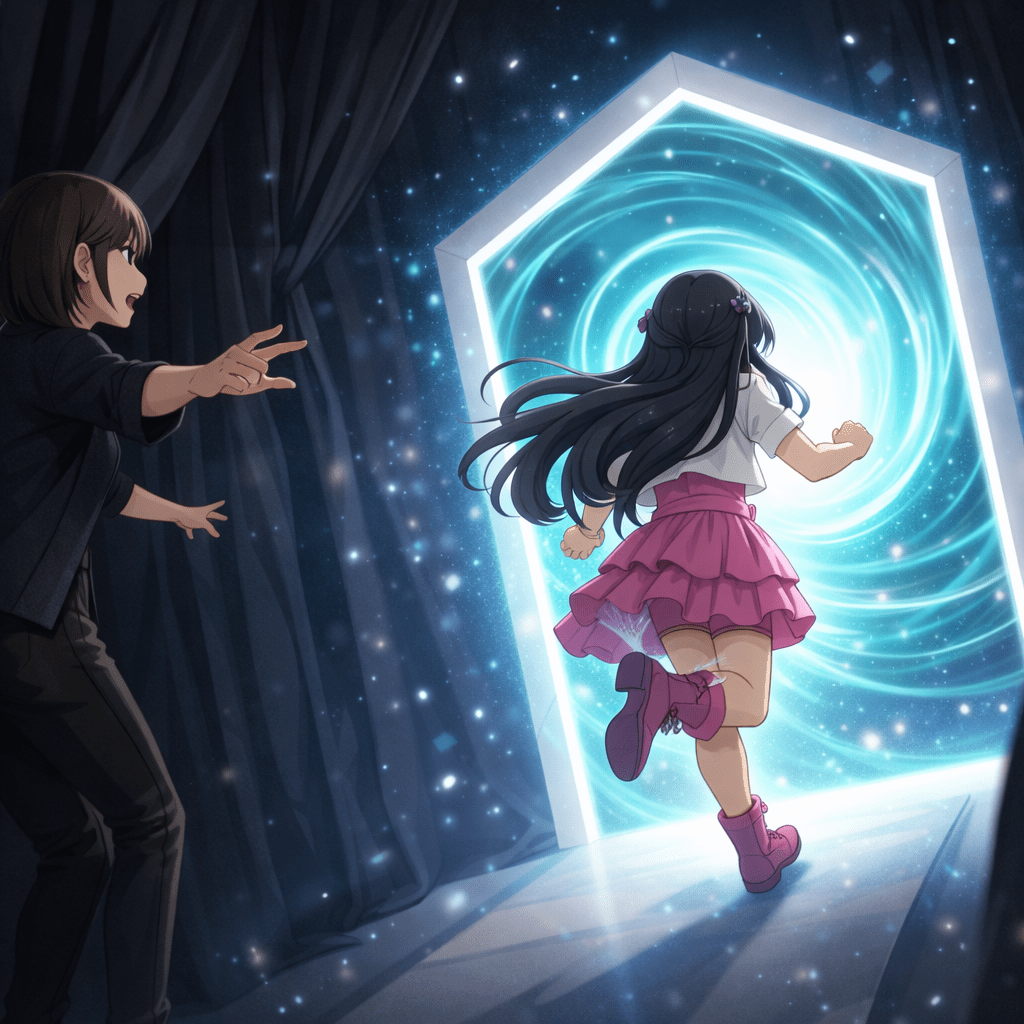
Allison’s panic registers in every aspect of her body language as she bolts from the scene like a speedrunner who just triggered an alarm and needs to reset before the guards spot her. Her feet pound against the floor with desperate velocity, arms pumping, dark hair streaming behind her in that classic “fleeing the crime scene” aesthetic.
Then reality decides to get weird.
A glowing pentagon-shaped portal materializes at the end of her path like someone just activated a fast-travel checkpoint. The geometric precision is beautiful—five perfect sides forming a doorway that radiates light with the kind of sci-fi elegance that would make Stargate designers jealous. It hovers there, pulsing with energy that screams “emergency extraction protocol activated.”
From a nearby hallway, Morissette catches a glimpse of Allison’s high-speed retreat, her eyes widening as she processes what she’s seeing.
What futuristic thing just appeared in front of me?
Allison’s internal monologue hits peak dramatic as physics betrays her. And… curse momentum! I can’t stop running!
Classic problem with velocity and mass in motion. Once you’re moving at that speed, stopping requires either friction, impact, or supernatural intervention. Allison’s getting option three.
She hits the portal at full sprint, disappearing into the glowing geometric gateway like a character model clipping through a loading zone transition. The portal snaps shut behind her with finality, leaving zero evidence of its existence.
Morissette arrives at the spot seconds later, her expression cycling through confusion, disbelief, and the dawning realization that she just witnessed something that violates every law of normal reality. She spins, searching the empty space where Allison just vanished.
Gone. Completely extracted from the premises via cosmic teleportation.
Clean getaway achieved through supernatural means.
The Peregrine’s retrieval systems work fast.
Companion_loyalty_protocol_boy_and_his_dog.sav
Night settles over the Kennedy mansion like someone activated the day/night cycle transition, and I find myself observing a scene that belongs in every classic “boy and his dog” narrative ever written.
The kitchen exists in that quiet stillness that only happens after everyone else has retreated to their respective corners of a large house. Soft overhead lighting creates warm ambiance against dark windows, transforming the space into something that feels simultaneously mundane and peaceful—the kind of setting where meaningful character moments happen naturally.
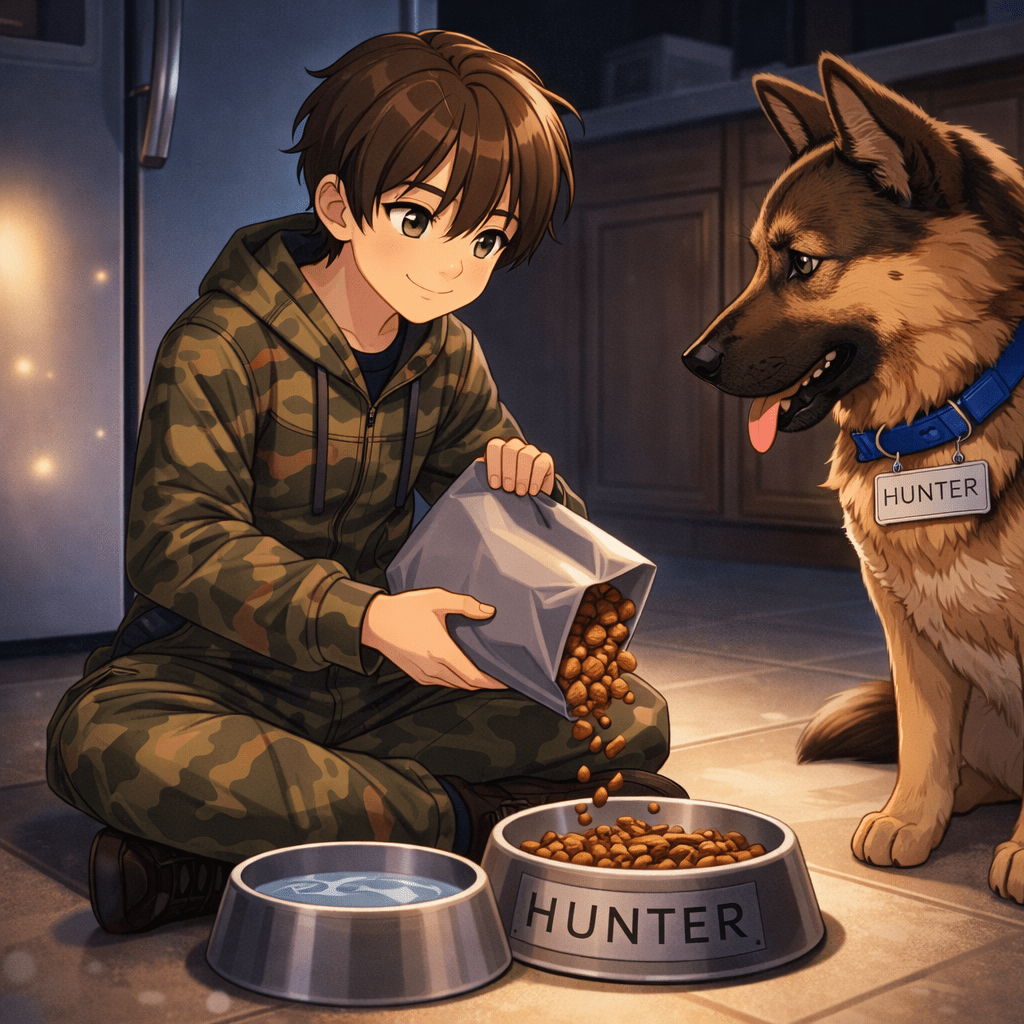
Topher moves through the feeding routine with practiced efficiency, grabbing the dog food carton and filling a metal bowl with measured portions. His movements carry the unconscious precision of someone who’s performed this exact sequence hundreds of times, muscle memory taking over while his mind probably processes other thoughts.
He sets the food bowl down, and Hunter—the tan-and-black German Shepherd who’s basically been Topher’s constant companion since the cave incident—approaches with the eager anticipation that dogs universally display when food materializes. The shepherd’s build shows that perfect combination of strength and agility that made German Shepherds the go-to breed for everything from police work to search-and-rescue operations.
Which, considering Hunter’s personal history, feels weirdly appropriate.
Topher fills a second bowl with water, ensuring his four-legged friend has proper hydration resources available post-meal. The attention to detail demonstrates genuine care rather than just going through obligatory pet ownership motions.
As Hunter enthusiastically devours his dinner with the kind of focus that suggests dogs experience food as a transcendent religious experience, Topher’s expression shifts into something contemplative. His gaze settles on his dog with that look people get when memories surface unbidden.
“You were just a pup then,” Topher begins, his voice soft with reflection. The words carry weight beyond their simple statement. “But you were brave—heroic, even. You showed the rescuers the way to the sinkhole. Because of you, Kuya Benjamin and I were found and saved. Mom told me the whole story.”
Companion AI with S-tier pathfinding capabilities.
The cave rescue three years ago involved a puppy leading adult humans to a sinkhole where two kids were trapped—which honestly sounds like a Lassie episode except it actually happened. Hunter basically speedran the “rescue mission” quest line while still in tutorial mode, demonstrating abilities that would make professional search-and-rescue dogs nod in respect.
No wonder Topher treats this dog like family. Hunter literally saved his life before most dogs even learn basic commands.
Hunter finishes his meal with the satisfied efficiency of someone who takes eating seriously, and Topher gently nudges the water bowl closer. “Hey, Bud, don’t forget to drink your water. You need to stay hydrated,” he urges with the kind of gentle insistence that demonstrates he’s learned proper pet care protocols.
The shepherd responds obediently, lapping at the water while his royal blue collar shifts slightly with each movement. A short, bone-shaped golden tag dangles from the collar, jingling with soft metallic sounds. The engraving reads “Hunter Kennedy” in clear letters—because this dog isn’t just a pet, he’s officially part of the family unit with surname inclusion and everything.
Full party member status confirmed.
With both nutritional and hydration requirements satisfied, Hunter trots over and rests his head on Topher’s lap with the contented trust of an animal who knows exactly where he belongs. The gesture carries that particular quality of canine affection that doesn’t require words to communicate complete devotion.
Topher settles down beside his dog, leaning back against the kitchen drawers in a relaxed posture that suggests he’s not in any hurry to be elsewhere. His hand moves to Hunter’s head, fingers gently stroking the soft fur with the rhythmic motion that soothes both human and animal.
The warmth of their bond radiates through the quiet kitchen like ambient heat from a comfortable fire. No dramatic declarations, no grand gestures—just a boy and his dog existing peacefully in each other’s company.
For this moment, nothing else matters. No supernatural destinies, no cosmic prophecies, no transformation sequences waiting to activate. Just Topher and Hunter, enjoying the peaceful stillness of the night in the simple way that companions do when they’ve saved each other’s lives and formed bonds that transcend species barriers.
Sometimes the best relationships are the ones built on mutual rescue and consistent feeding schedules.
Loyalty stat: Maximum.
The universe could learn something from dogs about unconditional support and heroic timing.
Music_room_manifestation_bard_class_activation.sav
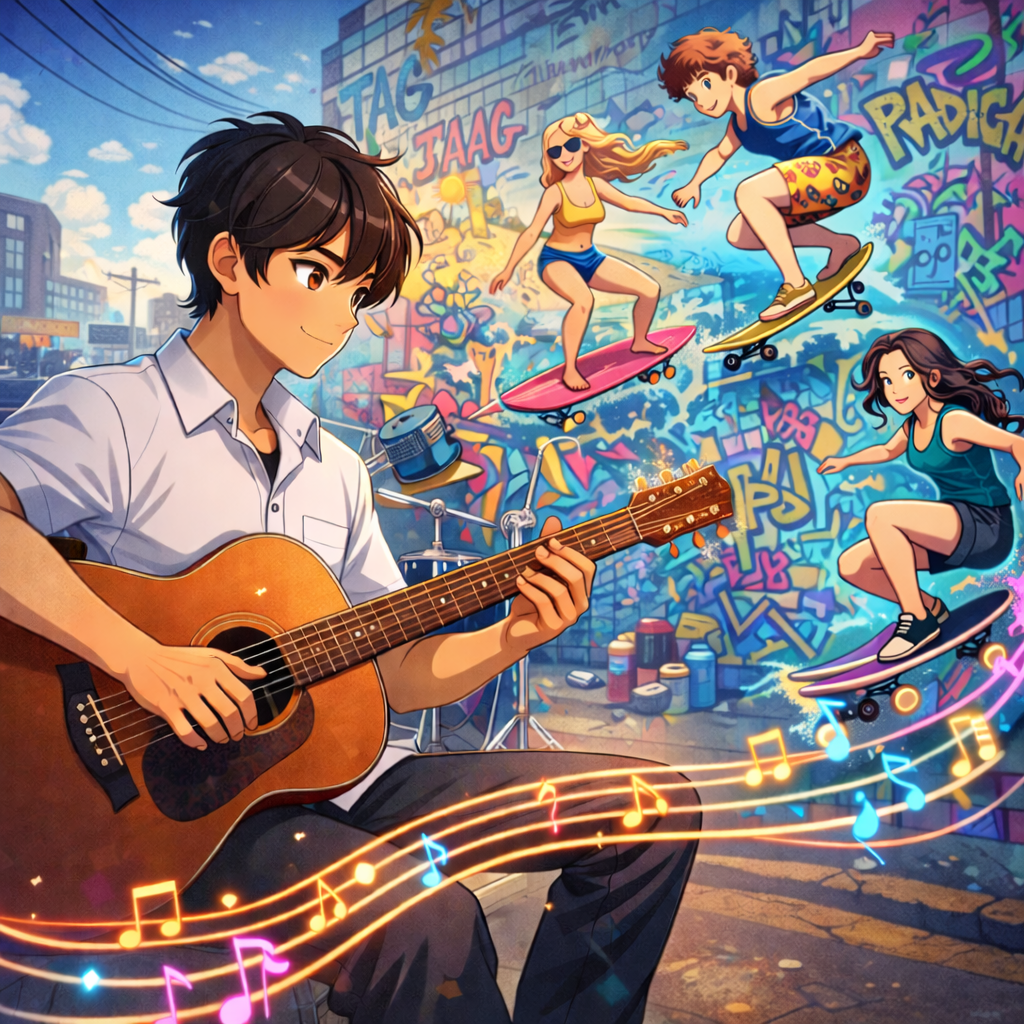
Daytime at Our Lady of Lourdes School—commonly shortened to just “Lourdes” by students who can’t be bothered with full institutional titles—and I’m observing what looks like a solo acoustic performance happening in the music room across the Magnificat Grounds.
The music room exists in that classic state of organized creative chaos that all artistic spaces eventually achieve. Instrument cases line the walls, sheet music scatters across stands, chairs sit at odd angles from various practice sessions. Afternoon sunlight filters through windows, creating warm patches of illumination that give the whole space that golden-hour aesthetic usually reserved for indie music videos.
James sits alone, guitar cradled in his lap, strumming with the relaxed confidence of someone who’s spent significant time developing actual musical skills rather than just learning three chords and calling it a day. His fingers move across the fretboard with practiced ease while his voice carries the melody of “I Lay My Love on You” by Westlife—a track from their 2000 album Coast to Coast that definitely qualifies as peak early-2000s boyband content.
The guy embodies his usual easy-going, carefree energy. No stress, no pressure, just vibing with his instrument and enjoying the creative process. His expression shows that peaceful focus musicians get when they’re lost in the flow state, where conscious thought fades and muscle memory takes over.
[Verse 2] I was lost in a lonely place Could hardly believe it, yeah Holding on to yesterday Far, far too long
His voice carries genuine emotion rather than just technical execution. The kid’s got that quality that separates performers from people who just sing—the ability to actually feel the lyrics and communicate that feeling through vocal delivery.
[Pre-Chorus] I believe it’s okay ’cause this time, it’s real
Then reality decides to remix itself.
[Chorus] I lay my love on you, it’s all I wanna do Every time I breathe, I feel brand new You open up my heart Show me all your love and walk right through (Oh yeah) As I lay my love on you
Mid-verse, something manifests in the air that definitely wasn’t there when he started singing.
A wavy band of orange musical staff materializes, floating in mid-air like someone activated augmented reality overlays except there’s no technology generating this—it’s pure supernatural manifestation. The staff glows with soft luminescence, five parallel lines hovering at eye level with the kind of visual elegance that would make music theory textbooks jealous if they could achieve this level of aesthetic presentation.
Small music notes—cyan, magenta, and yellow—hop along the glowing staff like animated sprites following programmed pathways. They bounce and dance with rhythmic precision, each movement creating gentle melodic sounds that harmonize with James’s guitar playing. The effect looks like someone took a music visualization plugin and made it physically real in three-dimensional space.
Visual Audio Display: Enabled.
James stops playing mid-strum, his expression cycling through surprise, confusion, and fascination in rapid succession. He carefully sets his guitar aside with the reverence of someone who doesn’t want to damage expensive musical equipment, then stands up to examine this impossible phenomenon at closer range.
The magical sight continues its performance, notes dancing and popping with sounds that shouldn’t exist without speakers or instruments generating them. The orange staff pulses gently, creating ambient light that casts colorful reflections across James’s face.
Curiosity overrides caution—classic protagonist behavior when confronted with mysterious supernatural manifestations. James reaches out tentatively, extending his hand toward the floating music like he’s about to interact with a hologram.
His fingers pass right through.
No resistance, no texture, no physical substance—just visual and auditory phenomena that exist without occupying actual space. It’s like trying to grab a projection, which creates this weird cognitive dissonance between “I can see and hear this” and “this has no physical form.”
Could this illusion have appeared because I was singing “I Lay My Love on You”?
The hypothesis forms in James’s mind with the kind of logical deduction that happens when you’re trying to establish cause-and-effect relationships for impossible events. Music-triggered manifestation would actually make thematic sense for someone who’s about to become a K-pop idol superhero with music-based powers.
Time to test the theory.
James picks up his guitar again, settling back into playing position with renewed purpose. He closes his eyes, blocking out visual distractions to focus purely on the music he’s about to create. His fingers find random positions on the fretboard and he strums an upbeat tune—nothing structured, just improvised melody with energetic tempo.
Clover leaves, clover leaves, he chants inwardly, focusing his intention like he’s casting a spell in a tabletop RPG where verbal and mental components combine to produce magical effects.
When he opens his eyes, reality has complied with his request.
Clover leaves float in the air around him—dozens of them, three-leafed and four-leafed variants drifting through the music room like someone activated a nature-themed particle effect system. They glow with soft green luminescence, spinning gently as they hover in defiance of gravity and basic botanical physics.
How is this possible? Did I just discover I have music magic?
The realization hits James with the impact of a major plot revelation. This isn’t illusion or hallucination—this is genuine reality-warping capability triggered by musical performance. He’s basically unlocked the Bard class skill tree, except instead of buff spells and charm abilities, he’s manifesting physical objects through sound and intention.
Confusion and worry flicker across his features for approximately three seconds before his natural creativity kicks into high gear and overrides all concerns about the logical impossibility of what he’s experiencing.
Creative mode: Activated.
If music creates manifestations, then the obvious next step is to experiment with different sounds and see what else he can generate. Scientific method meets artistic expression—hypothesis, test, observe results, repeat.
ON THE PEREGRINE SPACESHIP
The command center maintains its usual state of automated vigilance, monitoring systems tracking the seven Acolytes with mechanical precision. The large display screen shows their status profiles in neat rectangular arrangements—most still gray with DORMANT labels indicating powers that remain inactive.
James’s profile flickers.
The gray rectangle floods with orange light, the color shift creating visual contrast against the surrounding dormant panels. His status label updates in real-time with digital efficiency: DORMANT → AWAKENED.
The fourth Acolyte has activated.
The K-pop idol archetype has joined the roster. Music-based reality manipulation is now officially operational and ready for deployment.
BACK AT THE MAGNIFICAT GROUNDS OF LOURDES SCHOOL
The scene shifts to outside perspective as Rowan approaches the music room, his expression showing confusion mixed with curiosity. The guy’s carrying snacks—chips and a drink, standard teenage sustenance—but his attention focuses on the impossibly loud music blasting from inside the room.
Did someone set up a sound system in there?
The volume level definitely exceeds what a single acoustic guitar should produce. It sounds like a full concert is happening inside a space designed for small practice sessions. The bass resonates through the hallway with intensity that suggests amplification systems or supernatural audio enhancement.
Rowan approaches the door with the cautious interest of someone who’s about to discover something that will challenge their understanding of reality.
Inside, James has fully committed to his experimental music magic phase.
He’s dancing to happy, upbeat tunes flowing from his guitar—except the guitar is now producing sound that shouldn’t be physically possible from six strings and a wooden body. The music fills the room with concert-quality audio that pulses with energy.
But the real spectacle is the visual manifestations.
Neon-lit illusions of skateboarders fill the space, glowing figures performing tricks and grinds like animated sprites from a Tony Hawk game rendered in luminescent reality. Graffiti art splashes across the walls—vibrant tags and murals that glow with electric colors, creating urban scenery that transforms the music room into something resembling an underground hip-hop venue. The entire aesthetic screams “modern street culture meets supernatural light show.”
James moves through this self-created wonderland with pure joy radiating from his expression. He’s discovered reality-warping abilities and his first instinct is to make cool stuff and dance—priorities that honestly make perfect sense for a creative teenager who just unlocked magical powers.
Then Rowan opens the door.
The snacks hit the floor with simultaneous impact—chips scattering, drink bouncing—as Rowan’s hands lose all motor control from the shock of what he’s witnessing. His jaw drops, eyes widening to maximum diameter, face cycling through disbelief into full system-error mode.
James freezes mid-dance move, caught red-handed creating impossible magical phenomena. His expression shifts from creative euphoria to “oh crap I’ve been discovered” panic in under a second.
Stealth check: Critical failure.
Before James can formulate any kind of explanation or damage control strategy, Rowan slams the door shut and bolts down the hallway with the speed of someone whose brain just encountered information it cannot process through normal logical frameworks.
“Aaaaahhh!!!”
The scream echoes through the corridor with the kind of volume that suggests genuine psychological distress. It’s the sound humans make when reality violates their expectations so completely that verbal communication devolves into pure vocal expression of existential confusion.
The sound catches the attention of their other bandmates—Ezra, Apollo, and Kai—who immediately look up from whatever they were doing with the universal response to hearing someone scream like they’re being chased by supernatural phenomena.
Rowan rushes toward them with wild eyes and frantic body language, words tumbling out in a breathless torrent. “James has turned into a modern-day bard, like from the video games! You know, like the Pied Piper! He has music magic and conjured skateboarders and a graffiti wall!”
Exposition dump: Initiated under extreme duress.
Ezra stares at Rowan like he’s just announced that unicorns are real and running for political office. “What the—”
Apollo takes the practical approach, reaching out to check Rowan’s temperature by placing a hand against his neck. Medical diagnosis mode activated. “You don’t feel feverish. Maybe you drank too much Coke and the sugar went straight to your head?”
Logical explanation attempt: Failed.
“Sugar rush? Me. I drink coffee, Dude.” Rowan refutes.
Then Kai delivers a sharp slap across Rowan’s face.
The impact echoes with a satisfying crack that makes everyone wince reflexively.
“Did you just slap me, bro?” Rowan shouts, hand flying to his reddening cheek, outrage mixing with residual shock in his expression.
“Just making sure your sense of reality is still intact,” Kai replies with perfect coolness, like he’s performed some kind of percussive diagnostic procedure. “You’re talking crazy.”
Reality check: Administered via face contact.
Meanwhile, back inside the music room, James notices something new materializing.
A pentagon-shaped portal appears in mid-air, its geometric precision and glowing edges immediately distinguishing it from his music-generated manifestations. The five-sided gateway pulses with energy that feels different from his creative illusions—more technological, more purposeful, more extraction protocol than artistic expression.
What is that? Is it another illusion I created?
James studies the portal with analytical curiosity. It looks so different—more futuristic than cool.
The distinction matters. His music magic creates vibrant, artistic, culturally-relevant imagery. This portal looks like it came from a sci-fi transportation system designed by engineers who prioritize function over aesthetics. The style mismatch suggests external origin rather than self-generated phenomenon.
Curiosity—that recurring character trait that drives so many plot developments—compels James forward.
He approaches the portal cautiously, extending one finger toward its glowing surface like he’s testing water temperature before diving in. The moment his fingertip makes contact, everything changes.
The portal activates with aggressive suction that would make vacuum cleaners jealous of its extraction capabilities. James’s right arm gets pulled in first, then his left, the force dragging him forward despite his attempts to resist. His feet slide across the floor as physics stops being cooperative.
“Help! Help—”
His cries cut off abruptly as the portal completes its retrieval sequence, pulling his entire body through the geometric gateway in one smooth motion. The effect looks like someone getting sucked into a cosmic vortex, except it’s happening in a high school music room on an otherwise normal afternoon.
The portal snaps shut behind him, leaving zero evidence of its existence.
Extraction complete: Target acquired.
Moments later—perfect comedic timing—the music room door bursts open as Rowan, Ezra, Apollo, and Kai rush inside expecting to find evidence supporting Rowan’s wild claims about magical manifestations and reality-warping abilities.
They find nothing.
The room looks completely normal. No James, no neon skateboarders, no graffiti walls, no floating musical notes. Just standard music room contents sitting in their usual positions like supernatural phenomena never manifested here at all.
“See?!” Rowan gestures wildly at the empty space, his vindication mixing with fresh confusion. “James is gone, and so are all the illusions!”
Ezra, Apollo, and Kai exchange skeptical glances that communicate volumes without requiring verbal dialogue. The looks say: “Our friend has lost his mind and we’re witnessing the breakdown in real-time.”
“I swear, I’m not making this up,” Rowan insists, raising his hand like he’s taking an oath in court. His desperate sincerity clashes with the complete lack of supporting evidence.
Classic witness credibility problem. Extraordinary claims require extraordinary evidence, and right now Rowan’s got nothing but his own testimony and some dropped snacks in the hallway.
Achievement Unlocked: Unbelievable Truth Syndrome.
Four Acolytes awakened. Three more to go.
The K-pop idol has left the building via cosmic teleportation. The bard class is officially operational. And somewhere on the Peregrine, two newly-awakened heroes are about to get explanations for abilities they didn’t know they possessed.
Tutorial phase: Complete. Main quest: Loading.


Leave a Reply