Overview:
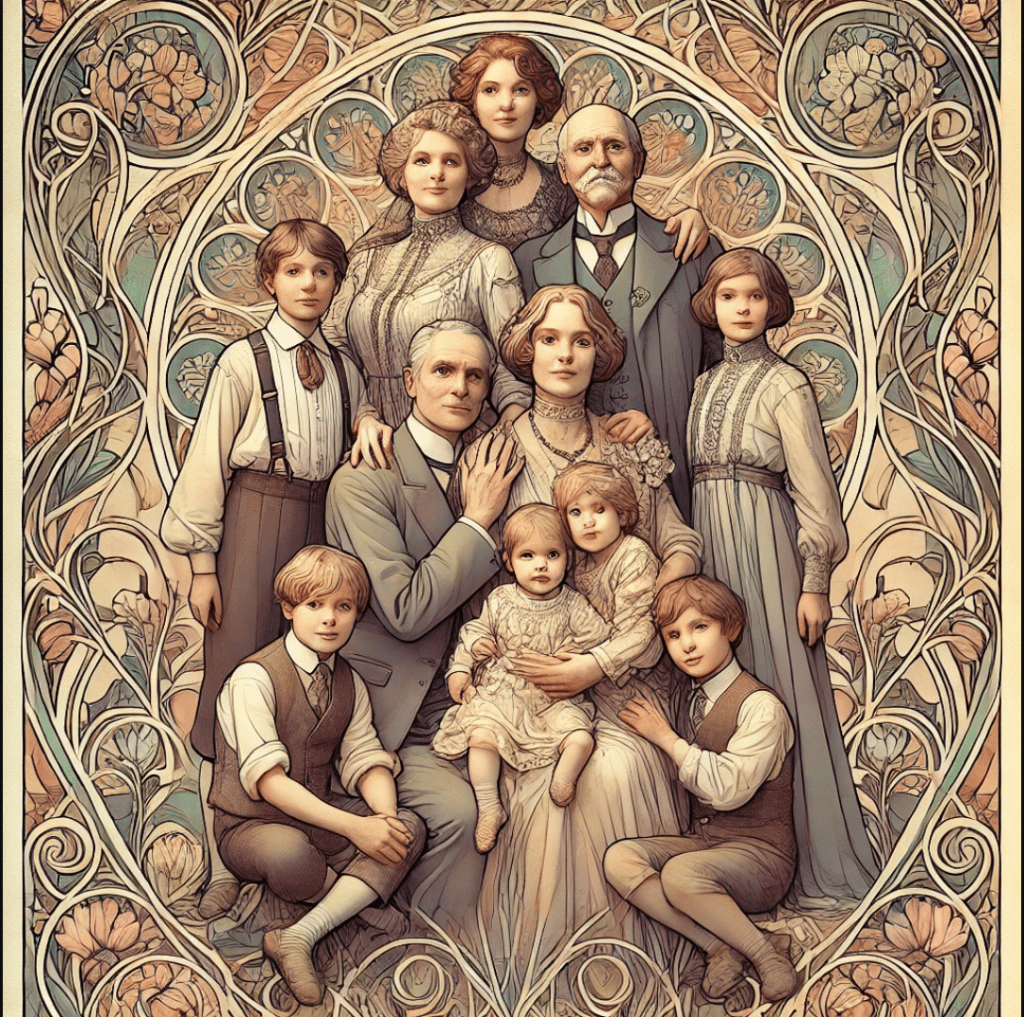
The Pangilinan clan is an ordinary family in the Philippines with deep roots in Batangas. Their patriarch, Grandpa Alejandro “Al” Pangilinan, a sugarcane landlord, and his wife Granny Emilia “Emily,” have five children: Selena, Gregorio “Greg,” Ronaldo “Ronald,” Nathalia “Thalia,” and Eleanora “Ellie.” Selena starts a family in the U.S., becoming the Kennedys, while Greg settles in Metro Manila with his own Pangilinan family. Thalia marries into the affluent Sevillas of Makati, and Ellie remains in Batangas with her husband Ansel, living near Grandpa Al and Granny Emily, who are accompanied by the bachelor Ronald.
Howling winds, roaring thunder, dark clouds, and a heavy downpour caused the sea waves to rise as high as mountains. Yet, the harrowing storm on the shore was blocked by the protective walls of the cave.
Seven kids sat in a circle around the board in the cavern, the bonfire burning brightly in the center, casting shadows of the four boys and three girls against the rocky walls. The fire emanated a warm, yellow-orange glow throughout the chamber.
“Go, Topher, you’re almost there!” James cheered on his younger cousin.
Topher shook the two dice in the palm of his small right hand as everyone held their breath in anticipation. The dice rolled and landed on double sixes.
“Hooray! You got twelve! The game is over!” James celebrated.
Topher moved his gray clay paladin token twelve spaces toward the finish line, a navy crystal ball in the center of the board. The paladin joined the other six pieces: a space captain, a K-pop idol, a superhero, a magical girl, a cartoon character, and a mermaid princess.
These tiny heroes and heroines from different genres, mediums, and age ratings stood on the seven pedestals surrounding the crystal ball. The idol was even an outlier, representing the broader world of music in popular culture.
The children believed the crystal ball was a small “hologram” and added the missing ivory luminary to the board game’s version of the Aristotelian universe. In this geocentric view, Earth took the place of the Sun, represented by a blue-white sparkling shooting star at the center.
The seven luminaries—traditionally known as light-giving bodies—were usually the planets Mercury, Venus, Mars, Jupiter, and Saturn, along with the Sun and the Moon. However, the board game replaced them with seven unidentified luminaries in the colors cyan, scarlet, orange, pink, yellow, seafoam green, and ivory.
To the right of the board, an inscription read: “When all seven luminaries revolve around the Star of Vis, a cosmic cataclysm shall rise. Heroes be born, and tales breathed unto life and onto the world.”
“Where’s the cosmic cataclysm?” Michael impatiently asked, eager for the thrill promised at the end of the game when the seven clay tokens reached all the pedestals around the “holographic” crystal ball.
Suddenly, the concentric planes of the seven luminaries began to shift. The prophesied cosmic cataclysm rose from the wooden board game’s central crystal ball, spiraling up to the cavern’s ceiling in a quasar-like twister, bursting with lights and colors. The ground beneath them shook violently.
“Holograms don’t cause earthquakes! We have to get out of here!” Benjamin warned, realizing the danger.
Roanne grabbed the hands of Allison and Sophie. “Allison, Sophie, come with me!” she urged.
“I’m scared! Are we going to die?” Sophie trembled.
“I need to stay with Topher!” Allison resisted, pulling back.
Roanne pulled the girls toward the cave’s exit, while James and Michael followed close behind.
Topher, however, remained fixed in place. “Heroes be born…and tales breathed unto life and onto the world,” he whispered. “This can’t be a force of evil. I know it’s meant to do good, even if it looks violent.”
“What are you saying?” Benjamin questioned, panic in his voice.
“Earth came into existence after cooling from a molten, red-hot planet. Afterward came life and civilizations. This could be the beginning of something amazing,” Topher insisted, his eyes wide with the possibilities.
“An unknown meteor wiped out the dinosaurs 66 million years ago. More often than not, uncertainty leads to destruction,” Benjamin countered. “We need to get out of here.”
After a moment of hesitation, Topher relented. “Okay, let’s go,” he agreed, and the two boys ran toward the exit.
But it was too late. The cavern began collapsing, and all exits were blocked. From the stellar tornado, the seven luminaries emerged—now massive, radiant, and seemingly alive, searching for their hosts.
“We’ve been found,” Topher murmured, staring at the approaching luminaries.
“I’ll protect you,” Benjamin said, pulling Topher close in an attempt to shield him. The cyan and ivory luminaries circled around them, illuminating the chamber with alternating bursts of light.
The clashing colors intensified, merging into a blinding white radiance.
SIX MONTHS EARLIER
In January 2016, in the town of Lemery, Batangas, it was a bright, sunny morning in the modest home of an old couple and their quiet neighborhood.
Emilia “Emily” Batumbakal Pangilinan, a fair-skinned woman in her early 70s, had shoulder-length, wavy white hair held back with a plain headband. Her dark brown eyes complemented her average build, though she was small in stature.
That morning, Emily was preparing daing na bangus (dried milkfish). She removed the fish from the bag and let the liquid drip.
She heated oil in a pan, and once it was hot, she fried the fish on medium heat until one side was crisp. She then turned it over and repeated the process on the other side.
After removing the fish from the pan, she placed it on a serving plate, fried two more, and made a spicy vinegar dip.
Emily ate breakfast with her husband, Al, and their son, Ronald, in the dining room. Al sat in the armchair at the head of the table, with Emily on his left and Ronald on his right.
On the table were daing na bangus, sunny-side-up eggs, and fried rice. Naturally, being Batangueños, they had cups of black coffee.
“Mahal (love), your cooking is as delicious as ever,” Al praised Emily’s daing na bangus.
“You’re flattering me too much, Al,” Emily replied with a modest smile.
“Ama (Father), Inay (Mother), you’re both too old to be flirting like that,” Ronald teased.
Later that afternoon, a van arrived, and its door opened as passengers stepped out.
Ronaldo “Ronald” Batumbakal Pangilinan, a tricycle driver, was first in line. He was a man in his mid-30s, bald, with dark brown eyes, brown skin, and an average build.
“Tricycle, tricycle, tricycle!” Ronald called out.
A middle-aged woman approached him.
“Where to, Ma’am?” Ronald asked.
“In Barangay Bagong Pook,” she replied.
Ronald helped her into the tricycle compartment. Then, he hopped onto the motorcycle and drove off, the wind blowing against him as he navigated the lightly trafficked road.
Two days later, on a medium-sized plot of land planted with sugarcane, Al inspected his crops, making sure they would be ready for harvest.
Federico Alejandro “Al” Monleon Pangilinan, a man in his early 60s, had short, wavy gray hair, dark brown eyes, and brown skin. Slightly short and overweight, his big belly was a signature feature.
“The sugarcane is growing well. No need to worry,” assured Al’s right-hand man.
“You’ve got good workers. What you’re paying them is worth it,” the man added.
“Well then, I’ll head home. Emily is waiting for me, and the sun’s already setting,” Al said as he prepared to leave.
He walked off toward the sunset, the orange sky blending with the green horizon of his sugarcane fields.
“I’ll be back next Friday as always,” Al called over his shoulder before leaving.
Two weeks later, a loud ching, ching, ching echoed from Emily and Al’s house, spreading through their humble neighborhood. Ronald was hammering a nail high on the living room wall.
“All done. You can hang the painting now,” Ronald announced.
Ansel, the couple’s son-in-law, picked up a vintage-looking art piece and carefully hung it on the wall.
“Ma (Mom), here it is,” Ansel said, showing it to his wife, Ellie.
“Perfect, Pa (Dad),” Ellie commended her husband.
“What unnecessary decorations are you hanging all over the house?” Emily grumbled.
“Inay, these are important. They’ll make your home look even better. I picked these paintings to match the traditional vibe of your house,” Ellie explained.
“Let her do her thing. She knows what she’s doing. Be thankful Ellie cares for us,” Al sided with his daughter.
“See, Inay? Even Tatay (Father) appreciates what I’m doing,” Ellie chimed in.
Meanwhile, in the nearby town of Calaca, Ellie was cleaning the house while Ansel worked at the construction site.
Eleanora “Ellie” Pangilinan Argente, a tall woman in her mid-20s, had shoulder-length, straight black hair, dark brown eyes, and tan skin. Wearing a bandana, an apron, and gloves, she vacuumed the living room carpet under the couch and center table, looking every bit the adorkable homemaker.
At the construction site, Ansel, wearing a protective helmet, reviewed the building blueprints.
Anselmo “Ansel” Salcedo Argente, a young man in his early 30s, had short, straight black hair, dark brown eyes, light skin, and a lean build.
Rolling up the plans, he headed downstairs, passing construction workers, hollow blocks, and cement.
“We’ll need to raise the ceiling a bit higher and make this area a little wider,” Ansel instructed the foreman.
“Boss, don’t worry, my men will make the necessary adjustments,” the middle-aged foreman assured him.
“That’s good to hear,” Ansel replied with gratitude.
Behind them, a large tractor rumbled by.
Two weeks later, in a predominantly white clinic, a large poster of the female reproductive system hung on the wall.
“Your condition is called Polycystic Ovary Syndrome, more commonly known as PCOS,” Ellie’s OB/GYN explained.
“What is it, Doc?” Ellie asked, her husband Ansel seated beside her.
“It’s a hormonal imbalance. This explains the irregularities in your menstrual cycles. You have cysts on your ovaries, and your eggs aren’t maturing or releasing as they should,” the OB/GYN explained.
“Will it affect my chances of having a baby?” Ellie asked, voicing her greatest concern.
“Frankly, yes. PCOS is the leading cause of infertility in women,” the doctor replied candidly.
Ansel consoled his distressed wife, holding her close.
The OB/GYN continued, “It will be a long treatment process, but we can work through it.”
“We’re ready, Doc,” Ansel said with a firm but calm resolve.
Skyscrapers. Light rail transits (LRTs) and crowds of passengers. Heavy traffic. Malls, theaters, restaurants, and bars. People on crosswalks, sidewalks, and streets. Welcome to the hustle and bustle of Quezon City, the most populous place in the country.
Following her daughters, Mary and Sophie, Martha locked the house door. Her sons, James, Benjamin, and Michael, went ahead to the gate, with Michael opening it. Greg drove out of the garage in the family van. Once Martha and the children got inside, Benjamin closed the gate and followed them.
Martha sat beside her husband, Greg, in the driver’s seat.
Greg glanced in the rearview mirror and asked, “Where’s Ining (little one)? Is Sophie in the back with you?”
“Yes, Tatay (Father), she’s sitting beside me,” Mary assured him.
The sisters sat in the second row, with Benjamin on the right, and James and Michael at the back.
“Vroom, vroom, vroom,” Greg started the engine, and the family van took off.
As they drove through moderate traffic, Greg turned on the music while Martha checked the windshield for the weather.
Greg dropped off Martha and the kids at Our Lady of Lourdes School. Afterward, he parked the van near the store and walked toward it, carrying the keys.
Gregorio “Greg” Batumbakal Pangilinan was a middle-aged man in his late 30s. He had short, wavy black hair, brown skin, a lean build, and average height. He resembled his younger brother Ronald but had noticeably lighter brown eyes.
Greg wore a light yellow short-sleeved polo with a plain red necktie. His nameplate, which read “Manager,” was sewn above his left chest pocket. He completed the outfit with khaki pants and black leather shoes.
Greg opened the store and walked past shelves stocked with car and automobile accessories, tools, spare parts, and equipment. He stood by the cash register, where he doubled as the cashier. From a distance, he saw his crew arriving.
Mathilda “Martha” Macatangay Pangilinan, a middle-aged woman in her early 40s, had long, straight black hair, dark brown eyes, fair skin, a lean build, and average height.
Martha’s uniform was an old-rose blouse, buttoned and short-sleeved, paired with black slacks and lady’s shoes. She carried a shoulder bag and held her lesson plan in one hand.
Students greeted Martha as she walked by. “Good morning, Ma’am,” they said.
“A pleasant morning to you,” Martha replied.
She continued walking until she reached the faculty room, where she entered and sat at her desk, putting down her things. Behind her, a young teacher was hurriedly preparing a lesson.
In the classroom, Mrs. Marquez, the science teacher, began the lesson. “Can someone define chemistry?” she asked.
At Our Lady of Lourdes School, the students’ uniforms varied slightly from the standard. Boys wore navy slacks instead of khaki, and girls sported white dresses with navy ribbons centered above the breast and navy belts around the waist.
Benjamin raised his hand first and was called on.
“Chemistry is the study of the properties, composition, and structure of substances, which could be elements or compounds, as well as the transformations these substances undergo and the energy released or absorbed during these processes,” Benjamin answered.
Benjamin Matthew Macatangay Pangilinan was a thirteen-year-old boy with short, slightly curly black hair, dark brown eyes, and brown skin. Lanky, he wore eyeglasses and a dual-display water-resistant wristwatch. His classmates often teased him for his resemblance to Indians.
“Very good, Mr. Pangilinan,” Mrs. Marquez praised him.
“Now, class, can someone give me the first ten elements in the periodic table?” she asked next.
Benjamin was the only one to raise his hand.
“This is telling, class. You’re supposed to be the cream section,” Mrs. Marquez said with disappointment. “Yes, Mr. Pangilinan?”
“The first ten elements in the periodic table are hydrogen, helium, lithium, beryllium, boron, carbon, nitrogen, oxygen, fluorine, and neon,” Benjamin recited without hesitation.
“Excellent, Mr. Pangilinan,” Mrs. Marquez praised him again.
During lunch at the library, students went about their own business. Many were reading, while others were just hanging out. One of the two librarians photocopied a handout for a student at their post.
Meanwhile, Benjamin spent the remaining twenty minutes reading Dune, the 1965 science fiction classic by American author Frank Herbert. The text read:
The worm drew back onto the sand, lay there momentarily, its crystal teeth weaving moonflashes.
“Lump! Lump! Lump! Lump!”
Another thumper, Paul thought.
Again, it sounded off to their right.
A shudder passed through the worm. It drew farther away into the sand. Only a mounded upper curve remained, half like a bell mouth, the curve of a tunnel rearing above the dunes.
Benjamin attentively flipped to the next page. Beside him, his trusty sling bag—cobalt blue and gray—lay on the chair.
Weekends at the Pangilinan residence. On the patio, James sat on a wooden bench, holding his guitar. He began to play and sing his favorite song:
“When your legs don’t work like they used to before…”
- Lyrics from “Thinking Out Loud” by Ed Sheeran, X (2014)
Inside the house, Sophie sat comfortably on the living room sofa, watching SpongeBob SquarePants on TV. Here’s how it went on the screen:
SpongeBob, a yellow sea sponge who resembled a dishwashing sponge, was walking his pet snail, Gary, down the road in Bikini Bottom, an underwater city.
“I tell you, Gary, there’s nothing better on a sunny day than a brisk walk,” SpongeBob said to his pet.
“What’s the matter, pal? Walk too fast for you?” SpongeBob asked when Gary stopped crawling.
Gary turned back and took SpongeBob along with him, the latter still holding the leash.
“Where is it, boy? Is someone in danger?” SpongeBob asked, trying to understand Gary.
“Uh, come here, little fella. I won’t hurt you,” SpongeBob said, comforting an old snail that Gary had found behind a rock.
Half an hour after SpongeBob, Sophie finished coloring Pooh, another cartoon character, in her Winnie the Pooh coloring book.
Sophia “Sophie” Macatangay Pangilinan was a four-year-old girl. She had shoulder-length, wavy black hair adorned with a yellow headband. Her big, expressive dark brown eyes and tan skin added to her small frame and average build. Her Tita (Aunt) Selena once remarked that Sophie had some Arabian features.
Inspired by Pooh, Sophie drew herself a jar of honey. After finishing her fully colored drawing, she set the paper aside to make room for her next creation.
 B. K. P. Carreon
Leave a comment