Overview:
| Ser Cerulean Arlentis joyfully carries Pandora’s Box, mounted upon his winged steed, Cielo, proclaiming it to be the hope of mankind. As the pair soar into the heavens, Typhon’s spirit awakens, much to Echidna’s delight. High in the sky, Cerulean and Cielo are intercepted by Typhon’s specter. The Griffin arrives to their aid, holding off Typhon long enough for the rider and steed to escape. Cerulean sends Cielo through a portal back to their headquarters, Peregrine Lightyear, before turning to face Typhon alone. Typhon ultimately prevails, but Cerulean refuses to yield. With death closing in, he relinquishes the Star of Vis to Captain McKinley, entrusting him with its power and purpose. As Cerulean takes his final stand, divine winds carry his last thoughts across the distance to his mother, Selena, waiting on the balcony of their home. Selena suddenly senses what has happened. She tells her husband, Bill, that their son is gone, and finally breaks down in grief. Princess Ruana and Cielo later find Cerulean’s body and bring him back to Peregrine Lightyear. There, Ruana gently prepares the boy for his funeral, cleaning and laying out his body with care. A funeral is held in Cerulean’s honor, attended by Captain McKinley, Princess Ruana, the robots, Cielo, and Uncle Ronald. The mourners gather to remember the fallen knight and the sacrifice he made for them all. But afterward, another tragedy strikes: Uncle Ronald is suddenly struck by the immense power of a nuclear reactor. |
Small_chest_long_goodbye.sav
The vault folds itself away without asking. One second I am ankle-deep in a projection of gold coins, the next my white cube goes blank, hums like an old refrigerator, and repaints the entire world as open sky. That is my sim room for you. All the processing power of a small star, the manners of a cat.
When the light settles, I am standing on nothing at all, a few hundred meters off a mountain face somewhere in old Greece. Morning. Thin, fast clouds. Below my feet, stone terraces stack their way up into the golden pyramid, and the colossal eagle statue crowning it stares east with ruby eyes the size of tower shields. Sunlight has just reached them. They burn like two coals someone forgot to put out.
The great gate at the summit stands open. Warm air shivers out of the doorway in slow waves, bending the light the way heat bends a road in summer. For a long moment nothing else happens, and I get to enjoy the rare experience of a quiet map.
Then something white bursts through the gap.
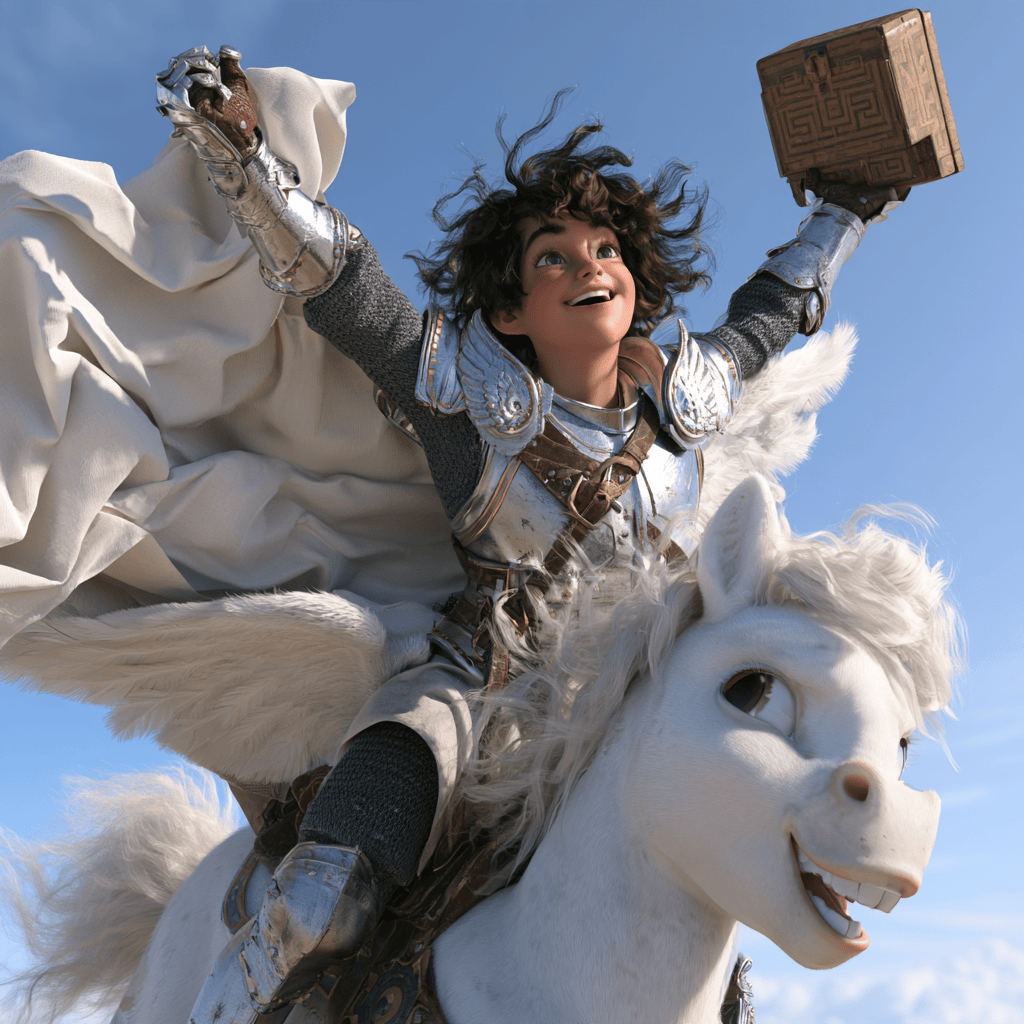
Cielo comes out at a full gallop, which is a strange and wonderful thing to watch a pony do in midair. His hooves strike off nothing. His wings snap wide on the second stride. Cerulean sits low over his neck, ivory cape cracking behind him like a flag in a storm, and the two of them climb. Past the eagle’s beak. Through the cloud shelf. Up into honest blue.
He is laughing. I can tell from the shape of him, the way his shoulders bounce, even though I have not dialed the audio in yet. My sim hands me every pixel of a scene and not one decibel until I ask. Sometimes I leave it silent on purpose. Some pictures are enough.
This one almost is. A boy and a winged pony corkscrewing through a sunrise, fresh off a treasure hunt that half of them treated as a philosophy exam. If this were a game, this is the cutscene after the vault dungeon, the one you don’t skip.
I bring the sound up just in time.
“This is Pandora’s Box!” Cerulean shouts to the whole sky, standing in the stirrups, lifting the small chest over his head with both hands. “The hope of mankind!”
Cielo answers with a neigh you could hear across a valley, then throws in a barrel roll for free. Cerulean rides it out with the loose calm of somebody who has stopped being surprised by his own life.
Behind them, far below, the great gate grinds closed on its own weight. The keeper of that vault chose to stay with his gold and his scales, and the sound of the sealing stone rolls across the range like distant thunder that decided to be polite about it. Cerulean glances back once. Just once. Then he faces forward again, because that is the kind of rider he is.
The prize does not look like much, and that is the entire point of it. A plain wooden chest. No gold, no jewels, small enough to carry in two hands, glowing a soft warm white along its seams like a night-light that means it. I watched that little box out-weigh a vault of treasure on a seven-notch scale. I have officially retired from arguing with this universe about physics. The universe is undefeated.
I raise both fists and cheer anyway.
Nobody hears that either. Zero interaction, zero impact, that is the standing arrangement with my setup: I ride shotgun on history in real time, and history has no idea I bought a ticket. Most days I make my peace with it. Today I allow myself to yell at a pony from a room on a spacecraft very far away, because after the season these kids have had, somebody in the audience ought to be on their feet.
Then the sky smears sideways.
Sim swap. No loading screen, no polite fade to black. The cube strips the sunrise off the walls and rebuilds, tile by tile, into a room I know better than my own bunk. The command center of the Peregrine Lightyear.
Evening cycle. The overheads are down to their night setting, a low blue-white that makes every surface look colder than it is. The command center is a wide crescent of consoles beneath a canopy of curved glass, and past the glass the dark goes on and on. Star charts idle across side displays in drowsy cyan. One deck below, through the transparent floor panel by the ramp, a squat little cleaning unit polishes a corridor that no one has walked through in days. It does the corners twice. Somebody has to.
Stations line the crescent, each one fitted for a crew member, each one dark. The ship was built to hum with seven heroes and their noise. Tonight it holds one captain, one robot, and enough quiet to furnish a library.
The big screen owns the forward wall.
Captain McKinley sits in the commander’s chair at the center of the crescent, and he sits the way he does everything: squared, still, spine like a plumb line. The hard segments of his suit catch the low light, cobalt-blue plates locked over gray, every seam machined tight, the gauntlet on his left wrist showing the faint outline where an ordinary watch lives when he is an ordinary kid. His helmet is racked beside the chair. Without it, the face above all that armor is just Benjamin’s, and Benjamin looks like someone who has been sleeping in ninety-minute installments.
ROBO4000 stands at his right shoulder, tall and chrome and patient, hands folded behind its back in a posture it definitely learned from him.
“Play it again,” McKinley says.
He does not say please, and the ship does not need him to. The forward wall wipes to black. Small white text blinks in the corner. PLAYBACK 09.
Nine.
I have watched him watch this. I stopped counting at six. He clearly did not. There is a version of grief that files itself under research, and the captain has been running it since the message arrived: pausing on frames, replaying phrases, hunting the footage for a clue his brother forgot to leave. I recognize the method. It is what you do when doing nothing is the only other option on the menu.
A familiar face fills the wall.
The recording is rooftop Athens, and Athens got into the frame everywhere it could: white buildings stacked down a hillside behind him, laundry lines, one stubborn column of ancient marble photobombing the skyline. Wind keeps shoving his hair around. The magenta visor is pushed up onto his head, out of the way, which means the person looking into the lens is not exactly Oppa Rockstar. It is James, wearing Rockstar like a jacket he has not zipped up yet. There are shadows under his eyes with their own shadows. Whatever sleep he has had lately, he has had it sitting up, in portals between capitals, on strangers’ benches. The smile he puts on anyway is the most Rockstar thing in the frame.
“Hello, Benjamin.” Half a grin. “Or Captain McKinley, if you’re suited up. This is Oppa. Your older brother James.” The grin thins. “Though I’ll admit I’ve been the irresponsible one. I’m sorry for leaving the Peregrine. There’s no excuse for it. In wartime, they’d call it desertion.”
He builds the case against himself like a prosecutor who has had a long time to prepare. He has. I watched him rehearse pieces of this speech across half the Mediterranean, muttering into the wind of five different capitals. None of the rehearsals had this much steel in them.
“I needed a boy named Anton, a kid who builds sandcastles by the shore, to show me how selfish I’d been. Abandoning the team. My friends.” He lets the wind have a second. “I was lucky. A kind couple took me in. Aling Sita and Mang Noel. Aling Sita tells stories the way other people breathe. Mang Noel barely spends ten words a day, and somehow every one of them is worth keeping.”
In the commander’s chair, McKinley has not moved. His eyes are doing all the work, tracking his brother’s face like a scan he intends to memorize.
“I left their home at sunrise without a proper goodbye. That was rude, and I knew it while I was doing it.” A muscle works in James’s jaw. “But after running for that long, I finally understood I had to make things right. So I went looking for Love Fey. For Allison. Sta. Jovita, where Medusa appeared. From there I ended up inside the fourth wave, answering the Sphinx’s riddle so I wouldn’t spend forever as her servant.”
The word forever comes out flat, like he sanded it down first so it would fit in the sentence.
McKinley’s thumb shifts once against the armrest. In his language, that is a flinch.
“I made it to Venice. Cerulean and I passed through there once, before the Underworld. Before Cerberus.” Something almost fond crosses his face and is gone. “There was no signal anywhere in the city, so I used the pocket portal and started hopping capitals. Rome. Madrid. Cairo. Beirut. Trial and error across an entire sea.” He huffs, not quite a laugh. “Mostly error.”
Here is some context, free of charge, from the only person in this story with time to provide it. Every wave of monsters so far has announced itself with a signal. The first ones came in loud, orbital-scan loud. Then the enemy apparently discovered volume control, and the readings shrank until a satellite could stare straight at one and see nothing. The Peregrine spent days sweeping a silent planet and calling it peace.
“I’m in Athens now. Fourth visit. Lady Luck finally blinked.” He turns his tablet toward the lens: a topographic map, one soft point pulsing on it. “I picked up a weak signal here, and I’ve worked out why we kept missing these. They only read up close. Handheld range. The orbital scans skate right over the top of them. This could be the fifth wave. Same fingerprint as every signal that came before a wave of Greek monsters.”
“So my speculation was correct,” ROBO4000 says to the room, even and satisfied. “The fifth wave also carries a weak signature.”
Nobody answers a robot annotating a recording. The robot does not seem to mind. Somewhere in its chrome heart it has filed the point under confirmed, and that is enough.
On the wall, James pulls the tablet back and looks into the lens properly.
“I plan to face the fifth wave alone.”
The wind on the rooftop picks that exact moment to go still, which I would call cheap writing if reality were a script.
“Even if I couldn’t find Allison, maybe I can rescue Topher this time. I beat the Sphinx at her own game, but that was luck, and luck runs out. If this signal is what I think it is, if it’s the Nemean Lion, then I might not walk away. If that’s how it goes, I want to carry out Michael’s wish and slay the beast.”
A small note from the cheap seats. At roughly this hour, the boy he wants to rescue is doing victory laps over a Greek mountain on a winged pony, holding the hope of mankind above his head and shouting about it. I would tell them. You have no idea how much I would tell them.
“It’s a shame I won’t make it to the Harpies’ site to help Spartan. Michael.” He stops. Starts again, smaller. “Our little brother.” The recording keeps rolling through the pause, patient as recordings are. “But I have no regrets if I fall in battle. Call it atonement. I lost Allison. I lost Topher. I lost Michael. I deserted the team, and my search came up empty. If I go down, at least I take one more monster off the board. One less for you and Roanne to carry.”
And here is the part where being me is a design flaw.
I know a cottage in the mountains where an old healer changes the bandages of a boy who is very much alive and being stubborn about it. I know it the way I know my own name. I have stood in that room, or in a perfect copy of that room, and counted his breaths. That knowledge sits in my chest with nowhere to go, because my sim has an audience of exactly one and a stage door that never opens.
So close. So far. The usual.
“If I don’t come back after the fifth wave, remember this, Benjamin.” James leans toward the lens, and the last of Rockstar drains out of his posture. “I made you shoulder responsibilities that were mine to carry. The panganay was supposed to be me. It was never fair, and you carried it anyway.” His eyes have gone bright. He does not wipe them, and he does not look away. “But I love you, brother. You’ll always be in my heart, no matter what happens. Goodbye, Captain. I have to go now.”
His hand comes toward the lens. The image freezes on the final frame: James mid-blink, a white city behind him, the sky doing that late-gold thing it saves for the Mediterranean.
The command center holds its silence the way the vault held its gold. In quantity.
“James hasn’t returned to headquarters,” McKinley says at last. His voice is level, careful, the voice of someone carrying a full glass across a moving ship. “No transmission since this one. And no word about Michael near the Harpies’ signal.”
“I am truly sorry, Commander,” ROBO4000 says.
McKinley does not answer. He does not stand, either. He stays squared in the commander’s chair with his helmet racked beside him and his eyes fixed on the frozen face that fills the forward wall, an older brother caught between one blink and the next.
I sit down cross-legged on the floor of a room I am not in.
Two of us keep the vigil tonight, the captain and me, and only one of us casts a shadow. Somewhere below the clouds, a golden hour. Somewhere in Nemea, dust settling around a sleeping boy while a bird made of fire stands over him, deciding what it is for. Somewhere over a mountain in old Greece, a plain little chest glowing at its seams, riding home on the back of a winged pony.
Hope is on its way, Captain. I would tell you that too, if telling were a thing I could do.
Father_wakes_guardian_burns.sav
The sim does not take me anywhere pleasant this time.
The sunrise strips off the walls of my cube and something older grows in its place, tile by tile, until I am standing in a cave I hoped I was done visiting. Echidna’s lair. Deep rock, no sky, the ceiling lost somewhere above the reach of the light. Vines sprawl across every surface, dark and thorny, moving when nothing moves them. Moss carpets the floor in damp green. Water drips from unseen heights and lands in black puddles with a patience that could outlast empires. My cube renders the cold down to the last detail, and I hug my elbows even though the cold is not technically mine.
At the center of the chamber sits the tomb.
It is a long block of ancient stone, carved edge to edge with markings I cannot read and would not read out loud if I could. Dark streaks run down its sides and pool at its base. And tonight, for the first time since I started getting dragged to this room, the tomb is breathing. Gray smoke seeps from its seams in slow, curling threads, gathering above the lid like weather planning something.
Echidna is coiled beside it.
From the waist up she could pass for a tall, regal woman, if you ignored the scales climbing her arms and the way her pupils sit in vertical slits. From the waist down she is serpent, meters of thick, gleaming coil looped around the tomb the way you would guard the only thing you love. Her tongue flickers out, tasting the smoke.
“Oracle.” Her voice rasps like dry leaves dragged over stone. “It is near. Typhon, the Father of All Monsters, shall soon awaken from his long slumber.”
Across the chamber, pinned on the cavern wall, the Oracle of Delphi says nothing.
She wears her older face tonight, lined and tired, white hair loose around her shoulders. The vines hold her the way they have held her for weeks: wrapped at the wrists, the waist, the ankles, their venomous tendrils hovering close without quite touching, a threat that never needs repeating. She watches the smoking tomb, and her expression does not change, and somehow that is worse than if it had.
I have stood in this exact spot before and made this exact fist. Nothing about the repetition improves it. She is right there. Ten steps, maybe twelve. I could count them. I have counted them. On a fair server I would cross that floor, tear the vines loose, and walk her out into daylight, and every rulebook I have ever loved says the guy in the audience gets to do that eventually. My rulebook says otherwise. My rulebook has one rule, and it is no.
The smoke above the tomb thickens, folds inward, and takes a shape.
It is not a body. It is the memory of a body, sketched in gray: broad where shoulders should be, long where a spine should be, and two points of pale light where eyes have decided to exist. The form drifts upward, unhurried, trailing threads of mist back to the tomb like a kite refusing to let go of its string. Then it turns toward the tunnel mouth and glides for the exit, and the whole cave seems to lean after it.
Echidna watches it go with a look I can only describe as devotion. She lays one scaled hand flat against the tomb’s lid, over the carvings, over the dark streaks, and holds it there the way people hold a door for someone they have waited on for a very long time. “Soon,” she murmurs, so quietly the drips nearly cover it. “Soon, my love.” The Oracle closes her eyes.
My cube follows the smoke.
Stone blurs past, tunnel after tunnel, then a ragged mouth of daylight, and suddenly I am in open sky and the sim is painting blue in every direction. The spirit rises through the air with terrible purpose, not wandering, not searching. Homing. Somewhere out there is a marquise-cut gem that answers to one boy, and this thing can feel it the way a compass feels north.
I know where the needle points. I spend the whole ride wishing I did not.
The sky over the mountains is bright and clean, one of those afternoons that looks freshly downloaded. Cerulean and Cielo cruise through the middle of it at an easy pace, the small chest secured at the front of the saddle, the ivory cape rippling in the slipstream. Cielo’s wingbeats have settled into the long, lazy rhythm of a flyer with good news and no deadline.
“Almost home, buddy.” Cerulean pats the pony’s neck, then rests his palm on the chest for the tenth time in as many minutes, the way you check a pocket you already know is full. “Wait until the captain sees this. Wait until everyone sees this.”
Cielo snorts, which in their shared language covers everything from agreement to requests for snacks. I have been watching these two long enough to want the flight to stay exactly like this, boring and golden, all the way to the ship.
Then the light changes.
Clouds gather ahead of them, fast, far too fast, sliding in from every compass point at once and stacking into a gray ceiling. Weather does not do this. Weather has rules. Cielo’s ears flatten. Cerulean straightens in the saddle, one hand finding the chest.
The clouds ahead knot into a swirling mass of smoke, and the ghostly form steps out of it as if the sky were a doorway.
“I am Typhon, the Father of All Monsters.” The voice arrives from everywhere, low and vast, the sound a cave would make if it learned to talk. “I demand the Star of Vis, Seventh Acolyte and Keeper. Surrender it, and I shall spare you and your divine mount.”
Cielo halts midair, wings backing hard. Cerulean looks at the shape in the smoke, and I watch him take its measure the way he took the measure of a riddle in a vault: carefully, completely, without letting the fear reach his face.
“No.” His voice carries, young and absolutely level. “You seek the Star for evil. You will never have it.”
“Then prepare for my wrath!”
The ceiling of cloud tears open. Streams of smoke whip down like the sky grew arms, a dozen of them, gray and fast, cracking toward pony and rider from above.
“Cielo, dive!”
They drop. A whip scythes through the space they occupied half a second ago. Cielo folds his wings and falls, then snaps them wide and banks so hard the world tilts, threading between two more strikes. Cerulean rides low against the pony’s neck, calling turns, left, climb, roll, and Cielo executes every one like they rehearsed this in another life. Maybe they did. Smoke lashes past close enough to drag frost across the boy’s cape. The chest stays under his arm through all of it, held like it is the only cargo in the universe.
They are magnificent. They are also losing. The whips keep multiplying, and the sky keeps shrinking. Cielo’s flanks are heaving now, each dodge a fraction slower than the last, and the spirit has not moved from its place in the smoke. It is not even fighting yet. It is herding, walling them in strike by strike, the way you drive a piece across a board toward the square you always intended. There is exactly one exit from a fight like this, and it is sealed inside a wooden box that must not open here.
“Begone, evil spirit!”
The voice booms across the heavens, and something golden falls out of the sun.
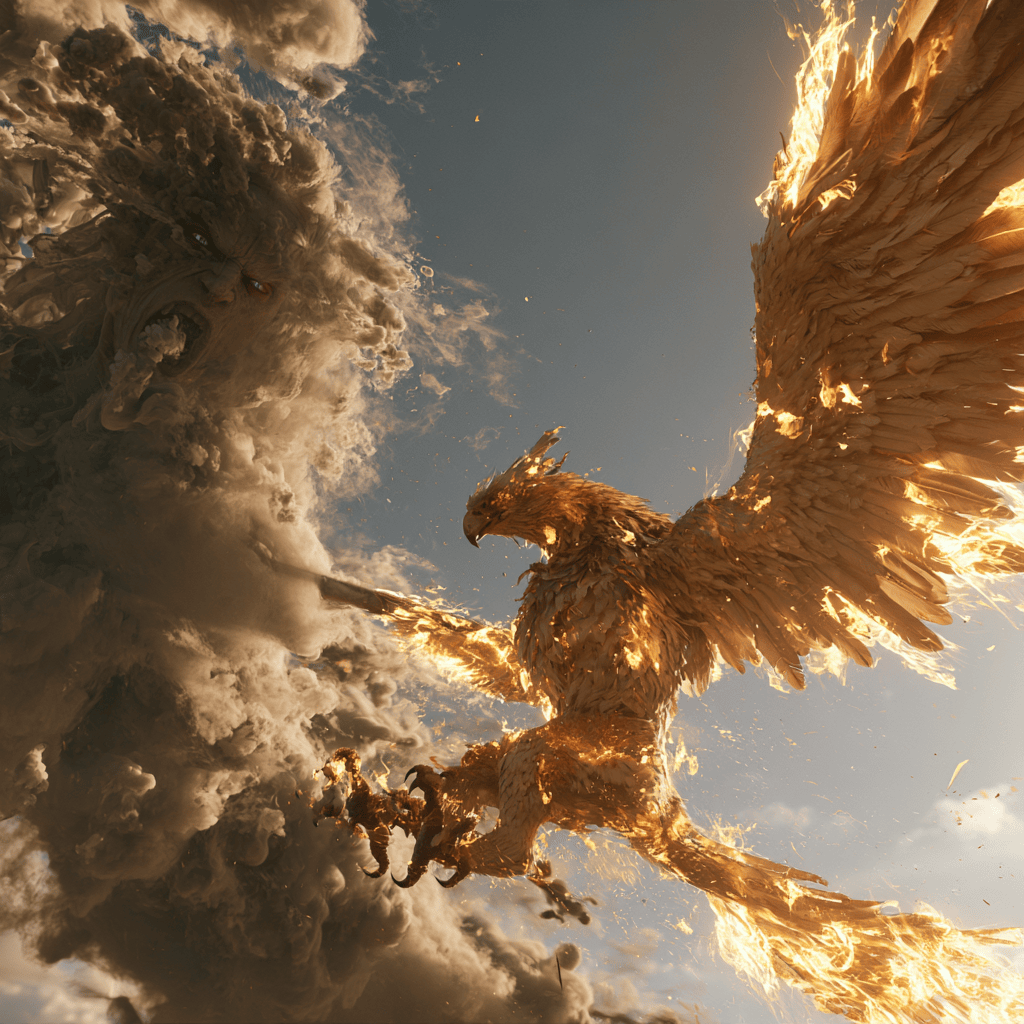
The Griffin arrives the way mountains would arrive if mountains could fly: eagle head thrown forward, lion body stretched full length, wings wider than Cielo’s whole silhouette, feathers burning bright even under the darkened clouds. It slams into the space between the spirit and the riders and spreads itself there, a wall with a heartbeat.
Understand something about this creature. It has guarded one mountain since before anyone alive could name it. It turned down an invitation to leave just yesterday, politely, permanently, the way you decline things that are simply not in your nature. Whatever pulled it off that mountain today outweighed a vault of gold and every age it spent there, and it is currently hovering between a spirit and a boy.
Somewhere far below, a sealed gate guards a vault of treasure, and for the first time in ages, nothing guards the gate.
“The Father of All Monsters does not yield to mere guardians,” the spirit says, and the bright green eyes brighten with something that might be amusement.
The Griffin does not look at it. The great head turns to the boy instead.
“Paladin. Crusader. Leave at once. I will handle this.”
“But what about you?” Cerulean brings Cielo around, closer, not further, because of course he does. “You’ll be in danger if I leave you here!”
“Fear not, my child. I am more than a guardian. I possess the power to ward off evil.” The Griffin says it plainly, the way it once said it in a vault full of gold, back when the words were just words. “Your priority is Pandora’s Box. Deliver it to your fellow Acolytes. For the sake of men.”
For a moment the boy does not move. The smoke coils overhead. The pony trembles under him and holds position anyway.
“I understand.” Cerulean’s jaw sets. “But take care of yourself. Stay alive.”
“Go now, while there is still time!”
Cielo wheels toward open sky.
“You will not escape until I possess the Star of Vis!” the spirit bellows, and the clouds answer it. Spectral shapes pour down in a gray curtain, sealing the horizon, cutting the escape route into nothing.
The Griffin inhales.
Golden fire erupts from its beak in a river, holy and roaring, and crashes into the curtain of smoke. Where the two meet, the sky ignites in amber light, spectral gray boiling away in sheets. A gap burns open in the wall of specters, ragged and bright.
“Now, Cielo!”
The pony spins. It is the strangest, best maneuver I have seen him pull: a tight corkscrew that winds up like a spring and then releases, hurling pony and rider through the burning gap at a speed that leaves a warm white contrail scored across the dark sky. One heartbeat they are there. The next they are a bright thread unspooling toward the horizon, and then not even that.
The gap seals behind them.
The Griffin settles into the center of the sky, wings out, chest forward, and faces the shape in the smoke alone.
“This is a death sentence you have placed upon yourself, Guardian.” The spirit drifts closer. The clouds crowd in with it, tightening around the two of them like the walls of an arena. “Prepare to face the consequences.”
“Power isn’t everything, Typhon.” The Griffin’s voice stays level, almost gentle. “You never seemed to grasp that.”
“Power is power!”
The spirit throws its arms wide and the sky detonates. A wave of spectral energy races outward, gray and screaming, wide as a weather front.
The Griffin spreads its wings to their full impossible span. Above them, six spheres of golden holy fire bloom into being, hanging in formation like small suns called to attendance. Streams of flame pour from all six at once, weaving together into a lattice of gold that meets the gray wave head-on. Light against smoke. The collision floods my whole cube; I throw a hand up out of pure reflex, shielding eyes that are in no danger whatsoever.
When the glare fades, the wave is gone. Boiled off. The six suns burn on, steady, orbiting the Griffin in a slow, deliberate ring. For the first time since the clouds closed, the sky belongs to the gold.
“Arghhhh!” The shriek that comes out of the spirit is rage with the manners peeled off.
Its eyes catch fire, crimson now, and its form begins to change. The swirling gray mist darkens, thickens, drinks in the light around it until the shape in the sky is no longer smoke at all but a hole. An absence. Impenetrable blackness in the outline of something enormous, and the clouds around it go dark in sympathy.
Then the void opens, and darkness pours out of it from every direction at once.
There is no wave this time, no front to meet. It comes as a flood, above, below, all sides, a tide of black surging inward with the Griffin at its center. The golden aura flares in answer, blazing, magnificent, six suns and a burning heart throwing everything they have against the closing dark. For a moment, one long moment, the light holds. Gold carves hollows in the black. The Griffin’s wings beat once, twice, feathers streaming fire.
The darkness does not fight the light. It simply keeps arriving. More of it, and more, patient as those puddles in the cave, and the hollows the gold carves grow smaller, and the six suns gutter one by one like candles in a closing hand.
The Griffin stops fighting.
I see it happen. The wings still. The great head lifts. And the Griffin closes its eyes, calm as it ever was on its mountain of gold, while the darkness folds over the last of the light and takes the whole sky with it.
My cube renders the black with perfect fidelity. No horizon. No clouds. No golden anything. I stand in a dark room on a ship very far away, and for a long time I do not ask the sim for a new location, and it does not offer one.
Somewhere out there, a white contrail is still cooling.
Fly, kid. Don’t look back.
Star_seeks_new_keeper.sav
My cube finds them again on a cliff by the sea.
It is a high shelf of pale rock at the end of the mountain range, scrub grass clinging to the cracks, a long gray drop to the water on one side and the ashen sky pressing down on everything. Waves work at the base of the cliff far below, slow and patient, the sound arriving a beat late the way sound does across big distances. The storm that swallowed the Griffin has smeared itself across half the horizon. No sun anymore. Just a bruised light that makes the white pony and the white cape the two brightest things in the world.
Cielo is shaking.
His wings are half-folded, twitching, his sides working like bellows. Landing did not calm him. His ears keep swiveling toward the dark stretch of sky they escaped, and his hooves shift on the rock, wanting to run and not knowing which direction counts as away.
“It’s okay, buddy.” Cerulean slides down from the saddle and stands at the pony’s head, both hands moving slow along the broad white neck. “No need to be afraid. I’m here.”
He keeps stroking, long and even, and talks in the low voice you use on frightened animals and small children, and gradually the bellows slow. Cielo leans his head into the boy’s chest. The chest with the box strapped beside the saddle glows its patient white glow, unbothered, as if it has seen worse skies than this.
I sit down on a boulder that will never know I sat on it, and I watch a boy comfort a pony at the edge of the world. It is very good work. I would rate it higher if I did not know what the sky behind them was busy doing.
Then Cerulean’s hands go still on Cielo’s neck, and his gaze drifts somewhere the cliff cannot follow.
Let me tell you what he is remembering, because I was there for all of it, in the way I am there for everything.
Years ago, before any Luminary ever lit up, a boy made a wish to the Star of Vis. He was small then, and the wish was enormous, and the Star answered the way the Star does, which is to say enormously. Out beyond the Solar System, past the last planet and the small cold worlds nobody visits, seven celestial panels unfolded across the dark. Screens, if screens came in sizes measured against moons, arranged in a great arc with starlight pouring through the gaps between them. And on those panels, the boy glimpsed the future of the Seven Acolytes, three years before any of them would awaken. Seven heroes. Seven lights. A knight in ivory, a captain in cobalt, a scarlet brawler, an idol in orange, a princess of seafoam, a magical girl in pink, a small golden blur with wings. A story that had not happened yet, playing in trailers across the deep, for an audience of one boy and, unknown to him, one me.
And out of his wish, something was born.
A winged pony came flying through the stars. White as a fresh page, wings beating against nothing at all, crossing space the way songs cross a room. I watched it descend the whole way, past the panels, past the planets, down through the blue of Earth’s sky. And when it touched the ground, it folded itself small and became a tan-and-black German Shepherd puppy with oversized paws and no explanation.
That puppy had a job before it had a name.
Two boys were trapped in a pit, hurt and hoarse, and the search was going nowhere. Fields in every direction, daylight running out, grown-ups calling names into the wind and getting wind back. The puppy found the searchers, barked itself sideways, bit trouser cuffs, ran ahead, ran back, ran ahead again, and dragged the rescuers and the whole Kennedy household across the fields to the right patch of ground. That is how Benjamin and Topher got pulled out of the earth alive, blinking at the sky like it was brand new. The family kept the puppy, obviously. You do not return a miracle to the pound. They called him Hunter, because he found things.
On the cliff, Cerulean’s eyes come back from wherever they went, and he looks at the pony leaning against him as if he is seeing all of it at once.
“You were born right after I made my wish to the Star of Vis,” he says aloud. Cielo’s ears turn to him. “But you’re not Pegasus, even though you look so much like him. You’re an angelic beast. A white-winged horse. Or, well.” A small huff of a laugh. “A pony. You’re my guardian.”
Cielo blinks at him, the picture of innocence, the way dogs look at you when you find the chewed slipper.
“You, Cielo, and Hunter are one and the same. You’ve been with me from the very start, even three years ago. You guided my family and the rescuers to find Benjamin and me in that pit. That’s why we were saved. You’ve stayed with me all these years.”
His voice goes softer.
“You waited for my awakening all this time, didn’t you, Cielo? You were there during the tenement fire. Never left my side. And you chose to come with me on this journey. To Atlantis. To the Griffin. And now, while Typhon’s spirit hunts us.” He presses his forehead to the flat of the pony’s cheek. “That’s a lot of waiting, buddy.”
Cielo makes a low sound, half nicker, half question. Somewhere in there is a dog who slept outside a boy’s door for three years, and a winged shape that crossed the galaxy for one wish. I have watched a lot of loyalty in this story. This is the oldest piece of it.
Gray smoke begins to curl at the peak of the cliff.
It gathers the way it gathered over the tomb, threads finding threads, and pale spectral shapes swim up inside it. Cielo’s head snaps toward it. Cerulean does not even look. He watches the pony instead, and something in his face settles, the way a house settles, quietly and all at once.
“Typhon’s spirit has caught up to us,” he whispers.
He unclips the small chest from the saddle and holds it a moment, then straps it firm again, checking the buckle twice.
“Buddy. Hunter. Cielo. Whatever your name is, whoever you truly are.” His hands frame the pony’s face. “Know that I am forever grateful for your love and loyalty. Keep Pandora’s Box safe. Deliver it to Captain McKinley. To Kuya Benjamin. It’s our only hope against Typhon and his monsters.” A breath. “For all mankind.”
Cielo’s ears flatten. He understands before I do, and he does not agree. He backs a step, wings mantling, and plants himself between the boy and the smoke at the peak, which is the bravest arithmetic a pony has ever done: one guardian, one storm, no chance, position held anyway.
“I know,” Cerulean tells him gently. “I know. But the box can’t stay here, and neither can you.”
His eyes shimmer, and he smiles anyway. One hand rises, glowing a warm, steady white, and Cielo lifts off the rock without a single wingbeat, held gently in a cradle of holy light. The pony fights it. Of course he fights it. Wings hammering, hooves cycling at empty air, a whinny that cracks in the middle and comes out as something rawer. The other hand ignites, brighter, and a portal tears open against the ashen sky: a ring of white light with the command deck of the Peregrine Lightyear shining on the far side, impossibly clean, impossibly far.
“Go home, Cielo.”
The light carries the pony through. The last thing to cross is the sound he makes, and I would rather not describe it. The portal shrinks toward its own center. And in the final sliver of white, Cerulean flashes his companion one last grin, crooked and bright and completely unfair, the kind you send someone so their final picture of you is a good one.
The portal seals.
The cliff is very quiet. The wind moves through the scrub grass. Somewhere below, the sea keeps its slow count against the rocks. Cerulean stands alone at the edge with his empty hands still faintly glowing, looking at the place in the air where the white ring used to be, and he lets himself have exactly three seconds of that. I counted. Three. Then his shoulders square, the glow climbs into armor light along his arms, and he turns to face the peak. One boy, one storm, and a boulder with nobody on it.
“Are you ready to die, Holy Knight?” The voice rolls down from the gathering smoke, vast and unhurried. The spectral shapes wheel inside the gray. “I killed the Guardian of Treasures.”
Cerulean draws the holy sword; the blade wakes with a warm white light that pushes back the bruised air around it. The heraldic shield settles on his other arm.
“The Griffin didn’t die in vain.” Not a tremor in it. “The hope of mankind lives on.”
“We shall see how you fare, Crusader.”
The smoke falls on him like a wave front.
The first surge comes as a flood of gray, specters riding the current with mouths open. Cerulean meets it head-on. The sword sweeps in bright arcs, and every strike lands with a deep, bell-like pulse of divine energy that shudders through my cube’s audio and probably through the mountain. A specter dives for his blind side; the heraldic shield flares and throws a construct of light in front of him, a broad shining panel that catches the diver mid-swoop and bursts it into scraps of mist, then pivots to catch two more. He fights along the cliff edge without once looking at the drop, boots finding the solid stone by memory, cape snapping out over the gulf and back. He moves like the vault taught him something. Maybe it did. No wasted swings, no panic, the sword and the shield trading the work between them like partners who have stopped needing to speak.
The wave breaks and pulls back.
The second comes heavier, dense smoke and rolling black cloud shouldering in from two sides. Cerulean plants his feet, sheathes nothing, drops nothing, and simply raises both hands. Twin blasts of ivory light pour out of his palms, two rivers of white that slam into the smoke and hold it, groaning, at bay. The recoil shoves his boots backward across the stone, gravel spitting, cape snapping.
And here is where I notice he is talking.
Not to Typhon. Not loudly. Under the roar of light against smoke, his lips are moving, and my cube obligingly tunes him in, because my cube has no sense of privacy and neither, at this point, do I.
“I have an amazing team,” he is saying, to nobody, to the wind. “Spartan. Michael. A brave warrior. He fights like the ground belongs to him.” The ivory rivers brighten. “Love Fey. Allison. The mage of love and beauty. Bee Girl. Sophie. Fastest of us all. Oppa Rockstar. James. The ultimate team player. He surfs on music. Actually surfs on it.” The ghost of a laugh under the strain. “Princess Ruana. Roanne. She holds everyone up. Captain McKinley. Benjamin. The best strategist I know.” The smoke shoves; the light shoves back. “I’m lucky. Honored. To be one of the Seven. To have fought beside them.”
The wind takes the words off the cliff as fast as he gives them. I hope it is taking them somewhere.
The second wave shreds apart. The clouds reel back and circle, and in the gap between assaults he keeps going, quieter now, a boy taking inventory of a life while the sky reloads.
“I was born to wonderful parents. I swam with Mom and Dad. I played cello in the opera house while they watched from the box seats, and Dad clapped too early every time.” His guard never drops; the sword stays lifted; the words just keep coming. “Mom told me stories about the food from her homeland. Dad and I stargazed on the balcony with the good telescope. Mom even told me about her first love once, and then she laughed and said her heart belonged to Dad and to me, in that order or the other, depending on the day.”
The smoke masses overhead, thicker than before, drawing in from every direction at once. He sees it. He keeps talking.
“Carlisle always found me when I wandered off. Every single time. Dad, you believed in me. You shaped me. Brave, just, wise, adventurous, that was the list, and you never let me skip a word. Mom, your love kept our family strong.” His voice holds absolutely steady. “I am the luckiest child to have you both.”
The third wave comes from everywhere.
Cerulean rockets upward off the cliff, cape streaming, and summons a white-golden sphere of light above his head, a small sun of his own. Bolts of divine lightning lance out of it in every direction, ten, twenty, thirty, spearing into the converging smoke, detonating specters in flashes of clean white. For a moment the whole storm is a chandelier. The boy hangs at the center of it, sword high, shield out, an ivory figure stitching the dark with lightning.
The barrier of light bows inward.
It happens gradually and then immediately. The smoke stops bursting and starts absorbing, drinking the bolts, pressing closer, and the white-golden sphere gutters like a lamp in wind. He pours more into it. I can see the cost of that in his shoulders, in the tendons of his lifted arm, in the way the glow of the sphere climbs while the glow of the boy dims. It is not enough, and there is no version of this where it was going to be enough, and he knew that when he sent the pony home. The spectral flood breaks through in three places at once, then everywhere, and the currents of gray wrap the boy in a slow spiral and lift him, sword arm pinned wide, shield arm pinned wide, higher off the cliff, into the cold heart of the storm.
The bright green eyes of the spirit open in the smoke before him, close now, vast.
“Surrender the Star of Vis, and I will spare you. You can return safely to your loved ones.” The voice has gone almost soft, which is worse than the thunder. “This is my final offer.”
And Cerulean smiles. Faintly. Held in the grip of a storm, he smiles the way you smile at an offer that almost worked.
“Your offer is tempting, Lord Typhon. I would do anything to be with my friends and family again.” The wind pulls his hair across his eyes; he does not blink. “But I know what you’d do. You would use the Star to resurrect yourself. Raise an army of monsters. Destroy innocent lives. You seek to conquer, to rule over all of it, and the price would be counted in people.”
His right hand opens, as much as the smoke allows.
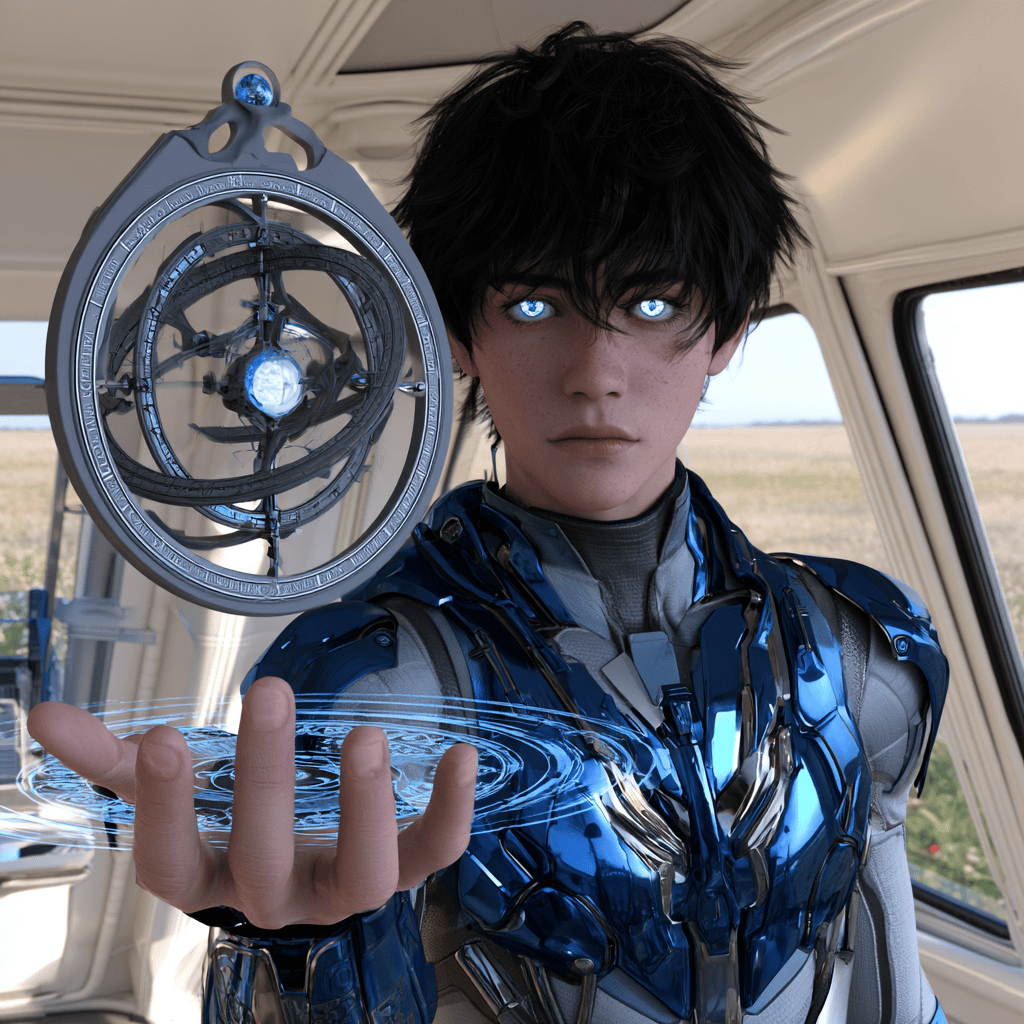
The Star of Vis rises out of him like a held breath finally let go. An astrolabe, small and ancient, metal rings turning slowly around a marquise-cut gem that glows blue-white against all that gray. It floats above his palm, patient, listening. The storm itself seems to lean toward it, and I finally understand hunger as a weather condition.
“The Star answers only to me. You can’t take it by force.” Cerulean’s voice carries clear through the wind, and there is something almost like teaching in it. “If you kill me, it will be yours to claim. But you kill only for your ultimate cause. The survival of your own kind. And it is not just, Lord Typhon, for another race to suffer so that yours can thrive.”
The pale eyes narrow. The smoke tightens a degree. The Star turns, ring within ring.
Then the boy does the thing I will be replaying for the rest of my existence.
He looks at the Star of Vis, held above his own hand, and he speaks to it with the solemn care of someone signing their name for the last time.
“From this moment on, I am no longer your master. Seek a new guardian. One who will protect you from evil.” The blue-white glow washes his face. “Go to our leader. Captain McKinley, the Sixth Acolyte. He bears the Cyan Luminary. The Acolyte of Universe and Space.”
The rings spin once, fast, as if the Star heard. And maybe it is only the storm light, but for half a second the blue-white glow seems to reach for him, washing up his arm, over the pinned shoulder, across the face of the boy who wished on it once and carried it ever since.
Then it soars. Straight up, a blue-white streak punching through the storm ceiling, through the ash, into the summit of the sky, gone. The smoke lunges after it and closes on nothing.
For a moment, nothing on that cliff moves except the wind.
“I admire your courage, Guardian.” The spirit’s voice has changed. The mockery is gone out of it, and what is left sounds old. “It’s a shame you won’t be part of my army.”
A sphere of green light kindles in the smoke where a hand might be. Ominous is a word people overuse. This green earns it. It grows, humming, and its glow climbs the boy’s pinned body until his face is lit in that deadly color, and he looks at it, and he does not look away, and he does not beg, and I stand up off my boulder for no reason that will ever matter.
The green strikes him square in the chest.
Light bursts from the point of impact, warm and white, flooding out of him as if his whole life had been stored as brightness. And out of that brightness rises the Ivory Luminary, huge and slow: a white-golden cluster of crystals arranged in a lotus, petals of light unfolding as it climbs into the dark air above the storm.
It cracks.
A line of black runs through one petal, then another, then everywhere at once, and the great lotus shatters. Not into pieces. Into thousands. A whole sky’s worth of white-gold shards scattering upward and outward, riding the storm winds beyond the clouds, higher and farther than any explosion has a right to reach.
Cerulean falls.
The smoke releases him and he drops to the cliff, and the rock receives him without any ceremony at all. His eyes are open and they are not seeing. The silver-and-gold armor, plate by plate, the boy remains, and the white cape, which billows once, weakly, and settles over the stone.
Typhon’s spirit hangs above the cliff a moment longer. Then it folds itself back into swirling gray and withdraws into the dark clouds, and the storm begins, slowly, to unclench. Light comes back to the shelf of rock in weak gray increments. The scrub grass straightens. The sea below keeps its count.
The boy on the stone does not move, and the white cape stirs when the wind asks it to, and that is all.
I do not say anything for a while. Neither does the sea.
Far from that cliff, in the present day, under an ashen and cloudy afternoon, the sky begins to fall in the most beautiful way anyone has ever seen.
A meteor shower in broad daylight. Thousands of shooting stars, warm white and ivory and white-gold, streaking silver linings across the heavens in every direction, bright enough to print themselves through the cloud cover. Phones come out on every continent. My cube starts jumping, place to place, because there is too much witnessing to do and only one of me.
At the mall, the Sevillas have stopped on the open-air terrace with their shopping bags forgotten at their feet. Aunt Thalia grips Uncle Enrico’s sleeve and points. Morissette, the maid, makes a small sound and covers her mouth. Beside them stands Allison, or rather the tireless android understudy who keeps Allison’s seat in the world warm while the real one waits, trapped in stone, for her friends to bring her home. The android tilts its face to the burning sky and smiles on cue. It photographs well. It is the only heart on that terrace not actually beating.
Jump. A park, green and ordinary. The Pangilinans stand in a loose cluster on the grass: Uncle Greg with his hands on his hips, Aunt Martha, cousin Mary, and the trio of James, Benjamin, and Michael side by side, which would be a miracle in itself if those three were not, at present, three courteous machines wearing the brothers’ faces while the originals are scattered across a war. The androids gaze upward with perfectly calibrated wonder.
Sophie stands a little apart from all of them.
No costume, no wings, no antennae. Just a girl in the park with paint on one thumbnail, watching white-gold fire write itself across the clouds. She is the only kid on that grass who is exactly who she appears to be, and her face is not doing wonder. It is doing arithmetic. Her lips move, barely.
“Cerulean Arlentis,” she whispers.
Jump. The grandparents’ home, where Grandpa Al and Grandma Emily stand on the porch steps with Aunt Ellie and Uncle Ansel, baby Felicity, crowded behind them, all four faces tipped up and lit silver, awe laid over them like a blanket.
Jump. The shores of Laiya, where the afternoon has gone silver over the water. The Mallari family has spilled out onto the sand: Carlota and Carding standing close, Kate shading her eyes with both hands, Roel with his wife, Christine and Sarah side by side, and the two boys chasing each other at the waterline until even they stop, because the sky over the sea is raining slow white fire, and the water is giving every shard of it back in reflection, and for one long minute the whole bay is made of light. Nobody speaks. Down the beach, a fisherman lets his net hang slack in the shallows and simply looks up, and stays that way.
None of them know what they are looking at. All of them will remember where they stood.
And one radiant blue-white point in all that falling brightness is not falling. It is traveling.
My cube catches up to it on approach: the astrolabe, rings turning around the marquise-cut shard at its heart, arrowing through the upper dark toward a sleek shape parked in the black. The Peregrine. Home. The Star does not slow for the hull. It phases through the gleaming glass of the command center the way light goes through water, and glides to a stop in the middle of the room, glowing.
Captain McKinley turns from the forward wall.
He has been standing beside Cielo since the portal spat the trembling pony onto his deck with a strapped chest and an empty saddle. The captain had unbuckled Pandora’s Box himself, set it on the console with both hands, and then done the thing he is best and worst at, which is wait. One gauntleted hand on the white neck. Eyes on the glass. A strategist assembling a picture out of a pony, a box, and a silence, and hating every piece of it.
Now his eyes find the Star, alone in the air, and I watch the calculation land on his face with all its weight. The Star of Vis has returned to the Peregrine.
Without its Keeper.
Cielo makes a low, broken sound. ROBO4000, at the console, goes very still, the way machines do when they have finished computing something and wish they had not.
The Star floats toward the captain. Slowly. Almost formally. And McKinley, space ranger, strategist, the brother who stayed at his post, reaches out on an instinct older than any of his training and opens his palm beneath it.
The Star settles into a hover above his hand.
A magical circle blooms around his wrist, rings of light turning within rings, and his eyes flood with a brilliant blue-white glow, the mark of an appointment made on a cliff by the sea and sealed by a boy’s last will.
The new Keeper of the Star of Vis stands in the command center, holding a light he never asked to hold.
Wind_delivers_last_words.sav
The cliff is where I left it. So is he.
The silver-and-gold armor has not gone anywhere. It holds its shine even under the ash-colored light, plates catching what little the sky gives, the white cape spread across the stone. Whatever else that storm took, it did not take this. A knight lies on the rock in full array, sword arm at rest, and the sea below keeps up its slow count against the base of the cliff.
Then the world updates around him.
I do not know a better way to say it. The light shifts first, ash draining out of the sky, ordinary afternoon gray flooding in to replace it. The horizon rewrites itself in pieces: a far coastline sprouts the tiny geometry of towns, a thread of highway stitches itself along the shore, a wind farm raises its white arms on a distant ridge, and high above, a passenger jet draws its slow line across the clouds as if nothing in the universe were unusual. The mountains stay. The sea stays. Everything temporary swaps itself out around everything that is not, centuries clearing customs in the space of a breath, and my cube renders the whole transition without so much as a stutter, which feels disrespectful somehow. Something that large should at least cost a loading screen.
Ancient Greece lets him go. The present day receives him.
My cube holds the wide shot for a while, and I let it, because down the clifftop path two figures are coming, and I am in no hurry to watch this part.
They left the Peregrine within minutes of the Star’s arrival. I saw that too. The captain had barely finished absorbing the blue-white glow around his own hand before Cielo was at the glass, pawing, wings flaring, turning circles like a compass needle with only one bearing left in it. Nobody aboard needed the behavior translated. Captain McKinley gave the order with his jaw set and his voice flat, the way you give orders you would rather carry out yourself, and Princess Ruana answered it before he reached the end of the sentence. A portal, a shoreline, and a search: the pony casting along the cliffs for a scent or a certainty, the princess scanning every shelf of rock from below, working their way toward the one place neither of them said out loud.
Cielo gallops in front now, hooves striking sparks off the stone, wings half-open for balance, mane whipping. He has flown this route once already today in the wrong direction. Beside him, matching him stride for stride, runs Princess Ruana: red hair streaming, seafoam gown fluttering around her like water that decided to come along, the twin-fish clasps at her shoulders flashing with each step. Neither one of them is saying the thing they are both racing toward.
The path bends. The shelf of pale rock opens ahead.
Cielo stops so hard his hooves skid.
He stands at the edge of the shelf with his neck stretched forward and his ears pinned back, staring at the shape in silver and gold, and he does not make a sound, and he does not take another step. Disbelief looks the same on every species. I can report this now with confidence.
Ruana comes around him slowly.
She sees. Her hand rises halfway to her mouth and stops there, hovering, as if her body has not agreed yet on what to do. Then she crosses the shelf, one careful step after another, bracing herself the way you brace for cold water, and kneels on the stone beside the fallen knight.
Up close, the armor is immaculate. No dents. No scorch. The storm did not manage to mark it, and it gleams on him now the way it gleamed in the vault, silver and gold answering even this weak gray light, the heraldry on the breastplate catching a shine as if it intends to keep his rank for him. His eyes are open, aimed at a sky that has already changed twice since he last saw it.
Ruana’s own eyes shimmer. With a tenderness I have only seen her spend on the smallest and most breakable things, she reaches out and closes his eyes, her fingertips barely touching, the gesture over in a second and permanent forever.
Then she folds.
She lowers herself over him and gathers as much of the armored shoulders as her arms can hold, and she grieves the way she does everything else, quietly, thoroughly, her face hidden against the white cape, her shoulders shaking without a single sound escaping. Of all seven, she is the one who carries the others: the healer, the steady voice, the one who waits at the edge of every battle to catch whoever falls out of it. Nobody caught this one. She holds him the way she would have, one beat too late, and does not let the lateness stop her.
The sea keeps counting below. The jet’s contrail feathers apart overhead.
Cielo whimpers. It is not a horse sound. Then he lifts his head and lets out a long, sorrowful neigh that rolls off the cliff and out over the water, the kind of sound that does not expect an answer. When it fades, the winged pony walks to the other side of the boy, and sits, actually sits, folding his legs under himself and drawing his wings in close against his body until he is as small as a creature that size can make itself. He rests his chin near the boy’s shoulder.
A princess, a pony, and a knight, on a cliff above the sea.
I stand where I always stand, close enough to count the fish scales on her clasps, far enough that it makes no difference, and I keep them company in the only way available to me, which is this sentence.
Half a world away, the wind has an appointment.
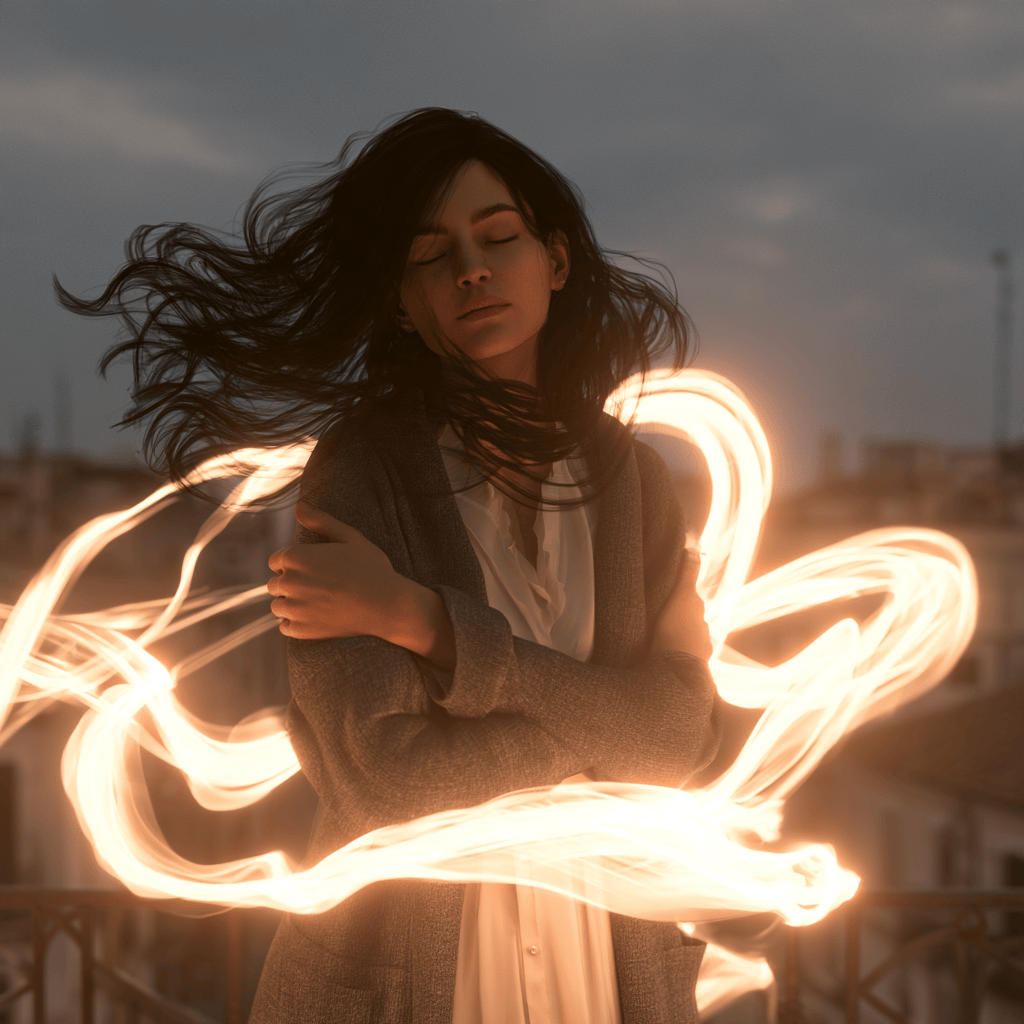
My cube swaps hemispheres. Austin, Texas, where it is night, and the sky has committed to it: clear from edge to edge and completely starless, one of those nights where the dark seems freshly wiped. The Kennedy house sits in its sleeping neighborhood with warm light in two windows, a porch swing holding still, a car cooling in the driveway. On the second-floor balcony, the one with the good telescope folded in its corner under a canvas cover that has not come off in months, a woman stands alone at the railing.
Selena wraps her cardigan tighter against the cold and looks out at nothing in particular. She has the stillness of someone who came outside without deciding to, drawn through the door by an instinct that did not explain itself. Behind her, through the glass, the den glows amber and ordinary: a lamp, a shelf of framed photographs, a room that believes tonight is a normal night.
Then the wind changes.
It arrives warm, out of season, out of nowhere, and it does not blow past her. It wraps. Soft white shimmers ride in it, small drifting points of brightness that circle her shoulders and settle around her like a shawl being laid on gently from behind. Her breath catches. Her eyes close.
And the wind begins to speak.
I recognize the words before the second sentence lands, because I heard them the first time, on a cliff, under a storm, from a boy holding back the sky with both hands. He gave them to the wind between one assault and the next, quietly, without an address written on them, and I stood there hoping the wind was the kind of courier that finishes its routes. It is. It carried them across an ocean and half a continent, over cities and weather and everything else that usually scatters a voice, and it did not drop a single word. Whatever else I say about this universe, its postal service is beyond reproach.
I was born to wonderful parents. I swam with Mom and Dad. I played cello in the opera house while they watched from the box seats, and Dad clapped too early every time.
Selena’s hand finds the railing.
Mom told me stories about the food from her homeland. Dad and I stargazed on this very balcony with the good telescope. Mom even told me about her first love once, and then she laughed and said her heart belonged to Dad and to me, in that order or the other, depending on the day.
Her other hand presses flat against her heart. She does not open her eyes. The shimmers drift closer, patient, unhurried, as if the wind knows this delivery cannot be rushed and refuses to try.
Carlisle always found me when I wandered off. Every single time. Dad, you believed in me. You shaped me. Brave, just, wise, adventurous, that was the list, and you never let me skip a word. Mom, your love kept our family strong.
The wind holds its breath. So do I.
I am the luckiest child to have you both.
Inside, past the glass, Bill has come to the doorway of the den. He sees his wife out on the balcony, alone in the cold with her eyes closed, and he does what a good man does when he cannot tell whether a moment is private: he stays behind her, hands at his sides, giving her the space and guarding the edge of it.
On the balcony, Selena suddenly bends, clutching her abdomen, a deep pain with no injury attached to it, the kind that arrives from the inside and answers to nothing. She stumbles half a step. Catches herself on the railing. Holds.
The shimmering wind loosens. The white points of light thin out, lifting away into the starless dark one by one, and the warmth goes with them, and the cold Texas night closes back in around a woman standing alone.
Her eyes open. She sways.
Bill is through the door before the sway finishes. “Are you alright, dear?” His hands find her shoulders, steadying, his eyes running the quick automatic checks. Pupils. Breathing. Color.
Selena turns to face him. Her expression has gone somewhere distant and taken all the pain with it.
“Topher is not here,” she murmurs.
“What are you saying?”
The balcony door is still open, and through it, right on cue, Carlisle arrives in the den. The butler’s suit is impeccable even at this hour, and his hands rest lightly on the shoulders of a boy in pajamas, steering him in with gentle formality. The boy has Topher’s face. The boy has Topher’s hair, sleep-mussed at the exact angle. The boy is not Topher, and has not been for some time, and performs its role so well that it has fooled a household, a neighborhood, and a school. It has never once fooled me, and as of tonight, its record has a second asterisk.
Selena gazes at the boy through the glass, recognition and disbelief crossing her face in both directions at once.
“He is not our son,” she says quietly, to Bill.
“I don’t understand.” Bill glances back at the den, at the boy standing there in pajamas, small and blinking. “He’s right there. With Carlisle. With us.” He turns back to his wife, searching her face the way he would read a chart that refuses to make sense. “Selena.”
“I let him out of my sight again.” Her voice has dropped to a whisper, and the tears arrive in it before they reach her eyes. “Just like when we lost him in that cave three years ago. I failed to protect him. Then, and now.”
“Dear. Look at me.” Bill’s hands move to her face, cradling it, his thumbs at her cheekbones, his voice pitched low and even, the voice he has used on a thousand frightened families in a hundred hard rooms. “We can work through this. You need rest. That’s all this is.”
“Our son is dead.”
She says it softly. That is the terrible part. No drama in it, no question mark anywhere near it, just a fact laid down in the space between them like something too heavy to keep holding.
“He’s gone.” Her voice breaks in the middle. “He told me his last words.”
And she begins to sob, openly now, the kind of crying that does not care who is watching.
Bill stands there with his hands still framing his wife’s face, and I watch two systems fight for the same man. The doctor runs the numbers: the boy is in the den, twelve steps away, visibly breathing, statistically fine, and grief without a body is a symptom, not a diagnosis. The father runs something older that does not use numbers at all, something that has been uneasy for months without ever finding the word for it, the small wrongnesses at the dinner table, the son who stopped humming in the shower, the hugs that land correctly and weigh nothing. The something older keeps returning the same result. His eyes begin to glisten, and he hates every bit of what they are doing.
“Please, Selena.” It comes out cracked. “Stop. Don’t do this to yourself. To me. To us.”
Selena pulls back from his hands, tips her face toward that empty starless sky, and lifts both arms to it, reaching for something that is not there to be reached, and the last of her composure lets go.
“Aaaahhh!”
The scream tears across the quiet neighborhood. Somewhere down the block a dog answers. A porch light blinks on two houses over, then another. She draws breath and screams again, and again, each one ragged and shapeless, grief with the words burned out of it, and Bill wraps his arms around her and holds on while she fights him and the sky and the truth all at once, and he is crying too now, silently, into her hair, because holding her is the entire job and he intends to do it.
Her knees give.
The screaming stops the way a storm stops, all at once, leaving its own silence. Selena goes slack in her husband’s arms, unconscious, spent, carried under by a sorrow too large to stay awake inside. Bill sinks with her, kneeling on the cold balcony tile, gathering her against his chest, one hand cradling the back of her head, rocking very slightly, the way you hold something you cannot fix.
Through the glass door, the den holds its tableau.
Carlisle has not moved. He stands with his hands still resting on the shoulders of the boy in pajamas, and his face, that fortress of professional calm, has gone somber in a way no member of this family has ever been permitted to see. This is the man who found a wandering boy every single time, in gardens and markets and once, famously, halfway up a tree. Tonight he watches the two people on the balcony from the wrong side of the glass, and his grip on the small shoulders tightens by a degree that only I would notice.
The boy in pajamas watches too. It stands very still, a few steps from the door, gazing out at the kneeling man and the woman in his arms with Topher’s face arranged in Topher’s expression, and whatever is running behind those eyes, it keeps its conclusions to itself.
Above Austin, the night stays starless from one horizon to the other. Tonight of all nights, it could have made an effort.
On a cliff across the world, a princess keeps her vigil in the gray afternoon, a winged pony tucked small beside her, over a knight whose armor never faded.
Somebody keeps all of it. That’s what I’m for.
Reactor_wakes_uncle_falls.sav
The room they bring him to is small and quiet and very clean.
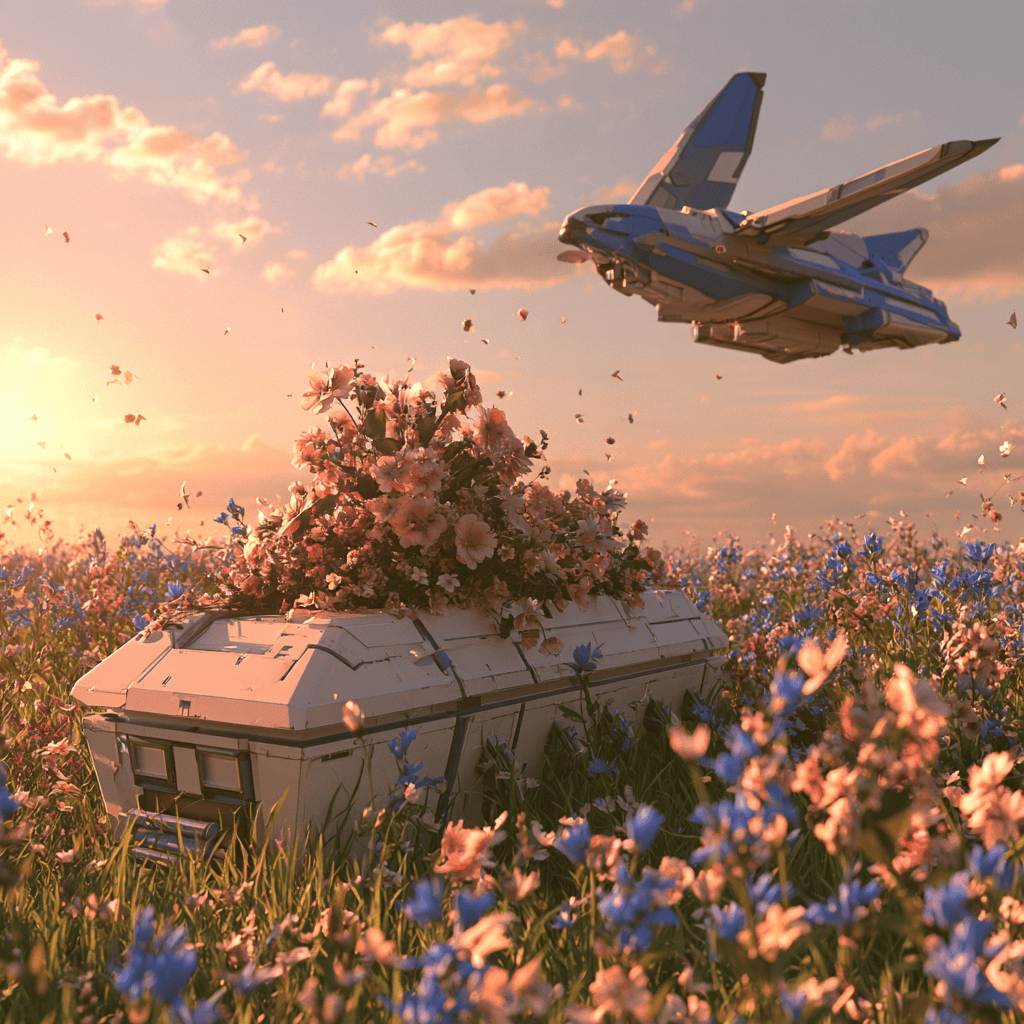
It is one of the Peregrine Lightyear’s side compartments, the kind with no purpose written on the door, lit by a low panel in the ceiling that makes everything look like early morning. A flat surface. A counter. A basin of water sitting on it, still faintly rippling from being set down. And on the flat surface, in silver and gold, the Ivory Acolyte.
The armor stayed. I keep circling back to that. Whatever left him on the cliff, it did not take the plate with it, and so he lies here in full array, the white cape arranged beneath him, every fitting exactly where it belongs. It ought to look wrong on a boy who is not moving. It does not. It looks like a rank that outlasted its holder.
Princess Ruana works alone.
She has a damp towel folded over her hand, and she wipes his face with it, slow passes, temple to jaw, the way you would clean a scrape on someone who might flinch. Cliff dust comes away in gray smudges. She rinses the towel in the basin, wrings it out with both hands, folds it again, and goes back. There is nothing hurried in any of it. Her red hair has come loose from wherever she had it pinned, hanging forward, and she keeps having to push it back with her wrist because her fingers are wet.
Nobody assigned her this. She simply did not leave.
She finishes the face. Then she moves down to his right arm and notices the gauntlet has slipped, riding a few centimeters low over the wrist, sitting crooked. She frowns at it. She takes hold and works it back up into place, adjusts the seat of it, presses the edge until it lines up flush with the vambrace, and then checks it again from a different angle to be certain.
It is such a small thing. He would not have noticed. Nobody would have noticed.
Her head bows.
The towel drops into her lap and she brings both hands up over her face and finally lets it out, alone in a small clean room with the door shut, crying the way people cry when they have been holding it for hours and have finally run out of tasks to hide behind. Her shoulders shake. The water in the basin goes still.
I stand by the counter with my hands in my pockets and I keep my mouth shut, because there is nothing I could say that would reach, and because some rooms you do not narrate over.
Sunset gets involved a few hours later.
The Peregrine has come down somewhere with a horizon, and the sky is doing that thing it does when it wants to be forgiven: orange low down, deepening into indigo above, faded clouds drifting through the middle in long soft bars. Amber light pours through the glass and floods the whole deck, laying warm color over every surface, over the steel, over the people standing in it.
They have set the casket on a stand.
It is coverless, open to the light. Cerulean lies in it clad in his silver-and-gold armor, the white cape draped beneath and around him, his holy sword laid along his chest with both arms crossed over the hilt. Three sleek panels rise around the stand and close together above it, transparent and seamless, forming something that is not really a coffin and not really a monument. A futuristic tomb, if you want the plain description. It looks like the ship built it out of respect and nobody had to ask.
His face, in that amber light, is peaceful. Asleep is the word everybody in the room is thinking and nobody is saying.
Uncle Ronald stands closest.
He is a big man in a mechanic’s build, forearms like cable, and right now he is not any of that. He looks at his nephew’s face for a long time without blinking. Then he reaches in and strokes the boy’s hair back from his forehead, once, twice, the gesture of a man who has done exactly this before, at bedsides and after nightmares and on ordinary Tuesdays when a kid fell off something he should not have climbed. He leans down. He kisses the forehead.
He straightens up and does not say a word.
Ruana watches with her eyes glistening, hands folded in front of her, letting the tears come without any sound at all. Captain McKinley stands a pace behind them, helmet off, jaw locked, blue-white still faintly banked in his eyes from the appointment he never applied for. He does not move and does not speak. Mourning, in his case, looks a great deal like standing at attention.
ROBO4000 is present, tall and chrome and motionless, its optical band dimmed to its lowest setting. CleanBot has parked itself near the base of the stand with its brushes stowed and has not run a cycle in an hour, which for CleanBot is practically a eulogy. And Cielo stands at the head of the casket with his wings folded flat, his chin lowered until it nearly touches the panel, the whole of him gone quiet in a way that no one has ever seen a pony be.
Amber light on armor. Amber light on a chrome shoulder, on a white wing, on a captain’s face.
I would love to tell you a swelling orchestral cue plays here. It does not. It is just a sunset, doing what sunsets do to a room, indifferently and beautifully, and then dimming out while everyone stands there.
Afterward, Uncle Ronald goes back to work.
I follow him, because grief that walks off alone tends to be worth watching, and because I have a bad feeling I cannot source. He changes into his jumpsuit, the faded one with the pockets worn soft at the seams. He collects the heavy toolbox from the rack and hooks it up in one hand, no strain, and he moves down the Peregrine’s corridors at his usual pace, past the lit conduit lines and the humming panels, boots ringing on the deck plating. He passes CleanBot in the junction. He does not look at it. CleanBot chirps a greeting at his back and gets nothing, which has never once happened before.
His eyes are hollow. That is the only thing about him that has changed, and it has changed completely. The hands still work. The route is still the route. A man can lose the middle of himself and keep the outside running for a good long while, and this one intends to test how long.
The reactor room is aft, behind a heavy hatch, and the air inside it has a low charged hum that you feel in the fillings of your teeth. He sets the toolbox down. At the center of the compartment stands the contraption: a transparent glass tube, tall and pointed at the crown, cradled inside a broad rotating gear that runs its slow ring around the base. Routine maintenance. He has serviced this thing dozens of times. It is the least interesting object on a spaceship full of interesting objects.
The gear stutters.
Ronald’s head comes up. It stutters again, catching, turning a few teeth and then stalling, turning and stalling, a rhythm that is wrong in a way a mechanic hears before he sees. He steps in closer, tilting his head, watching the ring hitch.
Sparks fly off the housing in a bright orange spray.
He recoils, one arm up, boots skidding back. And the gear, which has been stopping and starting for the last ten seconds, snaps into full speed all at once.
The glass tube ignites.
Cyan floods it from the base upward, brilliant, and inside the glass the energy does not sit still. It writhes. It gathers and unfurls, and the shape it makes as it unfurls is wings, twin arcs of light beating against the inside of the tube like something that has been waiting in there for a very long time and just found out the door exists.
The whole room begins to flash. Light, dark, light, the walls strobing, every surface going white and then black and then white again. Ronald throws his forearm across his face, shielding his eyes.
And then, because he is who he is, he peeks through his fingers anyway.
I like this man enormously. I want that on the record before the next part.
The shockwave leaves the reactor with a sound I feel in my chest from an entirely different spacecraft. Cyan radiance blows outward and swallows him, and Ronald lights up head to foot, jumpsuit, boots, hair, every inch of him glowing from the inside out. In each fist he is gripping a balisong, the two folding knives he has carried since long before any of this started, and the energy takes those too, running along the handles, flooding the pivots, filling the blades until both are burning cyan in his hands.
The floor cracks.
Fissures spider out from beneath his boots, and cyan rays lance up through them, thin and bright, filling the room with a lattice of light. He looks down. There is a half second where he simply looks down, the way anybody would.
Then the deck gives way.
He drops. The knives drop with him, still burning, and the light of him falls away into the dark below the reactor room and is gone from my frame in less than a heartbeat.
The explosion arrives right behind it.
It rocks the compartment, tears the hatch off its track, throws a wave of pressure down two corridors. My cube kicks me outside for the wide shot, because it knows what I need before I do, and from out here in the dark I watch a burst of cyan light erupt from a rear compartment of the Peregrine, blazing up behind the gleaming glass walls, painting the whole aft section in that impossible blue-green for one long second.
Then it fades, and the ship hangs there, and the corridors go quiet.
Somewhere on the deck above, in the last of the amber, a knight lies in silver and gold under three sleek panels with a sword crossed on his chest, and none of the people standing around him know yet.
I do. I always do. That is the arrangement.


Leave a Reply