Overview:
| James strolls along the shoreline, where a weathered Hanged Man tarot card catches his eye among the sand. Intrigued, he picks it up and slips it into his pocket. Further down the beach, he meets Anton, a cheerful boy carefully building a sandcastle. James joins him, and as they work together, the conversation naturally turns to James’s decision to leave his former team. Later, James finds temporary shelter in the home of an elderly couple, Aling Sita and Mang Noel. The couple welcomes him with genuine warmth, sharing a simple but hearty lunch as they exchange stories and pleasant conversation. Their kindness offers James a rare moment of peace. As evening falls, Mang Noel joins James on the porch overlooking the sea, where the two watch the sun sink below the horizon. Sensing the turmoil beneath James’s quiet demeanor, Noel gently deduces that the young man is running away from something. Mang Noel opens up about his own life, recounting the hardships he and Aling Sita endured throughout their marriage and the challenges of raising a family. Despite the pain, he says, he has never regretted choosing a life shared with others. He tells James that life always moves forward, and that merely existing within one’s comfort is not the same as truly living. A meaningful life is filled with both joy and sorrow, and the price of loving others is the willingness to suffer alongside them. Yet, Noel believes, that price is always worth paying. |
Word_left_behind_verdict.sav

I don’t know what time zone this coastal nothing-town runs on, but the sky over it has settled on a blue so clean it looks rendered. No filters, no god rays, just honest morning light doing its one job well. The sea rolls in soft and unhurried, the kind of tide that never remembers it’s supposed to be dramatic. Sand stretches gold and endless in both directions, studded with little glints of broken shell that catch the light like loot nobody’s bothered to pick up yet. Somewhere off past the tideline, a fishing boat with peeling blue paint sits beached and forgotten, half-buried, more landmark now than vessel.
I’ve parked my sim-view low, maybe ten feet off the ground, angled so I can track him without the wide shot swallowing what actually matters. James. Jameson, if his mother’s mad at him. Oppa Rockstar, if there’s a monster within throwing distance. This morning he’s neither. He walks the shoreline alone in a pair of scuffed Beachwalk slippers, rubber soles pressing shallow half-moons into sand that forgets them almost instantly. His hair, usually gelled into something stage-ready, sits flat and a little wind-mussed, no product, no performance. He isn’t dressed for a mission. No orange musical staff coiling around his arm, no butterscotch guitar slung across his back, nothing that says superhero. Just a plain gray shirt gone soft from too many washes, faded board shorts, both hands buried deep in his pockets like he’s trying to keep them from doing anything useful. Every few steps he flicks up a little spray of sand with the side of his foot and watches it scatter without much interest in where it lands. His eyes stay fixed on the horizon, that flat seam where the ocean gives up and becomes sky, the way a person looks at something when hoping it’ll answer a question he hasn’t said out loud yet.
It won’t. I’d know. I’ve been staring at horizons for three years straight, and mine’s never once written back.
Something in the sand snags his attention. A corner of card stock, poking up at an angle, edges gone soft from salt water, the color faded but not erased. He slows, crouches, brushes the grains away with two fingers, careful the way people get careful with things they already suspect might matter. When he turns it over, I find myself leaning in without meaning to, because even I don’t recognize it at first glance.
An upside-down man, painted in cracked gold and faded crimson. He hangs by one ankle from a bent, leafless tree, his free leg crossed loosely behind the other knee, arms folded neat behind his back. Not struggling. Not panicking. Like he chose to hang there and made his peace with the view a long time ago.
“The Hanged Man,” James murmurs, mostly to himself, thumb dragging once across the illustration to clear the last crescent of sand. “Surrender. Sacrifice. Letting go.”
I didn’t know he read tarot. File that under Things I’ve Apparently Never Asked My Own Cousin, right next to how he takes his coffee and whether he still keeps that lucky-clover trick a secret from the rest of the family. He says the words slow, like lyrics to a song he half remembers but hasn’t sung in a while, and something crosses his face that isn’t quite a smile. More the outline of where one used to sit. He slides the card into his pocket like it weighs more than paper has any right to, and keeps walking.
He stops once more before that, at the shoreline where the wet sand turns dark and firm underfoot, and picks up a flat gray stone. He turns it over once between his fingers, testing the weight the way a person does before a throw they’ve made a thousand times, then sends it skipping out across the shallow water. One skip. Two. It sinks on the third without much drama. Back when this whole mess started, he could get six or seven bounces out of a stone like that, showing off for cousins who’d cheer regardless of the actual count. Nobody’s counting now. He watches the ripples flatten out and fade, hands already sliding back into his pockets, and keeps moving down the beach like the stone never happened.
He doesn’t get far. A little way down the beach, half-sunk in a lopsided moat, a kid is losing a slow war against a sandcastle that keeps forfeiting one wall at a time. Small guy, sunburned across the bridge of his nose, damp swim trunks clinging to skinny legs, a plastic shovel gripped in both hands like a weapon he doesn’t quite trust yet. Two crooked towers flank a lumpy keep, and a scavenged twig juts from the top like a flag nobody’s gotten around to designing. His latest wall leans, sighs, and folds into a shapeless little hill, and the kid stares at the wreckage with the flat, personal betrayal only a certain age can manage. Old enough to plan. Too young to accept that plans fail.
“Need a hand?” James calls, already crouching before the answer arrives.
“Yes, please, Kuya.” No hesitation at all. The kid says it like turning down free labor would be the genuinely strange choice here. “It’s hard to make a sandcastle alone.”
“Good answer.” James grins, a real one this time, not the polished, camera-ready version that used to fill gymnasiums whenever Kaleidoscope took the stage. He drops down beside the ruined tower and starts packing wet sand into a fresh base, testing the give with his palm before stacking higher. I notice, because noticing things is basically my entire job description these days, how careful he is with it. Like the sandcastle’s feelings are somehow on the line.
“What’s your name?” he asks, smoothing a wall flat with the side of his hand.
“Anton. Yours?”
“Jameson. James is easier.”
“I’ll call you James.” Anton says it like he’s stamping the paperwork on the spot. “It’s shorter.”
James laughs, the honest kind, and pats a lopsided turret into something resembling a shape. “Good call, little man.”
“Are you a singer?” Anton asks suddenly, squinting up at him. “You kind of look like one. Like on TV.”
James blinks, caught off guard, then huffs a short laugh through his nose. “Something like that. Old hobby.”
“Sing something.”
“Maybe later.” He says it easy enough that Anton doesn’t push, already distracted by a shell half-buried near the moat’s edge, turning it over to check for a resident before pressing it decoratively into the outer wall like a jewel.
They settle into a rhythm after that, digging and packing and patching, the tide creeping close enough to threaten the outer wall before retreating again, cowardly the way tides always are. Anton fills the quiet with the sort of questions kids ask because the filter between brain and mouth hasn’t finished installing yet.
“Where’s your friend? The one you were with yesterday. A boy, about my size.”
James’s hands still for half a second over the wet sand. “We were together. He had to go home.” His voice drops something, not volume exactly, more weight. “We split up.”
“That’s a bummer.” Anton frowns like it’s genuinely bad news, personally inconvenient even. “I wanted to meet him. Play together.”
“Yeah,” James says, quiet. “Me too, honestly.”
“Why are you here, though? What are you doing all the way out on this beach by yourself?”
James’s hands slow further, pressing a wall smooth that’s already smooth. “Thinking things over. Wanted some peace.” A pause that runs a beat too long. “Not sure I’ll actually find it here.”
“Why alone? Didn’t you bring friends?”
“You’re alone too,” James points out, deflecting the way people do when a question lands somewhere tender.
“Yeah, but my playmates are busy today.” Anton pats down a wall, unbothered by the dodge. “Is it the same for you?”
James doesn’t answer right away. His jaw does something small, tightens, then lets go, like he’s chewing on a decision he already made and still doesn’t love the aftertaste. “I left my friends,” he says finally, “in the middle of a really big fight. I just got tired of fighting.”
Something lands in me that I don’t have a clean name for. Three years watching this family from a cube I can’t leave, and I’ve never once heard James describe walking away from anyone as anything less than a last resort.
Anton doesn’t soften it. Kids never do. They haven’t learned the little padded phrases adults use to keep from bruising each other. “That’s kind of selfish,” he says plainly, still carving a window into his tower with the flat edge of the shovel, not even glancing up to see if the word lands. “You left them when they needed you most.”
James freezes mid-scoop. Wet sand slips loose between his fingers and drops in a soft little pile that neither of them looks at. “You think so?”
“Definitely.” Anton’s tone doesn’t waver, doesn’t perform, doesn’t do anything but state a fact as plainly as the color of the sky. “In friendship, there’s no excuses. You stick together no matter what. You fight side by side till the very end.”
Something twists behind whatever passes for my ribs these days, long story, don’t ask. James doesn’t respond right away. He just sits there with cooling sand on his fingertips, staring at a kid’s blunt little verdict like it’s been carved into a wall somewhere permanent, somewhere he can’t sand it smooth again. His shoulders don’t slump exactly. They just stop pretending to be relaxed.
Part of me wants to jump in. Wants to remind Anton it isn’t that simple, that watching your cousin get swallowed whole by a windstorm and your brother nosedive out of the sky screaming isn’t the same as skipping band practice. Wants to tell James that nobody, not even a guy who can summon glowing sixteenth notes out of thin air, gets to carry a team forever without something in him finally giving out. But I’m a guy in a cube on a ship James doesn’t know exists, watching him through a simulation he’ll never feel me standing inside. I could probably count the grains of sand caught in the seam of his slipper if I wanted to. I couldn’t nudge a single one loose to save my life.
The tide finally wins its slow, patient little war and slides over the outer moat, softening the walls Anton fought so hard to raise. He doesn’t seem to mind much. He just picks the shovel back up and starts patching the damage, the way kids do, treating the ocean’s small theft as part of the game rather than a tragedy worth mourning. A crab, disturbed by the flooding, scuttles sideways out of the wreckage and vanishes down a hole nobody noticed was there.
“You should stay and finish it with me,” Anton says, already smoothing over the breach. “You’re good at this. Better than my playmates, even.”
“High praise.” James’s mouth twitches, almost a real smile this time, and he leans back on his palms to study their lopsided handiwork. “I used to build these with my little cousin. He was better at the towers. I was better at not stepping on it by accident.”
“Sounds like a good team.”
“Yeah.” The word comes out smaller than he means it to. “It was.”
Anton doesn’t push further. He’s already moved on to reinforcing a buttress, humming some tune under his breath that doesn’t belong to any song I recognize, which either means it’s something new or it’s nothing at all, just a kid’s private noise. James watches him work for a while, the stubborn, unbothered persistence of it, wall by wall, before lifting his eyes back out to the water. Past where the green shallows deepen into that unreadable dark blue. A gust moves his hair, and for a second the kid, the castle, the whole scene blur soft at the edges of his attention, like some part of him just checked out of the beach entirely and went looking for somewhere none of us can follow. The tarot card sits folded in his pocket, quietly heavier than card stock has any business being. A kid’s plain little verdict sits heavier than that.
He doesn’t say anything else. Down the beach, past the old beached boat with its peeling blue paint, a gull complains loudly about nothing in particular, gets no response, and gives up. The tide keeps coming in, unbothered, the way it always does, whether or not anybody down here is ready for it.
I let the sim hold on him a little longer than I probably need to. James Pangilinan, worn thin and trying not to show it, sitting cross-legged in the wet sand next to a stranger’s kid brother, half a tarot deck’s worth of guilt folded up in his pocket. Not fighting anything. Not saving anyone. Just a guy on a beach, working out whether the version of himself who walked away is someone he can still recognize in the mirror. I don’t have an answer for him. I don’t think anybody does yet, not even the card.
Neither am I. Some silences, I’ve learned, just aren’t mine to fill.
Warm_meal_quiet_refuge.sav
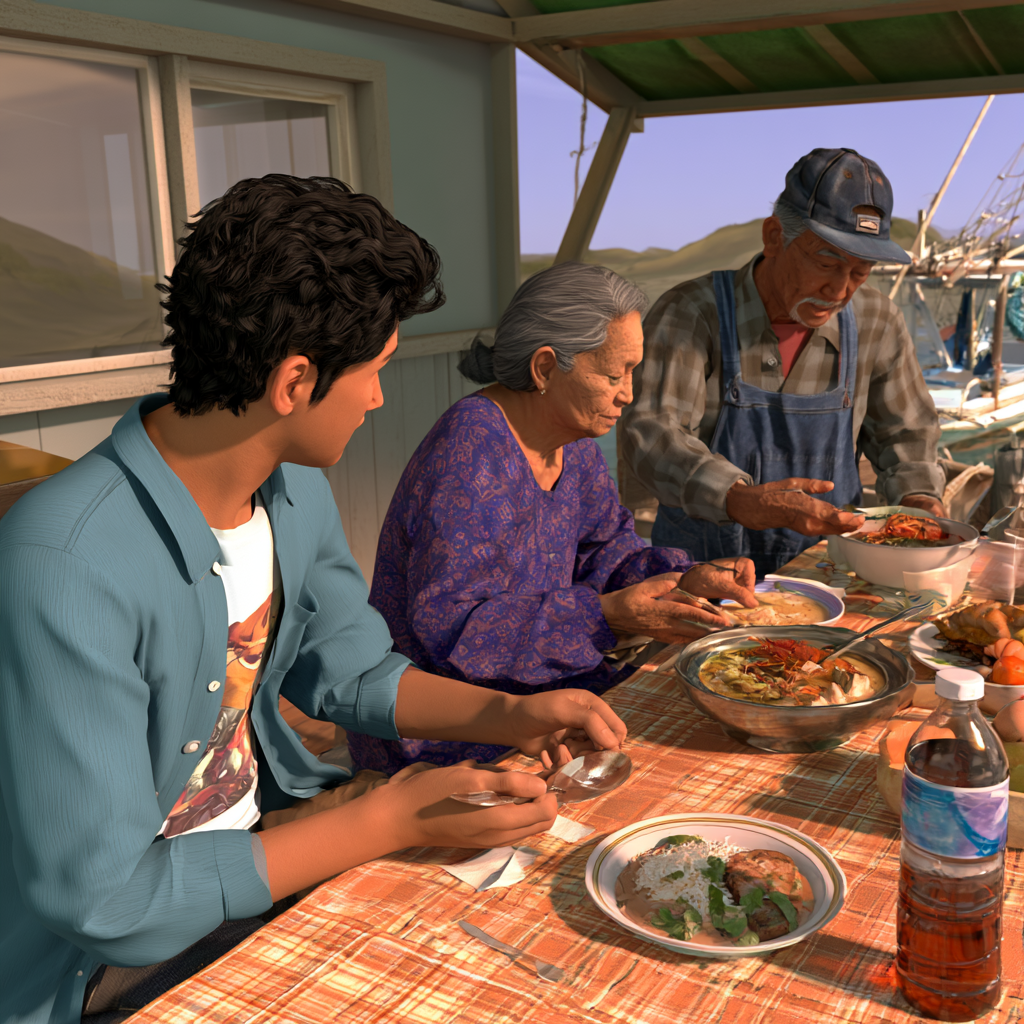
The lodging house sits three streets back from the beach, close enough to hear the surf, far enough that the salt hasn’t eaten the paint yet. It’s the kind of place travel blogs never mention and locals never forget: bamboo slat walls gone silver with weather, a corrugated roof that hums faintly whenever the wind picks up, potted san francisco plants lining a porch railing worn smooth by decades of forearms leaning on it. A faded tarpaulin sign out front reads BAHAY KUBO TRANSIENT HOUSE in letters someone repainted by hand, not quite even, clearly a labor of love rather than a franchise template.
Aling Sita runs it with the tireless energy of an NPC who’s never once glitched out of her routine, and right now that routine has her hauling a stack of table mats toward a dining table scarred with decades of elbow marks and old spilled soy sauce. James beats her to it.
“Aling Sita, let me help set the table,” he says, already reaching for the stack before she can protest.
She blinks up at him, surprised in the specific way older folks get surprised when a teenager volunteers for chores nobody asked him to do. A dish towel hangs over one shoulder, her graying hair pinned back in a bun that’s survived four decades of humidity through sheer stubbornness. Deep laugh lines fan out from the corners of her eyes, the kind that only come from decades of actually using them. A duster the color of overripe mango hangs loose over her frame, and gold hoop earrings swing every time she turns her head, which is often. “What a thoughtful young man.” She hands the mats over without further argument, because apparently even in the Philippines, free labor doesn’t get turned down twice. “Thank you.”
I watch him lay the mats down one by one, squaring the corners with more care than the job strictly requires, then follow with plates, forks, spoons, each placed with the crisp precision of someone who’s spent way too many nights folding origami cranes out of nerves. It’s a small thing. It’s the kind of small thing that tells you more about a person than the big dramatic ones ever do.
Lunch arrives steaming in mismatched bowls: fried galunggong, a plate of kangkong swimming in garlic, rice mounded high enough to survive a siege. James settles into a rattan chair across from Mang Noel, a lean, sun-cured man with forearms like braided rope, a faded fisherman’s cap pushed back off his forehead, and the kind of quiet that fills a room instead of emptying it. A thin white scar runs along one knuckle, the kind of detail that means a story exists somewhere and probably isn’t getting told at lunch. Aling Sita takes the seat between them like a referee who’s already decided which fighter she likes better.
“Iho, where did you say you were from again?” she asks, spooning rice onto his plate before he can object.
“Quezon City, po,” James answers, polite as ever, the honorific slipping out automatic and unforced.
“A city boy.” She says it like she’s cataloging him for later. “You’ve come quite a long way to be here in Laiya.”
“Yes. Both my Nanay and Tatay were born and raised in Batangas,” James explains, picking up his fork, “but they moved to Quezon City for work. Started a family there.”
“So we’re fellow Batangueños.” Aling Sita’s eyebrows lift, delighted, like she’s just found a long-lost cousin at a family reunion nobody sent invitations for. “But you’ve lost the accent completely. You speak like a Manileño now.”
James laughs, a real one, shoulders loosening for the first time since he sat down. “Can’t help it, po. Grew up there.”
“Do you drink kapeng barako?” she asks, already pouring herself a cup from the thermos beside her, black and thick enough to stand a spoon in.
James wrinkles his nose, the kind of small honest grimace nobody bothers faking. “Too bitter for me. I’m more of a milk tea guy. Tapioca pearls, extra ice.”
“Enjoy your sweet drinks while you’re young.” Aling Sita wags a finger at him, not unkindly, more like a warning label stitched into decades of experience. “Once your body starts turning on you, you’ll have to cut back. Noel and I have a whole pharmacy between us. Diabetes. Blood pressure. Cholesterol. Name it, we’ve got a pill for it, lined up on the shelf like little soldiers.”
Mang Noel grunts in agreement without looking up from his rice, which I’m starting to suspect is his version of a full sentence.
“This is really good,” James says, gesturing at the galunggong with his fork, genuinely surprised by how quickly he’s cleared half his plate. “What’s the marinade?”
“Calamansi, garlic, a little patis.” Aling Sita beams like she’s been waiting all lunch for someone to ask. “My mother taught me. Her mother taught her. Someday I’ll teach it to whoever finally marries my daughter, assuming that girl ever brings someone home.”
James laughs around a mouthful of rice, quick enough that he has to cover his mouth, and something about the sound seems to catch even him off guard.
“I understand,” James says, and actually looks like he means it, nodding the careful nod of someone raised around enough elders to know when a warning deserves respect instead of an eye-roll.
“So.” Aling Sita sets her cup down, folds her hands, and gives him the look. The universal auntie look that precedes every uncomfortably direct question in every household on this side of the planet. “What brings you all the way out here?”
James’s fork pauses halfway to his mouth. I watch the gears turn behind his eyes, watch him decide how much of the truth a stranger’s dining table can hold. “To think, I guess.” He sets the fork down slow. “I needed some space. Peace of mind.”
“Ah. Peace of mind.” Aling Sita says it like she’s tasting the phrase, deciding whether she approves of the flavor. “You’ll find plenty of that here.” She gestures toward the window, where the sea sits flat and unbothered past a row of coconut trees leaning like they’re eavesdropping on the conversation. “It’s quiet. No traffic. None of that chaos you have in the city.”
Mang Noel looks up then, just for a second, and fixes James with something that isn’t quite suspicion and isn’t quite sympathy either. Something in between, the look of a man who’s seen enough runaways and rest-cure tourists over the years to recognize the type on sight. James feels it. I can tell because his gaze slides sideways to his plate like it’s suddenly the most interesting rice he’s ever seen.
I don’t blame him. I’ve been on the receiving end of that exact look from robots with better poker faces than Mang Noel’s.
“You know, Iho, you’re a blessing,” Aling Sita continues, oblivious or choosing to be. “Tourists have gotten scarce these past few years. Business hasn’t been the same.” She says it lightly, but there’s a thread of real worry stitched into it, the kind you only notice if you’ve spent three years learning to read adults who’d rather not be read.
“Sita.” Mang Noel’s voice comes low, almost a sigh, more habit than reprimand. “Watch your words. You’ll overwhelm the boy with all your talking.”
“It’s alright, Mang Noel.” James smiles, easy and genuine, the kind of smile that used to get entire stadiums screaming his stage name and somehow works just as well on a couple of innkeepers in a fishing town nobody’s heard of. “I like listening to Aling Sita’s stories. She’s a gracious host.”
“There, you see?” Aling Sita turns to her husband with the triumphant air of someone who’s just won an argument she wasn’t sure was actually happening. “Take your time here, James. Go for a swim. Relax. It’s good to indulge yourself every now and then.”
James murmurs something agreeable, something that sounds like a yes but carries none of the weight one usually does. I clock it because that’s my whole deal, clocking the space between what people say and what they mean. He picks his fork back up, eats another bite of fish he probably can’t taste right now, and lets Aling Sita’s chatter fill the silence he isn’t ready to fill himself.
I could tell her the real answer. I could tell her the kid across her table spent the better part of a year trading blows with monsters straight out of a mythology textbook, that he watched people he loves get swallowed by storms and turned to stone and shipped off to who-knows-where, and that “peace of mind” is corporate speak for I don’t know how to keep doing this. I could tell her a lot of things. I’m not going to, obviously, because that’s not how the rules of this whole ghost-narrator gig work. I get front-row seats and zero lines, no matter how many times I’ve imagined breaking the fourth wall just to save someone a headache. So instead I just watch Aling Sita refill his water glass without being asked, watch Mang Noel go back to his rice with that same quiet weight still sitting behind his eyes, and file the whole scene away under things James needed and didn’t know how to ask for.
Outside, the tide keeps its appointment with the shore, unbothered by any of it, the way it always is.
Lunch winds down slow, the kind of slow that only exists in towns without traffic lights. Mang Noel clears his own plate without comment, the scrape of ceramic the loudest thing he’s said all meal, and disappears toward the back of the house where I can hear him fiddling with something mechanical, probably a boat motor that’s been dying by inches for a decade. Aling Sita keeps talking, cycling through weather, fish prices, and a nephew in Manila who never calls, and James nods along at all the right places even when his attention drifts toward the window and the flat blue horizon beyond it.
I get it. I’ve spent three years staring at horizons of my own, waiting for one of them to actually mean something. So far, mine’s never delivered, not once, not even a rerun.
When lunch finally ends, James helps clear the table without being asked twice, stacking bowls with the same careful precision he used setting it up, and Aling Sita watches him do it with the soft, assessing look of someone quietly deciding this kid isn’t like the usual burned-out backpacker crowd. She’s not wrong. She just doesn’t know the half of it, and probably never will, which is honestly for the best.
Through the screen door, the afternoon sun lays a long gold stripe across the floor, and somewhere out back Mang Noel’s motor coughs, sputters, and finally catches with a sound like relief. Aling Sita hums something old and off-key while she wipes down the table, content in a way that doesn’t require an audience. James lingers a moment longer than he needs to, drying a plate that’s already dry, watching a house that isn’t his settle back into its ordinary rhythm around him. It’s a small mercy, being somewhere nobody expects anything of him beyond good table manners and decent conversation. I think he knows it too. I think that’s half the reason he hasn’t left yet.
Toll_booth_sunset_bench.sav

The sun starts its slow dive somewhere behind the water, and Mang Noel is already outside to watch it happen, parked on a low wooden bench in front of the house like he’s got a standing reservation with the sky. The bench itself looks handmade, planks worn silver-gray and slightly uneven, the kind of furniture that’s survived more monsoon seasons than most modern appliances manage in a lifetime. A pair of rubber slippers sits abandoned beside it, and somewhere behind the house a dog barks twice at nothing in particular before losing interest entirely. Mang Noel sits with his forearms braced on his knees, that fisherman’s cap of his pushed back off his forehead, staring at the horizon with the kind of stillness you only get from someone who’s watched thousands of these and still shows up for the next one. A half-finished cup of something sits cooling by his foot, forgotten. He doesn’t look lost exactly. More like a guy quietly working through a math problem he’s solved before but wants to check his answer on.
James comes around the corner of the house, hands in his pockets, hesitating at the edge of the porch light the way people do when they’re not sure if a moment’s meant for two people or just one.
“May I join you?” he asks.
Mang Noel doesn’t turn his head, just pats the bench beside him. “Sure. I don’t mind.”
James sits, and for a while neither of them says anything, which honestly might be the most functional conversation this kid’s had in weeks. The sky in front of them goes full drama mode, streaks of orange bleeding into deep indigo, the kind of sunset that would absolutely get seventeen thousand likes if either of them thought to pull out a phone. Neither does. Some views apparently don’t need an audience beyond the two people already looking at them, plus one invisible ghost parked in a simulation cube a few hundred million miles overhead, but who’s counting.
“Many artists find sunsets fascinating,” James offers, filling the silence the way he always does, smoothing over a gap with something safe and a little bit rehearsed. “They say it evokes nostalgia.”
Mang Noel turns his head then, slow, and studies him with the patient attention of a man who’s spent decades reading weather patterns and knows exactly what a stalling front looks like. Whatever he sees in James’s face, and I’d guess it’s the same uncertainty I’ve been clocking since the sandcastle, makes his mouth curve into something that isn’t quite a smile.
“You’re running away, aren’t you?”
James’s whole posture jolts, like the bench just delivered a mild electric shock. “What? Am I that obvious?”
“To an old man who’s seen plenty of your type wash up here over the years? Yes.” Mang Noel says it without judgment, flat as the horizon in front of them, and something in James’s shoulders finally loosens, the way it does when a secret stops being a secret and turns into just a fact sitting out in the open.
James doesn’t argue further. He just sags a little, elbows on his knees, staring at the same water Mang Noel’s been staring at, and I get the distinct feeling this is the part of the conversation he didn’t know he needed until it was already happening to him.
Mang Noel lets the silence stretch a beat longer before he starts talking again, and his voice shifts into something different this time. Lower. Older. The kind of voice that’s telling a story it’s told itself a hundred times in the dark.
“I once courted Sita, a long time ago.” A smile finds its way onto his face, soft and a little sheepish, nothing like the stern quiet he wore at lunch. “I used to serenade her under her window. Borrowed a guitar I barely knew how to play, three chords total, and I stretched those three chords across every song I attempted that summer. My friends came along to back me up, badly, all of us off-key under a mango tree at midnight like a bunch of fools.” He chuckles at the memory, shaking his head slow. “Back then, she was the prettiest girl in this whole town, as far as I was concerned. Prettiest girl in any town, honestly, but I never told her that part. Would’ve gone straight to her head.”
I clock James’s mouth twitch, almost a laugh, the first real crack in the mood since he sat down.
“I was overjoyed when she said yes,” Mang Noel continues. “We became a couple. Eventually married, started a family. I thought that was the hard part done. The proposing, the waiting for an answer.” He shakes his head slow, like he’s still a little amused at how wrong he’d been. “Turns out that was just the tutorial level. Family life wasn’t anything like I imagined. Sita and I faced more trials than I can count, raising our children. Money running short. Fevers in the middle of the night with no doctor for miles. Arguments that felt like they’d never end, until somehow they did.”
“There were times I wanted to give up,” he admits, and here his voice drops further, quieter, more honest than anything he’s said all evening. “Times I wanted to just leave it all behind. Walk down that beach and keep walking. It felt that hard, some nights.” He glances sideways at James, just briefly, long enough to make sure the words land where he’s aiming them. “But then I’d think, what happens to Sita? To our children? If I just left?”
He pauses. The waves keep doing their thing, indifferent to the gravity of the moment, the way waves generally are.
Then Mang Noel chuckles, a short dry sound with no bitterness in it at all. “In a way, I realized it was good that it hurt. It meant I was still alive. Still in it. A dead man doesn’t feel anything, Iho. Feeling something, even the bad kind, means you’ve still got skin in the game.”
James listens without interrupting, and I watch something in his expression go very still, the particular stillness of a person absorbing a sentence that’s going to keep unpacking itself for days after it’s said.
“I managed to get all my children through college,” Mang Noel says, and pride slips warm into his voice for the first time, chasing away some of the weight from a moment ago. “Proudest day of my life, watching them graduate, one after the other, cap and gown and all that ceremony I never got to have myself. They found work. Started their own families. And now I get grandchildren running through this house every few months, tearing up whatever order Sita’s managed to put into it, tracking sand across floors she just mopped, breaking things she pretends not to mind breaking.” He laughs, and this time it’s the full thing, easy and unguarded, the sound carrying out over the darkening water. “Worth every sleepless night, every centavo we scraped together. Every single one, and I’d do the whole thing over again tomorrow if you asked me to.”
He falls quiet again, and for a moment I think that’s the end of the speech, the tidy bow on top, the moral wrapped up and ready for shipping. It isn’t. Mang Noel isn’t finished. He lifts a weathered hand and gestures out toward the water, toward the last orange sliver of sun disappearing below the line where sky meets sea.
“Look at the sea, James.” His voice has gone almost meditative now, matching the rhythm of the tide itself. “The tides come and go. The wind changes which way it wants to blow. The sun rises, sets, rises again tomorrow whether we’re ready for it or not. Nothing stops. Not time. Not the hard parts. Even when you want the world to just pause a second and let you catch your breath, it keeps moving forward without asking permission.”
James’s throat works, swallowing something he isn’t ready to name out loud yet.
“We don’t get to choose whether we get hurt,” Mang Noel goes on, and now he isn’t looking at James at all, just out at the water, like he’s talking to the whole ocean and James is simply close enough to overhear. “That part’s out of our hands completely. Storms come whether you’re ready or not, whether you deserve them or not. But we can choose who we’re hurt for. What we’re hurt for. Our people. Our causes. The things worth carrying even when they’re heavy, even when carrying them costs you sleep, costs you skin, costs you pieces of yourself you didn’t know you were spending.” He pauses, considers his next words with the care of someone choosing exactly the right size wrench for the job. “Maybe that makes us fools for putting up with it. Enduring all that, on purpose, over and over, when walking away would be so much easier on paper. But it’s because we love something. We fight to protect the people we care about. The hard parts, the aching parts, that’s just the toll booth on the road to being with them. You pay it because the destination’s worth it. Every single time.”
He turns to face James directly now, weathered eyes steady under the brim of that faded cap. “Sure, a man can choose to retreat from all of it. Live quiet. Avoid the mess entirely.” A pause, deliberate, letting the question sit there uncomfortable and unanswered. “But without the joys and the pains, the wins and the losses, the love and the heartbreak that comes bundled with it whether you asked for it or not, can you really call that living? Or is that just… waiting somewhere safe until the credits roll anyway?”
Nobody says anything for a long moment. The sky has gone from indigo to something closer to bruised purple, the first faint stars starting to punch through overhead like someone’s slowly booting up the night sky’s lighting rig.
Mang Noel’s mouth curves into that warm, weathered smile again. “Looking back, I don’t regret my choices. Not one of them, not even the hard ones. Especially not the hard ones, if I’m honest.” He reaches over and pats James once on the shoulder, firm and brief, the kind of touch that carries more weight than a hundred more words could. “I hope you’ll feel the same, when your own time comes to look back.”
He stands, joints creaking audibly in the quiet evening air, brushes sand off the back of his shorts, and walks back toward the house without waiting for a response, because I think he already knows James doesn’t have one ready yet. Some conversations aren’t built for replies. They’re built to be carried somewhere quiet and unpacked later, piece by piece, on your own time, long after the person who handed them to you has gone back inside for dinner.
Left alone on the bench, James stares at what’s left of the sunset, and I watch his composure finally give out entirely. It isn’t dramatic. No sobbing, no collapse, nothing you’d catch on a highlight reel. Just tears sliding down in silence, one after another, cutting thin tracks through the salt already dried on his cheeks from the ocean air, while his jaw stays clenched tight like he’s trying to hold the rest of himself together even as this one part lets go. He doesn’t wipe them away right away. He just lets them fall, hands loose in his lap, fingers curling slightly into the worn wood of the bench, shoulders finally, finally dropping the careful posture he’s been holding since the beach, since the sandcastle, maybe since the whole mess with the Sirens and the storm and everyone he couldn’t save.
Somewhere behind him, a light flicks on inside the house, warm and yellow against the darkening blue, and I catch a glimpse of Aling Sita’s silhouette moving past the window, humming that same off-key tune from lunch, oblivious to the private wreckage happening just outside her porch. It’s a strange kind of mercy, crying somewhere nobody’s watching closely enough to interrupt it.
I want to say something. I always want to say something, and I never get to, which is basically the entire tragedy of my existence summarized in one clause, filed somewhere between unrequited crush and perpetual eavesdropper. So I just watch instead, the way I always do, while the sunset finishes fading into full twilight around him, the tide shifting gentle against the shore, the wind moving soft through the palms like it’s trying to hum something comforting and doesn’t quite know the tune.
The world doesn’t stop for him. Mang Noel was right about that much. It just keeps turning, patient and unbothered, waiting for him to catch up whenever he’s ready.
Morning arrives quiet and gray-gold, that narrow window before full sunrise when the world hasn’t quite decided what color it wants to be yet. My sim jumps forward without me asking it to, the way it sometimes does when the story wants to skip the boring parts, and I find James already dressed and moving through the hallway with the careful, silent footsteps of someone who’s done this exact kind of leaving before.
He’s traded yesterday’s beach clothes for an open polo layered over a plain shirt, sleeves rolled once at the wrist, paired with regular pants and a pair of sneakers that have clearly seen more mileage than a teenager’s shoes usually rack up. His bag hangs off one shoulder, packed light, the strap worn soft from wherever he’s been dragging it these past weeks. He looks more like himself this morning than he has since I started watching him mope around this coastline. Less like a paladin’s grief-shattered brother, more like a normal kid catching an early bus somewhere.
He pauses at the doorway to Aling Sita and Mang Noel’s room, a doorway that doesn’t actually have a door attached to it, just an open frame with a faded curtain pushed to one side. He looks in.
The two of them lie tangled together in the soft gray light, Aling Sita curled on her side with one arm draped loosely over Mang Noel’s chest, her graying hair fanned across the pillow in a way that would probably embarrass her if she were awake to see it. Mang Noel lies flat on his back beside her, one hand resting near hers, chest rising and falling in the slow rhythm of someone who sleeps the way he does everything else: without wasted motion. Both of them are completely out, dead to the world, decades of shared mornings distilled down into this one small, unremarkable, perfectly ordinary tableau.
James watches them for a moment longer than strictly necessary. Something soft touches the corner of his mouth, not quite a full smile, more like the memory of one arriving early. I don’t know exactly what’s running through his head right now, whether he’s thinking about his own parents back home, or his cousins scattered across god knows how many corners of the world right now, or just this one particular image of two people who chose each other decades ago and are still choosing each other, unconsciously, in their sleep. Maybe all three. Maybe none of it. I only get the visuals, not the internal monologue, which honestly feels like a design flaw in this whole cosmic-observer setup somebody really should have patched by now.
He doesn’t wake them. Doesn’t leave a dramatic note pinned to the pillow, doesn’t linger for some big emotional goodbye scene that would only make this harder for everyone involved. He just watches for a few seconds, lets that almost-smile settle fully onto his face, and slips back down the hallway on quiet feet, easing the front door open just enough to squeeze through without the hinges complaining.
Outside, the morning is still young, the eastern sky washed in pale gold that hasn’t committed yet to becoming full daylight. The air smells like salt and last night’s rain, cool enough to raise goosebumps along his forearms. Somewhere a rooster announces its opinion about the hour to absolutely nobody who asked. A tricycle sputters awake two streets over, its engine coughing through the quiet like it’s clearing its throat before a long day of hauling passengers. A woman sweeps her porch with a walis tambo, the dry rasp of twigs against concrete the only other sound besides the surf. James walks down toward the shoreline one last time, sneakers crunching softly over sand still damp from the tide’s most recent visit, passing the same beached fishing boat with its peeling blue paint that’s been sitting there since before he ever set foot on this beach.
He stops at the edge of the water and just looks. Not searching for anything this time, not staring down some unanswerable horizon question the way he was doing when I first found him here. Just looking, taking it in, the way you look at a photograph you know you’re about to put away for good.
I think about the tarot card still folded somewhere in that bag of his. The Hanged Man. Surrender, sacrifice, letting go. He doesn’t say anything out loud about it, and neither do I.
He just turns, slings his bag a little higher on his shoulder, and walks away from the shore, back toward the road that’ll eventually take him somewhere I can’t quite predict yet, past the tricycle still warming its engine, past the woman still sweeping her porch, past all the small unremarkable pieces of a town that will keep existing perfectly fine without him in it.
The tide comes in behind him, erasing his footprints one wave at a time, patient as ever, completely unbothered by the fact that the story’s about to move on without pausing to watch him go. Somewhere far behind, back in that little house with no door on the bedroom, Aling Sita and Mang Noel are probably still asleep, still tangled together the way they’ve been for decades, still choosing each other without even knowing they’re doing it.
I keep watching anyway. Somebody has to.


Leave a Reply