Overview:
| Echidna revels in what she believes is the downfall of the acolytes: Bee Girl has been sent away, Love Fey has been turned to stone, Spartan has fallen, and Oppa Rockstar has been defeated. High above, within the tower, the Phoenix appears before the unconscious Rockstar. Elsewhere, Michael is revealed to be alive, recovering under the care of a faith healer. Meanwhile, Ser Cerulean Arlentis and his winged steed, Cielo, arrive at the Griffin’s vault high in the mountains. Inside lies a vast hoard of priceless treasures. Awaiting them is the Griffin, who presents their trial: an enormous set of weighing scales, with one pan already laden with treasure. Cerulean quickly realizes that simply piling more treasure onto the opposite pan will not solve the challenge. As he and Cielo search through the vault for another answer, they discover an unassuming paintbrush. Though ordinary in appearance, it is deeply connected to Sophie’s creativity and her dream of joining her school’s Art Club. |
> SAVE_the_serpents_ledger_of_names.sav
Back to Nemea for half a second, just long enough to see the dust still hanging in the light, and then the room takes it away from me.
That’s how the sim works. No loading screen, no fade to black, no little spinning icon to let you brace yourself. One frame I’m standing in a blasted tower with clover petals drifting past my shoes, and the next the white walls fold inward and unfold somewhere else entirely, and the somewhere else is hot.
Not desert hot. Furnace hot. The kind of heat that arrives with a smell attached, sulfur and wet stone and something underneath it that I don’t want to name. The floor under my sneakers goes from nothing to volcanic rock, black and glassy, veined with orange where it hasn’t finished cooling. Steam vents hiss out of cracks in a slow rhythm, like the cave is breathing through its teeth.
I know this place. I’ve been dropped here before and I’ve never enjoyed the visit.
Echidna’s lair.
She’s at the window. If you can call it a window. It’s a gap in the cavern wall framed by a crust of embers that pulse dull red, and the steam pouring through it doesn’t drift like normal steam. It hangs. It arranges itself. Right now it’s showing her the inside of the tower at Nemea from a bird’s angle, the hole punched in the roof, the fallen shape of the Lion, and a smaller shape slumped in the corner that I was looking at with my own eyes about four seconds ago.
She watches it the way people watch replays of a game they already won.
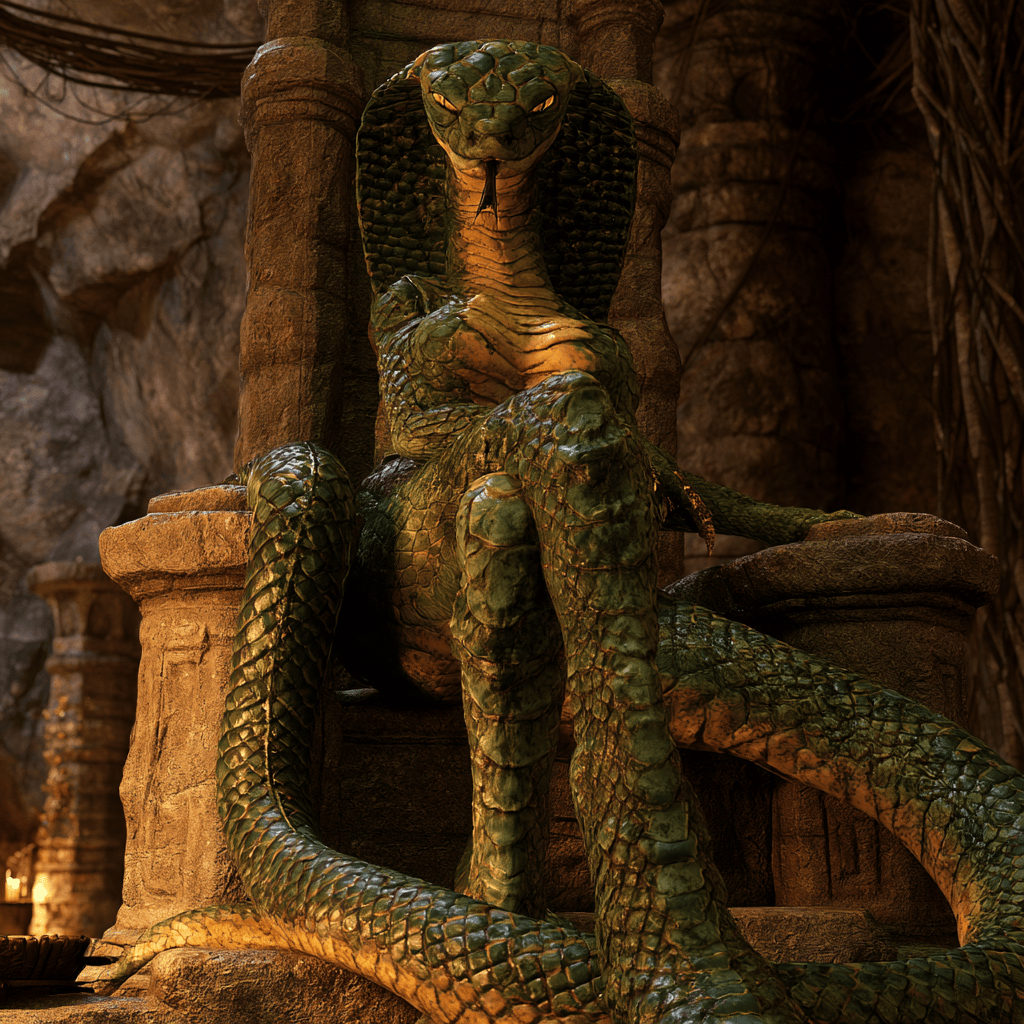
Her upper half is a woman-like, green scales with yellow underbelly, the head of a king cobra mimicking long hair. Below the waist she stops being anything like a woman. The serpent body goes back and back into the dark, thick as a bus, scales overlapping in green so deep it reads black except where the embers catch it. The tail is still moving. It’s always still moving. It loops around a raised slab in the center of the chamber, slow, patient, the way a cat’s tail moves when it’s decided something.
“The five days have ended,” she says. “Only two remain.”
Her voice comes out dry. Scraped. Like a page being torn slowly.
“The battle between the monsters and the Acolytes draws to its close.”
And then she starts counting.
I’ve seen this move in about four hundred stories. The villain gets a quiet moment before the last act and does inventory. Reads the list out loud. It’s supposed to make you feel the weight of everything that’s been lost.
The thing nobody tells you is that villains are bad at math.
“The Acolyte of Honeycomb,” she says, “was sent away before the war even began. For her own safety.”
Wrong. Sophie wasn’t sent anywhere before anything. Sophie stood in a hallway with a gun pointed at her and did not run, and what took her off the board came out of a barrel, not a schedule. If Echidna wants to file that under removed early for her protection, fine. It’s her ledger. I just want it on record that entry one is already garbage.
“The vanity and pride of the Acolyte of Love led to her downfall under the gaze of Medusa.”
Vanity. Sure.
I was there. I watched Allison put herself between a monster and people who couldn’t move, and I watched what it cost her, and I have watched a lot of things in this white room and I would not have used that word. But Echidna needs the story to be about a girl who loved mirrors too much, because a girl who loved mirrors too much is a girl who deserved it, and that’s a lot more comfortable than the alternative.
“The Acolyte of Champions,” she continues, “whose reckless bravery brought about his end. Alongside the Harpies.”
My jaw does something complicated.
I’m not going to say anything about that one. Partly because nobody can hear me. Mostly because I’ve now caught her being wrong twice in the space of one breath, and a lady who is wrong twice in one breath does not get the benefit of the doubt on the third.
That’s all. Moving on.
“And now the Acolyte of Music has fallen to the Nemean Lion, carrying the final wishes of his brother.”
The steam in the window ripples over the shape in the corner, and she smiles at it, and I have to stand here inside a hyper-immersive simulation with full sensory fidelity and absolutely zero ability to throw something at her head.
So close, yet so far. My whole entire situation, in five words.
She turns from the window and glides down toward the slab, and the scales drag over rock with a sound like sacks of gravel being poured.
“Three remain,” she says. “The Acolyte of the Sea. The Acolyte of Universe. The Acolyte of Heavens.”
She lays her arms across the stone. Rests her chin on them. Almost cozy.
“The Sea exists to hold her friends upright. She carries no weapon. She commands nothing that can wound. She is a bandage that learned to walk.” A soft laugh, more air than sound. “She is weak.”
Roanne’s waters can heal, shield, smother fire, bind, seal, and hide you from your own reflection. They just can’t hurt anybody. Echidna has looked at that and concluded harmless, which is the single most encouraging thing I’ve heard all week, because that’s not a weakness she’s identified. That’s a weakness she’s assumed.
“The Universe calls himself their leader. He is as untried as the rest of them. He plays at command.”
Benjamin has run more successful engagements than she has. But okay.
“And the Keeper.” Her eyes move, and for one bad second the angle of them lines up with where I’m standing, which is nowhere, which is a room that doesn’t exist. “The Acolyte of Heavens. His Star of Vis will be ours.”
Now I get a good look at the slab.
It’s a tomb. Long, black, unmarked except for a fracture running its full length, and something inside the fracture glows faintly, on and off, on and off, at about the pace of a heartbeat that isn’t in any hurry.
“My love,” she murmurs. “They are falling. Every day, fewer. Soon you rise, and I will be beside you, and the world above will belong to us. Their fields, their cities, their little lives. We will leave nothing standing that they built. Nothing they loved. They will have nothing left to ask for except an ending.”
She strokes the stone with the back of one hand. Gentle. Genuinely gentle. That’s the part that gets me.
“Oh, Typhon,” she breathes. “What a terrible, wonderful world it will be.”
The embers pulse. The steam hisses. The tail keeps its slow revolution around the tomb.
And in the far wall, past the reach of the light, there’s someone else in this room.
Thorny vines cross her arms, her waist, her throat, pinning her flat against the rock. Black tendrils move over them, unhurried, tightening whenever she shifts. She is old and she is upright and her eyes are open, and they have been open through the whole speech.
The Oracle of Delphi doesn’t say a word.
She’s been listening down here for longer than I can hold in my head. Listening while the world forgot she existed. Listening to a monster describe the end of everything with her chin propped on a coffin.
She hasn’t looked away once.
Neither have I.
> SAVE_eagle_of_ruby_gate_of_gold.sav
The heat drops out of the room and takes the sulfur with it, and I’m standing in Nemea again with dust in the air.
The sim doesn’t ask what I’d like to see. It just goes where the story goes, and right now the story has decided we’re not done here yet.
Afternoon light comes down through the hole in the roof in one solid column, so bright and so sharply edged that it looks fake, like somebody dropped a spotlight cue into a scene that didn’t ask for one. Everything outside the column is gray. Everything inside it is gold. Dust turns over in the beam without ever settling, which is a thing dust does in rooms that have just been demolished, because it’s got nowhere to land that isn’t also moving.
Oppa Rockstar is in the corner where he fell.
He hasn’t moved. That’s the first thing I check, every time. His back is against the wall, one leg bent, the other stretched out over broken tile. The magenta visor is gone. It shattered when he was still walking and the pieces are somewhere behind him, a little scatter of pink glass catching the light like a spill of hard candy. Without it he looks about nine years younger and about nine times more breakable. There’s a cut over his eyebrow. Dried blood at his hairline, drawn back into his hair where it went. His jacket is torn open in three long lines across the chest, and the tears are clean and slightly curled at the edges, the way fabric goes when whatever cut it was hot.
His chest moves. Slow, but it moves. I check that too.
And his hands are still wrapped around the belt.
Golden laurel, scorched black along one side, the Nemean Lion medallion sitting dead center. He hasn’t loosened his grip even a little. If anything the fingers have locked tighter, the way hands do when the rest of you has checked out and the hands didn’t get the memo.
That’s Spartan’s belt. Michael, who is not here, and about whom I’m going to keep my opinions to myself.
Behind me there’s a sound like somebody shaking out a heavy quilt.
I turn around and there’s a bird on the boulder.
Okay. Not a bird. Or, technically a bird, in the same way a supercar is technically a car. It’s the size of a large dog and it’s the wrong colors for anything that should exist. Red through the breast, going up into a gold that isn’t yellow so much as it is lit, and then the tail feathers run purple, deep and clean, three long ones trailing down over the rock. There’s a crest on its head like a thin crown. The whole thing gives off a low glow that doesn’t scatter properly. The dust near it doesn’t drift the way the rest of the dust drifts.
Phoenix.
I want to be cool about this. I’ve been in this white room a long time and I’ve had a lot of impossible things walk past my face. But I’ve never actually seen one before, and it takes me a second.
It doesn’t do anything.
That’s the part I wasn’t ready for. In every version of this I’ve ever run into, the bird shows up and something happens. Light pours out. A feather falls. Somebody sits up gasping and everyone in the audience exhales at once. That’s the deal with phoenixes. They’re a plot device with a wingspan.
This one just sits.
It stands on the broken concrete stories above from James, head tilted slightly, and it looks at him. Not the way an animal looks at a thing. The way a person looks at a thing they’ve decided to look at properly, taking their time about it. Its eyes are black and they don’t blink for long enough that I start counting.
The light column shifts a couple degrees as the sun moves.
The Phoenix doesn’t move with it.
I don’t know what it’s doing. I want to write it down as good sign, because a legendary firebird showing up beside your unconscious guy has to be a good sign, that’s just how the grammar of these things works. But I’ve been burned before by assuming the universe is running on a script I’ve read. Maybe it’s here to help. Maybe it’s here because someone was knocked off in this tower and that’s an event that draws attention. Maybe it’s a scavenger with excellent PR.
All I actually know is that it came, and it’s watching him, and it hasn’t left.
I’d like to ask. I can’t. I’m the guy in the theater who can see the screen and can’t reach it.
The sim takes the tower apart before I get an answer.
***
Cold air. Real cold, mountain cold, with grass in it.
The white walls come down somewhere completely different and I get one of those half-second lurches where my brain hasn’t caught up to my feet. Then it lands. Highland. Thin sunlight, huge sky, a river running fast and shallow over stones somewhere off to my left with that constant papery rushing sound that makes everything quieter instead of louder.
There’s a house.
One house. Not the first of a row, not the edge of a village. Just a small wooden place with a rusted roof and a stovepipe, sitting on a shelf of flat ground with the mountains stacked up behind it in blue layers going back forever. Grass everywhere, tall and green and bending all in one direction whenever the wind decides.
The garden takes up most of the yard. Somebody who knows what they’re doing planted it. Tomatoes staked with split bamboo, a low tangle of squash running along the ground, upright rows of something leafy, and along the near edge a whole bed of herbs I couldn’t name if you paid me. There’s ginger. I can smell ginger. The dirt has been worked recently and it’s darker than the ground around it.
Inside, through the doorway, an old man is wringing out a towel over a white enamel basin.
He’s bent forward at the shoulders, in a faded shirt with the sleeves rolled past the elbow, forearms like rope. His hands are enormous relative to the rest of him. He twists the cloth once, twice, patient, and the water goes into the basin in a steady thread, and steam comes off it. There are jars on the shelf behind him. Dried things hanging from a string.
He’s lived out here alone. You can tell by the way the house is arranged, everything within reach of one person, one chair pulled up to one table.
Not alone right now, though.
Sunlight comes through the open window and lands across a bed by the wall. Simple frame, thin mattress, a folded blanket. The dust turns over in that light too, slow and glittering, and I get a weird jolt because it’s the exact same effect as the tower, same drifting motes, same gold, and the two rooms could not possibly be further apart.
There’s a boy asleep on the bed.
Short black hair, unkempt, pushed flat on one side from the pillow. Tan skin. Arms that belong to somebody who did a lot of pull-ups on a lot of doorframes. He’s in a plain shirt and plain shorts that are not his and don’t fit right, and there’s a poultice bound to his ribs with strips of cloth, greenish at the edges where whatever’s in it has soaked through.
His mouth is slightly open. He’s out cold in the deep, boring, uncomplicated way of somebody who has been asleep for a while and intends to keep at it.
Michael.
The old man carries the towel over and folds it across the boy’s forehead without waking him. He does it the way you do something you’ve done a hundred times. Then he checks the binding on the ribs with two fingers, decides it’s fine, and goes back out to the garden.
Albularyo. That’s the word. Herbs, prayers, hands, a lifetime of knowing which root does what. Whatever he’s been doing up here, it’s working, because the kid on that bed is breathing like the world isn’t ending.
And nobody knows.
Not the ship. Not the Peregrine Lightyear. Not one single person who has spent the last however many days assuming the worst.
I stand in a house that isn’t a house, next to a bed that isn’t a bed, and I look at a boy who is very much alive, and there is no message I can send. No console. No way to lean out of the frame and yell down the mountain. The sim gives me everything except the one thing that would matter.
So close. Yet so far. I really need a different catchphrase.
***
It pulls me up before I’m ready.
Sky. Enormous, hard blue, the kind you only get at serious altitude where there’s not enough air left to soften anything. The wind up here has an edge to it that goes straight through.
Below and around me, peaks. Not gentle ones. These are rocky, raw, gray and rust-colored, sheer on their faces, dropping into gorges I can’t see the bottom of. Snow in the high creases.
There’s a speck.
It comes down out of the light and it takes a while to resolve into anything, and when it does I catch myself grinning like an idiot.
Cielo first, because Cielo is the loud one visually. White winged pony, and I want to be precise about this because people keep getting it wrong: he is not a full-size horse and he is not a Pegasus off a cereal box. He’s about the size of a large pony, compact and round-cheeked, with wings that are too big for him in a way that reads as angelic rather than awkward. The feathers are white going faintly gold at the tips. He glides in wide relaxed circles, wings barely working, clearly enjoying himself.
Ser Cerulean Arlentis rides him without holding on to anything.
Silver with gold accents, the plate catching sun in flat bright bars. The white cloak snapping straight out behind him. He’s leaning forward over Cielo’s neck, helmet off and clipped at his hip, hair completely destroyed by the wind, and the expression on his face is the least paladin-like thing about him. He looks like a kid on a roller coaster who has just realized there’s another drop coming.
They bank around a spur of rock and the summit opens up ahead of them.
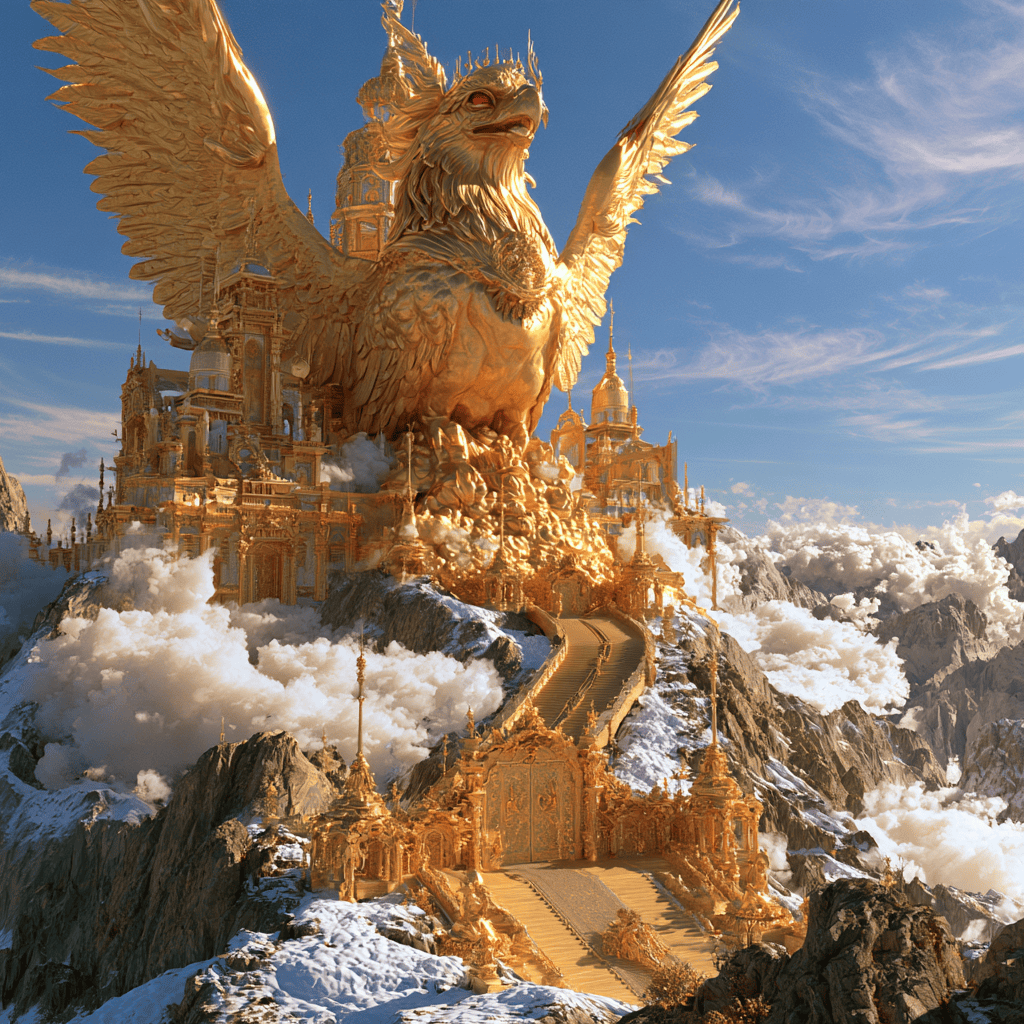
There’s a pyramid on it.
Gold. Actual gold, or something doing an aggressive impression, stepped in wide tiers and set right on the peak like it grew there. And crowning the top, sitting above everything, is a stone bust of an eagle. Hooked beak. Feathers carved so sharp you can count them from here. Two rubies where the eyes go, and the sun is hitting them at an angle that makes them look switched on.
Cerulean’s mouth falls open.
“That is one heck of a giant eagle,” he says.
Cielo neighs, high and impressed, and does a small unnecessary spiral.
“I want to know what’s inside.” Cerulean pats his neck twice. “Come on, buddy. There’s got to be a way in.”
They set down on the steps.
Steps that are, unhelpfully, also gold, and polished, which means Cielo skids about a meter on landing and has to catch himself with a wing. Cerulean laughs at him. Cielo shoots him a look that I’d describe as withering if I were talking about a person.
They climb together. The steps are too tall for comfortable walking, built for something with a longer stride, and by the top Cerulean is breathing hard and Cielo is just flying the last few.
The gate is enormous. Twice Cerulean’s height, worked over every centimeter with carving, interlocking spirals and rows of feathers running edge to edge. No handle. No hinge that I can see.
Cerulean runs a gauntlet across it, and stops.
“There’s a piece missing.” He crouches. “Like a keyhole. Except it’s not shaped like a key, it’s shaped like a—.” He stops. Looks at his other hand.
In it, the golden medallion he pulled out of Atlantis while the whole city was going under. Eagle head. Lion body.
He holds it up next to the recess.
Perfect match.
“Okay,” he says, and his voice does the thing where it drops a little because he’s decided something. “Let’s try it.”
Cielo bumps him with his nose and neighs, which I choose to translate as obviously.
Cerulean sets the medallion into the recess and turns it.
Something enormous moves inside the stone. A deep grinding that I feel through the floor of a room that has no floor. Dust jumps off the carvings in a fine sheet, and the gate splits down the middle and swings inward on its own, without anybody pushing, releasing a breath of air that is somehow warm.
The two of them look at each other. Boy and pony. Identical grins.
They go in together.
Gold_cannot_outweigh_gold.sav
The sim follows them in and the acoustics change before the picture does.
That’s the first thing. Outside there was wind and open sky and the thin scraping sound of a very high place. Inside, all of that stops, and what replaces it is a hush with depth to it. Big-room hush. Cathedral hush. Every footstep Ser Cerulean Arlentis takes comes back off a wall four seconds later, softened, from somewhere he can’t see.
Then my eyes adjust and I have to sit down. Metaphorically. There’s nothing to sit on.
Gold.
Not gold like a chest with a nice lid. Gold like weather. The floor of the pyramid runs back further than the outside of the pyramid should allow, which is a violation I’m choosing not to think about, and the whole space is filled with mounds of loose coins piled up in slopes taller than a house. Between them, chests. Dozens of chests, hundreds, lids thrown back, spilling downhill. Statues stand in the gaps, life-size figures cast in solid gold, some of them missing arms, one of them just legs on a base. There are amphorae the height of a fridge with black-figure painting still visible under the shine. Porcelain stacked in rows. Silver plate. Loose stones scattered underfoot like somebody swept them into a corner and gave up.
The light comes from above through slots cut in the tiers, falling in long angled bars, and every bar it lands on throws it back up again. So the whole ceiling is glowing with reflected coin-light, moving slightly, like being underwater in the world’s most expensive swimming pool.
Cerulean stops walking. His mouth opens. Nothing comes out.
Cielo makes a noise I can only describe as a squeak.
I want to be clear that I have watched this kid stand in front of a hydra-adjacent nightmare and hold his ground. Here, in a room with no monster in it yet, he’s got both hands half-raised like he’s afraid of knocking something over.
“Cielo.” His voice has gone quiet. “Don’t touch anything.”
Cielo, who has already got a coin stuck to his hoof, looks up with an expression of total innocence.
They walk the central aisle. It’s the only clear path, wide as a road, running dead straight toward the far end where the piles thin out and something raised sits in the light.
An altar. Low, black stone, out of place in all this brightness.
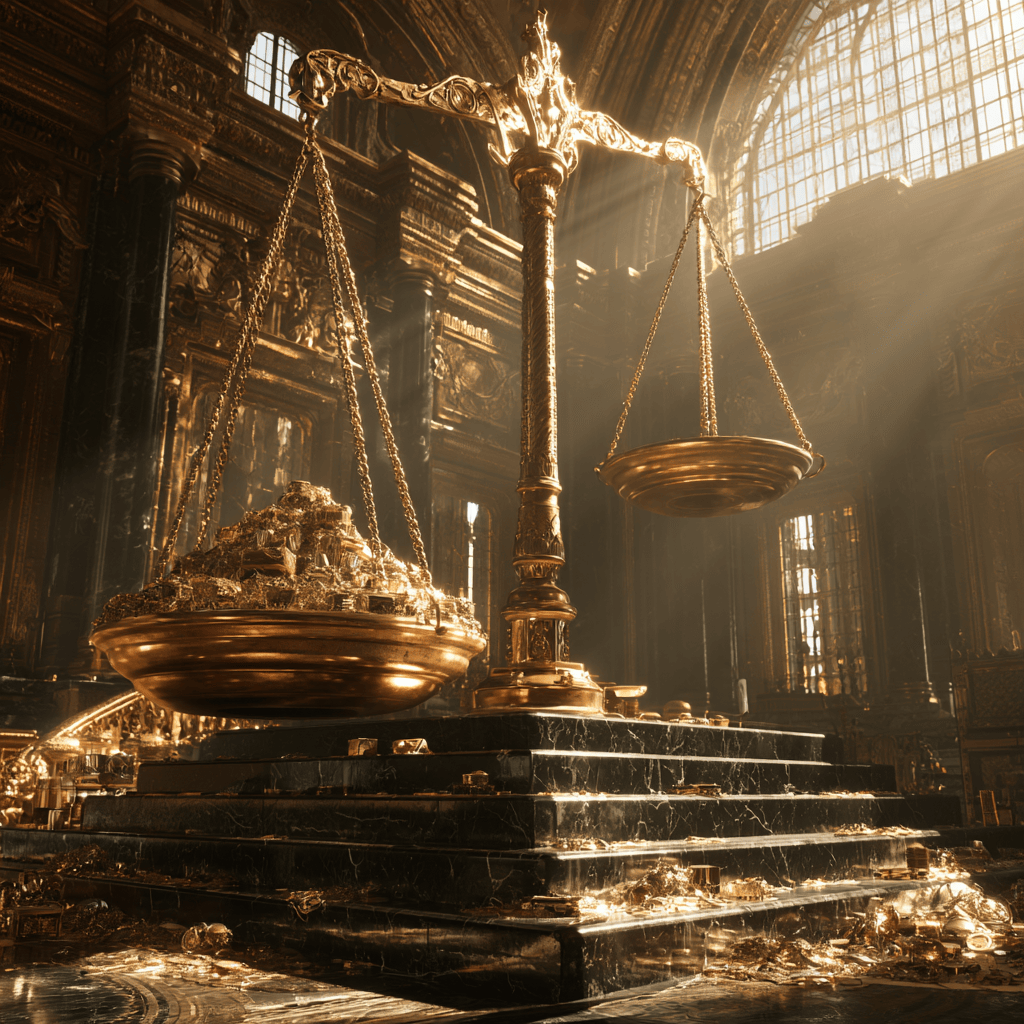
And behind it, hanging from a beam I can’t see the top of, a set of scales.
Giant ones. The kind you’d weigh a truck on if trucks were a thing here. Two bronze dishes the size of backyard pools, suspended on chains as thick as my leg. The left dish is loaded to the brim with coin and treasure and it hangs low. The right one is empty and it hangs high, way up, and the whole apparatus creaks very slightly as it settles.
Cerulean is looking at the altar. Which is why he doesn’t see the thing appear.
I do. It doesn’t walk in. It’s just suddenly present, the way a save-point boss loads in, air folding around a shape that wasn’t there half a second ago.
Eagle head. Hooked beak, feathers going from white at the crown to tawny down the neck, and a pair of wings folded across its back that would clear this aisle if it opened them. From the shoulders back it’s lion. Deep gold pelt, heavy forelegs ending in talons, hindquarters and a long tufted tail that curls once around its own paws as it settles.
It’s the size of a delivery van and it moves like something much older than that.
Cerulean’s head snaps up.
“The Griffin,” he says.
Not scared. That’s the part that gets me. He says it the way you say a name you’ve read a hundred times and never expected to use out loud.
Cielo neighs and takes exactly one step backward, which is honestly the more sensible reaction.
“You know well, young paladin.” The voice is deep and unhurried and slightly rough at the edges, an old voice that hasn’t lost anything. “And you have chosen your companion well. He belongs to the high blue. So do I.”
Cielo’s ears go up. Cielo, I regret to report, is now visibly flattered.
“This is my house.” The Griffin’s head turns, taking in the room without hurrying. “The highest peak, and everything beneath it. What you see here came out of the Mediterranean over a long time. Every port. Every wreck. Every king who thought his hoard would outlive him.”
Then the eyes come around. Yellow, ringed black, and they do a thing that eyes shouldn’t be able to do at that size, which is narrow slightly with interest.
“So tell me, little knight. What brings you up my mountain?” A pause. “Have you come for the treasures I guard?”
Which is a loaded question if I’ve ever heard one.
Cerulean doesn’t flinch. He steps forward, and he holds up the medallion in his open palm, flat, so it can be seen.
“I found this in Atlantis,” he says. “Under the sea. The city was going down and it was there, and I took it, and it brought me here.” He shrugs, armor shifting. “I came for the adventure. Him too.”
Cielo neighs. Firmly.
Something moves through the Griffin’s face. I don’t know how you read expression on a beak but I’d swear that was amusement.
“Adventure,” it repeats. “Very good. But a boy who climbs a mountain like this one wants a challenge as well, whether or not he says so.”
The great head tilts toward the scales.
“Look at the balance. The western dish carries gold. It hangs low, as gold does. The eastern dish is empty and hangs high.” The tail flicks once. “Tip it. Bring the east down and the west up, you and your companion together, and I will give you one treasure from this vault. The most valuable and the most precious thing in it.”
Cerulean turns and looks up at the scales.
I watch him do the math on his face. He’s not a dumb kid. You can see him weigh it, decide it’s too easy, look for the catch, fail to find the catch, and decide to proceed anyway.
“Okay, but.” He points. “There’s a mountain of gold on that side. If I want the other side to go down, I just need more gold than that. And there’s, like, unlimited gold in here.” He looks back at the Griffin. “Is that seriously it?”
The Griffin says nothing at all.
Cielo doesn’t need permission twice.
He launches. Straight up, wings hammering, and drops into the nearest coin slope like a kid cannonballing into a ball pit. Coins go everywhere. He comes up with a chest gripped in his teeth by the handle, flies it over, and dumps it into the eastern dish with a crash that echoes for a good six seconds.
Then he goes back for more.
I’ll say this for the pony: he commits. He’s up and down the aisle at full speed, hauling chests, shoving whole armfuls of loose coin off the slopes so they avalanche into the dish. He does a run with a solid gold statue that is very obviously too heavy for him and he gets it there anyway, legs pedaling, wings going like a hummingbird’s, tongue slightly out. Cerulean is standing underneath with both arms up yelling directions that Cielo is ignoring completely.
The eastern dish descends. Slowly, groaning on its chains, and Cerulean starts grinning, because it’s working, it’s actually working.
It comes down level with the western dish.
And stops.
Cielo dumps another chest in. Nothing. He dumps three more. The chains take up the weight and the dishes sit there, matched, dead even, as though the whole thing has agreed on a number and won’t be moved off it.
Cielo hovers over the eastern dish, breathing hard, mane stuck to his neck with sweat. He looks down at it. He looks at the western dish. He looks at Cerulean.
Then he lands on the rim of the dish himself and adds his own weight to it, which is genuinely one of the best problem-solving attempts I have seen from anybody in this entire story.
The scale doesn’t budge.
Cielo’s ears fold flat. He makes a small, deflating noise.
“Hey.” Cerulean walks over and puts a hand on his nose. “That was a good try. That was a great try. You moved half the room.”
Cielo does not appear consoled.
The Griffin hasn’t moved this whole time. Hasn’t commented. Hasn’t gloated. It’s just been sitting there by the altar with its tail curled around its paws, watching a boy and a pony throw an emperor’s ransom into a bronze dish and get nowhere with it. I get the strong impression it’s seen this exact routine before. Possibly many times. Possibly with people who then went home.
Cerulean steps back and stares up at the two level dishes.
The room is very bright and very quiet. Coins are still trickling down the disturbed slopes somewhere behind them, one at a time, tick, tick, tick.
“Okay,” he says slowly. “So gold doesn’t beat gold.”
He rubs the back of his neck. Turns in a full circle, taking in the piles, the chests, the statues, the whole absurd glittering weight of it.
“So what’s in here,” he says, “that’s worth more than all of this?”
He doesn’t have an answer. Neither does Cielo.
Neither do I, and I’ve read ahead on a lot of things, but the sim only ever shows me what’s happening, not what it means, and right now what’s happening is a kid standing in the richest room on the planet with absolutely no idea what to pick up.
A_stick_with_hair.sav
He’s already moving when the sim catches up to him.
Not the slow wander of a guy who’s given up. Cerulean is going up the coin slopes on all fours where they’re too steep to walk, sliding back half a step for every step he takes, working his way along the ridge of the biggest pile with his cape dragging a wake through the gold behind him. Cielo runs the aisle below, nose down, snuffling into open chests and knocking lids back with his muzzle.
They’re not admiring anymore. They’re hunting.
“Nothing,” Cerulean calls down. “Coins, coins, more coins, a crown, coins.”
Cielo neighs from inside a chest. It comes out muffled.
“Yeah, I know. That’s the point.” He straightens up on the ridge, breathing hard, and turns a slow circle. From up there he can see the whole floor, the slopes and the statues and the amphorae standing in their rows, all of it throwing that shifting swimming-pool light onto the ceiling. “Everything in here is the most expensive thing in a normal room. So none of it’s the most expensive thing in this room.”
He says it to himself. I appreciate a kid who talks through the puzzle. It’s a habit that either makes you a great detective or extremely annoying at parties.
Then he stops.
“Cielo.”
He’s looking down the far slope at something maybe four meters below him, lying flat across the coins where it must have slid to a stop a long time ago.
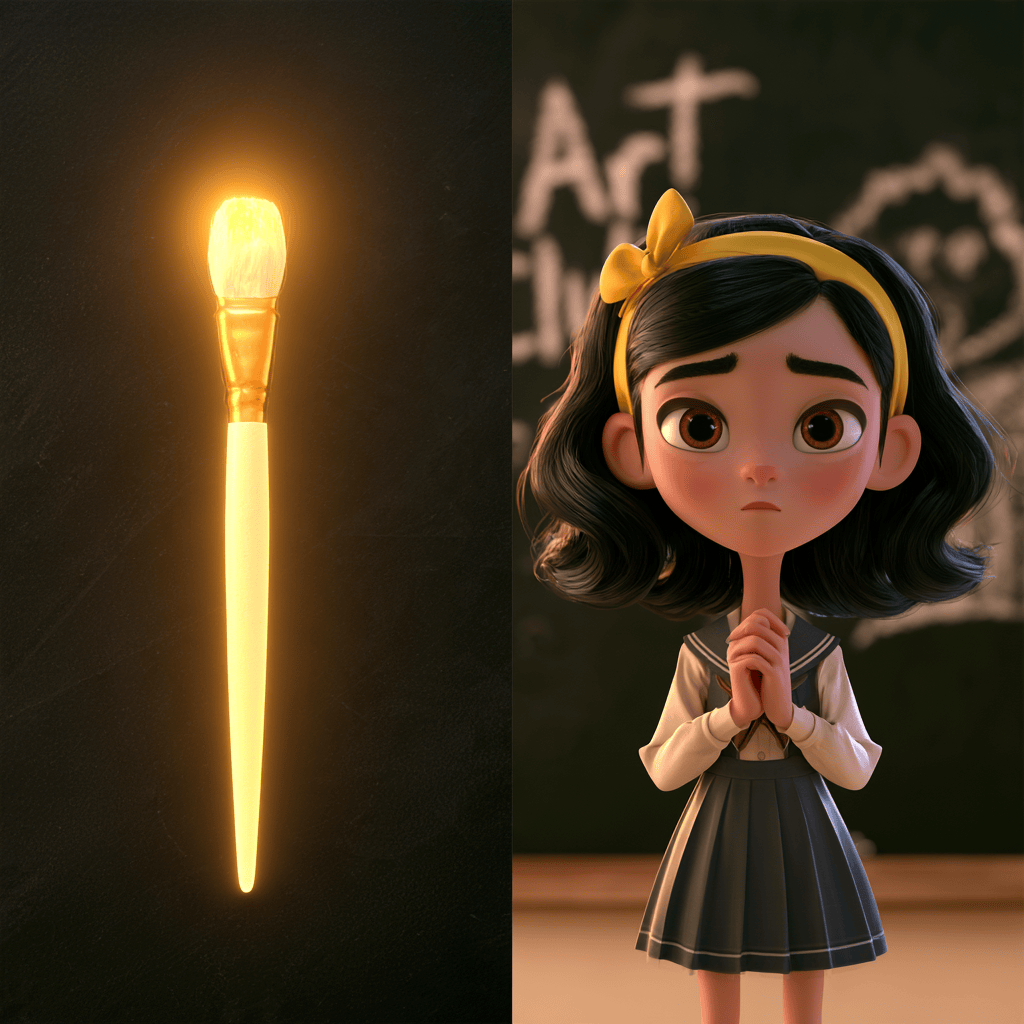
It’s a paintbrush.
Wooden handle, thick as a broom shaft, worn smooth in the middle where a hand would go. The bristles at the end are pale and stiff and splayed slightly, the way bristles go when a brush has done a lot of work and nobody remembered to wash it properly afterward. Somebody has, at some point, dropped it into a heap of gold, and the gold has done nothing to it.
Cerulean slides down the slope on his heels and picks it up.
“Okay, this is either the answer or it’s somebody’s garbage,” he says, turning it over. “A paintbrush. In here. Everything in this place could pay off a country and there’s a paintbrush.”
He holds it up next to a solid gold statue for comparison. The statue wins on every metric a normal person would use.
Cielo trots over and sniffs the bristles, then sneezes.
“Bless you.” Cerulean is already looking past him. “Hey. Wait.”
I follow his eyeline and I catch it at the same moment he does, which almost never happens, because I have a lot more angles than he does and usually I’m several beats ahead.
The walls in here are gold. All of them, every surface, tier after tier of hammered plate going up into the dark. Except one panel, off to the left between two coin slopes, and that panel is stone. Plain gray shale, dull and flat, absorbing the light instead of bouncing it back. It’s about the size of a garage door.
The frame around it is not plain. The frame is carved within an inch of its life: a running border of meander pattern, the interlocking square-spiral thing you see on Greek pottery, and above it a row of palmettes with the leaves curling out symmetrically. Somebody spent months on that frame.
And then left the middle blank.
“That’s weird,” Cerulean says. “Why would you build a fancy frame around nothing?”
He walks toward it. Cielo follows, close enough to bump his elbow, ears forward.
Three meters out, the brush twitches in his hand.
He nearly drops it. It’s a small movement, a single tug, like a fishing line getting a bite, and Cerulean freezes with the thing held out at arm’s length.
“It moved.”
He takes another step. It tugs again, harder, angling toward the wall.
“Cielo, it’s pulling. The brush is pulling.”
Cielo neighs and stamps once, which I read as so use it, obviously.
Cerulean looks at the brush. Looks at the blank stone. And then he does the thing I like most about this kid, which is that he doesn’t stand there for six paragraphs weighing the risk. He walks up to the wall, raises the brush, and drags it across the stone.
There’s no paint on it. Nothing on the bristles at all.
A stripe of gold appears anyway.
He makes a startled noise and pulls back, and the stripe stays there, glowing faintly, warm yellow against the gray. Then he leans in and does it again, and again, and the strokes start to run ahead of him. He’s not deciding what to draw. The brush is going where it wants and he’s holding on.
An image builds up out of nothing.
Honeybees first. Six or seven of them in flight, rendered in that flat black-and-gold Greek style, bodies banded, wings drawn as thin outlines so you can see through them. Then the comb beneath, hexagons stacked in a slab, and the wax rendered in a paler gold than the bees. And then honey, spilling out over the broken edge of the comb, running down in three thick ribbons that pool at the bottom of the frame.
It’s beautiful. I want to say that plainly. Nobody in the scene says it, so I will.
“Honeybees,” Cerulean says quietly. “Honeycomb. And honey, coming out of it.”
The brush goes hot in his hand and blazes yellow.
And then he stops being here.
I can tell the exact instant it happens because his shoulders drop and his eyes unfocus and Cielo shoves his nose into his ribs and gets absolutely no reaction. Whatever the wall is showing him, it’s showing him inside his own head, and I don’t get to see it directly. I’m not in there. I’m never in there.
What I get is his face.
His eyebrows go up first. Something surprised, something he wasn’t braced for. Then the corner of his mouth pulls, and it’s not quite a smile, it’s the expression you make when a memory that belongs to somebody else lands somewhere personal.
He’s seeing Sophie. He says her name out loud a second later, so I’m not guessing.
I know the moment the wall would pick, if it’s picking well. Small kid on a living room floor with a stack of scrap paper and a box of crayons worn down to stubs, copying a bee out of a library book with her tongue stuck between her teeth. Getting the stripes wrong. Doing it again. Adding a bow to its head, because a bee without a bow is just an insect, and a bee with a bow is a character.
And then later, older, standing in a classroom doorway after the last bell with a folder held against her chest, working up the nerve to walk in. The art club adviser waving her over. A girl named Mae sliding down the bench to make room. Somebody else saying is that yours, can I see.
That’s a whole dream, assembled one small act of courage at a time by the youngest person on the team.
Cerulean comes back to himself and blinks hard.
“Sophie,” he says. “It’s Sophie. Art. That’s her whole thing, she’s been building it since she was little.” He looks down at the brush in his hand, then up at the mural, then back at the brush. “This is hers.”
He turns toward the aisle, where the scales hang in the middle distance with their two dishes sitting dead level.
“Could this actually be it?”
Cielo doesn’t know. Cielo nudges him toward the aisle anyway.
They walk back. The Griffin hasn’t moved from the altar this whole time, tail curled over its paws, and it watches them come the entire length of the room without saying anything, which is somehow worse than commentary.
Cerulean stops at the foot of the scales and holds up the brush.
The great head tips.
“You are an odd one,” the Griffin says. “There is enough in this vault to buy a fleet. To buy the harbor the fleet sails from.” A pause, unhurried. “And for your first choice, you bet on a stick with hair on the end.”
Cerulean doesn’t rise to it. He looks at the brush, and his thumb moves once over the worn part of the handle.
“It looks like nothing,” he says. “It isn’t nothing.”
He raises his arm.
The brush lifts out of his palm and floats, turning slowly, up and up along the chain until it clears the rim of the eastern dish and settles onto that vast empty bronze surface with a sound too small to hear from where he’s standing.
Nothing happens.
Then the chains groan.
The eastern dish drops. Not far, but it drops, one clear step down, and the western dish rises to match it, and the whole apparatus settles again with the balance now visibly tipped toward the gold.
Cerulean’s fist closes.
Cielo rears and neighs so loudly it comes back off four different walls.
And the Griffin says nothing at all. It just looks at the scales, and then at the boy, with an expression I can’t read and would give a lot to.


Leave a Reply