Overview:
| Cerulean forces the gang members to kneel in surrender before divine wrath, delivering them to the police for arrest. Spartan stops the gang leader and his remaining thugs from escaping. Watching the superhero, Ellie is reminded of her nephew, Michael. Ruana heals Bee Girl with her restorative waters and tells Captain McKinley that she is still too young to fight. On McKinley’s orders, Cerulean reluctantly retrieves the transformation shard from Bee Girl, reverting her back to Sophie. McKinley then tells his sister to return to civilian life, far away from the dangers of the team’s field missions. Cerulean later reveals to McKinley the prophecy of the Oracle of Delphi that came to him in a dream. By reading Cerulean’s mind, Ruana uncovers his recovered memories of the cave incident from three years earlier. McKinley finally pieces everything together and realizes that Cerulean’s wish was the very force that brought fictional heroes, villains, and monsters into the real world. |
Heaven_drops_the_gavel.sav
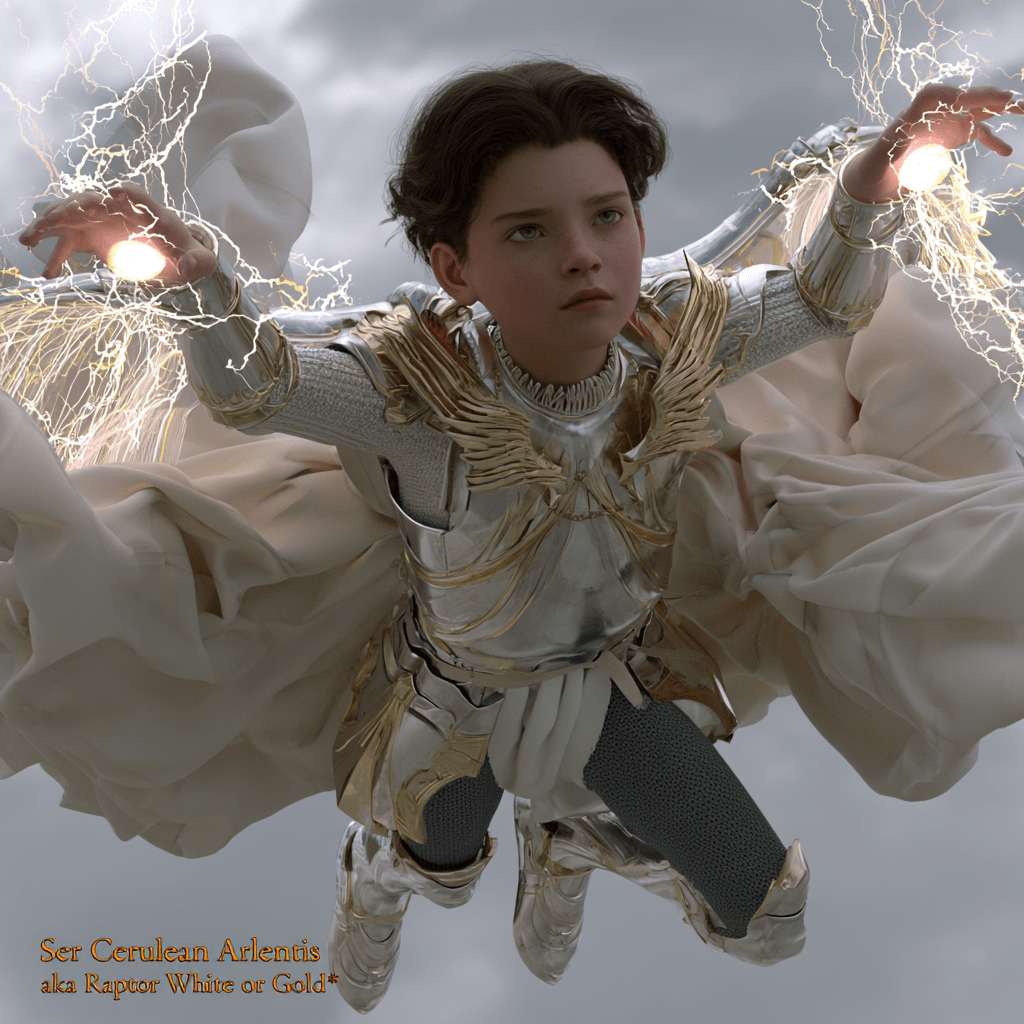
The police arrived seven minutes after the gang sealed the east wing. Forty-three officers. Two riot vans. Standard response, professional calibration, textbook deployment — and they are outnumbered on arrival by a margin that makes their riot shields look like dinner plates.
I watch from the sim room as the standoff crystallizes. Both sides holding position. The kind of tense, unresolved pause that precedes something going very wrong.
Then the ceiling opens.
Not breaks. Not cracks. Opens. The glass and tile above the east atrium simply go upward. A clean vertical eruption — shards and grout and steel framing rising in a column of displaced air, climbing two, three stories before dispersing at the edges of open sky. No crash. No rain of falling debris. The ceiling just decides it has other business.
Blue sky above. Actual clouds.
Every head in the east wing turns skyward.
Hovering there, maybe thirty feet up, is Ser Cerulean Arlentis—RAPTOR WHITE OR GOLD*.
His white cape moves in the updraft he just created. The ivory plate armor catches the afternoon sun on every surface — chest piece, pauldrons, gauntlets, greaves — throwing it back at the world with conviction. His eyes are lit from somewhere inside, warm and quiet, the glow you get from a lamp behind frosted glass. He looks down at the standoff below without urgency. Without agitation. Without the expression you’d expect from someone who just removed a ceiling.
He looks, if anything, like he’s been here before.
Both sides of the standoff are motionless. Gang members. Police officers. The same silence from everyone.
Then Cerulean opens his mouth. The Latin begins.
“Carissimi, non vosmetipsos vindicate, sed iram Dei derelinqite: scriptum est enim—”
The words do not disappear. They materialize. Actual letter-forms, white-gold and luminous, roughly the height of a forearm, rising from his voice the way heat rises off pavement. The phrase assembles itself in the air beside him, holds there fully formed for one breath, and then begins to orbit. Sweeping outward in a slow arc over the east wing.
He continues. A second verse, different cadence, the Latin rolling out evenly and without performance.
“Nemo vos seducat inanibus verbis: propter haec enim venit ira Dei—”
More letters. A second ring of text joining the first, spinning in the opposite direction. Two concentric orbits of scripture rotating around Cerulean at mid-height. The phrases drift lower. They tighten their spiral toward the gang.
I’ve watched a lot of battles. I’ve seen elemental magic and K-pop light shows and a girl exhale gangsters out of a building in soap bubbles. I’ve seen Spartan end a fight with a single clap. But this is something else. This is the genre asserting itself with total seriousness, and something in the room below recognizes it.
The gangsters are not moving.
They are reading.
Whether they know Latin or not is almost beside the point. The words are arriving in the manner of something long-settled. A ruling already handed down, now showing up for delivery.
Lightning follows.
It comes from the open sky above and hits the floor in front of the gangsters with a sound that fills the atrium and empties it at the same time. A crack so clean it leaves silence in its wake. The tile splits in a long fractured line. The white-gold light lingers for half a second after the sound, the same color as the letters still drifting in the air above.
No one is hit. That’s not the point.
Weapons drop first. They fall before the people do — firearms and blades and whatever else they’d been carrying, hitting the tile in a series of clatters and clangs that takes several seconds to fully resolve. Then the gangsters go down. Not knocked down. They go to their knees, one after another, like something structural gave out inside each of them and this is simply the result.
Cerulean descends. Slowly, his cape settling as he touches down in front of the police captain. His glowing eyes return to their regular color. When he speaks, his voice is completely ordinary.
“Sir. You may take over from here.”
The captain processes this for one long moment. Then his training kicks in, and he turns to his officers with the practiced authority of someone whose job is to restore order after exactly this kind of thing.
“Men, move in. Arrest the gang.”
They move. The gangsters are already on their knees with their hands up, and the process is quiet and efficient and takes approximately ninety seconds.
I watch from my sim room and say nothing, because I can’t say anything, because that’s how this works.
The Latin letters dissolve in the atrium air above the arrests. Fading letter by letter, the sentences completing themselves even as they go.
Cerulean stands to one side with his hands clasped and his cape still, watching.
Spartan_outside_no_escape.sav
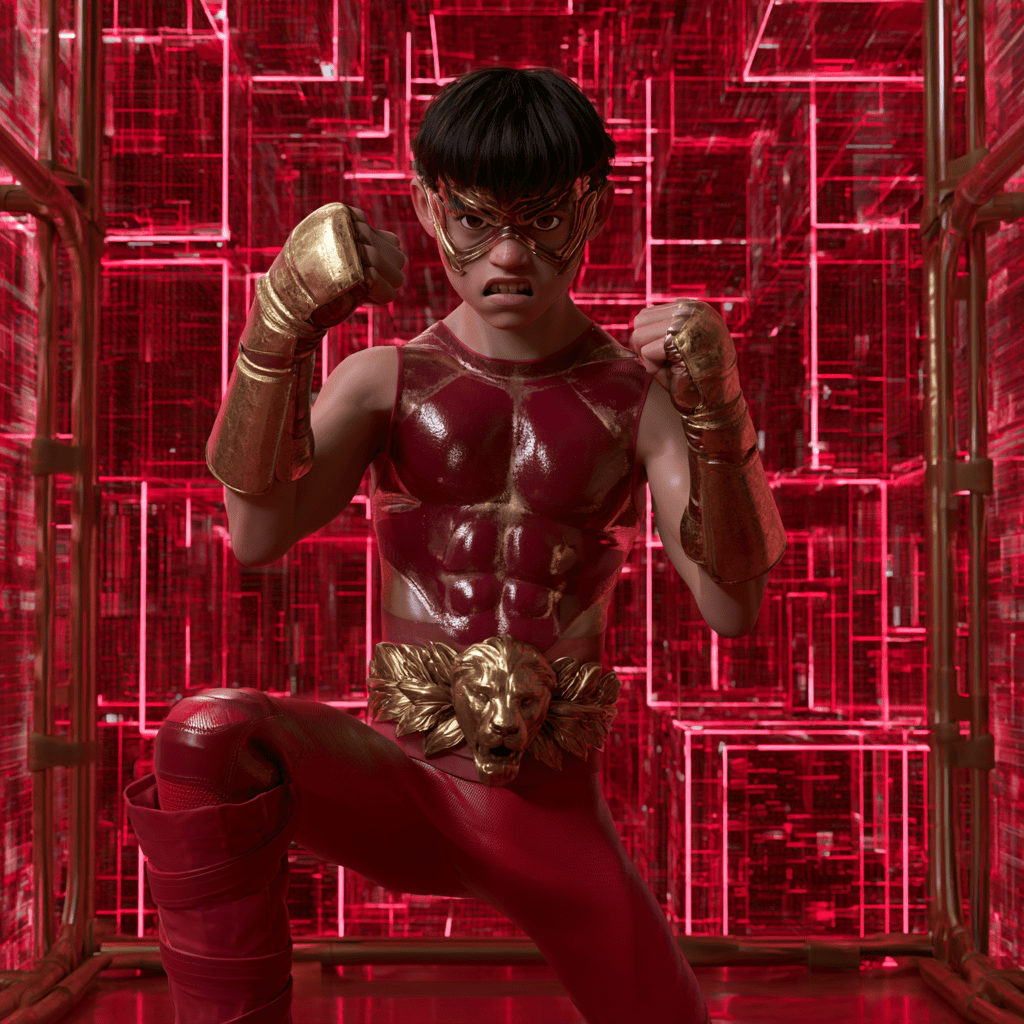
The gang’s overall leader makes his decision fast. Learning from the phone, his men going down in bubbles and lightning and rose-petal trail, he pivots for the nearest mall exit with his right-hand man and one remaining thug tight on his heels.
Smart call, tactically speaking. Wrong building to make it in.
Outside, under open sky, Spartan—RAPTOR RED—is already there.
He’s standing in the middle of the pedestrian lane with his arms loose at his sides, facing the exit doors. The maroon-red spandex suit under full afternoon sun is brighter than it looks indoors. The golden bracelets cover most of his forearms, thick and solid, catching the light on both wrists. Behind him, the crowd has been pushed back to the perimeter by officers, a wide uneven ring of people straining to see what’s happening without getting any closer to it.
The leader comes through the doors and stops.
A beat. The two of them looking at each other.
“Take him down.”
The remaining minions come from both sides — not just the leader’s three, there are more outside, a second cluster the police hadn’t finished corralling. Maybe nine total rushing in from different angles. It’s not a small number.
Spartan moves.
The first punch catches the nearest man center mass and sends him back into the second, and those two go down together. A kick to the left, knee height, clean and angled, and the next man folds. He doesn’t pause between. The rhythm of it is mechanical, one after another, switching direction without warning, no wasted motion between. The crowd behind the police line has gone quiet in the focused way crowds go quiet when they can’t look away.
“Fire!”
Three of them pull weapons at the same time. The shots ring out sharp and close.
Spartan raises both wrists.
The bullets hit the golden bracelets and ricochet off in separate directions, harmless sparks against the pavement. He doesn’t flinch. He doesn’t step back. His posture doesn’t change at all.
The shooters stare at their own guns.
Two of the remaining men rush him from behind while he’s facing the shooters. He hears them coming — or he anticipated them, I genuinely can’t tell from here — and reaches back, grabs, and throws. One goes left, one goes right, both of them covering serious distance before they land. The space around him opens back up.
At the edge of the police perimeter, a woman watches all of this without looking away. Her name is Ellie. She’s been watching since Spartan came through the exit. There’s something in her expression that is not quite what the rest of the crowd is feeling. Not the excited shock of a stranger watching something impossible. Something more careful than that. More specific. She watches the way he changes direction. The way he sets his feet. The way his arms pull back before a throw. Her brow creases slightly.
She doesn’t say anything.
The leader breaks left. He’s read the situation and decided running is the only remaining option, and he’s probably right. His right-hand man and the last standing thug split off in different directions, the classic scatter. Three separate vectors, trying to divide the problem.
Spartan sprints.
Not fast. Supersonic. The scarlet light trail fires out behind him the moment he moves, a streak of red that hangs in the air for half a second after he’s already somewhere else. He circles them. One full orbit, low to the ground, and the air starts to spin. You can feel it before you can see it — the crowd takes a collective step back as the pressure changes. The vortex forms around the three of them: the leader, the right-hand man, the last thug, all inside a column of spiraling wind that tightens as Spartan completes his circuit.
Inside the vortex they grab at their throats. Not a visible impact. Not a hit. Just the air going wrong, the oxygen thinning inside the funnel, and one by one their legs stop holding them. The leader goes last, still reaching for something, face a deep red, and then he’s down.
Spartan stops running. The wind dissolves almost immediately, the scarlet trail fading from the pavement as the vortex releases.
Three unconscious bodies on the pedestrian lane. The rest of the gang already handled, inside and out.
The crowd erupts. It starts at the front of the perimeter and moves backward through the whole ring of people — clapping, shouting, the specific unorganized noise of a crowd that agreed on something at the same time without planning to.
Ellie doesn’t applaud immediately. She stands with her hands at her sides for a moment longer than everyone else around her. Looking at the boy in the red-maroon suit standing in the middle of the pedestrian lane.
Then Ansel says something quietly beside her, and she comes back to herself.
She starts clapping.
Bee_girl_stands_down.sav
The sim finds the Peregrine Lightyear’s medical bay and holds there.
Sophie is on the table. Still in full Bee Girl form — yellow-and-black suit, wings folded flat against her back, the antenna slightly crooked from the fall. Her eyes are closed. She looks smaller than usual, which is saying something.
Princess Ruana stands over her with one hand extended, palm down, not quite touching. The healing water comes from the air itself, periwinkle blue drawing into coherence above Sophie’s body, threaded through with bright aquamarine. It moves in slow circles, no rushing, no urgency. Seafoam green and lavender ripple through the column of it in even pulses, tracing the outline of Sophie’s form before soaking downward.
Captain McKinley watches from two steps back. His cobalt armor is still on. He hasn’t moved to take it off. His arms are crossed and his face is set in the expression he uses when he’s already made a decision but is still processing it.
“She’ll recover soon,” Ruana says. Her eyes stay on Sophie.
A pause. The water keeps circling.
“She’s too young for all of this.” Ruana’s voice is quieter the second time. She glances at McKinley, then back down. Not an accusation. Just a fact she needed to say out loud.
McKinley doesn’t respond to it. He looks at his sister on the table and his jaw tightens once, briefly, then releases.
***
Bee Girl is awake when McKinley speaks.
She’s sitting up now, still in costume, Bumblebee hovering at her left side at shoulder height, his green optical sensors dimmed to something softer than their usual brightness. Sophie’s hands are in her lap. She’s looking at the floor.
McKinley stands in front of her. He doesn’t pace. He doesn’t build up to it.
“From this moment on, Sophie. I’m taking you out of commission.”
The words land in the room without drama. They don’t need any.
Ruana sits beside Sophie on the bench. She places one hand over Sophie’s. Doesn’t speak yet.
“This is for your own good,” she says finally, and she means it in the way people only mean it when it costs them something too.
Sophie doesn’t look up. Her shoulders curve inward a degree. Bumblebee drifts slightly closer to her, his rotors adjusting to a quieter frequency, and says nothing.
Cerulean stands near the wall. He’s been there the whole time, watching, his expression carrying the careful neutrality of someone who has opinions and is choosing when to use them.
“Is this the only way, Captain?” His voice is measured. Not challenging. Genuinely asking.
McKinley looks at him. “It’s the only way.”
Cerulean holds his gaze for a moment. Nods once, small.
He moves toward Sophie and crouches to her level, so she doesn’t have to look up at him. He holds out one hand, palm up. In it, the Star of Vis pendant rests in its dormant state, blue-pale and still.
“I’m sorry, Sophie,” he says.
She finally looks up. Her eyes are dry. She gives him a single nod, barely perceptible, and turns slightly so he can reach her back.
The Vis shard extraction is quiet. Cerulean places two fingers against the point between her shoulder blades where the shard is embedded beneath the suit, and the light comes out slow — powder blue, sparkling at its edges, running outward from the contact point in gentle waves before it fades. The Bee Girl suit follows it. The wings dissolve first, then the antenna, then the yellow-and-black fading back to Sophie’s plain clothes underneath. Her hair settles. The transformation releases her the way sleep releases a dream: gradually, without resistance.
She sits in civilian clothes on the medical bay bench and folds her hands back in her lap.
Bumblebee hovers. His optical sensors have gone a warmer shade of green than usual. He doesn’t say anything either, but he drifts another inch closer to her side, and she reaches up without looking and rests one finger against his hull.
I watch all of this from the white cube.
I don’t say anything. There isn’t anything to say from here.
***
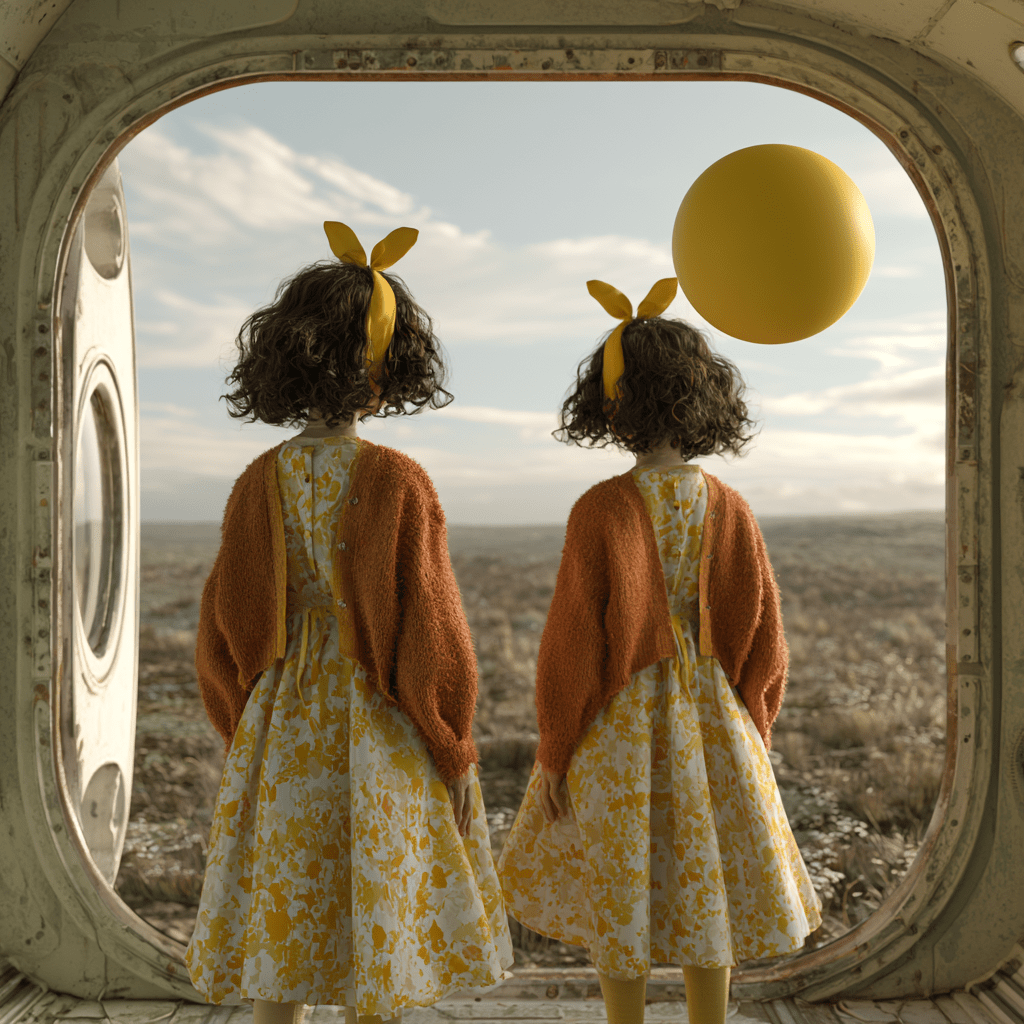
The Peregrine’s exit hatch is wide and tall, built for loading and deployment, and Sophie stands in front of it looking small against the scale of it. She’s in her regular clothes now. Bumblebee perches on her left shoulder, settled and still, his weight negligible but his presence precise. On her right, Android Sophie stands in perfect posture — Sophie’s face, Sophie’s build, Sophie’s exact hair and clothes, the whole replication technically flawless. The android’s eyes are calm and forward-facing, patient in the way machines are patient.
The hatch opens. Afternoon air moves in from outside, warm and ordinary.
Sophie looks out at it.
McKinley’s voice plays back in her head. Not the way you replay an argument — the way you replay instructions you’re trying to hold onto long enough to execute them.
You are to leave this spaceship with Bumblebee, for your safety. Android Sophie will escort you. Return home to our mother, Martha, and father, Greg, and to our sister, Mary. You’ll switch places with your double there.
The world outside is streets and sky. Recognizable. Familiar.
Live a normal life. Study. Pursue your passion in the Art Club.
She had wanted to be in the Art Club before any of this started. That was her original plan. An ordinary ambition for an ordinary kid who drew bees in her sketchbook and colored them in yellow crayon.
Keep the secret of our android clones. James 1.0. Benjamin 1.0. Michael 2.0. Treat them as you would your real brothers.
She exhales. One breath, not shaky. Just the breath of someone getting ready to move.
Bumblebee adjusts his balance on her shoulder as she steps toward the hatch. His optical sensors catch the light from outside.
Sophie doesn’t look back at the medical bay. She doesn’t look back at the ship.
She walks through the door.
The hatch closes behind her with the soft pneumatic sound the Peregrine always makes when it seals. Clean and final and quiet.
Seven_days_six_waves.sav
The command center of the Peregrine Lightyear is quieter than the rest of the ship by design. No cafeteria noise bleeding through the walls, no maintenance hum from the sub-deck. Just the soft pulse of the tactical display cycling through its data, and the ambient hum of systems that never fully sleep.
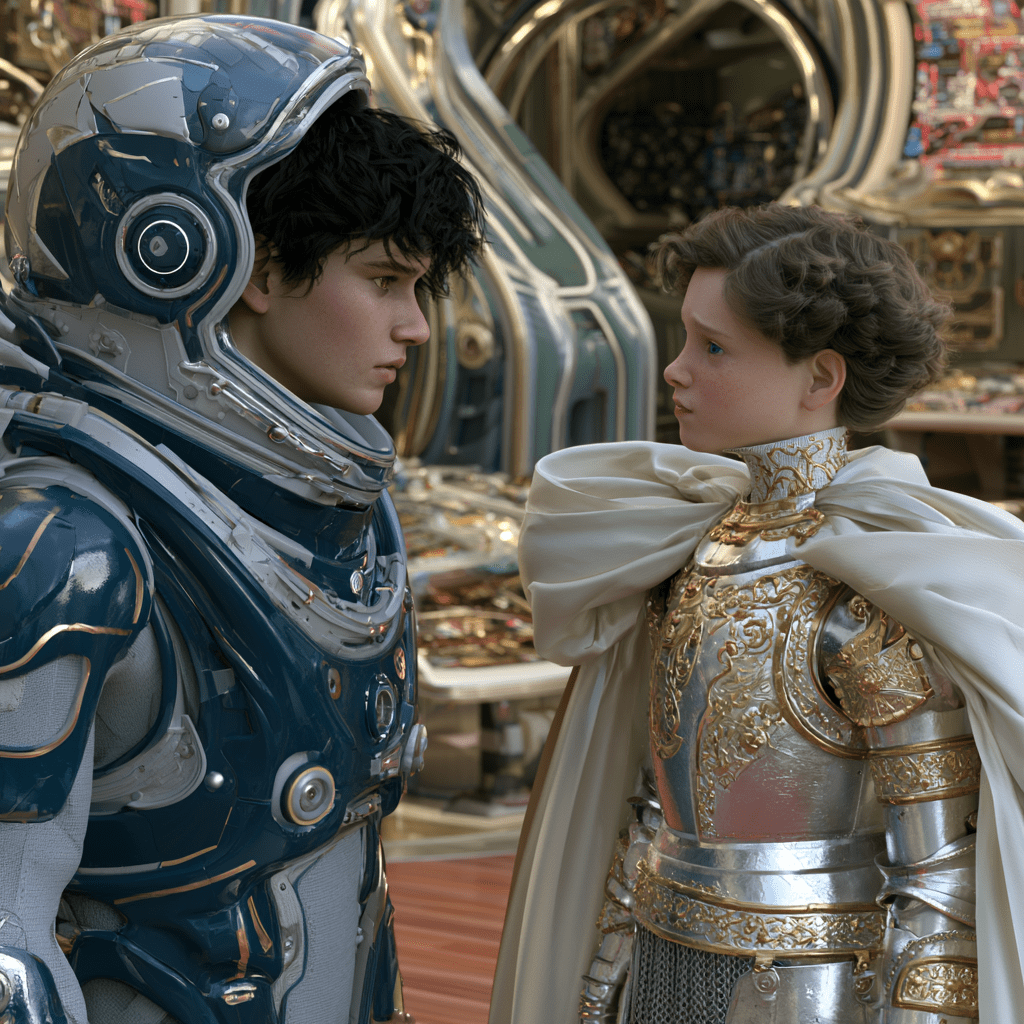
Captain McKinley stands before the large screen with his arms crossed, reading. His cobalt armor is still on, visor up. The display scrolls coordinates, timestamps, signal readouts from the island — the kind of data you stare at long enough and it starts to feel like it’s about to tell you something important. He’s been standing here for a while.
He doesn’t hear Ser Cerulean Arlentis come in. The kid moves quietly, which is either the paladin training or just Topher being Topher.
“There’s something I need to tell you, Captain.”
McKinley turns. Cerulean is standing a few feet back, hands at his sides, white cape settled. His expression is the one he gets when he’s been sitting on information and has decided, finally, that sitting on it any longer is irresponsible.
“What is it?”
Cerulean takes a breath. Not for drama. He seems to be choosing where to start.
“Before our powers awakened — back when we were still living our normal lives — I had a dream.”
McKinley waits. He doesn’t prompt. One of his better qualities as a commander.
“I was inside a cave. Ancient. There was a woman there — she told me she was the Oracle of Delphi.” Cerulean’s voice is even and careful, the tone of someone reporting rather than performing. “She gave me a prophecy. She called it the Seven Days Prophecy.”
That gets McKinley’s full attention. He turns away from the screen entirely.
“The Seven Days Prophecy.”
“The Oracle said monsters would come into our world. Greek monsters, across seven days.” Cerulean pauses. “But I don’t think the seven days are literal. I think they’re waves. Seven separate waves of monsters arriving in sequence.”
The tactical display keeps scrolling behind McKinley’s shoulder. He doesn’t look at it. He’s looking at Cerulean.
“Ruana and I,” McKinley says slowly, “on the island — we fought the Sirens. Greek monsters.”
Cerulean nods once, with the quiet certainty of someone watching a theory close. “The Oracle’s prophecy named the first wave. The Sirens of the Sea. Exact wording.”
The room holds that for a moment.
McKinley turns back to the screen. Not because the data has changed — it hasn’t — but because some information needs a second to settle before you can look the person across from you in the eye again. The Sirens weren’t an anomaly. Weren’t an isolated incident the island happened to produce. They were scheduled. First on a list.
“That was the first wave,” McKinley says. Statement, not question.
“Yes.” Cerulean’s voice doesn’t waver. “And there are six more.”
Six more waves. Six more days, or whatever the prophecy means by days. Six more entries on a list that the Oracle of Delphi handed to a twelve-year-old in a dream before any of them had powers, before any of them had suits or switches or a spaceship to stand inside. The list has been running this whole time. They’ve only just found the first item checked off.
McKinley stares at the display. The coordinates from the island sit in the upper left corner of the screen, a blinking marker on a map that is about to mean something completely different than it did this morning.
He’s done the math already. I can see it in the set of his jaw, the stillness of his shoulders. He didn’t need long.
This was not the end of something. It was the opening move.
Cerulean stands behind him, waiting. He’s already processed it — has had however long since the original dream to process it — and now he’s watching the captain work through it in real time, giving him the space to do that.
The large screen scrolls another line of coordinates.
McKinley exhales once, controlled, and straightens.
“Six more waves,” he says quietly.
Not a question. Not a lament.
Just the mission, getting larger.
Ruana_reads_tophers_mind.sav

The central console room is one of the Peregrine Lightyear’s quieter spaces — not a corridor, not a cafeteria, not a command center with active tactical readouts demanding attention. Just the console itself, a wide curved panel of brushed titanium, and above it the holographic projector running its default display: the Solar System, rendered at approximately one-to-eight-billion scale, rotating in slow and accurate silence.
Ser Cerulean Arlentis is at the console when Princess Ruana finds him. His white cape is draped over the back of the chair he isn’t sitting in — he’s standing instead, leaning slightly forward, fingers moving across the panel buttons with the particular focus of someone who genuinely wants to know what he’s looking at. The hologram responds to each input. Mercury adjusts its orbit. Jupiter’s storm system rotates. He zooms out until the whole system fits inside the projection field, eight planets and their moons hanging in dim blue light, and then he just looks at it.
Ruana approaches from the doorway. She stops beside him, following his gaze up into the hologram.
“I see you have a passion for astronomy,” she says, with the easy warmth she defaults to. “And the universe.”
Cerulean glances at her. The corners of his mouth lift slightly. “The Seven Worlds board game had its own system too.” He returns to the hologram, fingers resting lightly on the console edge. “The Visean Cosmos.”
Ruana tilts her head. Her sea green eyes catch the projection light, the blue of it reflecting in pale threads across her face. “The Visean Cosmos? I don’t think I’ve heard of it.” A pause, genuine and curious. “The board game must have been fascinating.”
Cerulean looks at her more directly this time. Something in his expression shifts — not unkind, just precise. “It’s not the first time you’ve heard of it, Ate Roanne.” He says it gently. “You and the others just forgot.”
Ruana goes still.
“The memories we lost,” she says. Not a question. Her voice has changed register, the easy warmth replaced by something more careful. “From the cave. You’ve regained yours?”
“It’s been a while.” He turns back to the hologram, giving her a moment. “The Star of Vis returned them to me.”
I watch from the sim room as Ruana processes this. She’s looking at the side of Cerulean’s face, and I can see the exact moment her intuition catches up to what he just said — the slight tension at her jaw, the exhale that doesn’t quite arrive. Lost memories. All of them. And this boy standing next to her has had access to the complete picture for some time now, quietly, while everyone else was working from fragments.
“Topher.” Her voice is soft. The name, not the title. “May I read your mind? To see the memories we’ve all lost?”
Cerulean turns to face her fully. His expression is uncomplicated, no hesitation folding into it.
“I don’t mind,” he says. “Those memories don’t only belong to me. They’re part of each of us.”
Ruana nods once. “Then come with me.”
The bench is against the far wall, away from the console’s glow. They sit side by side, close enough that the reading can work, far enough that it doesn’t feel crowded. Ruana’s gown settles around her. She folds her hands in her lap first, composing herself the way she does before anything that requires precision.
“I promise I won’t hurt you,” she says quietly.
Cerulean meets her eyes. “I trust you completely.”
She raises both hands and places them on either side of his temples, palms open, fingertips barely touching. Her touch is careful. Measured. The kind of contact that communicates I’m paying attention to you before anything else happens.
Then her eyes begin to glow.
White. Not the warm ivory of Cerulean’s paladin light — this is the cooler luminescence of moonlight on still water, and it comes on gradually, filling the silver of her irises from the inside outward. Cerulean’s eyes respond in kind, the same white blooming through his gaze as the connection opens between them.
They look at each other and neither of them looks away.
The light flows. A shimmer of white moving from Cerulean’s mind into Ruana’s, not a flood — a current. Steady and directional. The air around the bench doesn’t move, but something in the quality of the room changes, a subtle warping the way heat changes the look of pavement from a distance.
And then: the memories.
I see them too, because the sim projects what the connection surfaces, and I watch each image arrive like a slideshow someone assembled from an afternoon that all of them forgot they lived.
Topher and Roanne on the shore after sharing a meal, the tide coming in behind them. Topher speaking quietly, something about a little friend he intended to find. His face, in the memory, is younger than it is now — or maybe just less accustomed to weight. Roanne listening. Nodding.
The cave entrance. The group arriving together, before the game, before anything.
Allison inside the cave’s first passage, her phone raised, already narrating for a vlog that she presumably never posted.
The three Pangilinan brothers finding the board between two boulders in the cave’s interior — James pulling one end, Benjamin steadying the other, Michael already reaching for the box. The way they handled it before they knew what it was.
Roanne watching over Topher as he built the bonfire from gathered wood, her arms crossed against the cold coming off the cave walls, keeping watch without being asked.
And the last one: Roanne and Topher, side by side in the cave’s flickering light, reading a character profile together. Prince Ruana — mermaid princess of a fairy tale world, long red hair, a lunar scepter, eyes the color of seafoam green. Roanne’s expression in the memory is thoughtful. Topher is pointing at something on the card and saying something she’s leaning in to hear.
The light fades.
The white recedes from both their eyes at the same pace, dropping back to their natural colors by the time Ruana lowers her hands. She holds them in her lap again, looking at the floor in front of them. Not troubled. Somewhere between quiet and full.
Cerulean sits beside her and waits.
“We were there,” she says finally. “All of us. Together.”
He doesn’t answer immediately. He looks at his own hands.
“Yes,” he says. “We were.”
The hologram from the console casts its faint blue light across the far wall, the Solar System still rotating in its slow untroubled orbit.
Crossover_infinity_x_unlocked.sav
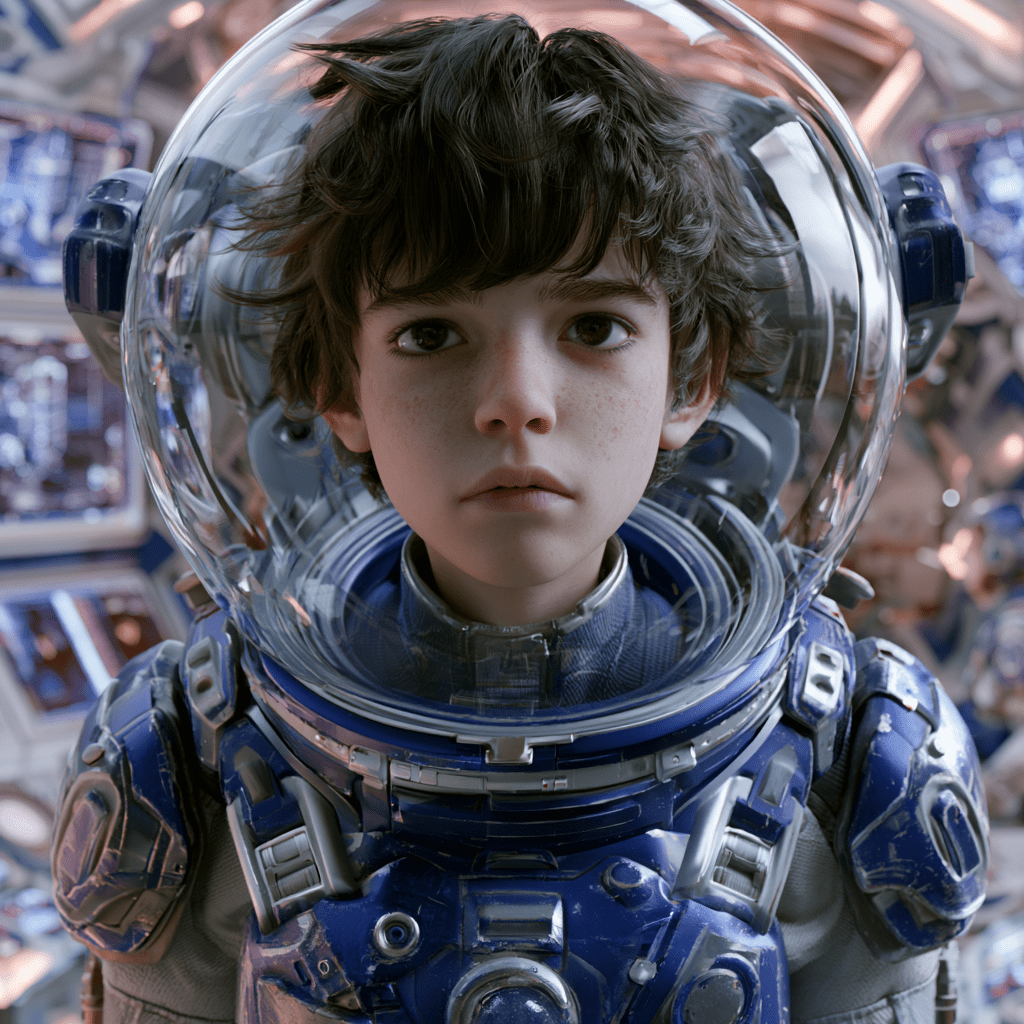
The command center of the Peregrine Lightyear does not change much between day and night.
There are no windows. No way to tell what the sky is doing outside unless you check the external feed, and McKinley hasn’t checked the external feed. The room runs on its own internal clock — the tactical display cycling through its data, the overhead panels dimmed to their lowest setting, the ambient hum of the ship’s systems filling every corner of the silence. It is the kind of room that feels the same at any hour, which I suspect is by design. Commanders need spaces that don’t change on them.
McKinley is alone in it. Standing in front of the large screen, not at the console, not in his chair. Just standing. His cobalt armor catches what little light there is, the chest piece throwing back a faint blue sheen from the screen’s glow. Visor up. Arms at his sides.
On the screen: a still image.
A meteor shower. The sky in the photograph is starless — fully dark, no moon, no ambient light from clouds — and across it a spread of shooting stars falls in long curved trails, warm white at their cores, yellowed at the edges. Most of them are the size of firefly streaks. Unremarkable, individually. The kind of shower that happens every year somewhere and gets photographed by people with tripods and patience.
One of them is not like the others.
Dead center in the frame, larger than everything around it by a factor that shouldn’t exist given the geometry of the shot, blazing blue-white and pure and trailing a tail that occupies a fifth of the image: the Star of Vis. It looks, if you didn’t know what it was, like a mistake in the photograph. Like something composited in from a different image by someone who didn’t check the scale.
McKinley stares at it.
I’ve been in this simulation for about four minutes watching him do exactly that, and I will tell you what I can read from where I’m standing: he is not seeing the photograph. He is seeing through it.
***
It started, as these things tend to, with a family trip.
July 2016. Three years before any of this. The Pangilinan family, the Kennedy family, the Sevilla family — Pangilinans and Sevillas piling into their respective vehicles and heading south from Manila on a weekend with nowhere particular to be. Laiya Beach in San Juan, Batangas. Fine sand, warm water, the kind of provincial coastline that doesn’t make it onto glossy tourism materials but is better for that. They were staying at a guesthouse whose caretaker was a man named Carding — quiet, reliable, the kind of person you don’t notice until you need something and he’s already there.
His daughter came with him. Roanne Mallari. A small-town girl with a reserved manner and a fairy tale she was always turning over in her mind, though she hadn’t told anyone that yet. She had no way of knowing that the family she was meeting that weekend would become the family she’d spend the next three years as a hero alongside.
None of them knew anything that night.
The news of the meteor shower had spread through the beach by sundown — word of mouth, a few texts, somebody’s cousin who tracked these things. They gathered outside after dinner, all of them on the sand, a crowd of families looking up at a starless sky. Wishes went up from the beach the way they always do at these things: informal, hopeful, most of them forgotten by morning.
One of them wasn’t.
Topher Kennedy III — twelve years old, younger than most of the group, quieter than all of them — made his wish with the particular sincerity of someone who didn’t think wishing was silly. He looked up at the streaks of light crossing the black sky and said what he meant.
I wish we could become heroes from the stories we love and the things we admire.
The Star of Vis heard him. Out of everything being asked of the universe that night, it chose that one. It dropped from the shower and descended toward earth, and became what Topher would later call his little friend — a fallen star that conjured, inside a cave on that same stretch of coastline, a board game hidden between two boulders.
He told them about the cave the next morning. They agreed to go.
***
The board game was called Seven Worlds.
Handcrafted is the wrong word. Conjured is better. The box opened onto a playing surface that depicted seven distinct dimensions — the Seven Worlds — each rendered in detail that no mass-produced game would bother with. At the center of the board sat a crystal ball, navy blue, with a small blue-white star suspended inside it. Two doors flanked the crystal ball. One door held the rules of the game, engraved in full. The other held a prophecy.
The facade of the board — its front face, the side you looked at before you opened it — showed the Visean Cosmos. A star system that existed nowhere in any astronomy catalog. McKinley had checked.
They thought the crystal ball was a hologram at first. It looked like one.
The tokens were gray clay, small and polished, and they moved on their own without anyone touching them. Turn order was established by birth date, oldest to youngest. Michael went first and promptly triggered a hidden rule — rolling double ones on the START space advanced a player straight to FINISH, bypassing the entire board — which was, in retrospect, extremely on-brand for Michael.
Each time a player’s token reached the center, a Luminary appeared. A light-giving body, orbiting the Star projected above the crystal ball. Seven total, each one further from the center than the last: Scarlet, Pink, Yellow, Orange, Seafoam Green, Cyan, and Ivory. Seven players. Seven Luminaries. The math was not a coincidence.
James guessed the compass minigame. Sophie met the Chest of Destiny, whose fate spaces altered her fortune and led her to FINISH space. When Topher finally joined the group and completed the roster of seven, something in the board’s internal logic recognized the number and reacted.
The Cosmic Cataclysm. A stellar twister, as foretold in the prophecy on the second door. The cave shook with it.
The earthquake.
Benjamin and Topher were trapped in the collapse. The Cyan Luminary found Benjamin in the dark and the Ivory found Topher in the same chamber, and both of them lost consciousness after the merging was done. The game was over. The cave was still. And somewhere in the dust and the aftermath, five other kids were unconscious with lights inside them they hadn’t agreed to carry.
McKinley has pieced together what he couldn’t see from his own position in the sinkhole. The Scarlet Luminary found Michael. Pink found Allison. Yellow found Sophie. Orange found James. Seafoam Green found Roanne. The Star worked its way through the group methodically, the way a machine running a complete protocol does — no exceptions, no partial completions.
The game had come to life. All seven of them had become it.
***
Three years of believing the powers were dormant.
Three years of ordinary life running over the top of something extraordinary, the way a road gets built over an archaeological site and nobody thinks about what’s underneath. School, family dinners, basketball courts, art clubs, bedrooms with closed doors. James a pop music fan who sang in the family van. Sophie drawing bees in her sketchbook. Michael with basketball. Benjamin studying everything.
Then the awakenings started, one by one, scattered enough that each of them experienced it alone before they transformed together. ROBO4000 and CleanBot found them — the kids with powers, the teenagers with powers — and brought them to the Peregrine Lightyear, which was and is a falcon-shaped spacecraft functioning as both a spaceship and a headquarters, currently parked somewhere on Quezon City of Earth with the exterior looking considerably more spectacular than the interior.
The alter-egos from the board game’s character cards became real. Not metaphorically. Actually real. The appearances, the weapons, the powers, the identities — all of it translated from printed card to living person with a completeness that suggested the Star had been planning the specifications since before any of them picked up a token.
Benjamin Pangilinan became Captain McKinley. He is standing in that form right now, looking at a photograph of the meteor shower that started all of it.
***
I watch him in the sim room and I don’t say anything, because I can’t say anything, and because some things don’t need commentary running over the top of them.
He’s still looking at the screen. His reflection is faint in the glass panel below the display — cobalt armor, the line of his jaw, the visor resting above his brow. The image of the Star of Vis burns blue-white above his reflected face, larger than the other meteors in the photograph by an amount that still doesn’t look natural.
His thoughts have moved past the chronology now. I can’t read minds, but I can read the quality of someone’s stillness, and his has changed. He’s arrived somewhere.
The Sirens on the island were not an anomaly. Cerulean confirmed that earlier, with the prophecy and its seven waves. But McKinley has been sitting with something beyond the tactical reality of six more waves coming. He’s been thinking about the shape of the whole thing.
The Sirens didn’t just come with powers. They came with a dominion. He and Ruana had gone to the island to investigate electromagnetic disturbances and ended up somewhere else entirely — not another country, another time. Classical antiquity. Ancient Greece, operating by its own rules, self-contained and internally consistent, as though the mythology had geography the same way continents do. They had stepped through a threshold from the present into an alternate reality built from a story that was old before most buildings currently standing were constructed.
The Star of Vis didn’t just give seven kids abilities. It imported the worlds those abilities came from. Spartan’s superhero physics. Love Fey’s magical girl logic. Cerulean’s paladin theology. Rockstar’s K-pop aesthetics. Bee Girl’s cartoon physics. Ruana’s fairy tale water magic. McKinley’s spacecraft and its robotic crew. All of it folded into the same geography, the same timeline, the same world — and now the Greek mythological ecosystem was doing the same thing, its monsters and their dominions arriving wave by wave through whatever aperture the Star had opened.
And the Star had chosen Topher to keep it. Not randomly. Not by default. By design, because the wish that started everything was Topher’s, and it was pure in a way the Star apparently recognized and valued. A boy who believed in heroism without conditions. The Star could bend space. It could bend time. It could bend reality itself, dissolving the line between fictional and factual, between mediated and lived, between genres that were never supposed to share a sentence.
McKinley has a name for this now.
Not crossover in the sense of two franchises producing a limited-edition collaboration. Not a mashup. Something larger, and more structurally accurate.
Crossover Infinity. The blending of everything. Every story, every world, every genre brought into contact at once, their boundaries dissolved by a blue-white star that a twelve-year-old wished on a meteor shower.
And then the second word.
X.
Not a number. Not a letter indicating an unknown variable. X in the sense of a coordinate. A specific location on a map that marks the point where all the lines cross. The Star of Vis is the X. The seven of them are the X. The cave, the board, the Cosmic Cataclysm, the powers, the spaceship, the Greek monsters arriving on a seven-wave schedule — all of it is converging on an X that the board game prophesied and that is now arriving, wave by wave, in real time.
Crossover Infinity X.
McKinley says nothing out loud. The command center stays quiet around him, the tactical display cycling, the ship’s hum filling the corners of the room.
He reaches out and touches the console below the large screen. A single key. The still image of the meteor shower shrinks and moves to the upper right corner of the display, and the tactical map expands to fill the rest of it — coordinates, signal data, the island, the known and projected positions of whatever comes next.
He looks at the map for a long moment.
Then he straightens. Both hands on the console edge. The posture of someone who has finished the part where you stand and think, and started the part where you figure out what to do about it.
The blue-white image of the Star sits in the corner of the screen, small now, almost incidental, the other meteors trailing around it in their warm yellow arcs.
Still burning. Still larger than everything around it.


Leave a Reply