Overview:
| Captain McKinley delegates missions to the team: Princess Ruana and Love Fey are assigned to investigate the forest, Spartan accompanies him to the national library, while Oppa Rockstar and Ser Cerulean Arlentis travel to Europe. In a woodworking village near the forest, Ruana and Love Fey meet two local women, Greta and Sari, who speak of huntsmen that have mysteriously gone missing within the woods. After entering the forest, the two girls stop for lunch, during which Love Fey’s vanity begins to irritate the more cautious Ruana. Along the way, they are ambushed by small snakes, though Love Fey easily disposes of them. Ignoring Ruana’s warnings, Love Fey recklessly attacks Medusa upon discovering Athena’s temple hidden within the shifting forest. Although Love Fey destroys Medusa with a giant heart-shaped attack, the victory comes at a cost, as she is turned to stone afterward. Ruana returns alone to the forest village, with the petrified huntsmen while keeping Medusa’s severed head sealed asleep inside a magical sphere of water. |
Three_pairs_monster_brief.sav

The command center of the Peregrine Lightyear is what happens when a naval bridge and a science lab decide to share a room and neither one compromises. Screens cover most of the forward wall, cycling through radar feeds, topographic data, atmospheric readings. The console runs the full width of the deck in a horseshoe curve, every surface occupied by instruments that look like they were designed to be taken seriously. Overhead lighting keeps everything clear and functional. No ambient mood. No wasted space.
Six of them stand gathered inside it, and not one of them is in uniform. That’s the detail that takes getting used to. Benjamin in a collared shirt and slacks, looking like he came from a student council meeting. Roanne in her modest blouse and skirt, hands loosely clasped. Michael with his arms crossed over his jacket, already done with wherever this is going. James is the easiest to read: a relaxed shirt, hands in his pockets, waiting without impatience. Topher has on a light jacket over a plain tee, the astrolabe-shaped pendant visible at his collar. Allison is the most put-together of all of them, as always — bolero, tube top, miniskirt, gold accessories, the complete ensemble, which somehow reads as fully appropriate for a pre-mission briefing and she knows it.
ROBO4000 stands at the edge of the console, barrel-shaped chassis upright, visual sensors running a quiet sweep of the room. CleanBot is a few steps back, compact and attentive.
Benjamin stands at the center with Roanne beside him. He faces the group and waits the exact number of seconds required to confirm he has everyone’s attention before he speaks.
“Our radar has picked up electromagnetic disturbances in three different areas,” he says. His voice is steady, measured. This is someone who has already run the numbers and is now presenting the conclusion. “This could indicate the second wave of Greek monsters. Based on my hypothesis, we’ll be dealing with Medusa, the Minotaur, and Cerberus. We’ll split into three pairs.”
Second wave. I pull up what I know and cross-reference it fast. First wave was the Siren encounter. If he’s right about the trio — and he usually is — then this is a significant escalation. Each of those three myths carries a specific threat profile. Medusa’s gaze. The Minotaur’s labyrinth. Cerberus guarding a border that shouldn’t be crossed. These aren’t random.
Benjamin turns toward Roanne and Allison. “Roanne, Allison — I’m assigning the two of you to a village near a forest. Locals have reported the disappearance of huntsmen who went pursuing an unknown creature. The creature is believed to be responsible.”
Allison’s chin lifts a fraction. A small smile appears, the kind that arrives before she’s fully decided what to do with it. “Oh, that sounds exciting.” Her tone is light, a little lazy with its own confidence. “I’ll teach that big, bad bully a lesson.”
Roanne says nothing. She’s listening, her expression settled and attentive, filing everything away.
Benjamin continues without reacting to either of them. “Michael and I will take care of the national library. Radar suggests it’s the center of the recurring disturbances in that zone.”
Michael uncrosses his arms and recrosses them the other way. He’s listening, but his face says he has already formed an opinion about the assignment. “Whoever this monster is, I hope it brings an action-packed fight.” A pause. “Because the library sounds like a snooze-fest.”
Benjamin doesn’t acknowledge this either. He turns to James and Topher. “Electromagnetic disturbances have also been detected in Europe. Separately from the other two sites. I’m sending both of you there. The pentagon portal will handle transit — ROBO4000 has already input the coordinates.”
James’ face shifts into something easy and pleased. “Nice.” He glances sideways at Topher. “We can squeeze in some sightseeing.”
“Visiting Europe again is great,” Topher says, and his enthusiasm is a different kind from James’s — less casual, more genuine. “The culture there is something else. It’ll be a real adventure.”
Benjamin gives the group one final look, traveling from face to face. “We’re in civilian clothes to blend in. Stay vigilant. These are monsters — not training exercises, not simulations.” He lets that sit for exactly one beat. “It’s not just about strength. Strategy matters just as much.”
Nobody argues with that. Even Michael is quiet.
The group begins to move. Chairs scrape. The room starts to break up into motion. And then Topher stays behind.
He waits until the others have cleared enough space, then steps forward toward Roanne and Benjamin. The pendant at his collar catches the overhead light.
“You were both out on the island,” Topher says, and his voice is quieter now, the briefing-room energy gone, something more personal in its place. “So I’m giving you your transformation devices now. You’ll need them when the time comes.”
He holds out his hand. The Star of Vis responds before anyone says anything — it surfaces from the pendant in a pulse of blue light, and two shards come from it, each one glowing with a soft, shifting luminescence. Not blinding. Just present.
The fifth shard drifts toward Roanne. It narrows in transit, reshaping itself, and by the time it reaches her it’s a white pearl — smooth, lit from inside. It finds the seashell pendant at her neck and settles into it without force, as if it was always supposed to be there.
Roanne touches it with two fingers. She looks at Topher.
“I promise,” she says, and the word carries weight because she means it. “I’ll protect this pearl. And the trust you’ve placed in me.”
Topher nods once. Then he turns to Benjamin.
“And for you, Kuya Benjamin.” The sixth shard releases and travels across the small gap between them, striking Benjamin’s wristwatch with a soft, clean sound. The watch absorbs it. The casing shifts — cobalt blue spreads across the surface, gray titanium lining the edges, the whole thing reconstituting itself into something that is unmistakably more than a watch now.
Benjamin looks at it on his wrist. His expression is difficult to read in the way that Benjamin’s expressions often are — controlled, thoughtful, the processing happening behind the surface. “You can count on me to use this responsibly,” he says.
Topher looks at them both. The smile he gives is small and uncomplicated, the kind that doesn’t need anything from the people receiving it.
“I know these shards are in good hands.”
From my simulation chair, I watch the three of them stand together in the clearing command center for a moment longer than the conversation technically requires. The Peregrine hums around them. ROBO4000’s sensors make their quiet sweep. CleanBot has already begun tidying the far end of the room.
Topher is twelve. He carries the origin of all of this in a pendant at his collar. He just handed out two pieces of it with the calm confidence of someone who has thought carefully about who deserves them.
That’s not a small thing.
The sim doesn’t editorialize. It just holds the frame — three figures, two glowing devices, one quiet room — and lets me look at it until the moment passes on its own.
Woodshop_gossip_forest_bound.sav
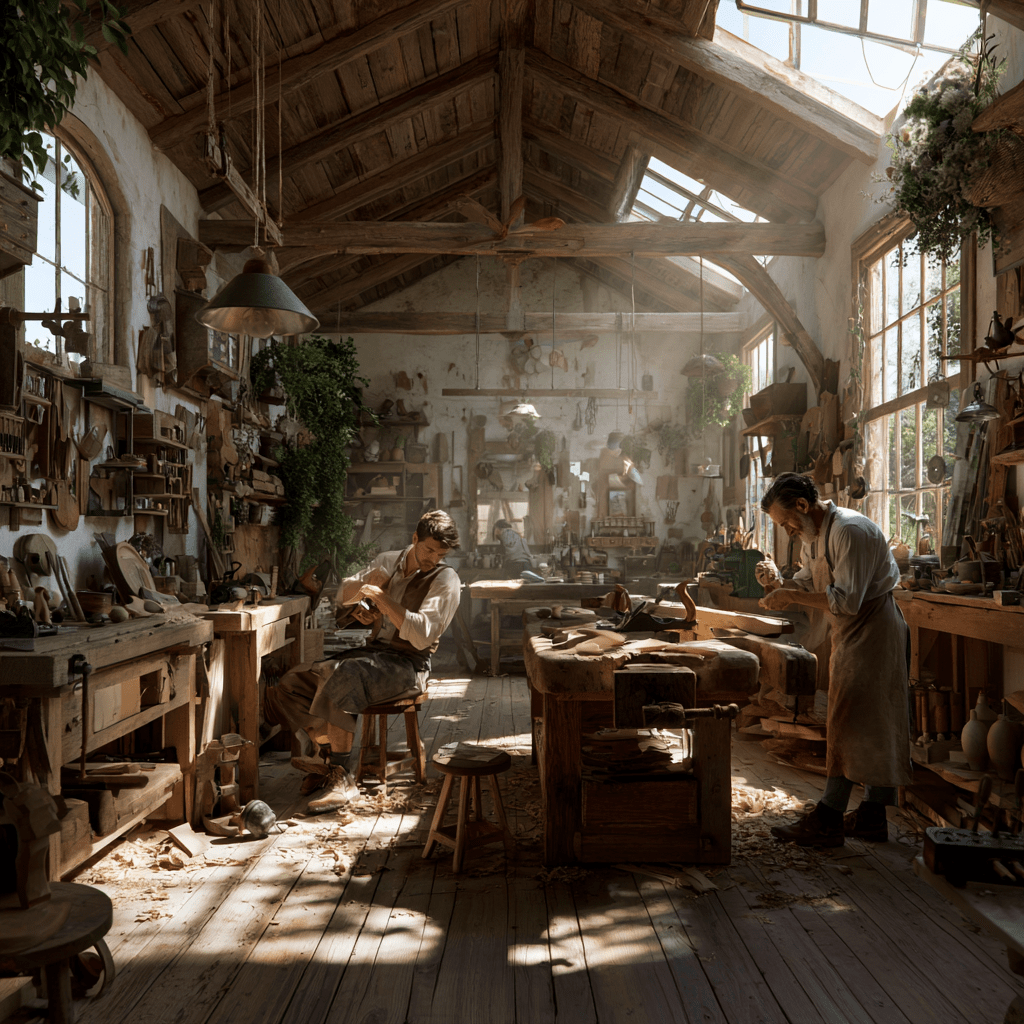
The sim drops me into a woodworking village somewhere in the Philippine province, late morning, and the first thing I register is the smell of cut lumber — which the simulation can’t actually transmit, but your brain fills in the gaps when you’re looking at this much raw wood. Tito Bobi’s Shop takes up a good stretch of the main path. The signage is handpainted, faded at the edges, the letters slightly uneven, the kind that says this place has been here long enough to stop caring about first impressions. Through the wide-open front, four guys are going at it: one has a towel knotted around his forehead like he’s gearing up for a final boss fight, another has his draped loose over one shoulder, a third works in a plain tank top, and the fourth has just abandoned a shirt entirely — denim pants, bare chest, no regrets. The floor is thick with wood shavings. Outside, the finished product is stacked in rows: benches, tables, chairs, bowls, condiment holders, sungkas with their shallow cups already sanded smooth, and the kind of giant decorative spoons and forks that end up on someone’s dining wall for the next forty years.
It’s peaceful. Productive. A perfectly ordinary morning.
Which is exactly the kind of setup this story uses before it puts something terrible nearby.
Roanne and Allison come into frame walking side by side, and the contrast is immediate. Roanne is in a modest blouse — pale, collared, tucked neatly into a long skirt that brushes her ankles. She moves with a quiet kind of steadiness, not drawing attention, not trying to. Allison is in a bolero jacket over a tube top, a large belt cinching her miniskirt at the waist, her long black hair loose and moving with every step. She walks like she expects to be looked at. Gold earrings catch the light. There’s a confidence to her that is almost architectural in structure.
They pass the shop without stopping. Two women are coming from the opposite direction — one broad-shouldered with a sharp face, her eyes already cataloguing every detail of the two girls with the efficiency of someone who makes this their personal hobby. The other is a bit taller, calmer, a shopping bag hanging from one hand. The sharp-eyed one slows first.
Roanne clocks the slowdown and moves to meet them.
“Good day, Ma’ams,” she says, stopping at a respectful distance. Her hands are relaxed at her sides. Her voice is even. “We don’t mean to interrupt, but we were wondering about the missing huntsmen in the forest.”
The sharp-eyed woman — Greta — takes her time looking from Roanne to Allison and back again. Her expression is suspicious in the particular way of someone who considers skepticism a virtue. “Wait a minute, Iha.” The word comes out almost gently. The tone doesn’t match. “I don’t recognize you two. Are you just visiting the village?”
“Yes. I’m Roanne, and this is my younger sister, Allison,” Roanne answers, easy and direct.
That should be enough. It isn’t.
Greta tilts her head. “I don’t believe you.” She gestures between them with the blunt certainty of someone who has been saying exactly what she thinks for her entire life, without apology or adjustment. “You’re tan. Your younger sister is light-skinned.”
Allison’s chin lifts slightly. Her face stays pleasant. She doesn’t say anything, which costs her visibly.
“Greta, stop it,” the other woman, Sari, says. The firmness in her voice is practiced — she’s been redirecting Greta for years, apparently, and has developed a rhythm for it. She turns to Roanne and her expression opens up. “The huntsmen disappeared in the forest. The men here depend on those trees — it’s how we make a living. So when the first ones vanished, the others went in to look for them. Then more followed after that.” She pauses. “None of them came back.”
Greta leans forward slightly. Her voice drops, which is how you know she’s proud of what comes next. “That’s why I told my husband Roman, and our sons, never to go near that forest. Not once, not ever. This started a few months ago. Even our barangay captain can’t explain it.” She straightens and delivers the final line with full conviction: “There is a monster in that forest.”
I believe her. I’ve already seen the chapter summary. I know exactly what’s in there.
Allison has been standing with her arms loosely folded, weight on one hip, watching Greta with an expression of controlled patience. She times it well. The moment the monster declaration lands and the silence that follows it is just a beat too long, she fills it.
“Well,” she says, her voice light, “it’s nice to see your nosiness has some use, Aling Greta.”
Greta’s face shifts through several stages at speed. “I don’t like your tone, little lady.”
“Greta.” Sari’s hand finds her arm. “Let it go.” She glances at both girls. “Take care.”
They walk off down the path. Greta mutters something. Sari doesn’t release her arm.
Roanne waits until there’s enough distance between them and the two women. Then Allison turns to her, chin up, a satisfied light in her brown eyes. “Your idea to pose as sisters worked. I’ll give you that.”
“We got what we needed,” Roanne says. She’s already looking toward the far end of the path where the tree line starts, her expression settling into something quieter and more focused. “Next stop: the forest. That’s where our target is.”
Allison nods once, sharp. Whatever was easy in her face closes over, replaced by concentration. It takes a second.
I watch them head for the trees and run back through the exchange in my memory, the way I do. What actually happened there wasn’t a disaster avoided by luck. Roanne chose a cover that was easy to sell quickly and didn’t require backup detail. Allison held back when holding back was the correct move and picked a single moment to speak when it couldn’t do any real damage. The friction between them is real, but it doesn’t stop the system from working.
The forest sits at the end of the path, dense and still in the late morning heat. Nothing from here to suggest anything is wrong with it. No sound carrying out. No movement at the edges.
I know what’s in there. I’ve seen how this thread ends.
I could say something. Cross whatever line separates observer from participant.
The thought goes nowhere, like it always does. That isn’t what this is. It was never what this is.
The sim holds them in frame — two figures getting smaller against the wall of trees — and then the forest closes behind them. The village path settles back into the sounds of sanding, the rhythm of tools, Tito Bobi’s Shop turning out its patient catalog of beautiful, ordinary things.
The morning doesn’t notice they’re gone.
Moon_bell_mirror_mayhem.sav
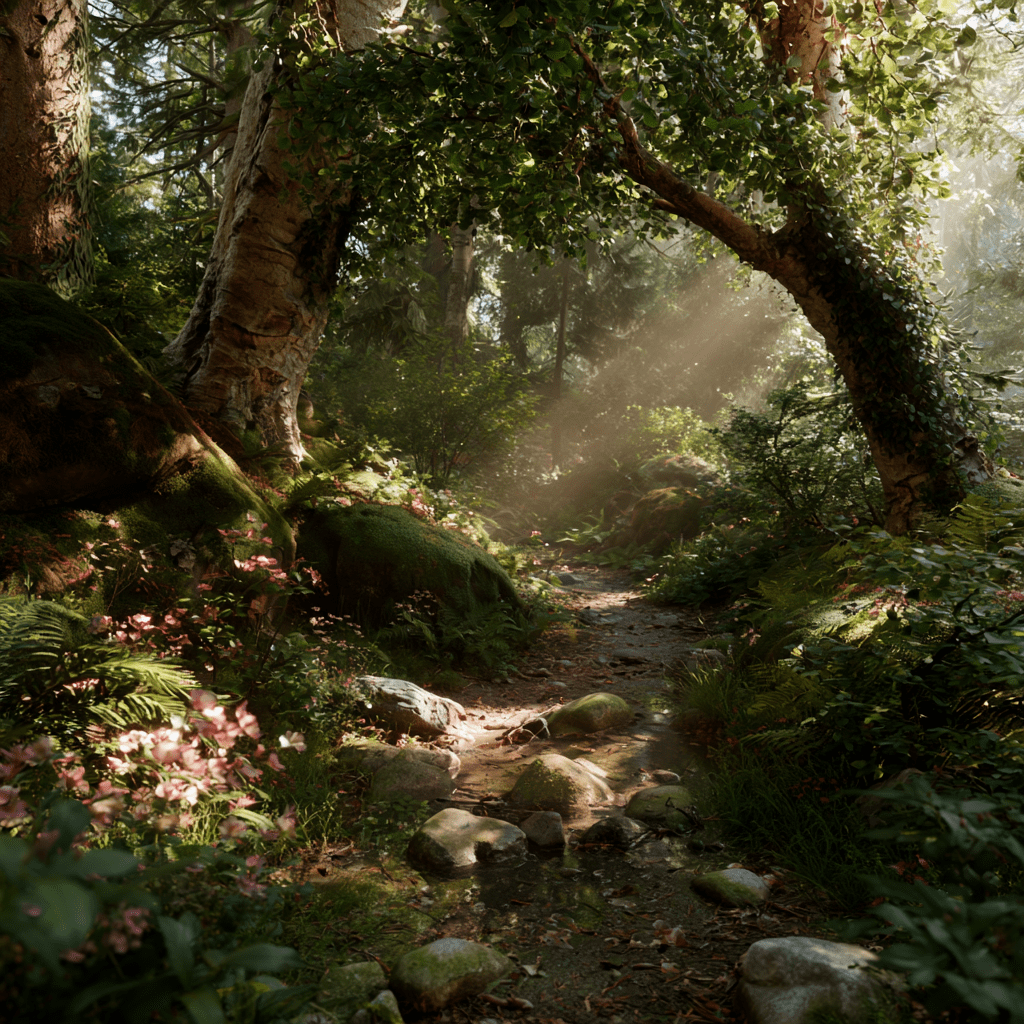
The forest at the edge of the village looks thick from outside. Up close, it’s a different situation entirely. The trees are tall and tightly packed, their trunks wide enough that two people couldn’t link arms around them, their roots coiling out of the ground like something that chose to surface and then reconsidered. Roanne and Allison stop at the boundary where the dirt path ends and the shade begins.
From inside the canopy, no direct sunlight reaches the ground. The air changes almost immediately — cooler, quieter, carrying the particular hush of a place that gets very little foot traffic and is comfortable with that arrangement.
Roanne reaches under the collar of her blouse without hesitating. She draws out a lavender seashell on a thin chain, holds it level in her palm, and closes her eyes.
“Aha-ha, aha-ha.”
Her voice is low and melodic, more breath than sound. The seashell responds to it. It lifts off her palm, rises to about eye level, and opens — two halves parting smooth and unhurried, revealing the white pearl nested at its center.
“Aha-ha, aha-ha.”
The second melody lands and the pearl shifts. It becomes the Moon Bell: a small, luminous thing that glows in ripples of seafoam green and lavender, pulsing softly like something alive. Water materializes around Roanne, periwinkle and aquamarine, swirling upward in slow spirals until it closes over her completely. For a moment she’s gone. Just a dome of luminous water.
Then it dissipates.
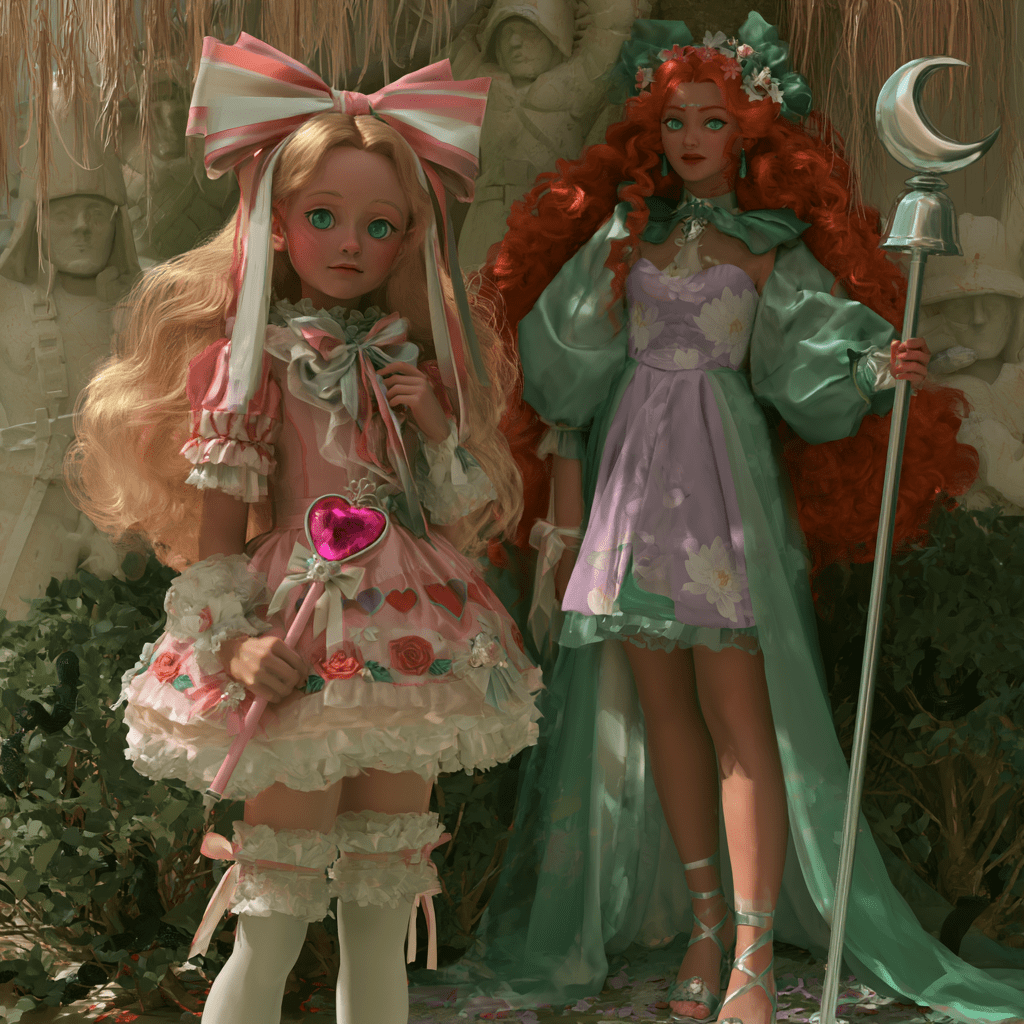
Princess Ruana stands where Roanne was. The transformation always does this to me — there’s a beat where the sim goes completely still, as if even the rendering engine needs a second to process the change. Her gown is pastel and flowing, layered, the kind of fabric that moves independently in still air. In one hand she holds a long rod. The Moon Bell sits at its crown, secured and glowing. Lunar scepter. The whole effect is something between a formal portrait and a weather system.
Allison, who has completed her own transformation off-screen somewhere between the village path and here, is already Love Fey. Pink dress, heart wand clipped at her hip, long blonde hair loose. She glances at Ruana’s entrance without comment.
They head into the forest.
I track them for the next several hours. The sim warps time in fast-forward during the searching stretches — a navigational mercy, since watching two people walk through identical trees for quarter a day would test anyone’s patience. What I catch in snapshot is the steady, unhurried rhythm of it: Princess Ruana moving with quiet attention, checking the direction of roots and the angle of light through gaps in the canopy, reading the forest the way you’d read a map. Love Fey keeping pace slightly behind, scanning the middle distance, her wand hand loose but ready.
No monsters yet. Just forest. The kind that knows how to wait.
By afternoon they’ve found a clearing where two moss-covered boulders sit close together, and they stop. Ruana sets down the woven basket she’s been carrying — it’s the kind of thing that looks too ordinary for the situation, a picnic basket in a potentially haunted forest — and they eat. Simple food, probably something Ruana prepared before the mission. Love Fey accepts it without complaint, which from her is worth noting.
After, they stay seated on their respective rocks. The forest makes its small sounds around them. Leaves. Distant birds.
“I want to share a little self-care routine of mine,” Love Fey announces, with the generosity of someone offering you a seat at a table they’ve decided is exclusive.
Ruana looks at her.
From somewhere in her outfit — the physics of which I have long stopped questioning — Love Fey produces a mirror. Not a compact. Not a hand mirror. A full Rococo-style looking glass with an ornate gold frame, carved flourishes running all the way around the border. She holds it up with both hands and tilts it until her reflection fills it perfectly.
“To keep myself sane,” she says, with complete sincerity, “I look in the mirror.” She pauses for effect. “To see my beautiful face.”
She giggles at her own reflection.
Ruana’s expression doesn’t collapse into anything dramatic. It’s a small frown. The kind that doesn’t require commentary because the situation has already made its own point.
Love Fey angles the mirror, checking from slightly below, then slightly to the side. She is genuinely engrossed. Her concentration is, technically, impressive. The rock beneath her, however, is curved, and her weight has been shifting incrementally with every new angle she tries.
The shift finally completes itself.
Her balance goes. The mirror tips. Love Fey tips with it, and then she’s off the boulder entirely, the movement too fast to be graceful, too slow to be dignified. She hits the ground with a thud that sounds final.
“My beautiful face!”
Ruana is off her rock immediately, crossing the small gap between them. “Are you hurt?”
Love Fey is lying with her head on the ground and her legs still partly elevated against the boulder, hair spread out, mirror face-down beside her. She blinks at the canopy above. Her expression runs a quick damage assessment.
“I’m fine, I think?” She pats her own cheek once. “My pretty face is still intact.”
She sighs. The tension drains out of her in real time.
Ruana looks at her. The concern is still there in her eyes, but behind it — visible if you’re watching closely — is the dismay of someone who is going to have a very long afternoon.
I lean back in my chair and decide not to say anything. The sim holds the image: a princess standing over a magical girl who is lying on the forest floor reassuring herself that she is still beautiful.
Somewhere in this forest, there is a monster that turns people to stone.
It has no idea what’s coming for it.
Gaze_stone_snakes_rising.sav
The balete tree announces itself before you see it clearly.
It’s the kind of presence that alters the atmosphere of a space just by existing in it. The strangler figs hang from its upper branches in long, pale curtains, reaching toward the ground from every direction, some already touching it, others swaying in the minimal air movement. The trunk at its base is enormous and gnarled, the bark folded into irregular ridges, roots radiating outward across the ground in thick, exposed runs. In a forest that is already dense and dim, the balete tree manages to be its own separate category of dark.
Princess Ruana stops walking when she sees it. Love Fey stops a half-step after.
Then they both register what surrounds it.
The statues are scattered across the clearing in no particular arrangement. Some stand close to the base of the tree. Others are farther back, near the treeline, as if caught mid-retreat. A few are in partial crouches. None of them are posed the way a sculptor would choose. They are fixed exactly as they were at the moment something happened to them: weight shifted wrong, hands half-raised, faces carrying expressions that were never meant to be permanent. The stone is pale, the color of ash, and the detail in each face is precise enough to be uncomfortable.
I count eleven. There may be more at other angles the sim isn’t showing me.
Huntsmen. Based on the clothing — boots, heavy trousers, packs still strapped to some of them — these are the men the village women mentioned. Multiple groups, sent in at different times over several months. None of them came back. Now I know why.
“How did statues end up here?” Love Fey turns slowly, taking in the perimeter of the clearing. Her tone is the specific flavor of sassy that she uses when something is genuinely throwing her off and she refuses to admit it. “Statues in a forest. This isn’t a museum or a monument — seriously, what gives?”
Ruana doesn’t answer immediately. Her eyes are moving across the scene with careful attention, pausing on individual figures, reading the details. When she speaks, her voice is quiet and deliberate.
“Could it be — ‘a gaze that turns you to stone.’” She pauses. “From the prophecy. Second Day. Think carefully, Allison.”
Love Fey goes still. The sassy energy recalibrates into something more focused. Her light brown eyes track from statue to statue with a new kind of attention. “So you’re saying these aren’t statues.” She says it like she’s confirming a calculation rather than asking a question. “These are the missing huntsmen.”
“Yes.”
Love Fey looks at the nearest one — a man frozen mid-step, one arm extended, his face locked in an expression that didn’t get to finish becoming whatever it was becoming. She studies it for a moment without performing a reaction.
“And if these are the huntsmen,” she says, “the other half of the prophecy phrase is ‘the slithering snakes.’”
The hissing starts before she finishes the sentence.
It comes from the shrubs ringing the clearing, low and sustained, the kind of sound that isn’t one snake but many arriving at the same conclusion simultaneously. Between the hanging figs and the dark undergrowth, pairs of yellow-green eyes appear at ground level, slit-pupiled, tracking both of them with the flat patience of something that isn’t in a hurry.
Ruana’s posture changes. Her hand tightens on the lunar scepter. “Did you hear that? Something feels wrong.” She doesn’t take her eyes off the shrub line. “Brace yourself, Allison.”
The snakes come out of the shadows all at once.
They’re dark — near-black scales, thick bodies moving fast across the grass in rapid lateral curves, converging from multiple directions. Not one or two. A lot. The clearing goes from quiet to loud in about a second and a half, the hissing from a background sound to something immediate and surrounding.
Love Fey’s response is immediate.
Her blonde hair lifts. Not in a breeze — there is no breeze. It rises in the particular way that signals the magic is activating, each strand separating slightly, the whole cascade floating up around her as the energy concentrates. Her posture shifts into something deliberate.
“Love Chains, Rising!”
The ground around them illuminates. A thin circle of pink light spreads outward from the point where she stands, precise and geometric, burning into the grass in a clean ring. From inside the circle, the chains come up — vertical columns of red hearts, linked and luminous, erupting from the ground in sequence around the perimeter. They don’t just appear. They shoot outward, extending toward the incoming snakes fast and accurate, catching each one before it crosses the boundary.
The impact isn’t violent in the conventional sense. It’s pink light and then contact, and then the snakes stop. Not slowed down. Stopped. Every one of them, hit simultaneously, the chains finding their marks across the entire perimeter of the clearing without a single miss.
What follows is quiet.
Pink petals begin to fall. They come from nowhere in particular, drifting down from above as if the attack itself exhaled them on the way out. Fully formed roses appear among them, complete and open, landing across the pale dissolving bodies of the snakes. The serpents don’t linger — they shred apart in the air, breaking into nothing, like smoke deciding it’s done being a shape.
The clearing settles. The strangler figs hang still. The stone huntsmen stand exactly as they were. The roses continue falling for a few more seconds, then stop.
Love Fey gives her hair a single, unhurried toss. It resettles perfectly. She watches the last of the snakes dissolve with the expression of someone who has just reviewed their performance and found no notes.
“Well,” she says, “that was easy.”
Ruana looks at what remains: twelve roses on the ground, the faint afterglow of the pink circle already fading from the grass, and a clearing full of frozen men who were not as well-equipped for what lives in this forest.
She doesn’t say anything. She doesn’t need to.
From my sim chair I watch Love Fey do a slow visual sweep of the clearing, cataloguing every corner without making it look like work. Ruana stands at the center near the balete tree, her scepter upright, the Moon Bell pulsing soft and steady at its crown.
The snakes were the advance. Every narrative instinct I have is telling me that much. You don’t send the scouts unless there’s something larger that doesn’t want to move yet.
Whatever that something is, it’s still in here with them.
Athena_domain_petrifying_gaze.sav
The forest doesn’t stop gradually. One moment there are trees. The next moment there aren’t.
The shift happens without warning and without sound — the hanging figs, the dark undergrowth, the scattered remains of snake corpses dissolving in pink petals, all of it blinks out in the span of a single frame. What replaces it is open sky and white stone, and the sudden brightness after the forest canopy is disorienting enough that both of them pause for a full second just to process the change.
I’ve seen the sim do environmental transitions before. This one is different. The forest didn’t fade. It was replaced. As if the forest was always just a waiting room.
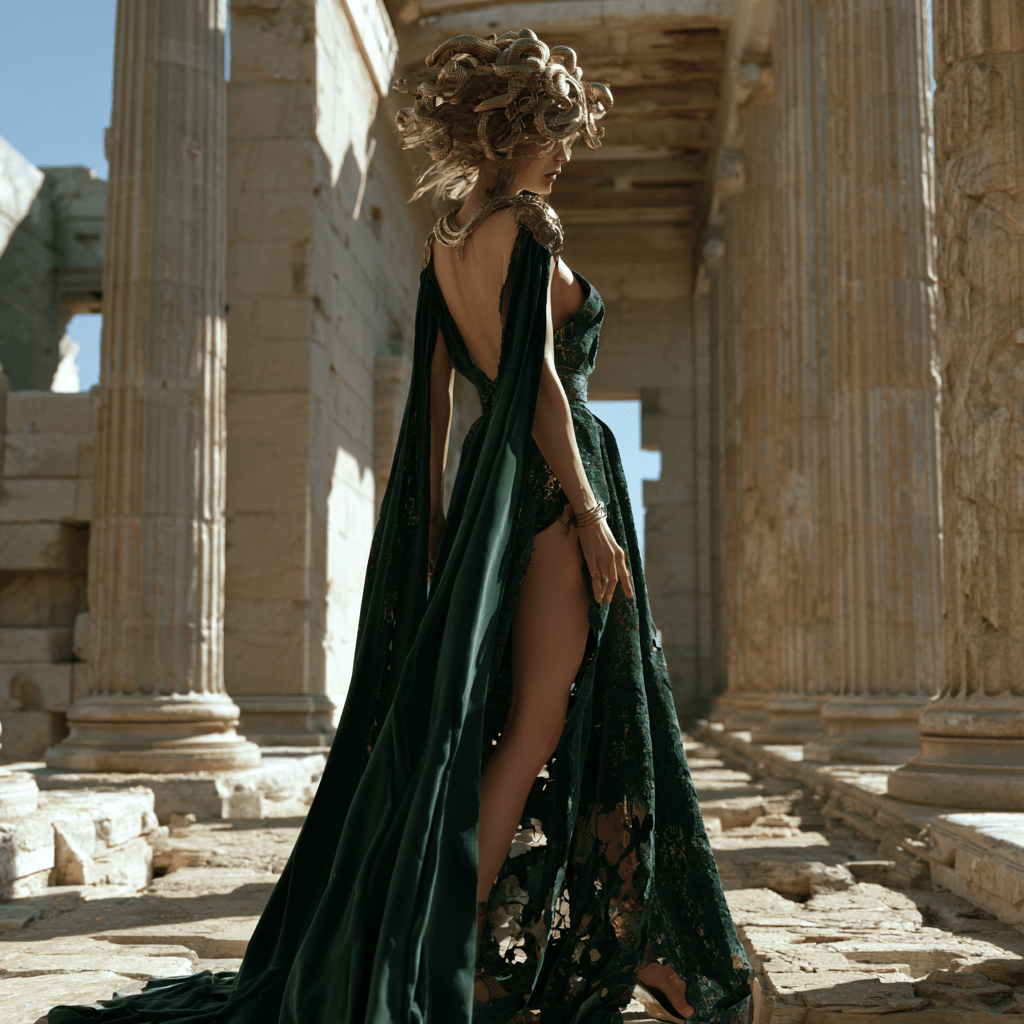
The Temple of Athena opens around them: a vast expanse of pale marble that was once covered and is now exposed to the sky, the ceiling long gone, blown outward at some point in the deep past and never restored. Columns line both sides of the structure, thick and cylindrical, carved from solid stone. Some still stand at their full height, casting long narrow shadows across the marble floor. Others have crumbled midway, their upper sections lying in fragments where they fell, some intact as full drums, others shattered into rough chunks. At the center of the space, where an altar might have been, sits a boulder of enormous size — raw, irregular, pale against the white marble surrounding it. It doesn’t belong here architecturally, but it’s here, and whatever it’s covering stays covered.
At the far end, undamaged and still presiding over all of it, sits the statue of Athena.
She is immense. Seated on a throne carved from the same stone as the temple, she occupies the full height of the rear wall, her face calm and without expression, one hand resting on her knee, the other raised slightly, her posture unchanged by whatever happened to the rest of the structure around her. She is the Goddess of Wisdom and War and the statue doesn’t let you forget either half of that. The craftsmanship is exact. She looks like she is paying attention.
On the marble floor near her base, puddles of rainwater catch the light in irregular patches.
Ruana takes the temple in with a measured scan. Her scepter is up, the Moon Bell pulsing at its crown. She is doing the right thing — reading the space before committing to movement, identifying the exits, checking for threat vectors.
“Allison,” she says, keeping her voice level. “This is the dominion of the Greek monster Benjamin warned us about. Each monster has a realm it values, one that’s associated with it.” Her eyes complete their circuit of the columns and return to center. “We should think this through.”
Love Fey doesn’t answer.
She is already looking at the boulder.
Her expression has that particular quality it gets when she’s decided something and the decision is complete and the rest of the conversation is technically optional. She pulls her heart wand from nowhere specifically — it materializes in her grip with the casual ease of something that has always been there — and begins rotating it between her fingers with the practiced ease of someone who has watched way too many performance routines and retained all of it. The movements are sharp, deliberate, the wand spinning around her palm like a baton, switching hands, switching directions.
Then she stops. Plants her back foot. Lifts one knee, the other leg straight on its heel, one arm bent at her waist at a precise angle. The pose is instantaneous and held without wobble. Behind her, the air does something inexplicable — color, sudden and saturated, swirling through the space in a tight radius, pinks and oranges and yellows bleeding into each other and then cutting off clean.
Her own personal intro animation. She’s workshopped it.
“I don’t care what dominion this monster has,” she announces, and her voice carries through the open-roofed temple with total conviction. “I’ll finish it right here, right now.”
And then she runs.
She crosses the marble floor at full speed, both arms pumping, wand in one hand, the pink hem of her dress moving fast behind her. She reaches the boulder and goes up it without slowing — finding handholds in the irregular surface, boots finding grip on the rough stone, pulling herself up through the last section with her arms and then straightening on top.
She looks down the other side.
And sees her.
Medusa stands between the boulder and the base of the Athena statue. The description I’ve always had in my head from the myths involves something monstrous immediately and entirely, but the reality the sim is showing me is more complicated than that. She is tall. The dress she wears is dark green and torn at multiple points along the hem and sleeves, the fabric fraying and thinned from age or damage, the color close enough to the stone shadows that from a distance she would be difficult to isolate. Her hair moves constantly, the snakes shifting and resettling in slow, independent cycles, their scales catching the light in irregular flashes of green and brown.
Her face, at this moment, is turned away. She is looking at the Athena statue above her. Her shoulders are drawn inward. Something in the angle of her posture reads as stillness of the wrong kind — the stillness of someone who stopped moving because there was nowhere else to go, not because they chose to.
Is that Medusa? Love Fey thinks, disgusted. Yikes, talk about an extreme bad hair day.
Love Fey swallows her revulsion and focused.
The snakes register Love Fey first. One of them on the right side of Medusa’s head rotates toward the boulder, eyes finding her position with the flat precision of something that functions on instinct. It takes a breath — half a second, less — to complete the turn.
Love Fey is faster.
“Love-Me-O-Babe!”
The wand goes up. The heart forms above it, enormous, vivid red at the center shifting to bright pink at the edges, the surface pulsing with light. It hovers for the width of a heartbeat between Love Fey and the space below her. She is standing at full height on the top of the boulder, which puts her level with the upper section of the Athena statue, which is a considerable distance from the floor. The pose she lands into has both of her feet planted and every line of her body radiating certainty.
Medusa turns.
Whatever her face was doing before, it isn’t doing it now. The transition is complete and immediate — the quiet, inward posture gone, the features reshaping themselves, the sadness and the stillness burning off in a single second as her eyes come to full illumination, white light flooding outward from the irises in expanding rings. Her face becomes angular, the features sharpening, scales visible at the edges of her cheekbones and jaw. Her mouth opens. The expression that replaces everything prior is the specific kind of fury that comes from a wound that never closed.
The heart descends.
Let’s see if your petrifying gaze can get through my opaque heart, Love Fey smirks.
It crosses the space between them and makes contact. For a brief moment, Medusa’s gaze peeks through the heart construct and meets Love Fey’s eyes. And the sound it produces isn’t what I expected — not an explosion, not a crack. More like a compressed burst of pressure, everything releasing outward at once. The pink light expands in a sphere from the point of impact. Medusa’s form flashes white inside it, the outline still briefly legible before the light becomes too dense, and then her silhouette shatters — not slowly, not in stages, but all at once, the shape breaking apart and dispersing in every direction with a gust of wind that drives petals and rose heads spinning upward in wide arcs.
The wind drops. The petals fall. The roses land across the marble floor.
Medusa’s severed head rests among them. The snakes on it are still alive, each one hissing with separate intensity, writhing against each other in agitation. Her eyes are open. Her features, at rest again without the activation of the curse, have settled back into something that doesn’t match the word monster particularly well.
“I did it!”
Love Fey’s voice bounces off the remaining columns. She is standing at the top of the boulder with her wand extended, looking down at the outcome of the attack with the particular brightness of someone who aimed for something and hit it.
Ruana comes around the far side of the boulder. She has been there the whole time — positioned behind cover with the scepter up, reading the situation as it developed, letting Love Fey make her call. She looks at the severed head on the floor. She looks at the petals. She looks at Love Fey.
“What have you done, Allison?”
Her voice isn’t angry. It’s careful. The kind of careful that is covering something else.
Love Fey lifts her chin, still looking up at the Athena statue behind the head. “I’ve slain Medusa,” she says, with the full-beam satisfaction of a completed objective. The smile is real and wide and pointed upward at the goddess above her like a declaration.
The stone starts at her eyes.
Not the pupils first — the entire eye surface simultaneously, the color draining out and the texture changing in the same instant, pale gray spreading across both irises in a ring that moves outward to the whites. Then it runs. Down the bridge of her nose. Across her cheeks. Along her jaw. It moves the way something solid would if it were flowing — not like water, like something thicker and more deliberate, finding the contours of her face and following them exactly.
Her arms go next. The shale travels down from her shoulders along both forearms, reaching her hands, crossing the knuckles, filling in each finger to the tip. The pink of her dress disappears under it section by section, the fabric and the form beneath it both captured, both stopped. Her legs. Her feet. The wand in her hand. The bow in her hair.
All of it, stone.
She is standing on the floor now, with her chin lifted and her eyes toward Athena and her wand extended. The expression on her face, locked in now, is the exact expression of victory. Not fear. Not realization. She didn’t get to change it.
She is a statue.
“No.” Ruana is at the base of the boulder before I’ve finished processing what I’m looking at. “Allison, no!”
Her hands are already glowing, the seafoam green and lavender light expanding from her palms as she reaches Love Fey. She raises both hands and the water comes — real water, the kind with weight and movement and the luminous quality that is particular to Ruana’s power, swirling in currents around the stone figure, washing over every surface. The light is dreamy, mystical, and constant. It doesn’t waver.
Nothing changes.
Love Fey doesn’t change. The stone doesn’t respond to the water. The color doesn’t return. Ruana keeps her hands up and keeps the healing current running and nothing happens, and after a moment the expression on her face shifts from urgent to something quieter and harder to look at directly.
She stops. Her hands drop. The water dissipates.
Then the vision arrives.
I can see it in the sim the same way I see everything else — from outside, observing. But what comes through is not just Ruana’s face changing. The temple shifts around her, the light modifying in temperature, and I hear a voice that doesn’t belong to anyone present.
“I will not forgive your transgression, maiden of my temple.”
The voice is cold. Not loud in the way of shouting — loud in the way of something too large for a room, filling space by displacement. Athena’s voice in the memory of a woman who served her and was answered with a punishment that had no appeal and no end.
“I curse you: your hair shall become snakes. You will remain beautiful, but anyone who gazes upon you will see your hideous hair of snakes. Men will fear you, and they will turn to stone. Let no one undo the curse of a goddess.”
The memory closes. The temple goes back to what it is. Ruana is standing at the base of the boulder with her hands at her sides, looking at the severed head on the marble floor.
The head’s eyes open. The snakes on it hiss quietly, slower now, as if winding down.
Ruana doesn’t look at the head directly. She looks at the puddles of rainwater on the floor instead. They’re small and scattered, catching the light at different angles. She moves her gaze across them carefully, using each reflection to triangulate the position of the head without putting her eyes in its direct line. Ruana using the reflection from the water to deflect the petrifying gaze of Medusa’s severed head, the sea princess concealing herself from the snake-haired woman’s gaze.
Her hands come up again. Different light this time — periwinkle and aquamarine, the colors more specific, more intentional. The water that forms from them is also different, not the healing current but something with more surface tension, more structure. It expands into a sphere, a closed vessel of shimmering indigo-shot water, and she moves it across the floor toward the head without touching the head, surrounding it, drawing the sphere closed around it until the snakes and the face and the open eyes are fully enclosed. The sphere seals. The light inside it pulses once, twice, and then goes still.
The snakes stop moving.
The hissing stops.
Ruana stands over the sealed sphere for a moment. Her face is composed. Her eyes are not.
I can feel your rage. All of it. Betrayed by the goddess you once served — all that injustice, all that loneliness. She doesn’t say it aloud. But you did this to so many people who didn’t choose any part of your story.
She kneels beside Love Fey’s statue.
The stone figure is exactly as it was at the moment of contact — chin up, wand out, the smile of someone who thought she’d won. Ruana puts one hand on Love Fey’s arm and doesn’t pull it away. The stone is cold. Obviously it’s cold. It’s stone.
“I’m sorry, Allison.” Her voice is barely above a whisper. “I failed to save you.” She stays kneeling. Her eyes are wet, but her voice stays even. “I’m no match for the curse of a goddess.”
The temple shifts.
Not violently. Not the way it arrived. It goes the same way the forest went — replaced, one frame to the next, the white marble and the standing columns and the Athena statue and the petals on the floor all of it transitioning back into trees and roots and hanging strangler figs and the balete tree at the center of the clearing.
Love Fey is gone.
Ruana’s hand closes on air. She looks at where the figure was and then at what surrounds her: the stone statues of the huntsmen exactly where they were before, the balete tree, the quiet forest light. The sealed water sphere is still in her hands, the indigo glow steady. The clearing is still.
In the ruins — still there on the other side of whatever boundary the temple exists behind — Love Fey stands with her chin lifted and her wand extended, looking up at Athena, standing in the place of Medusa. Alone, the magical girl was forever enshrined. From a distance, the long green leaves bore dewdrops—or perhaps, tears.
In the domain of a goddess, in a temple that closes when it decides to close.
I stay in my chair for a long time without moving.
I don’t have a line for this. I’m the narrator, technically. I observe and I report and I place the gaming metaphors where they fit and keep the scene moving.
I have nothing to say right now.
Love Fey went in fast and hit hard and the result was correct and the cost was total and the clearing doesn’t notice either of those things because clearings don’t have opinions. Ruana is standing inside it alone, holding a sealed sphere that contains a myth, and the teammate she came in with isn’t coming back out today.
The sim holds the frame.
I let it.


Leave a Reply