Overview:
| Captain McKinley and Princess Ruana adapt to life on the remote island as they continue investigating its recurring electromagnetic disturbances. Sitting beside a bonfire at dusk, Ruana confesses that she already misses their comrades back at headquarters. Later, she convinces McKinley to swim with her in the sea. Beneath the waves, the two communicate telepathically as they explore the coral reefs, deepening their mutual connection. That night, three enchanting voices lure McKinley away from their capsule shelter and toward the sea. By morning, Ruana awakens to find him missing. After searching every room in vain, she rushes into the ocean in her mermaid form, leaving the tropical island behind. Her search leads her to the shores of another island with an entirely different climate. |
Roanne_hears_the_fish_plead_for_their_lives.sav
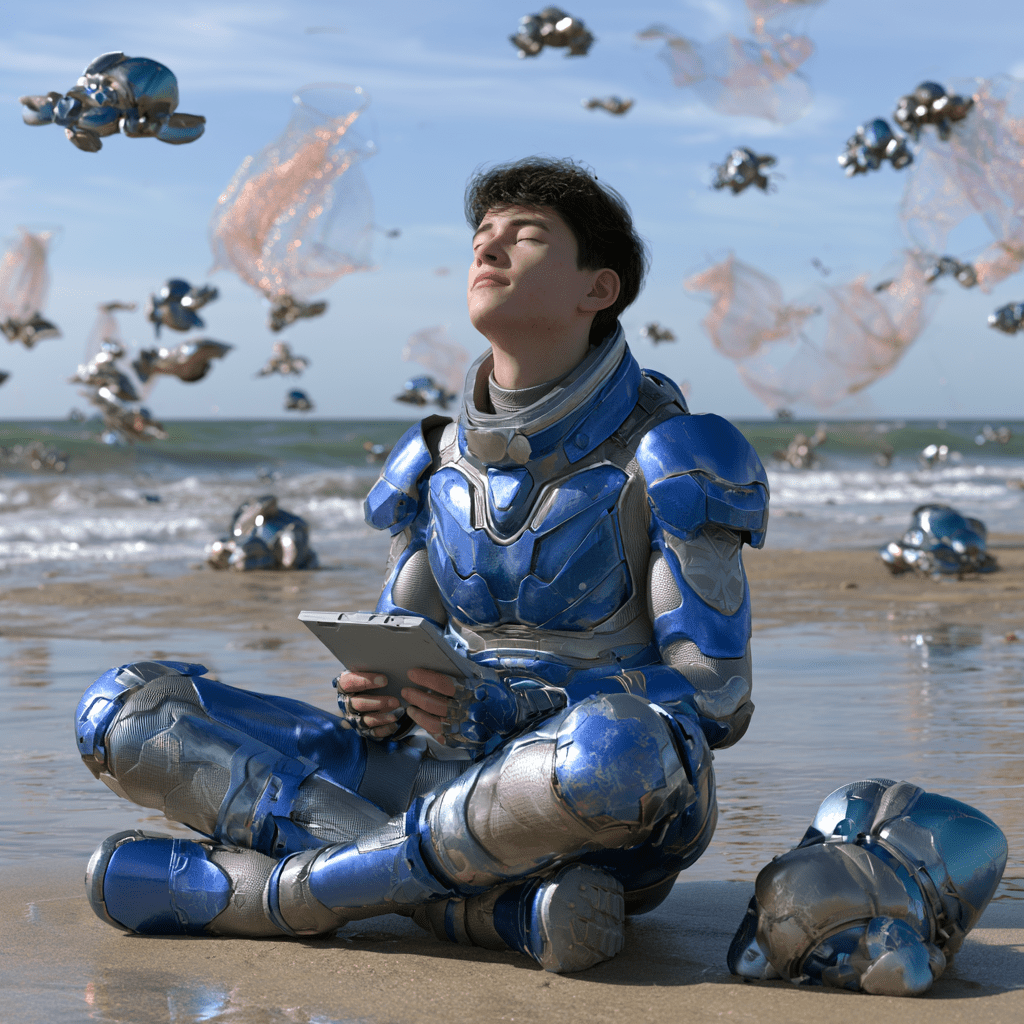
The island is almost insultingly beautiful.
I pull up the simulation and the white cube fills in like a loading screen — pale sand materializing grain by grain, a sky so blue it looks like someone cranked the saturation in post, then the ocean, the trees, the wind. The sun hangs high and unambiguous. Zero cloud cover. Tropical paradise, day one, no fast travel option. Classic.
Benjamin snaps into focus first.
He’s standing at the tree line, laser gun raised, one eye squeezed shut in the practiced squint of someone who has converted a combat weapon into a grocery-getter. He’s in his McKinley field gear — cobalt blue and gray, the visual language of someone who takes logistics. He fires. A cyan beam cracks upward with a low-pitched zap, and a coconut drops like it just remembered gravity was a thing. Thud. Roll. Two more follow.
Efficient, I note. Unorthodox. Respect.
He doesn’t celebrate. Benjamin never celebrates small victories — that’s practically his defining trait. He crosses to the capsule sitting maybe twenty meters from the waterline: igloo-shaped, off-white, smooth-sided, with a protruding ventilation tube and a sealed entrance door the width of a hatchback. He pops his space gauntlet open with his thumb and a holographic display blooms above it in layered translucent rings. His fingers move through the light like he’s conducting something only he can hear.
Nano-molecule repair. The capsule’s exterior ripples faintly in response, microscopic architecture knitting back together under remote direction. He watches the progress without expression — the look people get when something’s complicated enough to need their full brain but familiar enough not to need their emotions.
After a while, he settles cross-legged on the shore. The holographic rings rearrange. Out in the shallows, three submersible drones surface just long enough to catch the light before casting nets in widening arcs, mesh sinking into the blue.
The man is multitasking his way through survival. Peak McKinley.
Roanne comes into focus further down the beach.
She’s crouched over a wide basin set in the sand — shallow water, still, holding maybe a dozen fish. Her red hair moves in the wind like something from a cutscene, and she’s in a seafoam green-and-lavender gown that lands somewhere between practical and fairy-tale concept art. A gleaming knife rests in her hand, blade catching full late morning light.
She’s about to work.
Then she stops.
Her brow pulls together — not confused, not alarmed, but somewhere in the exact middle where a person has just received information their brain is still filing. She straightens slightly. Her eyes drop to the fish. Her grip on the knife loosens by two degrees.
The fish, as it turns out, have opinions.
I can’t hear the transmission directly — but I can read what happens to Roanne’s face, and what happens is: her eyes go wide, then still, then complicated. A long breath moves out through her nose.
“Oh Goddess, Regina—” they plead, collectively, in whatever frequency mermaids receive and everyone else doesn’t. Red-haired and green-dressed above them, she must look exactly like the answer they’ve been praying for. A patron saint. An old agreement from the deep end of the world. “Please spare our lives. We are your brethren and sisters from the sea.”
Top five strangest things I’ve observed from this chair, I think. Easily.
Roanne is quiet. The kind of quiet that means she’s actually listening to herself.
I don’t know what to say, runs the thought behind her eyes. This is the first time fish I’m about to cook have spoken to me. My family has eaten seafood since I was a child.
True. Doesn’t make this easier. The fish watch her — if fish can be said to watch — with the collective desperation of creatures running low on water and options. Their fins move weakly against the basin’s floor.
She closes her eyes. Opens them.
I feel for you, little ones. There’s something genuine in it — not performed guilt, just honest acknowledgment from someone who means the weight of what she’s about to do. But it is the Lord’s will that man catch fish and serve them at the family table.
The knife comes up.
The blade catches the light one final time — a brief, precise flash.
Scene.
I lean back and stare at the cube ceiling for a second. There’s a quieter kind of storytelling that doesn’t announce itself — it just lands. One red-haired girl on a sun-bright beach, one gleaming knife, twelve fish who made their case as eloquently as fish can.
She heard them.
She proceeded anyway.
Sometimes heroism isn’t about the answer. It’s about the full second you spend before you give it.
McKinley_and_ruana_watch_the_dusk.sav
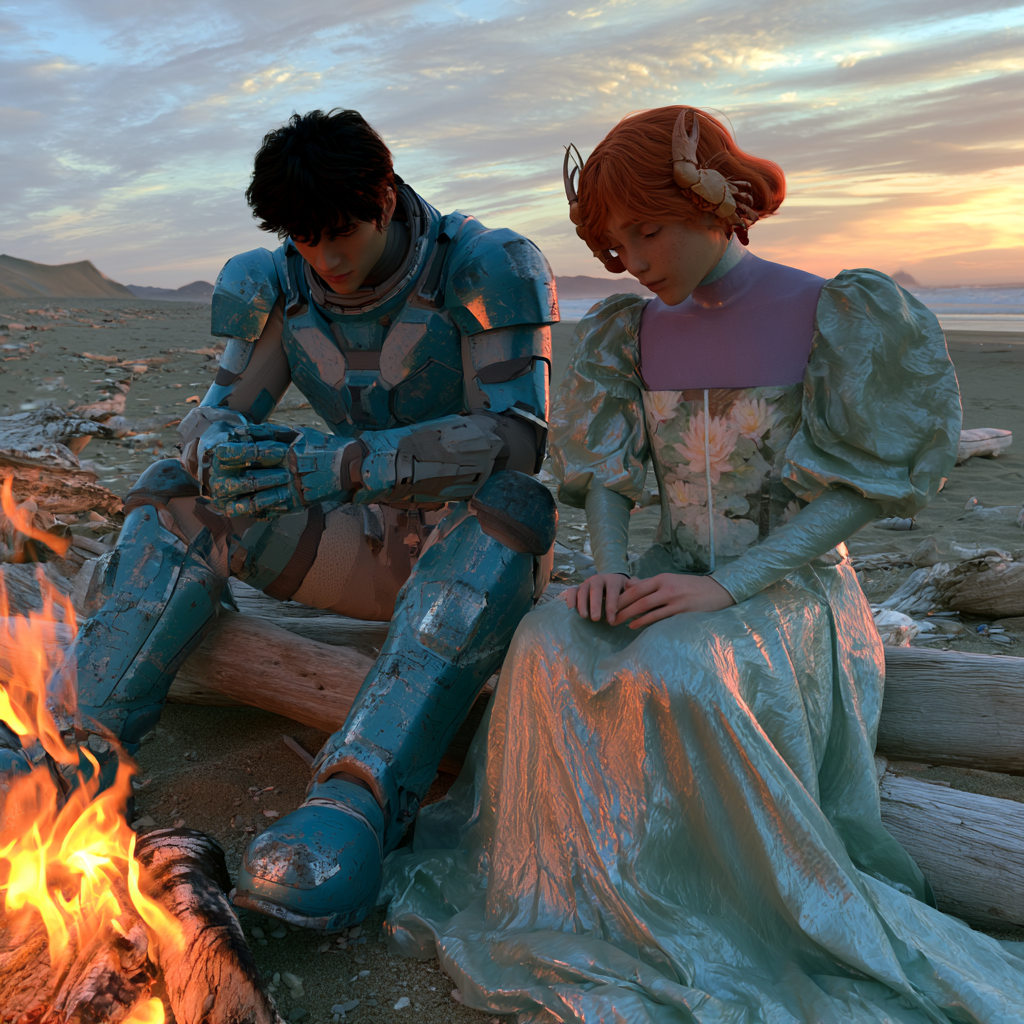
The sim shifts to dusk.
Indigo bleeds into orange at the horizon in that specific gradient that looks fake until you remember the real world never got the memo about subtlety. The island beach settles into evening quiet — waves pulling at crumpled sand, the bonfire already going, flames doing their warm, flickering thing between two silhouettes.
Princess Ruana and Captain McKinley, sitting side by side, watching the sky like it owes them something.
Ruana has her knees drawn up, seafoam-green-and-lavender dress pooling around her, red hair catching the firelight in a way that’s almost unreasonably cinematic. McKinley sits at an angle beside her, elbows resting loose on his knees. They’re not looking at each other. They’re looking at the same sunset from slightly different angles.
Classic pair composition. Someone always frames this shot before the emotional scene.
“Topher knows how to make fire because he’s a Boy Scout, right?” Ruana says. Her voice carries that particular warmth people use when they’re talking about someone they miss while pretending they’re just making conversation.
McKinley’s expression does something brief and honest before settling back into neutral. “You miss them.” A beat. “I miss them too.”
Ruana exhales. The fire crackles to fill the space.
“It’s been a month since we got stuck on this island.” McKinley shifts slightly, gaze moving to the middle distance where the ocean goes dark. “There are recurring electromagnetic disturbances, but beyond that, we can’t pinpoint the cause.”
One month. I do the math without meaning to. Isolated, one capsule, one fire, fish that have opinions. Not ideal.
“I wonder how James and the others are doing.” Ruana’s voice goes quiet at the edges — wistful is the word, even if she wouldn’t use it. “All we have are those training footages ROBO4000 sends from time to time.”
Neither of them says what that actually means: that curated highlight reels from a combat robot are a poor substitute for knowing your family is okay.
The bonfire doesn’t comment. It just burns.
Some silences say everything. This is one of them.
Ruana_splashes_the_captain_and_pulls_him_into_the_sea.sav
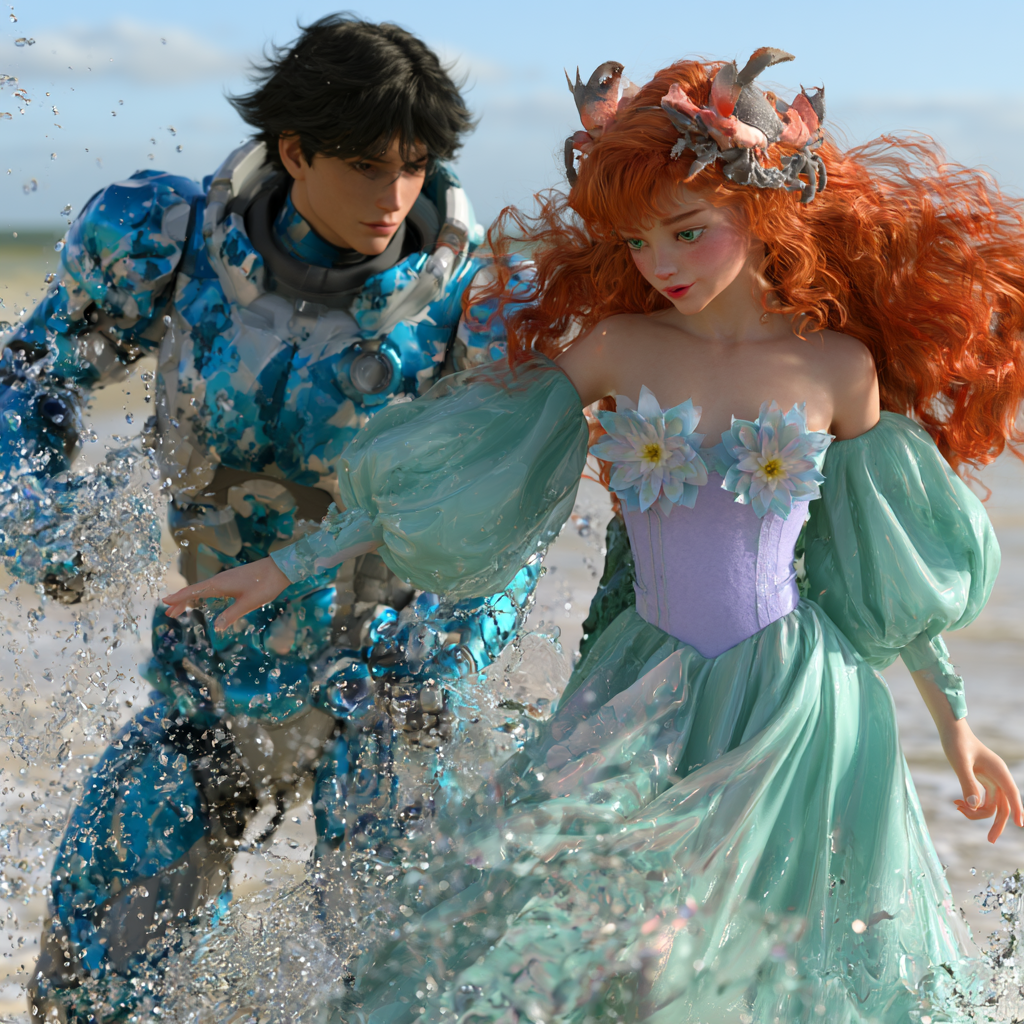
Morning comes in with the particular brightness that islands do — no buildings to filter it, no clouds to negotiate with, just raw tropical sun and the sound of water going wherever it wants.
I settle into the sim and find them.
Ruana is already up. She’s standing at the waterline in her seafoam-green-and-lavender gown, feet bare, hem threatening the foam where the waves reach their farthest point and then think better of it. The ocean is doing what oceans do in the morning — calm, quietly enormous, completely indifferent to the two humans stationed on its doorstep. She looks at it the way someone looks at a friend they haven’t spoken to in a while.
Behind her, McKinley sits cross-legged in front of the capsule with his tablet across his knees, stylus moving in short deliberate strokes as he reads the radar display. There’s a half-finished coconut beside him that he’s clearly stopped caring about.
“Want to swim?” Ruana says, without turning around. “The sea will go to waste.”
McKinley doesn’t look up from the tablet. “You go ahead. I need to monitor the next electromagnetic disturbance. Maybe this time we can pinpoint its location and cause more accurately.”
Of course he does. The man treats electromagnetic anomalies like homework due in an hour.
Ruana turns. She’s grinning — not the polite kind, the mischievous kind, the kind that means a decision has already been made and Benjamin just doesn’t know it yet. She raises one hand, fingers loose at her side, and flicks.
A column of seawater leaves the ocean, travels approximately four meters, and hits McKinley directly in the side of the face.
“What?!” He’s on his feet before the second half of the word leaves his mouth, tablet clutched to his chest at a forty-five degree angle of instinctive protection. His hair is dripping. His expression cycles through about six things in two seconds before landing somewhere between annoyed and trying not to smile. “Stop that! It’s a good thing our equipment is waterproof.”
“Come on.” Ruana’s grin stays fixed. “All work and no play makes Benjamin a dull boy.”
She went there. Classic.
McKinley looks at his tablet. Looks at the ocean. Looks at Ruana, who is still grinning at him with the patient confidence of someone who already knows how this ends.
He sets a countdown on his space gauntlet. The display blinks: 40:00.
“Forty minutes,” he says.
The sea takes them.
The_mushroom_coral_and_the_hand_that_forgot_to_be_private.sav
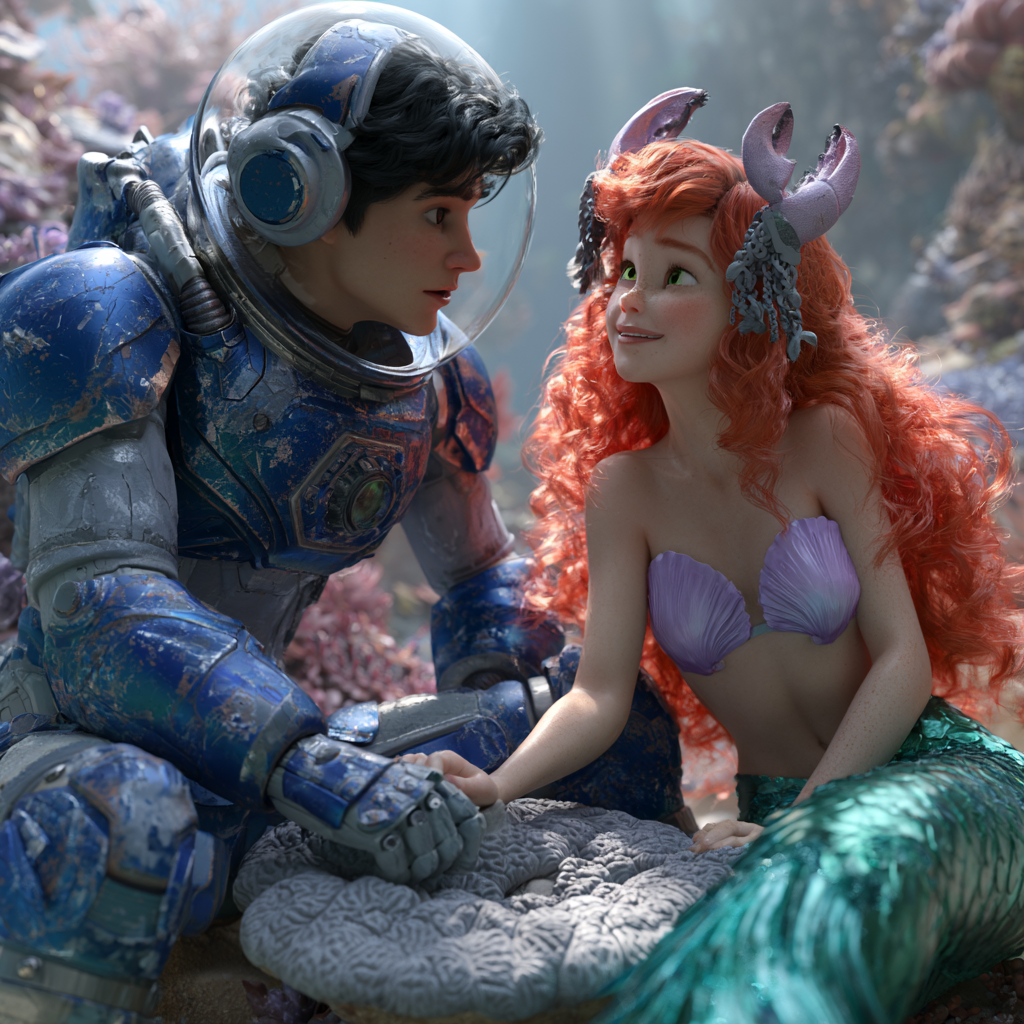
They hit the water and Ruana is already changing before they’re fully submerged. It starts at her feet — a shimmer of seafoam green light that moves upward in a spiral, shifting green and aquamarine, and then her legs are gone and her tail is there, wide and strong, the same sea-green as her luminary color. She moves through the water the way fish move: without effort, without noise, like the ocean is simply making room.
McKinley swims alongside her at a human pace, his space gauntlet sealed, his helmet cycling from exterior air to stored oxygen with a soft internal click.
Good thing the gear has multi-environment support, I note. Deep space. Open water. Tuesday.
It’s good your space helmet has stored oxygen, Ruana sends through the telepathic channel. Her voice in his head carries the same warmth as her actual voice, maybe more. It’s useful not only in outer space but also under the sea.
I guess so, McKinley thinks back, and there’s a subtle stiffness in it — the involuntary discomfort of a private person discovering that privacy is a land-based concept. He’s not used to his thoughts being ambient. Ruana receives them the way someone reads a room.
They swim. The world under the surface opens up.
The coral reef is dense and detailed — pillars and fans and branching formations in colors that don’t exist in Quezon City, orange and violet and a particular shade of electric blue that looks like it was invented specifically for this moment. Fish thread between the corals in schools, moving in the fluid unison that always looks choreographed until you realize they’re just not thinking about it. The sand floor sits pale and distant below.
Fish have corals as their home, Ruana sends. Her tail moves in one long, unhurried stroke. ‘Your heart is where your home is.’ I believe that applies to people too.
McKinley doesn’t respond immediately. He’s watching a school of yellow tang part around him like he’s a slow-moving obstacle they’ve collectively decided to tolerate.
They pass through fields of seaweed — long, kelp-dark curtains swaying in the current, backlit from above into something almost stained-glass. Ruana trails her fingers through them as they go.
Seaweeds are to the sea as trees are to the land, she offers. The sea and the land — they’re connected.
I’ve always preferred the land, McKinley sends back, steady and honest the way he always is. We stand, walk, and work on solid ground. Life seems more predictable there.
Ruana is quiet for a moment, the kind of quiet that means she’s holding something she’s deciding whether to say.
But the sea offers peace when I grow weary, she says finally. The calm waters, the waves — they’re like emotions, thoughts, and memories. There’s depth in them.
Yeah, I think, watching from wherever I am. There is.
Come, Ruana sends. I’ll show you something.
She guides him deeper and slightly north of where they’ve been, past a formation that looks like it was designed by someone who’d never seen coral before but had strong opinions about architecture. She stops in front of it.
This coral stands out to me, she says. It’s shaped like a mushroom. It looks like it should belong in a jungle. Its top surface is wide enough to place both hands.
McKinley reaches out and touches it. The surface is gray, smooth in the places where it’s been worn and textured in the places it hasn’t, dotted across the top with pale off-white spots.
Something in him loosens by a fraction.
I like gray, white, and black, he thinks — not directing it at her, just thinking it, the way people think when they believe they’re alone. They remind me of glass and steel. And shades of blue calm my mind. They help me think clearly.
He forgets, for one unguarded second, that his thoughts are not a private room.
His hand moves across the coral surface and finds hers. He doesn’t notice immediately. Then he does. He looks up.
Ruana is already looking at him. She grins — the same mischievous grin from the beach, except this one is softer at the edges, less teasing, something else entirely. Seafoam bubbles from between her lips as she laughs without sound.
McKinley’s expression does the thing where it tries to stay neutral and doesn’t quite make it.
I watch the three of them — the mermaid, the space captain, and one unremarkable mushroom-shaped coral — exist together in the aquamarine quiet of the deep water.
Forty minutes was a negotiating position, I think. He was going to stay longer. He just needed the math to justify it.
The_sirens_sing_and_the_captain_walks_into_the_sea.sav
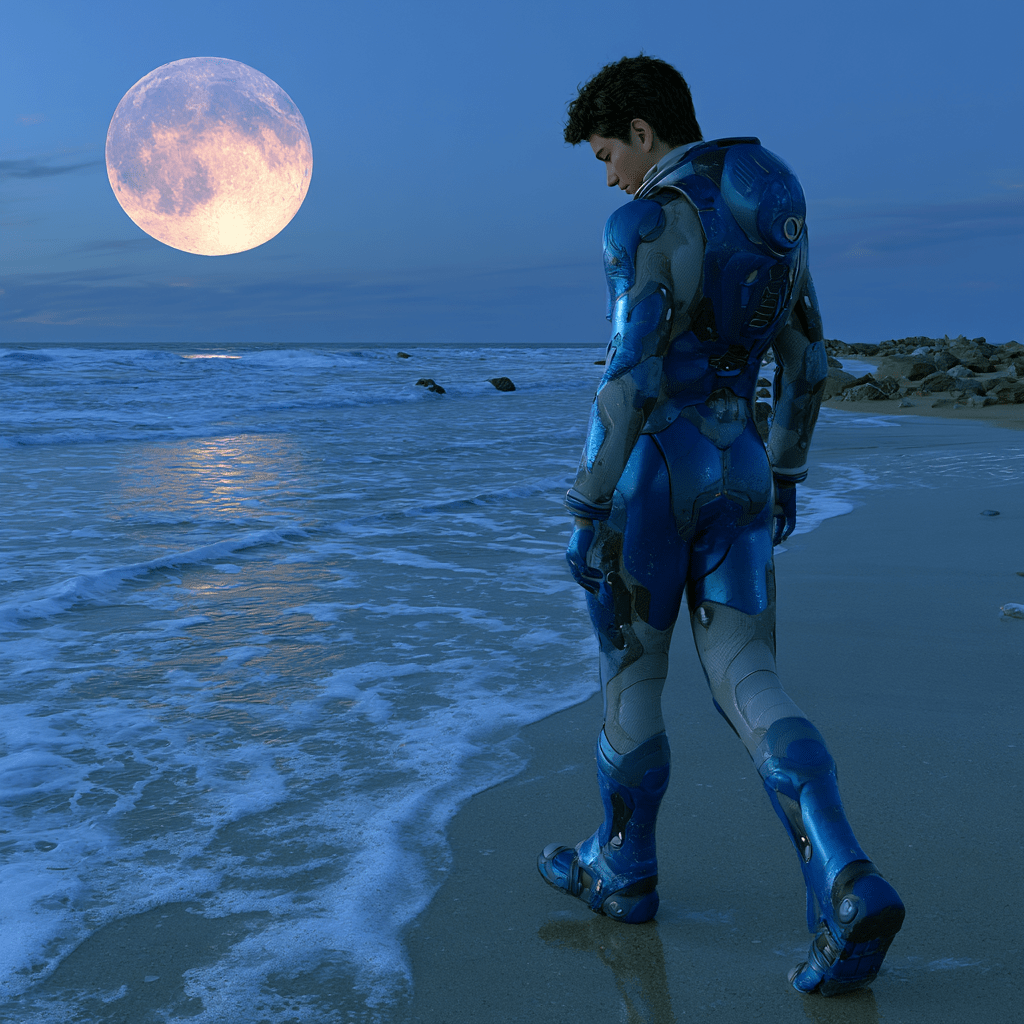
The sim doesn’t warn me when something’s about to go wrong. It just shows me.
Full moon tonight. The kind that looks painted — perfectly round, unreasonably bright, hanging over the island like a stage light that forgot to ask permission. The sea below it is flat and dark, barely moving, waves making their quiet return trip up the crumpled sand and back again. The igloo capsule sits on the shore exactly where it always does, off-white and sealed, the ventilation tube catching a thin ribbon of moonlight on its curve.
Everything looks fine.
Everything looking fine is always the problem.
Then the voices start.
They come from the water — out past where the moonlight stops making sense and the dark takes over. Three of them, staggered in their entry like they’ve rehearsed this, which they absolutely have. The first voice rises alone, wordless and high and devastating in the way that certain sounds are devastating: not because they’re loud, but because they reach directly past your ears and grab something behind your sternum.
“Ahahahahahahaha.”
The second joins it, a third lower, threading underneath like a harmony that knew where the gap was before the first note even finished.
“Ahahahahahahaha.”
The third arrives and completes the chord. The three voices lock together into something that has no right to sound that good.
“Ahahahahahahaha.”
Sirens, I register immediately. Greek mythology’s original audio exploit. Three-part vocal hack, range: lethal, countermeasures: wax, rope, or being Odysseus. None of which McKinley has on hand right now.
Inside the capsule, Ruana sleeps. Her red hair fans out across her pillow, arms loose at her sides, breathing slow and even. The siren song moves over her like weather over a lake — present, and completely irrelevant. She doesn’t stir once.
McKinley is another story.
I watch his eyes open.
It’s not a normal waking-up. There’s no groggy pause, no blinking adjustment to the dark. His eyes open like a switch gets thrown — and for one brief, strange moment they glow white, the same color as the moon outside, before settling back to their usual dark irises. He sits up. His expression is blank in a way that’s different from his usual neutral — the focused blankness of someone who is thinking is still there, but whatever he’s thinking about, it isn’t him anymore.
He stands. He crosses the capsule floor without looking for his tablet, without checking anything. He opens the door and steps outside.
The sand is cool under his feet and he doesn’t notice.
The sirens sing.
McKinley walks toward the water with the unhurried certainty of someone following directions from a source he trusts completely. His arms hang loose at his sides. His eyes are forward and fixed on something I can’t see from the sim — something in the dark past the break of the waves.
The foam reaches his ankles. He doesn’t stop.
His knees. He doesn’t stop.
His waist. The moonlight catches the surface of the water moving around him, silver and shifting, and for a second he looks like a special effect — like something rendered rather than real.
His shoulders.
He doesn’t stop.
The sea closes over Captain Benjamin Matthew Macatangay Pangilinan with almost no sound. Just the water resettling. The sirens’ song continues for a long moment over the empty surface, as beautiful as it was when it started, as beautiful as it will be for whoever it finds next.
The shore is quiet. The capsule door stands open. A set of footprints leads from it into the water and stops where the waves have already begun erasing the evidence.
Ruana_wakes_to_an_empty_room.sav

Morning arrives without asking.
The island does its usual thing — birds, light through the capsule’s small porthole window, the sound of waves running their morning shift on the sand. Normal. Routine. The kind of opening that tricks you into thinking the day intends to behave itself.
Ruana wakes up, smooths her blanket with the automatic efficiency of someone who makes her bed before she’s fully conscious, and stands in the middle of her small room in her seafoam-green-and-lavender gown, red hair loose and tangled from sleep.
Then she notices.
Benjamin usually wakes up before me, she thinks, head tilting slightly toward the wall that separates their rooms. He should be the one knocking on my door.
No knock. No movement sounds from the other side. No smell of whatever the capsule’s food processor produces when McKinley decides breakfast is a tactical decision that requires early execution.
Just quiet.
She steps into the corridor. His bedroom door is open — not ajar, not cracked, but fully open, the way a door looks when the person who left through it had no particular reason to close it behind them. The entrance to the capsule itself stands the same way.
That doesn’t feel right.
She goes into his room. The bed is unmade on his side — sheets pushed back at an angle, pillow dented, the particular geometry of someone who got up and walked out mid-sleep.
She checks the bathroom. Empty. She moves through the rest of the capsule with increasing speed — living area, dining corner, kitchen, the small study where he keeps his tablet and the radar equipment running its constant passive scan. Room by room. Nothing. The shelter is a sealed environment with four rooms and one exit, and Captain Benjamin Matthew Macatangay Pangilinan is in none of them.
Standard missing-person scenario, I register from the sim, keeping my voice level in my own head. Except the person missing is the one who tracks everything, planned for every contingency, and set a timer for a forty-minute swim.
Ruana is outside before I finish the thought.
She stands on the sand in the full morning light, one hand raised against the glare, turning in a slow circle. Beach in every direction. Trees behind the capsule. Ocean in front. The island offers her nothing — no figure on the sand, no shape in the shallows, no answer of any kind.
Her eyes drop.
Footprints. Single set, leading from the capsule entrance straight toward the waterline, ending where the waves have spent all night quietly trying to erase the evidence and only partially succeeded.
Could it be?
Her face goes very still for exactly one second — the particular stillness of someone whose mind has already arrived at the conclusion and is just waiting for the rest of her to catch up.
She runs.
The waves meet her feet and the transformation takes her immediately — seafoam rushing up from the waterline in a spiral of pale green light, her legs giving way to her tail in one fluid shift. The ocean receives her like it’s been expecting her.
She dives.
The search has a one-person search party, I think. And she already knows where to look.
Ruana_follows_the_wrong_island.sav
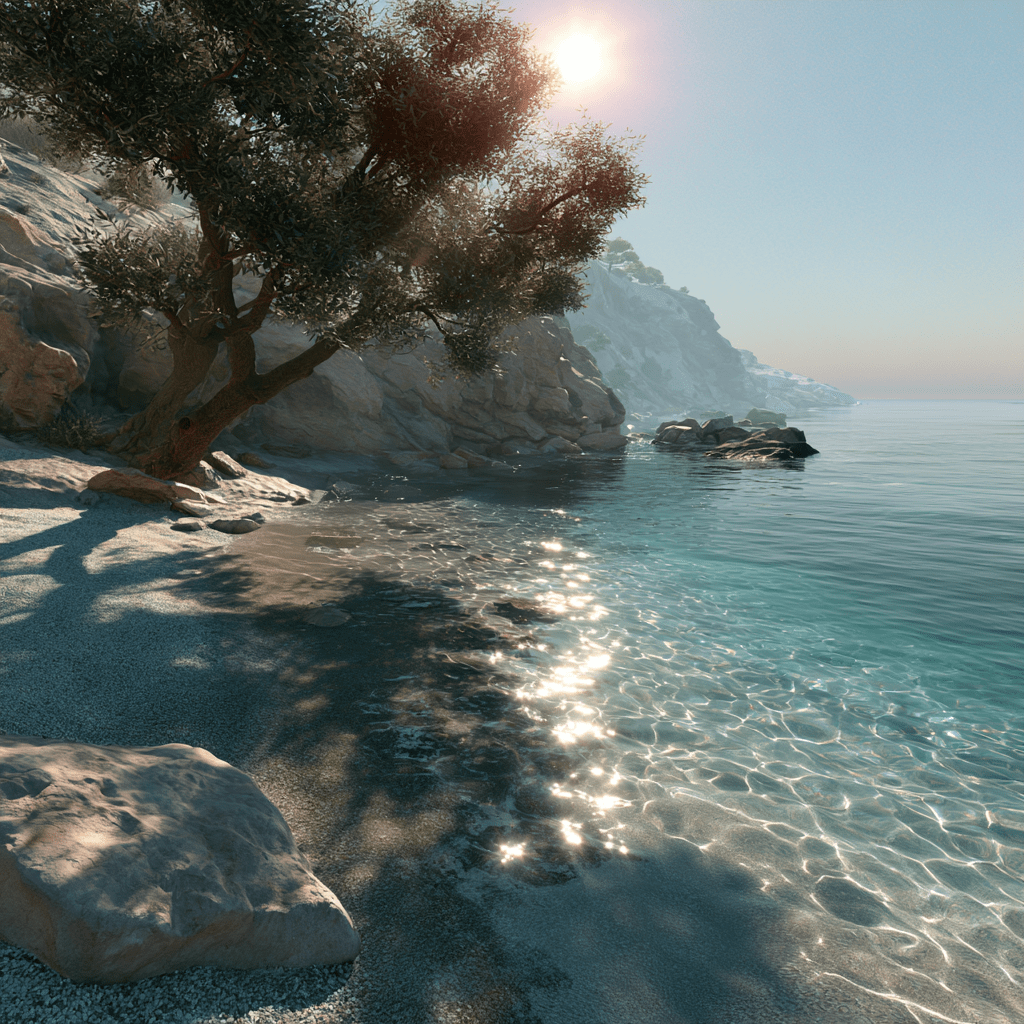
The sim shifts and I’m watching the ocean.
Ruana breaks the surface like a question mark — shoulders first, red hair plastered flat, sea-green tail catching the light below the waterline. She’s been down there long enough that the air hitting her face registers as a small surprise. Her sea green eyes sweep the horizon in both directions, quick and efficient, and then land on something I clock half a second after she does.
Land. A different island — not theirs. Tropical trees visible from the waterline, dark green against the sky, fronds moving in the heat.
New location. Unscheduled. Uncharted.
She doesn’t deliberate. She dives.
Back under, the reef opens up again — corals in orange and violet and deep arterial red, fish parting around her tail in practiced indifference, seaweed hanging in long slow curtains from the mid-water to the floor. Ruana moves through all of it with her eyes down, scanning the pale sand, checking beneath the coral shelves, reading the seafloor the way someone reads a map they memorized before the territory changed. She’s methodical about it. She’s also running out of places to check.
Come on, McKinley. I find myself leaning forward in the simulation chair, which is a reflex I’ve stopped being embarrassed about. Be somewhere findable.
She surfaces again.
And something is different.
I watch her realize it before I fully process it myself — her chin lifts, her brow pulls together, and she turns a slow half-circle in the water with the expression of someone whose internal calibration system has just flagged an error it can’t immediately classify.
The sun is still up. That much is the same.
But the heat is gone. Not reduced — gone, the way heat goes when the season behind it has been swapped out entirely. The air sitting over the water has the temperature of somewhere else, some other month, some other set of rules.
And the island ahead of her is wrong.
The coconut trees that were there — I watched them from the sim, fronds wide and fan-shaped and distinctly tropical — are gone. The treeline is altered. The silhouette of the island against the sky is the same rough shape but emptied of the details that made it specific.
That’s not atmospheric distortion, I note. That’s not heat haze. That’s the scenery changing while nobody was looking.
Ruana stares at it.
Everything is different, runs the thought behind her eyes. The landscape felt out of place, like another season had taken hold in an unfamiliar land.
Then her expression shifts from puzzled to certain in the way that intuition shifts — not gradually, but all at once, a switch thrown. Her gaze fixes on the altered island with the particular focus of someone who has just decided that the thing that doesn’t make sense is exactly where they need to go.
That island. The thought is quiet and absolute. It holds the key to all this.
She moves.
Her tail cuts through the water in long, powerful strokes, the sea-green catching the flat light of the heatless sky. The distance closes fast. The altered shore comes up to meet her — pale sand, the strange empty treeline, the sound of small waves doing their indifferent work.
She reaches the shallows and the transition from swimming to crawling is ungraceful in the specific way that mermaid-to-shore always is — no elegant beach arrival, just the hard physics of a tail on wet sand, arms taking the weight while her lower half catches up. Her right hand closes around a conch shell half-buried at the waterline, gripping it like an anchor, like a tool, like something to hold onto.
Then the transformation begins.
It starts as sound — a melody that comes from somewhere between her and the water, not external exactly, more like something the air remembers. Lights follow: seafoam green and lavender, shimmering in loose spirals above the sand, the colors of her luminary rendered in something halfway between bioluminescence and stage lighting. The magic moves through her in a visible wave from tail to waist, the green scales dissolving into light that resolves into the flowing fabric of her princess gown — seafoam green and lavender, floor-length, the kind of dress that has no business being practical and somehow always is.
Her legs return. She finds her footing on the crumpled sand, one hand still holding the conch, the other steadying herself against the transformation’s last shudder.
She stands.
The altered island spreads out ahead of her — quiet, sun-bright but heatless, wrong in a way she can’t fully articulate and doesn’t need to. Her chin is up. Her jaw is set. She takes her first step across the sand toward whatever the island is hiding.
One mermaid princess, I observe from the sim. One conch shell. Zero backup.
In most genres, this is where things get complicated.
In this one, this is where she finds him.


Leave a Reply