Overview:
| McKinley awakens inside a cave beside a mysterious woman while Ruana discovers a diary aboard a shipwreck split in half on the island. As McKinley explores deeper into the cavern, he uncovers a hidden chamber filled with artifacts from Ancient Greece. Elsewhere, Ruana comes face to face with the skeletal remains of the ship’s crew. The quiet woman soon reveals herself to be a siren, forcing McKinley into a brutal fight for survival. Underwater, Ruana confronts and defeats the two remaining sirens on her own. Badly wounded and unconscious after the battle, McKinley is carried by Ruana back to the surface. |
The_cave_and_the_wreck.sav
The simulation room shifts.
One moment I’m watching Ruana dive into open water, a streak of seafoam green cutting through the blue — and then the walls of my sim room recalibrate and split the feed. Two locations. Same island, different depths. The system’s running parallel tracks now, and I lean forward in my chair because this is the part where things get interesting.
First: the cave.
Captain McKinley is not having a good morning.
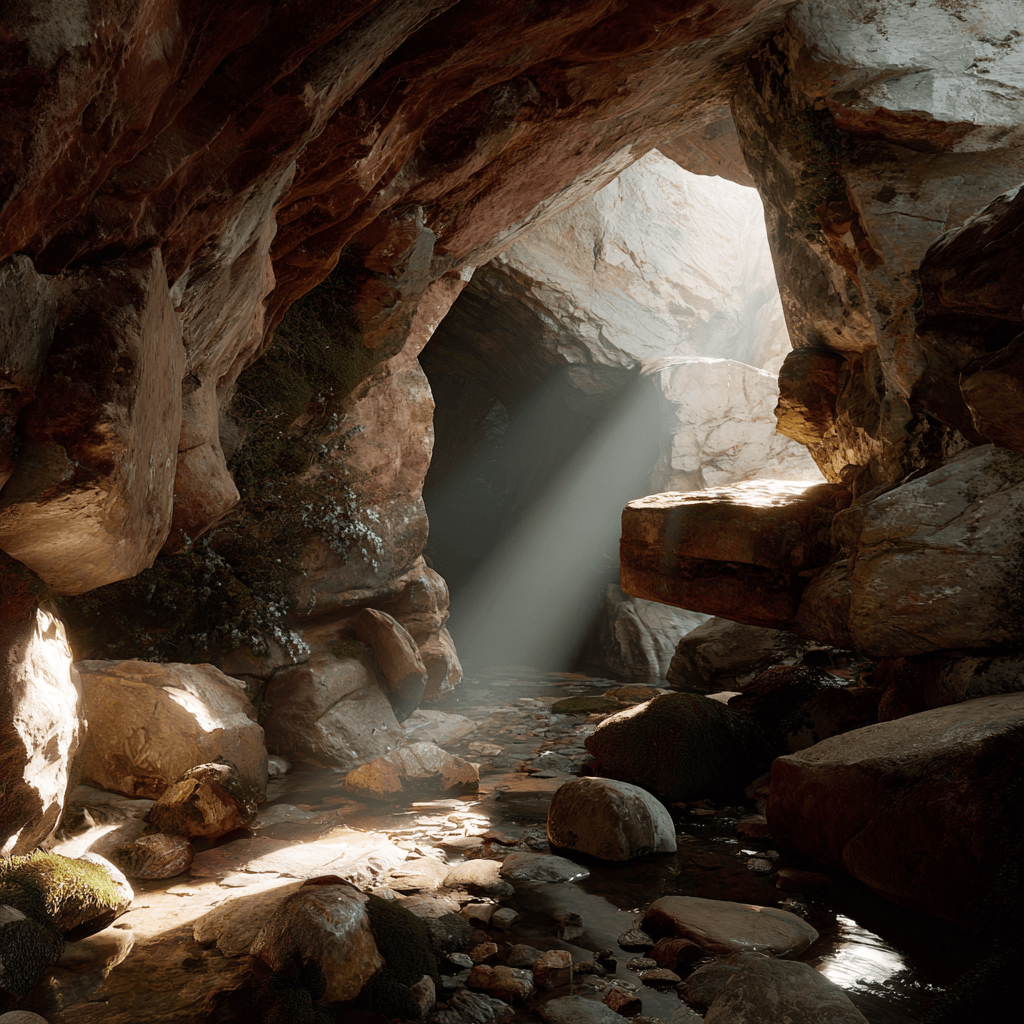
He comes to slowly, the way you do after a boss fight you didn’t survive — blinking through the dark, head heavy, the kind of groggy that tells you something hit you hard and didn’t apologize. The cave is dim and damp, lit by thin cracks of light coming from somewhere above. The walls are rough stone, slick in patches. It smells like salt and old wood and something older than both. His back is against the wall in the most literal sense possible: both wrists are shackled, chains bolted into the rock on either side of him.
He takes stock. Looks down at his gauntlets, still on. Looks at the chains. Looks back at his gauntlets.
Smart.
His right wrist flicks inward — a practiced motion — and a laser blade hisses out from the space gauntlet, clean and cyan-bright, cutting a sharp line through the dark. Two seconds. The left chain goes first, then the right. The links hit the cave floor with a clatter that echoes longer than it should, bouncing off the walls until the sound fades into the drip of water somewhere deeper in.
McKinley straightens up and rolls his shoulders. Doesn’t rush. Scans the cave.
That’s when he sees her.
Across the cave floor, maybe eight feet away, a woman sits with her knees drawn close and her bare feet tucked beneath the hem of a white dress — the kind of dress that belongs to a painting, not a cave. The fabric is clean despite everything. Her hair is tangled and loose, dark strands falling across her face, hiding it entirely. She isn’t moving. She isn’t reacting to the noise he just made, which is either because she’s deeply out of it or because she’s very, very good at pretending.
McKinley crosses the cave in a few quiet steps. He crouches in front of her.
“Are you okay?”
His voice comes out measured. Not soft exactly, but careful.
She doesn’t answer right away. He reaches out and brushes the hair back from her face, and she lets him, which surprises me a little from where I’m watching. Then the hair moves aside and he gets a proper look at her, and his expression does something complicated that I won’t describe in detail because he’s sixteen and I have some decorum.
She is, objectively, striking. High cheekbones. Dark eyes that are somewhere between vacant and just barely present. She looks like she’s been sitting in this cave for a while and has made a kind of uneasy peace with it.
He offers his hand. She takes it, and he pulls her gently to her feet. She steadies herself against the wall, and McKinley keeps one hand near her elbow — not holding, just ready — while he scans the cave again. Tactical. Looking for exits, threats, anything that explains why both of them ended up here.
Good instinct, I think. But the exit problem is going to get complicated.
The sim wall divides again and I shift my attention to the other feed.
Ruana is inside the wreck.
The ship is old in the way that history books are old: the kind of old that stops being a number and becomes a feeling. It has enormous paddle-wheels along both sides, the wood warped and barnacled now, and it’s wedged between two boulders like something threw it there and didn’t care where it landed. The hull is split open across nearly half its length. Ruana swims through the gap without hesitating, her mermaid form moving through the dim, sun-streaked water with the kind of quiet efficiency that comes naturally to her.
Inside, everything is chaos organized by decades of stillness. Crates split at the corners. Clay jars tipped and cracked, some intact, their contents long dissolved into the sea. Fabric, rotted down to threads. And scattered through all of it: artifacts. Urns with painted figures running around the circumference. Bronze fixtures turning green. A sandal. A helmet visor, detached from whatever it once protected. The whole interior looks like a museum exhibit that skipped the museum and went straight to the ocean floor.
Ruana moves carefully through the debris field, her tail making slow, deliberate sweeps to avoid disturbing things. Something catches her eye near a listing crate in the corner.
A book. Weathered, the cover warped and soft with age, the spine barely holding. But it’s there, intact enough to open.
She picks it up. Settles onto the crate with her tail curling beneath her and opens to the first page.
The handwriting is dense and cramped, in characters she doesn’t recognize. Not Filipino. Not anything she’s studied. She turns a page, then another. Same. Some old Mediterranean script, maybe, something she has exactly zero context for.
That should be the end of it, I note.
Then the letters move.
I catch it on my feed — subtle at first, like heat shimmer on pavement, the characters shifting and rearranging themselves without drama or fanfare. Ruana watches it happen with very wide eyes and holds very still. One by one, the words resolve into something she can read.
She reads.
The diary belongs to a sailor. He’s writing to his mother. The tone is warm, chatty in the way that people are when they’re far from home and want to make it sound like an adventure rather than a hardship. He talks about the Mediterranean, the city-states they’ve passed, the islands with people and the islands without. He mentions the ones without people more than he probably means to, the way you circle a thing that unsettles you without quite naming it.
Then he gets to the sirens.
According to what he’s heard, the drill is this: crew covers ears with beeswax, captain gets tied to the mast. Beeswax for the crew because the song will pull you off the deck and into the sea before your brain even finishes processing that you’re moving. Ropes for the captain because the captain has to be able to give orders afterward, which means he needs to hear the song, which means he absolutely cannot be trusted to stay on the ship under his own power.
A drunk man at one of the ports told them this. Insisted. The sailor found it funny. His crewmates found it funny. They were rational people and this was a superstition from people who’d never been anywhere. They knew better. They’d seen real things. They weren’t going to plug their ears with wax and tie their captain to a wooden post because some local drunkard with a dramatic flair for the ominous told them to.
“I promise, Mother, I’ll tell you what truly lies there when I return home.”
The handwriting ends there.
The diary ends there.
Ruana closes it slowly. Holds it in both hands and looks at the split hull around her, the split crates, the artifacts scattered by impact rather than by time. The ship that hit the boulders so hard it cracked sideways and never left.
Sirens’ island, she thinks. The words sit in her head the way heavy things sit: settled, not going anywhere.
From my sim room, I watch her face shift from discovery into something quieter. The diary didn’t say anything she didn’t already half-know from the moment she saw the ship’s design and the bones of its shape. But reading it is different from knowing it. Reading the last words of someone who got it wrong makes the thing real in a way that theory doesn’t.
She sets the diary back on the crate with something close to care.
I split the feed again. McKinley in the cave, still watching the mysterious woman, still calculating exits. Ruana in the wreck, still holding the weight of what she just read. Both of them moving toward the same problem from different directions, which is either a great sign or a terrible one.
I genuinely cannot tell which.
The_artifacts_and_the_crew.sav
McKinley doesn’t stop moving.
He’s got the mysterious woman close at his left side and his right gauntlet primed, and he walks deeper into the cave with the careful, deliberate pace of someone who knows that standing still in an unknown location is how you end up in the next problem before you’ve solved the current one. The cave narrows briefly, then opens up without warning into a chamber so large the ceiling disappears into shadow.
He stops. She stops.
The room is full.
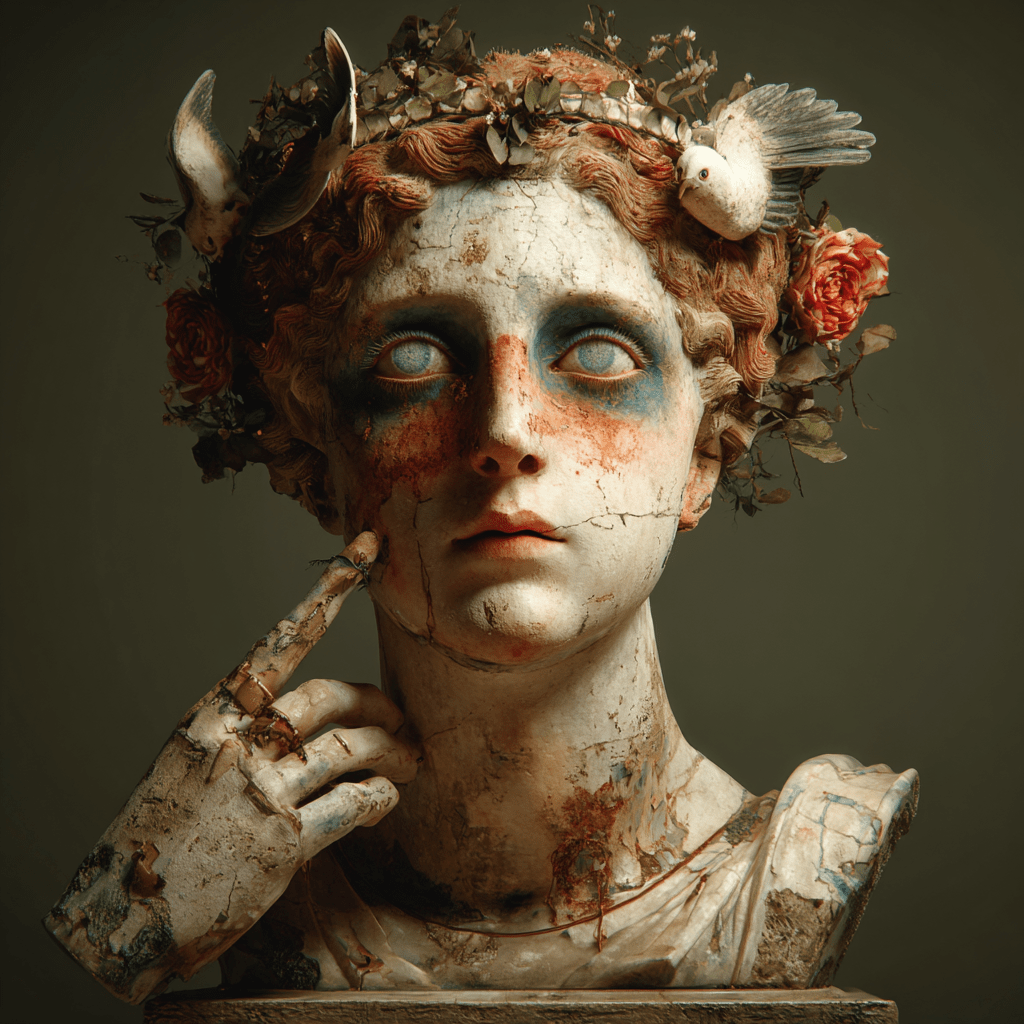
Not of monsters, not of Sirens, not of anything threatening — just objects. Arranged with intention, set on flat stones and low wooden platforms that have somehow survived the damp. Urns with painted figures. Marble busts, most of them intact. A bronze tripod. Clay tablets stacked in careful rows. The whole chamber has the quiet, organized feel of a collection, not a raid. Someone put these here on purpose. Someone cared.
McKinley sweeps the room once with his eyes before he speaks.
“These are ancient Greco-Roman artifacts.” He’s not talking to the woman exactly — she’s still quiet beside him, still carrying that hollow, slightly-elsewhere quality she had in the cave. He’s talking the way you talk when something genuinely surprises you and you need to say it out loud to confirm it’s real. “Who gathered all this? And why here, of all places?”
The woman offers nothing. McKinley doesn’t push.
He moves further into the chamber.
The first thing that stops him is a statue near the back wall, standing taller than he is. Female figure. White marble, cool and smooth and precise. She holds a sheaf of grain in the crook of one arm, and her expression is the kind that artists spend careers trying to get right — not sad, not serene, somewhere between the two.
“Persephone,” McKinley says quietly.
He knows his mythology. I’ve watched him enough to know that this isn’t performance — he’s actually interested, has been since Topher started having his prophetic dreams and the whole Greek monster situation turned from abstract to very, very real.
“Daughter of Zeus and Demeter,” he continues, more to himself than anyone. “Hades took her. No negotiation, no warning — just gone, down to the Underworld. Demeter refused to let anything grow until she got her daughter back. So a deal was made. Six months below, six months above. That’s winter and summer, according to the myth.”
He stands in front of the statue for a beat. Then he moves on.
The next platform holds a stone bust with a jagged neck, the head separated cleanly from the shoulders. McKinley crouches down and picks up the severed head from where it rests on the platform beside the body — it’s heavy, both hands required, the marble cold and slightly rough at the break.
“Demeter.” He glances across the room at the headless bust on its low pillar, the torso still standing there like it’s waiting. “Someone took her apart.”
He sets the head back down with both hands, careful about it. Straightens up.
From my sim room, I watch him move through the chamber with steady focus. There’s something in his posture that I notice and don’t comment on — the way he keeps cataloguing the room even as he talks, the way his eyes are never entirely where his words are. McKinley is always running two things at once.
The feed divides.
Back at the shipwreck, Ruana has gone deeper.
The main hold of the ship is a dead end — she’s exhausted it, taken in the diary, taken in the scattered artifacts and the stillness. Now she’s working through the peripheral spaces, the smaller compartments that open off the sides. Her tail moves in slow, quiet sweeps. The light in here is filtered and low, blue-green, coming from the gaps in the hull.
She finds the chest wedged between two collapsed crates. Black wood, banded in corroded bronze. Small, the size of a footlocker. It’s locked, but the mechanism is so old that when she bends down and applies pressure, it gives without much argument.
What could be inside?
The lid falls away and the rest of the chest collapses with it, the wood finally giving up after however many centuries it’s been holding on. What’s left, settled in the debris, is a skeleton. Compact. Still wearing the remains of a belt. The bones have that particular yellow-grey color that means old, and they are absolutely, completely, unmistakably human.
Ruana steps back. Her hand comes up to her mouth.
“Oh my!”
She stands very still for a moment. Then she looks around.
To her left, barely visible in the low light, is a narrow gap between two sections of collapsed wall — not quite an alley, just enough space for one person to move through sideways. At the far end of it sits a small door. Closed. The light around it behaves strangely, partly dark, partly lit, like it can’t decide which one it wants to be.
Ruana looks at the skeleton on the floor. Looks at the door. Looks at the skeleton again.
She goes to the door.
She stops in front of it for a moment with her hand not quite touching the handle. Gathers herself. Opens it.
The room beyond is small — barely a den, really. And it is full. Every corner, every wall, every flat surface occupied by the same pale, still shapes. An entire crew. Sitting, slumped, propped. All of them long past anything that could be helped.
Ruana’s eyes go wide and stay that way.
I watch her face from the sim room, and I don’t add anything.
Some things don’t need commentary.
The_fight_on_land.sav

The cave is quieter on the way out.
McKinley walks a half-step behind the woman, which I initially read as courtesy and then immediately reconsider as I watch his eyes. They’re not on the cave walls. They’re on her. Specifically, on the space between her shoulder blades, which he keeps tracking with the particular quality of attention that doesn’t look like attention from the front.
Something’s bothering him. I can tell because his jaw is doing a thing.
This woman constantly smells like iron, he thinks. He doesn’t say it. He just keeps walking, and thinking, and tracking. And there are no mineral deposits here. I need to be sure.
The woman moves ahead by a step, and McKinley’s left hand drops to his side, fingers moving. The space gauntlet projects a small keyboard in pale blue light, hovering just above his palm, barely visible in the cave’s low light. He types without looking down. One-handed, fast, silent.
The message goes to MAurI.&SE jr. — the AI embedded in his armor, named in the specific way that only geniuses and people who’ve given up on conventional naming conventions ever name things. He types: “analyze the woman in front of me discreetly and send the findings to me quietly.”
Four seconds pass.
The result surfaces on his gauntlet’s holographic display in small, clean text, angled so only he can read it.
“Positive. Stains of blood detected on the woman.”
McKinley reads it once. Reads it again.
Blood, he thinks. She reeks of it. But there’s nothing visible. Just dust and dirt.
He looks at the back of her white dress. Clean, as far as he can tell. He looks at her hands, swinging loosely at her sides as she walks. Clean. He looks at her hair, still tangled, still falling across her shoulders in dark ropes. He doesn’t find anything. The dress is white. There’s no red anywhere.
And yet.
He keeps walking. He doesn’t change his pace. He doesn’t signal anything with his face. McKinley is sixteen and he’s been running covert missions for two months, and whatever else is complicated about his situation, he knows how to not give himself away.
The cave opens up ahead. Natural light spills in, warm and afternoon-gold, and the sound of the sea comes through with it, distant and rhythmic. They step out onto the rocky shore together, and the full scope of the island hits after the cave’s enclosed dark — wide sky, shimmering water, the sun high and indifferent.
The woman stops.
Not gradually. She just stops, like a machine reaching the end of its program, and stands very still on the rocks with the sea wind moving her hair. Then she turns to face McKinley, and for the first time since the cave, she speaks.
“We were once handmaidens of Persephone.” Her voice is low and even, stripped of any particular emotion. She’s looking directly at him. “We were beautiful, even if we were less than our muse.”
McKinley doesn’t respond. He’s listening.
Her expression shifts. Something comes into it — tight and bitter, pressed up against her features from the inside.
“But that wretched Demeter.” The words come out quiet, which is almost worse than if she’d shouted them. “Persephone’s mother blamed us when Hades took her daughter. She accused us of negligence.” A pause. “And she cursed us.”
The shadow at her feet moves.
That’s the first sign — the shadow, behaving wrong, stretching in directions the light isn’t coming from. Then her arms begin to change. The skin along her forearms ripples, the shape of the bone underneath shifting, lengthening, the whole structure of her arms reorganizing into something with a different purpose. Dark feathers push through the skin in rows. Her fingers extend and merge, the architecture of hands becoming the architecture of wings.
Her legs follow. The white dress tears at the hem as the proportions below her waist change dramatically — thick, feathered, powerful. Her feet hit the rock with a sound that is not the sound of bare feet, because her feet are no longer that.
The talons are long. Curved. Very obviously not decorative.
McKinley’s gauntlets are already up.
The Siren — because that’s what she is now, fully, the transformation complete in the span of four seconds — spreads her wings to their full width and lunges. She covers the distance between them in less time than it takes to register that she’s moving. The talons come in fast and low, aimed at his torso, and McKinley sidesteps and brings both gauntlets up in the same motion. The laser blades extend with a sharp hiss, one from each wrist, glowing cyan in the daylight, and the first clash of talon against blade throws sparks across the rocks.
She’s strong. The impact travels up both his arms and he absorbs it, feet planted, and pushes back. She presses. He holds. They’re locked for a beat, close enough that he can see the color of her eyes — which have changed, golden now, with vertical pupils — and then she shrieks, a sound that is nothing like her speaking voice, and breaks away.
Her wings carry her skyward in three hard beats.
McKinley tracks her. He’s already reconfiguring — the laser blades retract and he brings his palms together, gauntlets touching at the wrist, and nano-molecules stream out from both, assembling into a laser gun in his grip, the whole process taking under two seconds. Cyan energy builds in the barrel.
“MAurI.&SE.”
The AI responds immediately. The AR interface activates across his helmet’s face shield — a targeting overlay, tracking the Siren’s flight path in real time, annotating her trajectory with projected lines and probability arcs as she wheels and dives and pulls back up. She’s fast. She’s erratic on purpose, cutting unpredictable angles, and the overlay keeps recalculating.
McKinley fires. Twice. She rolls away from both, the beams passing close enough that the air around her shimmers.
She circles. He keeps the gun up and keeps tracking. The overlay is collecting data on every move she makes, building a pattern from the chaos, looking for the thing she’ll do twice.
She dives again. He fires once, leading her, and she breaks the dive early — but the break puts her into a banking turn he’s seen before, arcing back over the rocks, and MAurI.&SE flags it. The probability arc on the overlay narrows to a single projected point, highlighted in bright white.
McKinley waits.
The Siren sweeps back in, wings folded for speed, talons forward. Her guard is down because she’s committed to the approach.
He fires.
The beam catches her square in the back. She doesn’t cry out — she just seizes, the wings locking, and then her whole form begins to pale. The color drains out from the wound and spreads, the feathers going from dark to grey to white to nothing, her shape losing coherence at the edges. She comes apart without drama — no explosion, no collapse — just unraveling, the pieces dissipating into the air like smoke in a breeze until there’s nothing left above the rocks but empty sky.
McKinley lowers the gun. Lets out a slow breath.
I watch him from the sim room, and I’m already scanning the feed because I know this genre, and I know that when the music stops too early something is usually about to go very wrong.
The second Siren doesn’t announce herself.
She comes from directly behind him, high and fast, and the first he knows of her is the impact — two sets of talons driving into his shoulders, finding the gaps where the space gauntlet’s armor doesn’t extend, and the pain is immediate and total. McKinley’s knees buckle. His hands go slack. The laser gun hits the rocks and breaks back down to molecules before it finishes clattering.
His eyes are open for another half-second, then they’re not.
The Siren’s wings beat hard, and she lifts him. He hangs from her grip, limp, head dropping forward, the cyan trim of his gauntlets catching the sun as his arms dangle. She’s airborne in seconds, clearing the rocks, angling out over the shoreline where the rocks give way to open water.
She folds her wings and they drop.
The sea takes both of them without ceremony, the surface closing over the point of entry and going smooth again, like nothing happened, like the afternoon is perfectly ordinary, like a sixteen-year-old space captain isn’t currently unconscious and sinking.
From somewhere along the rocks — I catch it at the edge of my feed before the sim room reorients to follow — Princess Ruana surfaces.
She’s been out of the water long enough to see all of it. I can tell from the way she’s moving: she’s already running before the splash finishes, her mermaid form breaking through the seafoam at the waterline, hands driving her forward against the surf. Her red hair is plastered flat and her expression is doing something I don’t have a word for — not panic exactly, too focused for that, but not calm either.
She hits the water at full speed, and the seafoam rises around her and the transformation takes hold, and she’s gone under the surface before the wave from her entry has time to reach the shore.
I lean back in my simulation chair and stare at the last frame before my feed recalibrates.
Empty sea. Smooth water. The rocks where McKinley was standing, a moment ago, now just rocks.
So close, I think. Yet so far.
Ruana_versus_the_deep.sav

The seafoam closes over Ruana’s head and the transformation is already complete by the time she’s fully under.
The mermaid form takes hold the way it always does — fast, clean, no wasted motion. Her legs are gone, replaced by the tail, sea green and powerful, and she’s moving before the surface water has stopped rippling from her entry. No hesitation. No adjustment period. She just goes.
The second Siren is below her and ahead, hauling McKinley deeper with both talons still locked into his shoulders, her wings working differently underwater than in air — shorter strokes, more controlled, genuinely fast. I didn’t expect that. Sirens are aerial hunters in the mythology, bird-women, sky predators. The water efficiency is a detail the old texts don’t really dwell on.
It’s a detail that matters right now.
Ruana is closing the gap, but not fast enough, and I’m watching the oxygen indicator on McKinley’s gauntlet display tick down from yellow into red, the warning beeps registering as faint pulses on my sim feed. He’s unconscious. He doesn’t know any of this is happening. The number keeps dropping.
Then something moves at Ruana’s left side.
She feels it before she sees it — I can tell from the way her head turns a half-second before the third Siren fully commits to the lunge. Telepathy working exactly as advertised, picking up intent through the water like a signal through a wire. The Siren is coming in fast, talons first, banking from behind a shelf of coral.
Ruana’s hand comes up and the glow starts at her palm, spreading outward in slow, rippling rings of seafoam green and lavender, and she reaches down.
The ocean floor responds.
Seaweed shoots upward in thick, dark ropes, moving with purpose rather than current, and the third Siren runs directly into them. The first tendril catches a wing. Two more wrap the torso. The Siren thrashes, hard and immediate, which is exactly the wrong response — the more she pulls, the tighter the weeds draw in, and within seconds she’s locked, suspended in the water column, wings pinned, talons scrabbling at nothing.
She goes pale. The color leaves her the same way it left the first one — draining outward from the center, wings going grey, then white, then shredding apart at the edges until the pieces drift and dissolve into the blue. The seaweeds go slack and sink, settling back to the seafloor in a loose, dark tangle.
Ruana is already moving again before they land.
Ahead, the second Siren has dropped McKinley. He’s resting on a coral shelf maybe thirty feet down, facedown, arms loose at his sides, the cyan lights on his gauntlets still running. The oxygen indicator is solidly red. The beeping is faster.
Ruana pushes harder. She’s twenty feet out, then fifteen, then the Siren cuts across her path.
She pulls up short.
The Siren hangs in the water between her and McKinley, wings fanned wide, and her face underwater is different from the cave — less human now, more committed to what she is. Her mouth opens and the teeth are wrong, too many and too sharp, and she surges forward and Ruana breaks left and the chase begins in earnest.
They move through the water at speed, weaving around coral formations and through open channels between rock shelves. The Siren is not slow. This is the part nobody tells you — that things built for the sky can adapt, that speed transfers. Ruana is fast. The Siren is nearly matching her.
This is a problem, I think, with some feeling.
Ruana glances back once. The Siren is close, talons reaching, teeth visible. Ruana faces forward and sees, off to her right, the dark shape of a shipwreck hull — the shattered ribs of it rising from the seafloor, broken timber and protruding iron in every direction.
She angles toward it.
The Siren reads it as flight and accelerates. I see the plan forming in the shift of Ruana’s trajectory — she’s not heading for cover, she’s heading for a specific point, a rusted iron pole jutting horizontally from the wreck’s broken midsection, angled toward open water. She lines herself up and then, at the last possible second, dives sharply downward.
The Siren can’t redirect in time.
The impact is immediate and total. The pole catches the Siren mid-chest at full speed, and the water around her goes dark for a moment before the dissolution begins — the same pale unraveling, faster this time, more violent, the pieces scattering outward and fading before they drift far.
Then it’s quiet.
Ruana turns and swims back, fast, straight to the coral shelf where McKinley is lying still. She gets her hands under his arms and pulls him up off the shelf, and his head lolls back, face finally visible, eyes closed. The oxygen indicator has stopped beeping.
She moves. Both of them, upward, toward the light.
 B. K. P. Carreon
Leave a comment