Overview:
| Princess Ruana protects Captain McKinley from the storm beneath the sea and carries him safely back to shore. As the local villagers rush to McKinley’s aid, Ruana remains alone upon a rocky outcrop, singing of her love for him across the waters. The sirens are revealed to have once been handmaidens of Persephone, cursed by Demeter to wait eternally for unfortunate sailors. Meanwhile, McKinley uncovers the team’s secret heroic activities. Tensions soon erupt into a fight between McKinley and Spartan, culminating in the sudden revelation that the grandparents have been taken hostage. |
Seafoam_sphere.sav
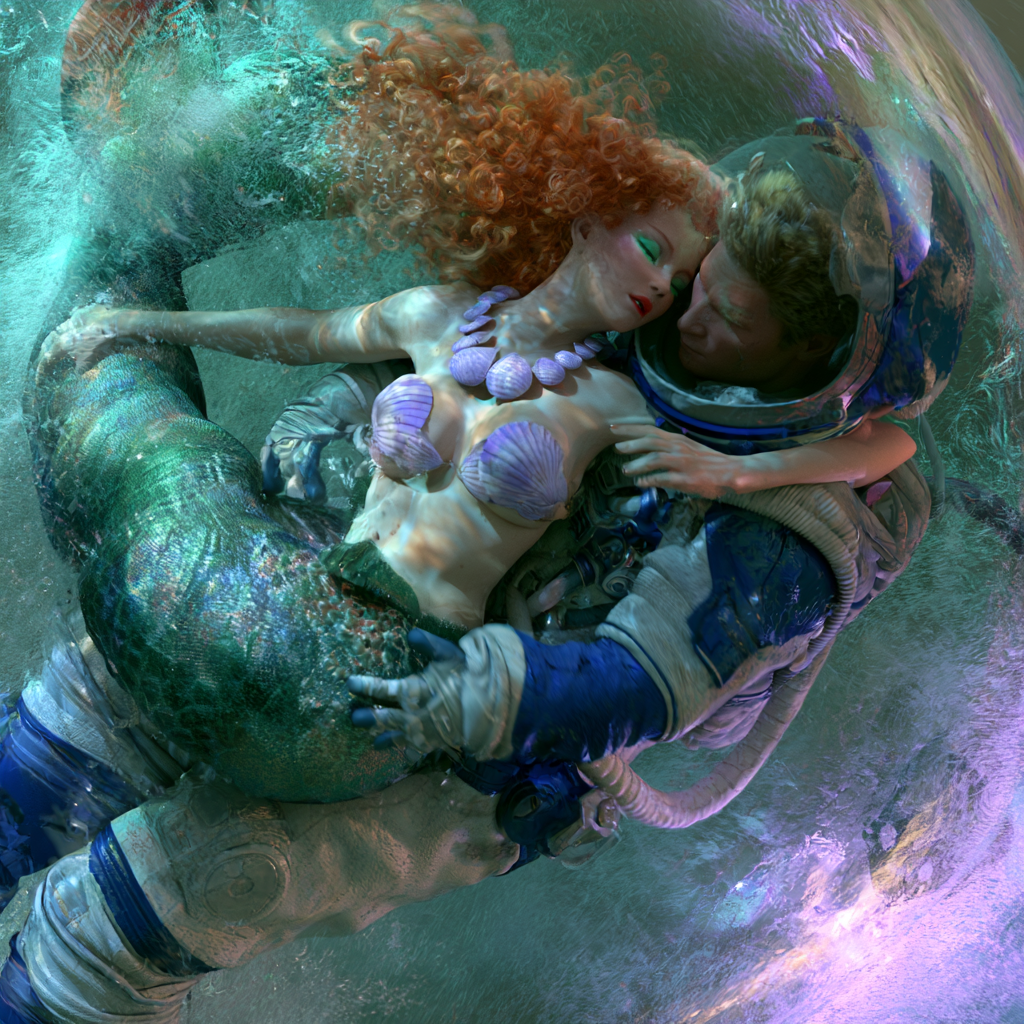
The corals look like a garden that forgot it was beautiful.
McKinley lies among them, still. Face-down in the current, the amber glow of his oxygen bar cycling between red and nothing. Princess Ruana reaches him first. Her hands hook under his arms and she pulls, strong and deliberate, her red hair spreading wide in the water like a flag.
She brings him up.
The surface breaks around them both, and the world above is not better than the world below. The sky has gone the color of old bruises. Rain hammers the water so hard it looks like static. Lightning comes. Thunder answers. The wind presses the waves forward in a way that feels personal.
Ruana treads water. McKinley’s visor is up, his face slack and pale. She checks his oxygen readout on the suit’s display. Whatever number she sees, she doesn’t like it.
A wave builds on the horizon. The kind that doesn’t ask permission.
It takes them both back under.
I watch through the sim wall as the ocean swallows them and the surface closes. My hand finds the edge of the console without me telling it to. I don’t do anything with it. There’s nothing to do.
Down in the dark, Ruana moves fast. Her palm opens and the light comes from somewhere inside her — seafoam green bleeding into periwinkle, colors that don’t quite exist in normal water. It spreads outward into a sphere, soft and luminous, its surface shimmering against the surrounding current. The turbulence presses in from every side and the sphere holds anyway. Inside it, the storm is just noise.
She pulls McKinley against her and holds.
I’ve seen survival scenes. Plenty. The ones where someone does the thing because they have to and the audience gets it without anyone explaining. This is one of those. Ruana’s grip is the kind that doesn’t calculate distance or pause to consider awkwardness. It just holds.
The wave hits the sphere and everything outside it goes white.
Then the force passes. The water stills, degree by degree. A crack of light splits the surface above them, actual sunlight, thin and provisional, but there. Ruana looks up at it.
McKinley still hasn’t moved.
In my cube, I watch the light reach through the water and touch them both. The sim picked a good frame for this one. Peaceful, almost. Like the ocean decided it was done.
I don’t say anything.
Some moments don’t need a caption.
Song_for_no_one.sav
The storm is gone. No fade, no slow dissolve. Just: gone.
The tide comes in quiet now, the kind of quiet that feels like an apology. Palm trees stop straining against the wind and go back to regular swaying. The shore looks like it doesn’t remember what happened an hour ago. Convenient amnesia. I know the feeling.
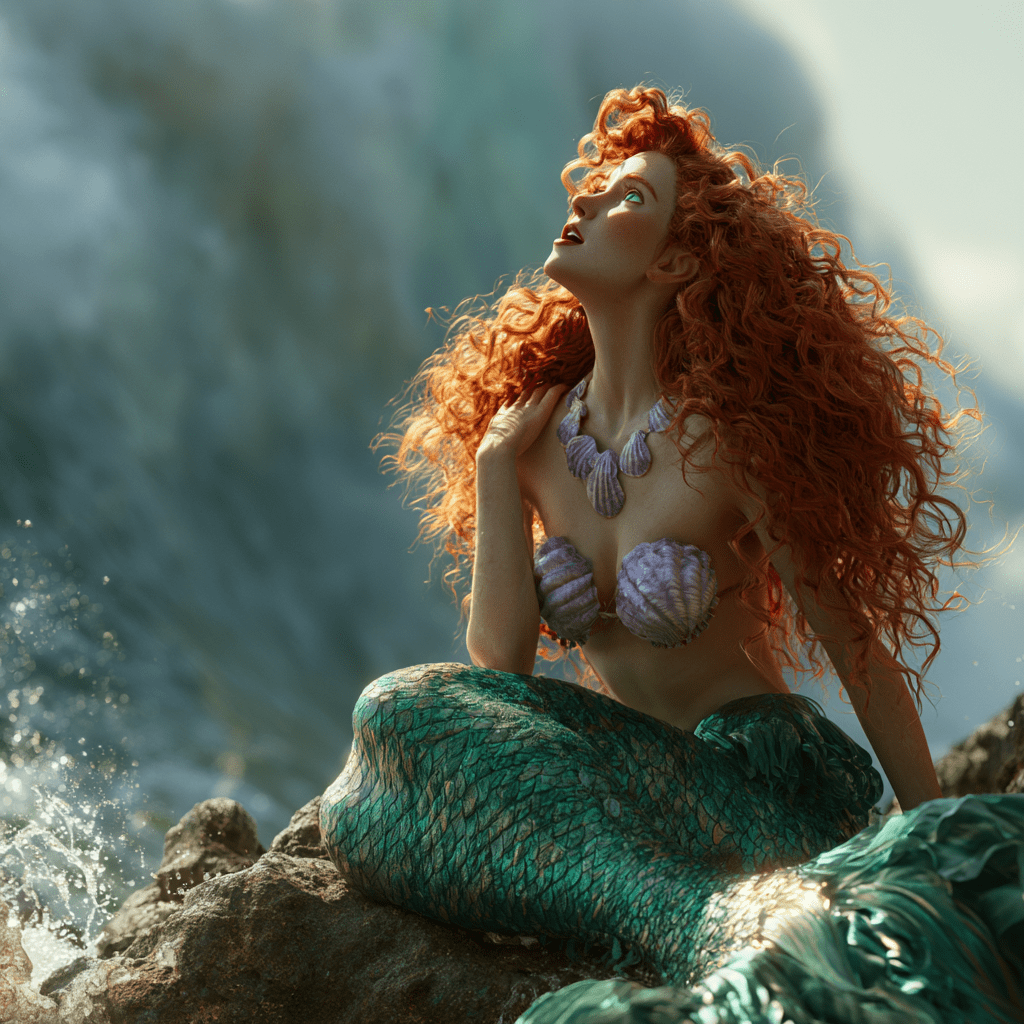
Ruana is already on the sand. I don’t know exactly when she made it out of the water, but she’s beside McKinley now, kneeling, her sea green tail catching the afternoon light in shifting scales.
McKinley is on his back. Unmoving. The cobalt-blue of his space armor is salt-streaked and scuffed at the shoulder plates where the siren’s talons went in. His visor is down.
Ruana reaches for it. Her fingers find the retraction point at the hinge and the faceplate slides up with a soft click, folding back. McKinley’s face comes into view. Pale. Still.
She doesn’t hesitate. Both hands go to his chest, interlaced, and she starts compressions, steady and measured. She knows what she’s doing. I file this away. Eighteen, graduated, already acts like someone who’s read the manual for every emergency ahead of time.
On the fourth cycle he coughs. Water. Then air. His eyes open partway, glazed and blinking, not tracking anything yet.
Ruana sits back. The tension goes out of her shoulders all at once.
She looks at him for a long moment. His face, unguarded. The version of him that exists when he’s not running a command center or making the hard call in four seconds flat.
Her hand moves to his cheek. Just briefly. A touch she doesn’t announce, doesn’t explain.
Then she starts to sing.
I can’t describe her voice except to say it doesn’t belong on an island shore. It belongs in a concert hall, in an acoustic space designed to hold it. The melody she chooses is one I recognize. Something old. Something written for exactly this situation by people who understood that certain feelings outrun the vocabulary available to them.
She sings about wanting. She sings about distance. About the particular longing of someone who is close to something and still can’t reach it.
I sit very still in my cube.
The villagers appear before I clock them coming. A small group, following the treeline, carrying tools. They stop when they see McKinley. The space armor reads wrong in every context and their faces confirm it: confusion, then concern, then the decision to help anyway.
Ruana clocks them first.
She’s behind the nearest rock before any of them look in her direction. The locals lift McKinley carefully and start carrying him inland. He’s stirring now, trying to say something that doesn’t form into words yet.
From the rock: her voice continues.
I can see the top of her head. Then one eye, peering around the edge. Then nothing as she shifts sideways. The song moves through its verse, its bridge, building toward something. She climbs to the top of the rock without seeming to think about it. Red hair. Green tail. The sea rolling wide and open behind her.
She holds the final note.
It rings out over the water.
The locals are too far inland to hear it. McKinley can’t see her. The moment belongs entirely to no one.
I watch from my cube, two hundred kilometers of vacuum and simulation between me and that shore, and I think: some people aren’t built for standing on rocks and singing their feelings at the horizon.
Ruana clearly is.
Three_on_the_rock.sav
The sim pulls back wide before I can ask it to.
Good instinct. Whatever this is, it deserves a full frame.
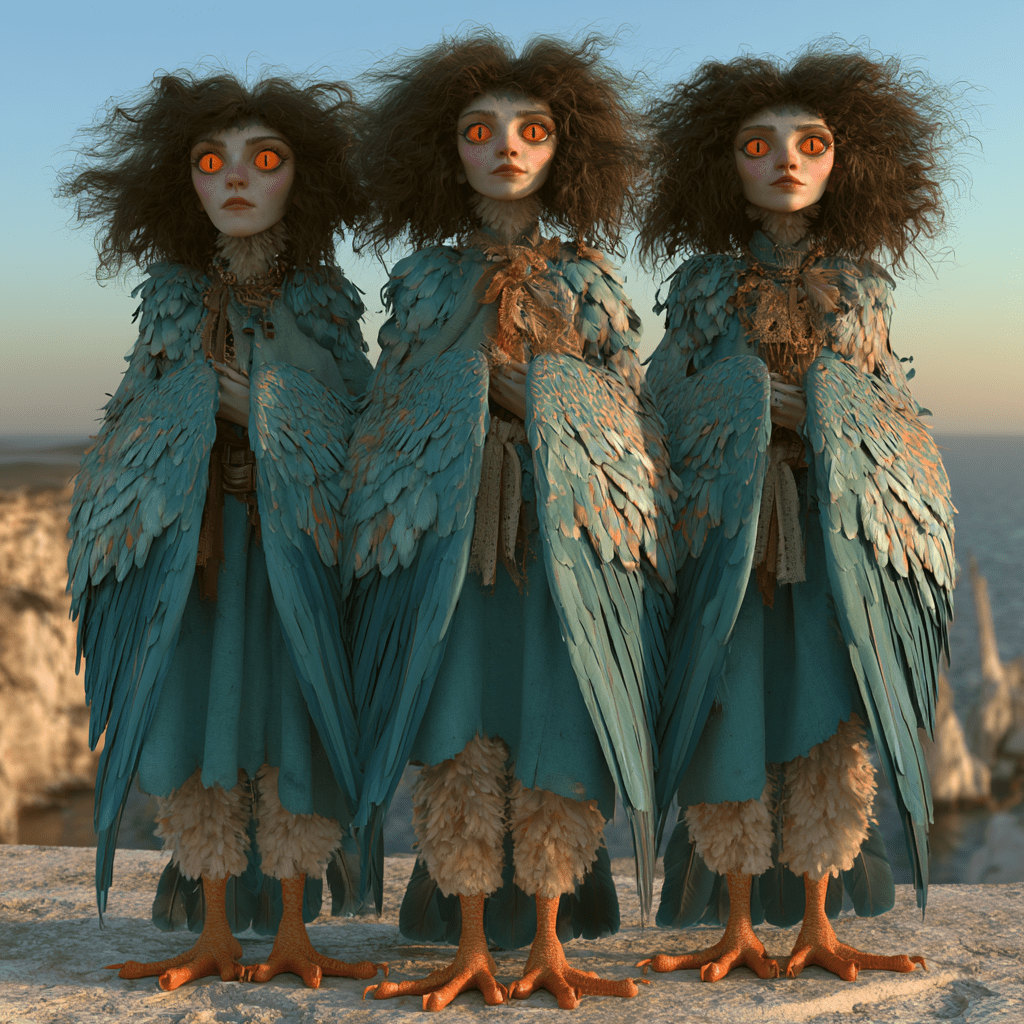
Three figures stand at the top of the island’s highest rock, the peak jagged and salt-white, carved by centuries of wind and water into something that looks deliberately dramatic. The sky behind them is clear and bright in broad daylight. Below: the sea. Going on forever.
The Sirens.
Up close — or as close as a simulation gets — they look nothing like how old paintings render them. Those usually go one of two ways: tragic beautiful women, or full monster. The reality, if this counts as reality, is somewhere in between and worse for it.
Their hair is long, thick, some braided through with feathers — teal and blue-green, the same colors as their plumage, so it’s hard to tell where the feathers end and the hair begins. Three of them, three different heights, but the same basic structure. Human from the neck down to the hip. After that: feathered legs, stout and powerful, built for gripping. The feet end in talons, three-pronged, the kind of grip that could close around a ship’s railing and hold. Where arms should be, wings fold against their sides, enormous and layered, teal shading into deep blue at the tips. At rest, the wings look almost decorative. Almost.
Their faces are the disorienting part. High cheekbones. Eyes that catch light the wrong way, too bright, too still. Lips closed softly over whatever’s underneath. They look patient. Serene, even.
I’ve seen this design pattern before in a few games — the kind of enemy that’s beautiful until the hitbox triggers. I understand it better now.
I pull up what I know about them while the sim holds the frame.
They were Persephone’s handmaidens. That’s where this started. Persephone: daughter of Demeter and Zeus, which already makes her life complicated in ways most mythology students gloss over. Hades wanted her. He took her. One day Persephone was picking flowers in a field and the ground opened up and that was that. Gone. Queen of the Underworld before she had any say in it.
Demeter, her mother, did not take this well.
Demeter is the goddess of seasons and harvest. All of it. Every crop, every growing thing, every piece of bread that has ever fed anyone. When she stopped functioning, the world stopped eating. She went looking for her daughter and the whole earth went fallow while she searched.
The handmaidens had been there. They saw it happen and did nothing. Whether that’s fair is a separate argument — three young women against the Lord of the Dead is not a fight anyone was winning — but fairness was never the point. Demeter needed someone to blame within reach. The handmaidens were within reach.
The curse she gave them was precise in the way only divine punishments are. Beautiful voices, kept. Everything else, changed. The soft-armed women who had served the goddess’s daughter now stood on legs built for perching, with wings that would never carry them home because there was no home to return to.
I try to work out what year this island is operating in. The diary Ruana found on the shipwreck was ancient Greek, something out of a long sea voyage, a crew ignoring warnings about exactly this island. The language of classical antiquity, before even Rome hit its stride. This pocket of the world has been running on its own timeline. The Sirens have been here since before most of the countries currently on a map existed.
That’s a long time to be standing on a rock.
The mythology record on what happened to sailors who came too close is not ambiguous. The singing started as ships entered the surrounding waters. Specific accounts vary — ancient sources rarely agree on details, they prefer the atmosphere — but the outcome is consistent. Ships went off course. Crews stopped making rational decisions. By the time the vessel hit the rocks, whoever was left was already too far gone to save themselves. The bodies were picked apart. Bones scattered on the shoreline. A few particularly grim accounts include the smell.
What I find interesting, if I’m being honest with myself while sitting alone in a simulation room, is what the Sirens never did.
They destroyed ships. They killed sailors, generation after generation, for longer than most civilizations lasted. They never once turned their attention upward. Not at Demeter, who made them. Not at Hades, who triggered all of it. Not at Zeus, who let his daughter get taken in the first place. The fury went sideways and downward, toward whoever happened to be passing through. The people who actually wronged them were apparently not on the target list.
I don’t say this out loud because there’s no one here to say it to.
From the rocky peak, the tallest of the three shifts her weight. The motion is subtle — a small redistribution, talons adjusting grip on the rock face. Her wings open slightly at the shoulders, not a threat display, just the ordinary adjustment of something that maintains balance differently than a person does. Her eyes move across the water below in a slow, practiced sweep.
Still watching. Still waiting.
The other two are motionless. One has her head angled slightly toward the horizon, tracking something I can’t see from this angle. The third stares straight ahead into the sky blue distance, expression the same closed, patient nothing as when I first pulled the wide frame.
Centuries of this. The same rock. The same sea. The same song, eventually, for whoever gets close enough.
I don’t know if they talk to each other when no ships are coming. I don’t know if they remember what it was like before. The sim doesn’t offer me that information and I don’t have a way to ask.
The wind picks up and their feathers shift.
They’re still there when the sim settles back into real time. Watching the water. Waiting for the next thing that strays too close.
Whatever it is, I hope it’s carrying beeswax.
Whos_calling_the_shots.sav
They make it back to the Peregrine Lightyear looking like they’ve been through something. Which they have.
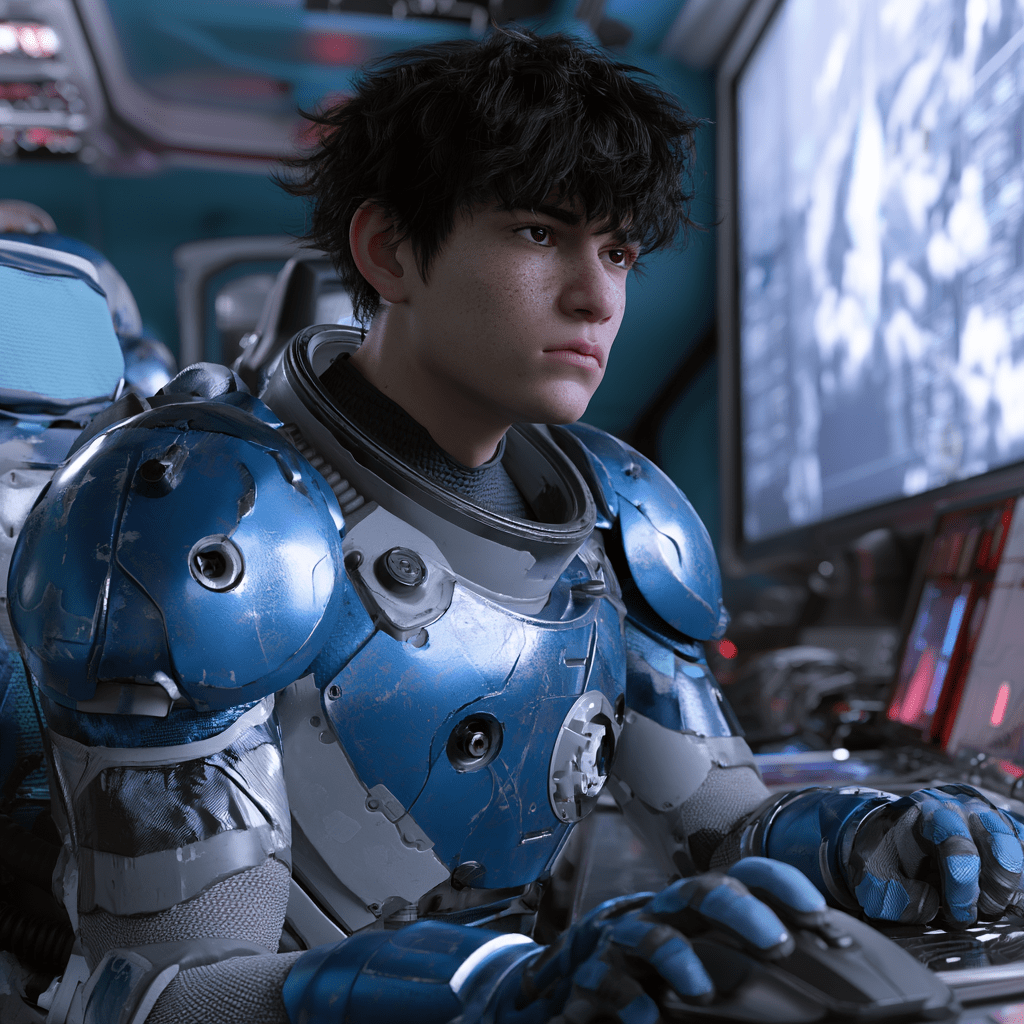
The ship’s docking bay opens as they approach, the ramp extending with a hydraulic hiss, and Captain McKinley walks up it with the kind of stride that belongs to someone who is extremely tired and extremely unwilling to show it. Salt crust on the shoulder plates of his cobalt-blue armor. A new set of scuff marks across the left gauntlet where the siren’s talon caught it. His visor is up, which means anyone paying attention gets the full picture of his face: jaw set, eyes forward, processing something he hasn’t said out loud yet.
Princess Ruana follows half a step behind. Her mermaid gown has dried stiff at the hem, the seafoam-green fabric carrying a faint waterline. She walks with her spine straight and her expression neutral, which I’ve noticed is what she defaults to when she has feelings she’s not ready to file.
I follow them through the sim. My cube adjusts, the walls cycling through corridor views as they move deeper into the Peregrine.
The command center is the way they left it, except it isn’t.
The main screen is active. Not the coordinate display McKinley was running before they left. Four live panels, stacked in a grid, footage playing on each one. McKinley stops walking when he sees it. Ruana stops beside him.
I get a good angle on all four panels and I watch the same thing they’re watching.
Panel one: a high-rise window. The external cleaning rig has slipped its cable housing and a worker in a yellow vest is hanging by one arm, forty floors up, the rig swinging loose beneath him. Two figures arrive on the ledge: Oppa Rockstar in his orange stage outfit, and Bee Girl in her cartoon bee ensemble, cartoon-physics propulsion keeping her level with the building face. Between them they get the man stabilized and back through an emergency window in under two minutes. The crowd on the street below is filming everything.
Panel two: interior of a plane hijacked, stopped sideways. Hostages visible through the glass. Armed men. Spartan. Scarlet-red costume, the full superhero build, moving with the kind of controlled force that ends the situation before either hijacker can recalibrate. The hostages are out and clear in three minutes. Spartan, then, is gone.
Panel three: an LRT platform. Passengers pressed against the walls, a train kept going. Love Fey pink magical energy decelerating the train, Topher’s Ivory light doing something precise to stop the train altogether. The doors open. Every passenger gets off. No injuries.
Panel four, the same two: a tenement building on a narrow street, third and fourth floor windows lit orange with active fire. Love Fey confronting the looters. Cerulean saving the man in the fire. Cerulean on Cielo, the pony-sized angelic steed ultimately putting the fire off. They get everyone out. The building doesn’t fall.
McKinley looks at all four panels for a long time.
I watch his face while he does it. The surprise comes first, fast and visible — eyebrows up, a small sharp breath. Then it goes somewhere colder. Not rage exactly. The specific expression of someone whose plan has been comprehensively overridden by people who were supposed to be following it.
Ruana beside him says nothing. She’s watching him, not the screen.
“Oh no,” says a voice from the far side of the command center. “They’ve found out.”
CleanBot. The smaller robot is already edging toward the corridor, its chassis angled for an exit it’s pretending isn’t happening. ROBO4000 stands slightly ahead of it, processing something with the processing speed of someone who knows exactly how this conversation is about to go.
McKinley turns around with the measured slowness of someone who has decided to be in control of this.
“Where,” he says, “do you think you’re going?”
CleanBot stops moving. “I — we can explain.”
“I’m listening,” McKinley says. He is not listening in the way that means he’s open to new information. He’s listening in the way that means he’s giving them an opportunity to be honest before he says what he already knows.
ROBO4000 straightens. “The recordings—”
“Were fabricated,” McKinley finishes. “Yes. I figured that part out. What I want to know is how long you’ve been looping training footage at me while they were out doing whatever they wanted.”
Neither robot answers immediately.
The main screen flickers. The four panels collapse, replaced by two lines of text in large clean letters: AUTO MODE disengaged. MANUAL MODE active. The ship’s AI, MAurI.&SE, makes no announcement about this. The message just sits there, matter-of-fact, while the room rearranges its priorities.
McKinley clocks it without comment. He turns back to the robots. “ROBO4000. Get my brothers, sister, and cousins. All of them. Here. Now.”
The wait is not long.
They file in through the corridor entrance and arrange themselves in a loose group, and I take a moment to look at them properly because this is the first time I’ve seen them all together since McKinley and Ruana left for the island. Bee Girl upfront, yellow-and-black cartoon bee costume, hands clasped in front of her, not meeting anyone’s eyes. Oppa Rockstar in the orange stage outfit, one hand in his pocket, reading the room. Spartan arms crossed, jaw forward, already set for an argument. Love Fey just behind him, pink fey costume, expression impossible to read at seven years of distance from what’s about to happen. And Cerulean at the back, the Star of Vis pendant against his chest, posture straight, which is what Topher does when he’s prepared to take responsibility for something.
They’re not in the grey shirts and matching sweatpants.
McKinley notices. Of course he notices.
“I see you’re not in your training clothes,” he says. His voice has flattened out to the register that means he’s being very precise about his word choices. “So — were you training? Or were you out there doing something else?”
Silence.
He shifts to Sophie first. Bee Girl’s antenna bobs slightly as she senses the attention coming her way. Her fingers knit together in front of her. She just helped pull a man off a forty-floor drop, but right now she looks like she’d rather be anywhere else than in this room.
“Sophie,” McKinley says. Quieter. “I didn’t think you’d be the one leading the charge on this.”
Bee Girl’s head dips. Her cartoon-round eyes fix on the floor. She doesn’t say anything.
McKinley moves on. “Topher.” He looks at Cerulean, who meets it directly. “You’re the one I thought would hold the line.”
“I’m sorry, Captain,” Cerulean says. He means it — there’s no defiance in his voice, just the careful honesty of someone who has already weighed the situation. “But there were people who needed help. I couldn’t stand by.”
McKinley doesn’t respond to that yet. He turns to Rockstar.
James is leaning against the wall with his arms folded, watching McKinley with the particular patience of an older brother who has run out of ways to pretend a conversation isn’t coming. He knows it. The silence says he knows it.
“Kuya James.” McKinley’s voice carries something different now. Not cold. More like tired. “You’re older than me. You’re the oldest one here. You let the younger ones go out.”
“Bro,” Rockstar says, his voice easy, “let’s dial it back a little. We can find a middle ground on this, talk it through.”
McKinley doesn’t answer. He’s already turned to Michael.
Spartan has not uncrossed his arms. He has, if anything, crossed them tighter. He’s built the way superhero alter-egos tend to build people, which is to say that the Scarlet Luminary did not give him a body that looks like it belongs to a fourteen-year-old. He meets McKinley’s look with the particular expression of someone who came into this room ready.
“You led this,” McKinley says. “The whole thing. You organized it, got the others on board, convinced them it was a good idea.”
“Yeah.” Spartan doesn’t blink. “And I’d do it again.”
“Michael—”
“What exactly do you want me to say?” Spartan’s voice comes up fast. “Sorry for doing something useful while you were gone? Sorry for not sitting in gray training clothes running drills on a spaceship while actual people needed help? You want me to apologize for that?”
“I made the decision to keep everyone safe,” McKinley says. “That decision doesn’t change because you disagreed with it.”
“You made the decision,” Spartan shoots back, “and you didn’t ask any of us what we thought. You just decided. Locked us in here. Picked our clothes. Scheduled our days. And called it protection.”
“It is protection. The world out there does not handle things it doesn’t understand—”
“You don’t get to decide that for us.” Spartan steps forward. The gap between them closes. “You’ve been acting like you know everything because you’re in the chair. But a commander who doesn’t listen isn’t leading. He’s just in charge.”
The room has gone very quiet.
“Enough.” McKinley’s voice hardens the way ice does. “I won’t accept insubordination on this ship, Michael. Not from you, not from anyone.”
Spartan doesn’t step back. “Then we have a problem. You want to handle it? Name the place. We’ll settle who’s giving orders and who should be listening.”
McKinley and Spartan stand eye to eye, close enough that neither of them could make a move without the other seeing it coming. The room is holding its breath. I’m holding mine, in the technical sense that I’m not moving.
Ruana opens her mouth.
She doesn’t need to use it.
“Enough!”
The voice comes from the corridor entrance. Big, unhesitant, the kind of voice that doesn’t need volume because it has weight behind it. Every head in the room turns.
Uncle Ronald stands in the doorway. He’s a wide man, wearing a mechanic’s shirt with a name patch on the chest, a wrench still in his hand from whatever he was doing before he walked in. His expression is the expression of a grown adult who has watched two younger relatives about to make a significant mistake.
“You’re brothers,” he says. “Act like it.”
The silence that follows is a different kind from the one before.
McKinley stares at his uncle for a full three seconds. His voice, when it comes back, has lost about forty percent of its edge. “Tito Ronald. What — how did you get on board?”
Ronald holds up the wrench with the casual energy of a man who has never had a problem he couldn’t approach with tools. “Side access panel. Engineering sector. Your robots needed a mechanic and I was available.”
Before McKinley can process this, the main screen brightens.
MAurI.&SE. The ship AI’s interface expands across the display, text forming in clean white lines, and beneath it, a live feed that hasn’t been there before.
“There is a situation,” MAurI.&SE says, voice even, the particular flatness of an AI that delivers bad news without editorializing. “Organized criminal activity. Multiple locations within a commercial mall complex. I’m classifying it as widespread. Armed personnel confirmed at multiple points of entry and throughout the building interior.”
The feed expands.
I see the mall interior. I see the food court, cleared of customers except for a cluster of people being held at the far end, surrounded by men with weapons. Security shutters down over the storefronts. People on the floor, hands behind heads.
Then the camera angle shifts.
There, in the cluster of hostages: a man in his sixties, bald with a round belly. Beside him, a woman the same age, copper dyed hair, one hand over her mouth.
Grandpa Al.
Grandma Emily.
The room goes completely still. Not the argument kind of still. The different kind.
Bee Girl makes a small sound. Love Fey’s hands come together in front of her. Cerulean straightens sharply, the Star of Vis pendant pulsing once, faint. Even Spartan uncrosses his arms.
McKinley looks at the screen for exactly two seconds.
Then: “Suit up.”
Nobody argues.


Leave a Reply