Overview:
| Spartan pursues the Harpies alone and tracks them to the highest mountain in Thrace. Calling upon the power of the sun, the superhero forges two divine weapons: Zetes, a short sword, and Calais, a spear, to use against the monsters. Wielding the Aegis, the legendary shield bearing Medusa’s head, Spartan confronts the Harpies in a fierce aerial battle. He ultimately slays the creatures, but the victory comes at a terrible cost as he plummets from the sky. Princess Ruana, Oppa Rockstar, and Captain McKinley search for their fallen ally and discover only Spartan’s laurel belt lying within a massive crater deep in a forest, with no trace of the hero himself. While investigating, Princess Ruana receives a vision through the Chimaera’s memories and witnesses Echidna within her cave. From this revelation, Captain McKinley concludes that Echidna has been the true mastermind behind the monsters’ attacks all along. As the journey nears its end, James records a heartfelt farewell message for Captain McKinley. Looking back, he reminisces about the joy of pretending to be heroes with his friends before reflecting on the grief, guilt, and pain of losing so many members of their team. |
Solo_battle_falling_silent.sav
I’ve got a theory about solo missions in every game I’ve ever played: they always look cooler in the trailer than they feel when you’re the one holding the controller. No backup. No party wipe insurance. Just you, the boss room, and whatever’s left in your health bar when the cutscene ends.
Spartan hasn’t watched that trailer. Or if he has, he skipped straight past the warning label.
My own ship hums along somewhere out past the edges of whatever this story needs today, a medium-sized hull with more storage space than actual crew, which is to say none, which is to say just me. I don’t fly it much. I don’t need to. The cube does the traveling for me, folding distance up like a napkin while I stay planted in the exact same spot, arms crossed, watching lives happen to other people. It’s a good gig if you enjoy suspense and hate the part where you get to do anything about it.
My cube warps around me in that slow, taffy-stretch way it always does when the story jumps continents, walls dissolving into a wash of static before resolving into open sky. I’m strapped into nothing, floating in the middle of a room that isn’t really a room, and below me the world reassembles itself into blue. Bright, cloudless, storybook blue, the kind you’d paint on a nursery ceiling. Cumulus clouds drift past like they’re auditioning for a shampoo commercial.
And cutting straight through the middle of that postcard is Spartan, maroon and gold and moving like a comet with somewhere to be.
He’s alone. He left McKinley’s briefing through the Peregrine’s back exit while everyone else was still hearing the words “we don’t split up.” I watched him do it. I couldn’t stop him then and I definitely can’t stop him now, which is the whole miserable deal with being me: front row seat, zero say in the plot.
His sleeveless suit ripples at the collar from the wind resistance, gold accents catching sunlight along his forearms, and his eyes are locked dead ahead like he’s got a waypoint marker only he can see. Knowing him, he probably does. Some instinct built into whatever cosmic patch notes came with his powers.
No plan. No backup. Not even a snack in his pocket, knowing him. Just a boy who decided somewhere between the briefing room and the hangar exit that a monster with his name on it was worth more than a team meeting, and went and found one on his own terms. I want to be annoyed about it. Mostly I’m just worried, in the specific, useless way you worry about a friend who doesn’t actually know you exist.
There. A seam in the sky, ragged at the edges, clouds spiraling up into it like water circling a drain in reverse. It glows the color of a sunset that’s decided to stay.
That’s it, he thinks. I can practically hear the gears turning under that helmet. The way to the monster.
He doesn’t slow down to admire it. He just tips forward, horizontal, left fist leading like he’s about to punch a hole clean through the atmosphere, right arm tucked tight against his ribs. The clouds around him blur into gold streaks, and then he’s gone, swallowed by the portal in a wash of light that makes my sim room flash white for half a second.
I don’t get a countdown. I don’t get a loading screen. The cube just yanks itself sideways and drops me somewhere new.
THRACE. SOUTHEASTERN EUROPE.
The text hovers in the corner of my vision for a second, courtesy of whatever narrator-brain translates raw location data into something a viewer can read, and then it fades. Spartan’s already through, hovering above a landscape that looks like someone took that storybook sky and ran it through a horror filter. The clouds here are the color of old bruises, low and heavy, snagging on jagged peaks below. Wind howls across the rock in long, tearing gusts, the kind of sound that makes the hair on your arms stand up even when you’re watching from a spacecraft with zero actual arms in the wind.
Spartan drops altitude, and I get the full effect of his vision kicking in, that faint golden shimmer around his irises that means he’s scanning terrain most people would need a satellite for. The Balkan Mountains fold out beneath him in jagged rows. Far south, a smear of silver that has to be the Aegean. West, the thin ribbon of the Bosporus, barely visible through the haze.
He picks the tallest peak in the range and goes for it, descending in a controlled dive that flattens his suit against his frame. Boots touch stone, kicking up a spray of loose scree that scatters off the edge and vanishes into fog. He straightens up, rolls his shoulders once, and starts walking the ridgeline like he owns it, scanning left, scanning right, chin up, jaw set. There’s no trail up here, no path worn into the rock by anything with two legs and a reason to be here. Just wind, stone, and the kind of silence that isn’t really silence at all, more like something holding its breath.
“Anybody home?” he mutters. Not a question so much as a challenge, thrown at a mountain that has no particular reason to answer.
The mountain answers anyway.
Wings unfurl from a jagged outcrop to his left, big and brown-edged in black, snapping open with a crack like a sail catching wind. Yellow talons flash. Spartan’s already moving before I’ve fully processed the shape, twisting sideways with a speed that shouldn’t be possible for something built like a linebacker, and the strike that would’ve opened his shoulder clean through skids past empty air instead.
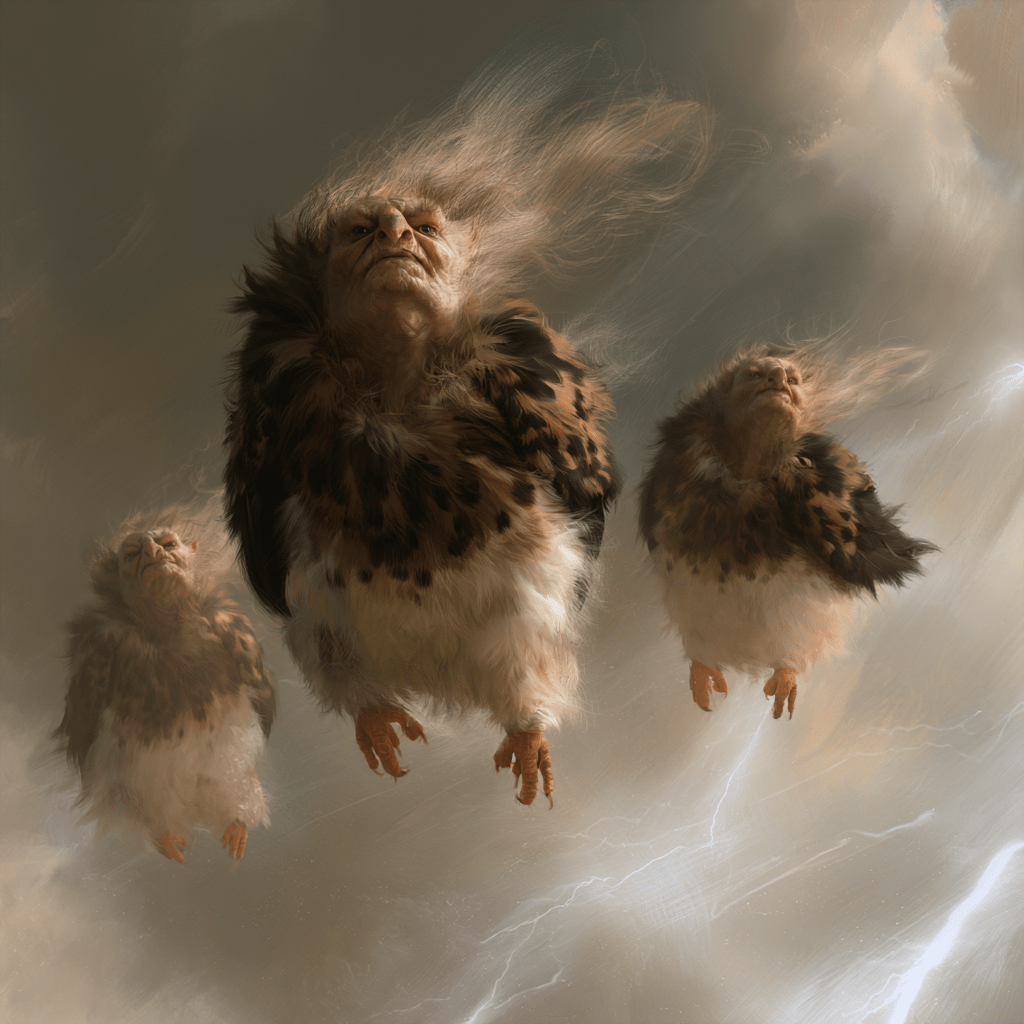
The creature lands hard, folding those wings behind a body that’s somewhere between bird and nightmare. Long hair, tangled and gray-streaked, frames a face locked in permanent fury, cheeks hollow, eyes rimmed red like she hasn’t slept since the Bronze Age. Her torso’s covered in patchy dirty-white feathers, exposed at the chest, and where legs should be there’s just more of those talons, curved and glinting. She’s shorter than Spartan, built stocky and low to the ground, and when she screeches it’s not a bird sound at all. It’s a woman’s voice stretched thin and cracked down the middle.
A Harpy. Full-blown, straight-off-the-vase Harpy.
I’ve read enough mythology summaries to know these ladies used to steal food off dead men’s tables in the old stories, snatching meals right out from under starving kings as punishment from the gods. Somebody clearly upgraded the job description since then. Punishment detail’s gone full combat class.
She’s smaller than Spartan by a full head, but there’s nothing small about the way she holds herself, wings half-spread, shoulders hunched forward like every muscle in that stunted body is coiled and ready to strike again. Up close, if my cube counted as close, the smell would probably be the worst part. Wet feathers and old stone and something underneath that I don’t have a word for and don’t especially want one.
Spartan settles into a fighting stance, weight low, fists up, and for one second the clouds actually part. A single ray of sun spears down through the gap, landing right across his open palm like the universe decided to hand him a weapon on cue. He closes his fingers around it, and gold light braids itself into shape, hardening into a short sword with a gleam that looks almost liquid.
“Zetes,” he says, low, like he’s greeting an old friend. He turns the blade once in his grip, testing the balance, and settles his stare on the Harpy like she’s the last defender standing between him and a dunk.
She comes in fast. Talons first, claws raking, wings snapping for extra leverage, and Spartan meets every strike with a parry so clean it barely looks like effort. Steel rings against bone-hard claw, sparks skittering off into the wind. He gives ground exactly as much as he needs to and not an inch more, feet planted, blade angled just right to redirect her momentum past him instead of through him. It’s the kind of form you don’t get from raw instinct alone. Somebody’s been drilling him, or he picked up more from those training montages than I gave him credit for.
She circles wide, testing him, throwing a feint low before snapping high, and he reads it half a beat before it lands, ducking under a swipe that would’ve taken his head clean off his shoulders. His jaw’s set tight, sweat already beading along his hairline despite the cold, but there’s something almost happy buried under the concentration. This is the part of the job he actually signed up for. Not the briefings. Not the strategy talk. This.
The Harpy screeches again, frustrated this time, and pulls back out of range.
Zetes dissolves in his hand, sunlight scattering like sparks off a grinder, and reforms almost instantly into something longer. A spear, gold-shafted, tipped in honed steel. Calais.
“Round two,” Spartan says.
In his other hand, gold light gathers into a disc, expanding outward into a shield etched with an eight-point sun, rays fanning out from a center that isn’t quite as solid as the rest of the metal. I know what’s tucked behind that seam even if the Harpy doesn’t. Aegis. Sleeping just beneath the surface, wrapped in gold and pretending to be ordinary hardware.
The Harpy charges again, screaming, talons out, and Spartan doesn’t wait for the impact. He plants his back foot and throws.
Calais crosses the gap in a blink, gold streak against gray sky, and buries itself through her chest with a sound I’d rather not describe in detail. She folds midair, wings going slack, and drops.
One down.
I want to feel something cleaner about that. Mostly I just feel the cold, familiar nothing of watching a fight from behind glass that isn’t really glass, in a body that isn’t really here.
The second Harpy doesn’t announce herself with a screech. She just appears, dropping out of the low cloud cover in total silence, and Spartan barely gets Aegis up in time to catch the first raking blow. Sparks fly off gold. He staggers half a step, catches himself, and goes into full defense, spear tucked back, shield forward, rolling and tumbling across the ridge as she rains down strike after strike from angles that shouldn’t be possible for something her size.
This one’s leaner than the first, wings edged in a darker brown, and there’s a calculation to her attacks that the first Harpy never showed. She’s not just clawing at whatever’s closest. She’s hunting for the gap, probing his footwork, waiting for the half-second his guard drops. I’ve watched enough of these fights to know that’s the moment where things usually go sideways, and my stomach does a thing it has no business doing since I don’t technically have one anymore.
She’s faster than the first. Angrier, too, if that’s a thing you can measure in a face already stuck on furious.
Spartan takes a hit across the ribs that spins him half around, grunts through it, and rights himself with his jaw tight. For a second he just watches her circle, breathing hard, calculating.
Then his thumb finds the hidden catch behind Aegis’s rim, and the shield splits open like a locket.
I brace myself for it even though I’ve technically seen it before. Medusa’s head, suspended in that eerie, dreamless calm she wears when she’s dormant, snaps awake all at once. Eyes flare open, and the moment they do, the color drains straight out of them into something ancient and merciless. Her hair, which had been hanging still as rope, comes alive in a slow, hissing ripple, dozens of narrow bodies uncoiling at once.
The Second Harpy is already looking dead at her.
There’s no scream this time. Just a flicker of confusion crossing that furious face, replaced almost instantly by nothing at all. Stone creeps across her cheeks first, spreading fast, climbing up through her hairline, down her throat, out along her wings until every feather goes matte and gray and still. She hangs there a half-second too long, frozen mid-flap, before gravity remembers she exists.
She hits the rocks below and comes apart like a dropped statue in a museum nobody’s insuring properly. The pieces skitter and roll to a stop, gray dust settling over the ridge like snow that showed up to the wrong season. For one long beat, nothing moves except the wind picking through the wreckage.
Spartan snaps Aegis shut, breathing through his teeth, sweat cutting a line through the dust on his jaw. He doesn’t look proud of that one. Doesn’t look much of anything except tired, which honestly tracks. There’s a difference between winning a fight and watching something ancient do the winning for you.
He doesn’t get long to process it.
The Third Harpy comes in from above, diving out of the bruised cloud cover with her talons already extended, and instead of going for his throat she goes for Aegis. Rips it clean out of his grip mid-motion, sun rays folding shut over Medusa’s face as the shield spins away from him, caught tight in those yellow claws.
“Hey!” Spartan actually sounds offended, more than scared, which is such a Michael reaction I almost laugh out loud in an empty room. “That’s mine!”
Classic. Absolutely classic. Three seconds from possibly losing a family heirloom disguised as a war shield, and his first instinct is theft outrage. I’d respect it more if it weren’t currently airborne and getting farther away by the second.
He dismisses Calais in a burst of light and launches skyward after her, and this time it’s not swordplay, it’s a straight-up dogfight. Scarlet heat beams lance out from his eyes, cutting streaks through the cloud cover, and the Harpy jinks and weaves with Aegis clutched against her chest, faster than something that size has any right to be.
She’s smart about it too, ducking behind outcrops of rock and folding through gaps in the clouds that force him to break line of sight, buying herself half-seconds he can’t afford to keep giving up. Every miss chips something off his patience. I can see it in the set of his shoulders, the way his fists clench tighter each time a beam sails past her instead of through her.
The clouds finally give up entirely, boiling back to reveal a hard, bright sun, and I watch Spartan’s whole body change under the light. His eyes go from scarlet to gold, blazing bright enough that the Harpy actually flinches back, and then he’s just gone. Vanished into the glare like the sky swallowed him whole.
She’s still scanning, twisting midair, confused, when he reappears behind her in a full horizontal line, fists clenched together in front of him like he’s about to spearhead a cannonball dive. Except the thing hurtling toward her isn’t made of muscle anymore.
He’s plasma. Full orange-red, white-hot at the edges, a comet with a face I can’t quite make out anymore, streaking a trail of fire across a sky that’s gone the color of a struck match.
The Harpy sees it a half-second too late. Aegis pops open on instinct or reflex or pure bad luck, sun rays parting to reveal Medusa’s face at its absolute worst, fury etched into every scale, and then Spartan hits her dead center.
The explosion swallows the whole ridge in white light. My cube flares hot even though there’s no actual heat, no actual anything, just the memory of a shockwave translated into a room that isn’t real punching me in a chest that also isn’t real. Somewhere below, I’d bet actual money that the shockwave alone flattened half the treeline. When the light fades, gold metal is running molten down through the smoke, dripping off nothing, and somewhere in the middle of that collapsing shield Medusa’s stone gaze finally does what it does best. The Harpy’s face cracks first, then splits entirely, snakes tumbling loose as the whole shape disintegrates into ash and feather and falling rock, scattering into the wind like a puzzle nobody’s putting back together.
Three down.
Spartan drifts out of the smoke a second later, and this is the part I don’t love watching.
His faceplate hangs open, revealing an expression that isn’t set in determination anymore, isn’t set in anything. Eyes shut. Jaw slack. His suit’s torn clean across one shoulder and down the ribs, scorched black at the edges, and underneath it his skin isn’t the tan I’m used to seeing. It’s raw and blistered, the kind of burn that should have him screaming if he were conscious enough to scream.
He’s not falling with any control. He’s just falling, arms loose, head tipped back, one boot missing entirely somewhere in the wreckage of the last thirty seconds. Whatever fire drove him out that back exit alone, whatever point he was trying to prove, it’s not steering anything anymore. Gravity’s got the controller now, and gravity doesn’t care about points.
The gold sky above him fades back to ordinary blue, indifferent, unbothered, like it didn’t just watch three monsters die and one boy nearly die with them. He gets smaller. Smaller. A maroon speck against a dense green blur of forest canopy rushing up to meet him, and then one last flash of scarlet swallows him whole before the trees do.
I don’t get to follow him down. My cube doesn’t do impact.
I sit there in white nothing, in a room shaped like a cube because somebody somewhere decided that was the least disorienting geometry for a kid stuck watching other people’s lives instead of living his own, and I think about how close I am to every single one of these moments and how far I’ll always be from actually being in them.
If I had hands that mattered, I’d have caught him. If I had a voice that carried past this glass, I’d have told him three Harpies and a solo op wasn’t a fair fight even for someone with his stat sheet. Instead I get to sit here doing math on falling velocities and hoping the forest canopy’s got enough give in it to matter, which is a genuinely terrible way to spend an afternoon.
So close, yet so far. Story of my whole existence, really.
I just hope somebody down there in that forest finds him before the story decides it’s done being kind.
Belt_in_the_ashes.sav
Nobody tells you the worst part of search-and-rescue is the searching. Not the rescue part, the part where you don’t know yet if there’s anything left to rescue. Games skip that bit entirely. One minute you’re at the crash site, next minute there’s a marker on your map and a health bar to worry about. Real life doesn’t hand out markers.
Real life just hands you trees. An endless wall of them, roots tangled underfoot, branches clawing at anything that moves through at the wrong height, and somewhere in all that green a boy-shaped needle in a haystack the size of a small country.
My cube settles somewhere above a stretch of forest so thick the sunlight barely makes it past the first layer of branches, dappled green light scattered across a floor of ferns and rotted leaves. Somewhere down there is a boy who dropped out of a burning sky twenty minutes back. Somewhere closer than that, three of his people are combing the underbrush with nothing but instinct and dread to guide them.
Captain McKinley leads, visor pushed up, eyes cutting across the terrain in slow, deliberate sweeps like he’s running a threat assessment on every fallen log. Beside him, Princess Ruana picks her way over roots in a gown never designed for hiking, the hem soaked dark at the edges, her usual serenity cracked at the corners. Rockstar trails a step behind, guitar strap slung crosswise over his chest, and for once in his life he isn’t cracking a single joke.
That silence tells me everything I need to know about how scared he actually is.
McKinley stops first, one hand raised. Ahead, the forest floor just stops existing, a jagged crater torn through soil and root, smoke still lifting off it in thin, lazy ribbons.
“There,” he says. One word. Flat as a dropped signal.
Rockstar doesn’t ask questions. He just jumps, disappearing into the smoke without a second’s hesitation, and something about that move feels painfully familiar. His brother did the exact same thing a continent away, minus the smoke, minus the crater, but the same reckless logic underneath it. Leap first, ask questions never. Must be genetic.
My cube dips down after him on its own, and the haze thins out to show scorched dirt and cracked stone, a crater bottom that looks exactly like what it is: a landing zone for something that hit hard and hit fast.
No Spartan down here. Just his belt.
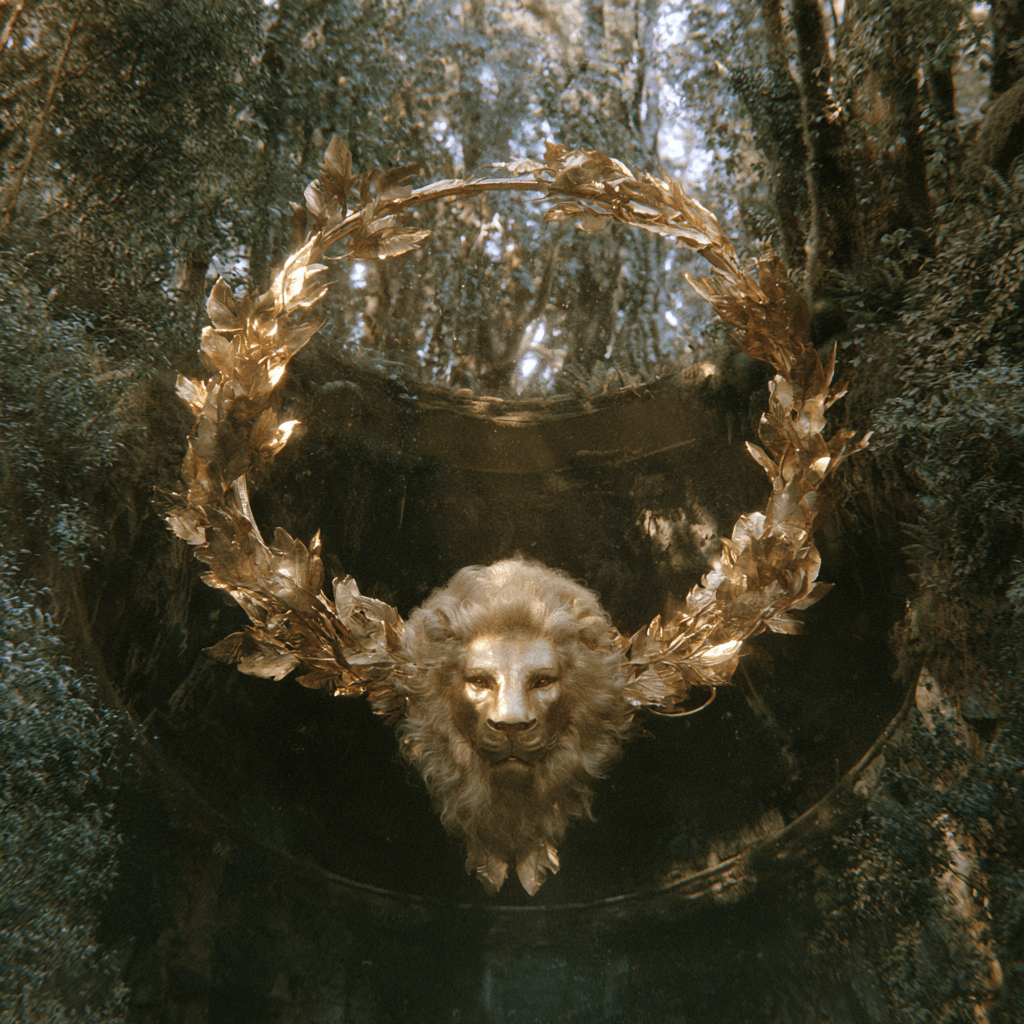
Gold and laurel-shaped, half-buried in gray ash, the medallion at its center stamped with a snarling lion in profile. One end’s still faintly warm, curling a thread of smoke into the air. The leather backing is scorched black along one edge, and a few links of the chain have fused together from whatever heat tore through this crater last. Rockstar crouches and lifts it free with both hands, like it might shatter, and turns it slowly, studying the lion like it owes him an explanation it can’t give.
His shoulders drop. His throat works. Whatever’s building behind his eyes, he’s fighting it hard enough that I can practically feel the effort from here. He doesn’t wipe his face. He just holds the belt against his chest and stares at the crater walls like they might still be hiding an answer he hasn’t found yet.
I know something he doesn’t. That belt landing here doesn’t mean what he’s clearly bracing himself to believe. But being right about that from inside a room nobody can see into isn’t exactly useful information. I’ve got front-row seats to the truth and absolutely no way to pass a note.
Above the crater, McKinley and Ruana arrive at the edge, and their faces do that same slow drop the second they see what’s in Rockstar’s hands. Nobody says the word out loud. Nobody has to. It just sits there in the smoke between them, unspoken and enormous.
“He wasn’t supposed to go alone,” Ruana finally says, voice barely above the wind.
“None of them were,” McKinley answers, and there’s an edge under the calm now, something that sounds a lot like guilt wearing a captain’s uniform.
He crouches at the crater’s rim, studying the scorch pattern radiating out from the center, the way the roots nearby are singed but not the ones farther out. “Impact and detonation,” he mutters, mostly to himself. “Something big went off right here. Whatever hit this ground didn’t glide in soft.”
Rockstar climbs out gripping the belt against his chest, and nobody asks him to let go of it. He doesn’t meet either of their eyes on the way up, jaw locked, sneakers kicking loose gravel down the crater wall behind him with every step.
Hours later, deep inside the Peregrine Lightyear, the grief hasn’t gone anywhere. It’s just changed rooms.
I find Ruana alone in the containment wing, standing before a slab of brown, cracked shell mounted against the far wall, leftover from the Chimaera’s goat form. It’s the size of a small boulder, ridged like ancient bark turned to stone, and she’s got both palms pressed flat against it, eyes shut, breathing slow and deliberate.
McKinley’s footsteps announce him before he speaks. “What are you doing?”
She doesn’t open her eyes. “Emotions leave traces. Like water on sand. The tide goes out, but the wet stays behind for a while, and things stick to it.” Her fingers curl slightly against the ridged surface. “This carried part of the Chimaera. If I’m patient, maybe something’s still clinging to it.”
“And if there’s nothing there?”
“Then I’ve lost nothing but time.” A small, tired smile ghosts across her face. “Which today, I have plenty of.”
McKinley doesn’t argue that. He just leans against the wall opposite her, arms folded, watching with the patient stillness of someone who’s learned not to interrupt work he doesn’t fully understand.
Her grip tightens. Her breathing slows further, and then stops looking like breathing at all.
My cube yanks sideways, and suddenly we’re both somewhere else. A cave mouth, sun bleeding gold around the edges of black stone, and coiled just past the light line, a shape that’s neither fully woman nor fully serpent, scales catching what little sun reaches her.
“My beautiful children,” the shape hisses, voice split into two competing tones like a bad radio signal. “My sons. Destroy the Seven Acolytes, destroy them all, so the Star of Vis may become ours, for your father, Typhon. This is the plea of your dearest mother.”
The image tears itself apart like static eating a broadcast, and Ruana staggers back a full step, catching herself on the shell’s edge.
“I saw her,” she breathes, eyes wide, pupils still adjusting. “Half woman, half serpent. She called herself mother to the Chimaera.”
McKinley’s expression sharpens into focus fast. “Mother of the Chimaera. There’s only one name that fits. Echidna.”
“She’s watching us,” Ruana says, steadying herself. “Directing all of this from somewhere we can’t see.”
“In the old myths, she’s mother to four of the worst names in the book,” McKinley says, already calculating three moves ahead like always. “Cerberus. The Chimaera. The Nemean Lion. The Hydra. If she’s speaking through her children, this isn’t random monster after monster. It’s a campaign.”
Ruana’s jaw sets, grief hardening fast into something with teeth. “Then we find her before she finishes what she started.”
McKinley crosses the room and rests a hand briefly on the shell, careful, almost reverent, like he’s thanking a piece of furniture for doing more work than any of them managed today. “Get some rest first. A vision’s only useful if the person who saw it can still stand upright tomorrow.”
Ruana nods, though her eyes stay fixed on the wall of the containment room, somewhere past the metal, somewhere the cave still lingers behind her eyelids.
I sit inside my quiet white cube turning that sentence over. Before she finishes. Everyone in that room thinks the worst has already landed on one of their own. It hasn’t. Not yet. Somewhere in a forest a continent away, a boy the whole team just mourned is still breathing, and I’m the only one who knows it.
Being right and being useless at the same time is a genuinely rotten combination.
I really hope somebody figures it out before I have to keep watching this play out alone.
Kuya_says_goodbye.sav
Late-night shifts on the Peregrine Lightyear hit different. No engines humming for once, no alarms, no boots pounding down corridors. Just the low electric breathing of a ship that’s finally allowed to rest, and one very tired captain sitting alone in the dark like the last player left in a lobby nobody else wants to join.
My cube drifts into the command center quiet as a held breath. The overhead lights are down to almost nothing, just the faint blue glow bleeding off standby consoles and the massive wraparound screen curved around the far wall. Rows of empty stations stretch out on either side of the chair, chairs pushed in, monitors dark, the whole bridge holding a kind of stillness that only shows up when a ship’s crew has finally scattered to their bunks. Captain McKinley sits in the commander’s chair, back straight even now, facing forward into the dark like he’s waiting on orders that stopped coming hours ago. The kind of stillness that looks less like calm and more like a system running on fumes.
I know that look. I’ve worn it plenty of nights myself, minus the chair, minus the ship, minus basically everything except the staring into nothing part.
A soft chime cuts the silence. Incoming transmission, the kind of alert tone that means somebody out there still has enough signal to reach home. McKinley’s head turns, slow, almost reluctant, like some part of him already knows this isn’t going to be good news dressed up nice.
The screen flickers awake behind him, and there’s James.
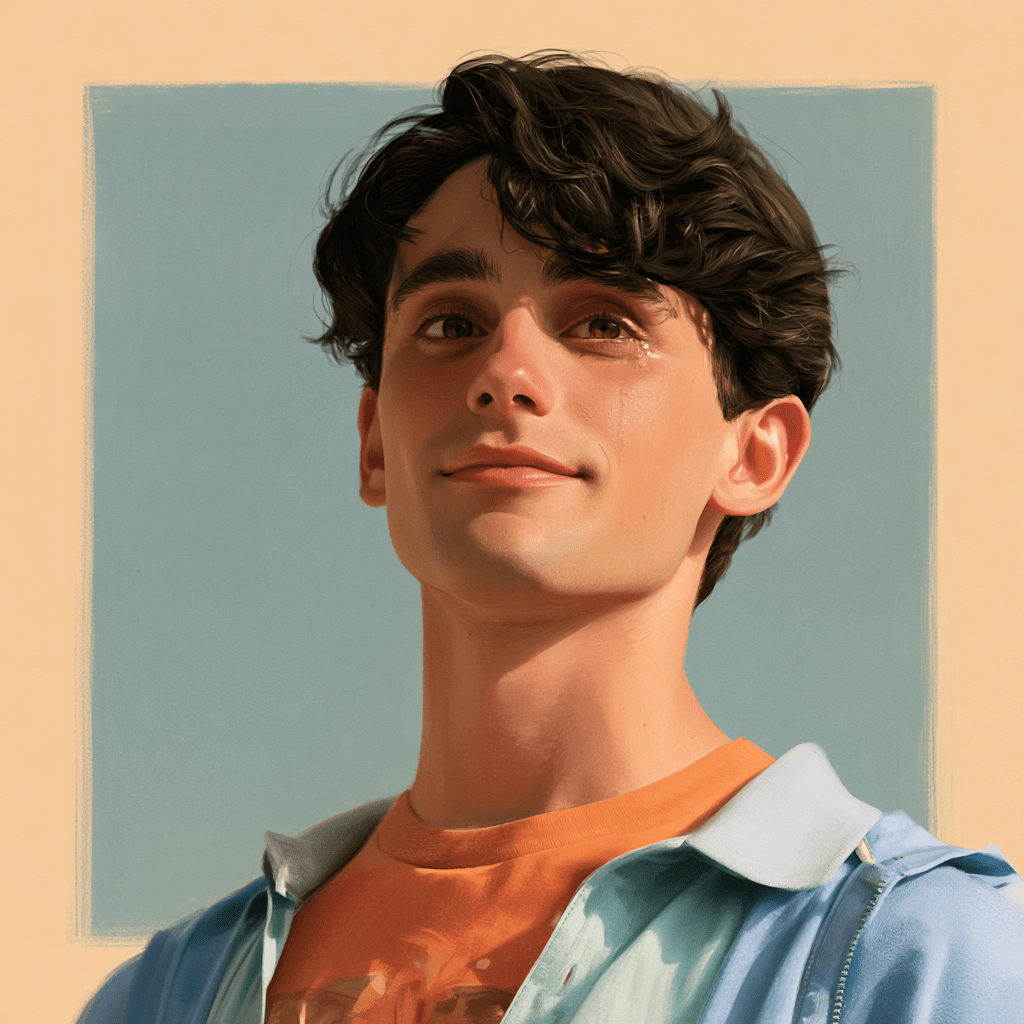
He’s not in his Rockstar gear. No white-gray jacket, no surfboard slung under one arm, no orange shirt catching light like a walking sunrise. Just a hoodie, hood down, hair a mess like he’s been running his fingers through it for the better part of an hour deciding whether to hit record. His eyes are already red-rimmed before he’s said a single word, and there’s a half-empty water bottle sitting just out of frame, forgotten. Behind him, I can’t quite place the room, dim and cramped, the kind of space that isn’t home and isn’t anywhere official either. Somewhere in between, which feels about right for where his head’s clearly at.
He fusses with the camera angle, tilting it once, twice, muttering something under his breath I don’t quite catch. Then he settles, forces a grin that cracks halfway through into a short, humorless laugh.
“I was just the lead vocalist of my boy band, Kaleidoscope,” he says, “with my best friends. Ezra, Apollo, Kai, Rowan.” He shakes his head slightly, the ghost of an old memory passing behind his eyes. “Those were good times, for sure. Sold-out shows, terrible matching outfits, the whole deal. Feels like a different lifetime now.”
McKinley doesn’t say anything. He just watches, arms resting on the chair, jaw tight in that particular way that means he’s bracing for whatever’s coming.
“When I discovered my powers,” James continues, voice softening, “I was confused. Scared, honestly, even if I never really said it out loud. But I found the fun in it fast. Playing my guitar, making music that could actually bring street art to life. Skateboarders weaving through graffiti that’s suddenly moving on its own. Whole skylines lighting up because I hit the right chord.” A small, genuine smile breaks through, the first real one. “Becoming a kind of superhero. Fighting bad guys, saving people. It’s awesome, Bro. Especially doing it with you guys. Not just as brothers, not just cousins. As best friends. The dream team those forum geeks are always going on about.” He pauses, and for a second the old easy charm flickers back across his face, the version of James who never met a room he couldn’t win over.
I catch the reference and can’t help the small, appreciative nod nobody’s around to see. Dream team’s not wrong. Takes a certain kind of squad to fight actual mythological monsters and still crack jokes about it in the group chat afterward.
Then his voice drops, and the light in his eyes dims right along with it.
“But it’s not all fun and games. You know that.” He swallows hard. “Sophie got shot, fighting those gang members. Pulling her out early was the right call, and I need you to know I really believe that. She’s safe now. Back doing what she loves in the art club, drawing instead of dodging bullets, and that’s exactly where she should be.”
He pauses there, jaw working, and I watch him gather himself for the part that’s clearly costing him more. His fingers pick at a loose thread on his sleeve, twisting it around one knuckle and back again, the kind of small nervous motion that says more than his voice does right now.
“Allison wasn’t as lucky.” His eyes go glassy, catching the low light of whatever room he’s sitting in. “Ruana told us. Medusa’s gaze got her, somewhere in the Parthenon. We don’t even know if she’s still alive in there. Stone doesn’t exactly send updates.”
The joke lands flat even as he says it, the kind of humor people reach for when the alternative is falling apart on camera. McKinley’s expression doesn’t move, but something behind his eyes does, a flicker of the exact grief James is trying to outrun with words.
“Topher.” James breathes the name like it costs him something just to say it. “We had such a blast in Venice. Met this kind old man at a little diner, saw the canals, the palaces, that huge bell tower. Remember when he tried ordering gelato in Italian and just butchered it so bad the guy behind the counter started laughing?” A brief, real laugh slips out before it dies just as fast. “It was beautiful, man. Genuinely one of the best days I’ve had since this whole thing started.” His voice catches. “Then a simple gondola ride turned into a trip to the actual Underworld and back. We thought we made it. Thought we were fine. Then a whirlwind just took him. Ripped him right out of the air in front of me. Hermes managed to pull me out, but I came back alone. Standing at the top of that bell tower by myself, and he was just gone.”
I watch McKinley’s hands tighten on the armrests, knuckles going pale under the low light. He doesn’t interrupt. Doesn’t ask a single question. Just sits there and takes it, the way captains do when the report they’re hearing is already the worst version of events.
“Michael.” James’s voice actually breaks on the name, cracking clean down the middle. “He was so ready to go slay that Nemean Lion. It’s literally the symbol stamped on his laurel belt, you know that? Kid’s been an action hero since he could walk. Loved fighting, loved it especially when it was against something mythological and stupidly dangerous. He used to talk trash about villains in movies like they’d personally insulted him.” A watery half-smile flickers and dies just as fast. “But he fell.” James wipes at his face fast, like he’s hoping the camera missed it. “He fell to the Harpies. He might really be gone, Bro. I don’t know. Nobody knows. We just have his belt.”
The room goes quiet enough that I can hear my own cube humming, which shouldn’t even be possible given that it doesn’t technically hum for anyone but me.
I want so badly to lean into that screen and just say it. He’s not gone. Not confirmed, not even close. But I’m a ghost watching a recording of another ghost telling a third person about people none of us can currently reach, and there’s nothing in that chain of custody that includes me getting a word in. It’s like watching someone spoil their own plot twist and not being able to yell that the game’s got a save file two chapters back that fixes everything.
James takes a shaky breath, dragging himself back together enough to keep going. “Between the two of us, you’re the one who always wants things clear. Set in stone, planned out, a strategy for every possible outcome. I’m the indecisive one. I thrive on change, on chance, on just seeing where the wind takes me.” His laugh this time is worse than the first one, cracked at the edges. “Lately, though? Lady Luck’s been playing some seriously cruel pranks. On me. On all of us. Feels like every time I roll the dice lately, something else gets taken.”
His grin trembles, doesn’t quite hold, and then it just breaks entirely. Tears track down fast, and he doesn’t bother hiding them anymore.
“I never thought losing people you care about would hurt this much,” he says, voice barely holding together. “Like, I knew it would suck. I didn’t know it would feel like this.”
McKinley’s face, still lit only by that pale screen glow, goes about as somber as I’ve ever seen it. No mask, no captain’s composure holding the line right now. Just a brother watching another brother come apart from somewhere far away, completely unable to reach through the screen and do anything about it. His hand drifts up briefly, like he means to touch the screen, then stops halfway and drops back to the armrest instead, fingers curling slowly into a loose fist.
Which, hey. Welcome to my entire existence, Benjamin. Glad you’re getting a taste.
“I keep asking myself why I’m still here,” James continues, “when Love Fey, Cerulean Arlentis, and Spartan are gone. It feels like a thousand cuts, one after another, and I can’t tell anymore which one’s supposed to be the one that finally does it.” He presses the heel of his hand against one eye, breath hitching once before he forces it steady again. “I’m sorry, Bro. I’m supposed to be the Kuya. The big brother. That’s supposed to mean something. But I’m leaving it all to you now. I need you to be the strong one, because I clearly can’t hold that job down right now.”
His voice cracks again, rawer this time, scraped thin.
“It’s just too much. I can’t keep going like this. I need to leave. Find myself, find some answers, I don’t even know exactly what I’m looking for, but I know I can’t find it standing still on this ship.” He wipes his face with both hands now, giving up entirely on hiding it. Behind him, whatever room he’s in stays perfectly still, no sound but his own breathing and the faint hum of whatever device is holding the transmission open. “I hope I can make things right eventually. Goodbye, Benjamin. This is your irresponsible, weak Kuya James.” He forces one last watery smile straight into the lens, the kind that’s trying so hard to look brave it almost gets there. “But please believe me when I say this. I love you, man.”
The transmission cuts.
The screen goes dark, and the command center drops back into that thin blue standby light, quieter now than it was before somehow, like the room itself is still processing what just happened. McKinley sits perfectly still, staring at the space where his brother’s face used to be, hands still gripping the armrests like letting go might mean admitting something he isn’t ready to admit yet. A console somewhere behind him blinks lazily, cycling through some routine diagnostic nobody asked it to run, the only thing in the whole room still moving.
He doesn’t call for anyone. Doesn’t hit a comm channel, doesn’t wake Ruana or send word to the others still asleep somewhere down the corridor. Whatever he’s carrying right now, he’s carrying it alone, and something about that tells me exactly how deep the Kuya instinct runs in this family. Somebody hands you the weight, you just take it. Nobody teaches you how to put it back down.
I don’t get sound effects for silence like this. I just get to sit in it.
Sometime later, somewhere else entirely, a bus grinds to a stop along a coastal road, brakes hissing, and James steps off, back in civilian clothes now, hoodie traded for a plain jacket, guitar nowhere in sight. The road behind him curves off into hills dotted with small houses, whitewashed and sun-bleached, the kind of quiet coastal town that doesn’t show up on any tourist map worth mentioning. He doesn’t check a phone. Doesn’t check a map. Just walks like his feet already know the way, past a shuttered fish stall and a bench with peeling green paint, until the road runs out and the rail begins.
He stops there, hands braced on cold metal, and just stares, the rail digging faint lines into his palms that he doesn’t seem to notice or care about.
The sea stretches out in front of him, calm, endless, catching the last orange light of a sun that’s already halfway gone below the water. Gulls wheel somewhere overhead, distant and unbothered, and the tide rolls in low against rocks scattered along the shoreline, a steady rhythm that doesn’t care what kind of day anybody just had, in or out of a spandex suit. A gentle breeze pushes his hair back off his forehead, carrying salt and something faintly like woodsmoke from a chimney further down the coast, and he just stands there a long moment, saying nothing, needing nothing from anyone.
I don’t know where this road leads. I don’t think he does yet, either. Sometimes the point of walking isn’t the destination, it’s just proving to yourself your legs still work after everything’s tried to knock you down.
But for the first time since that transmission cut out, his shoulders drop half an inch, like something’s finally allowed to breathe out here where nobody’s watching, where nobody needs him to be the strong one or the funny one or the glue holding six other people together.
Except me, obviously. But he doesn’t know that, and honestly, that’s probably for the best. Some moments deserve an audience of exactly nobody, even if I’m technically stuck being that nobody whether I like it or not.


Leave a Reply