Overview:
| Ser Cerulean Arlentis and his winged steed, Cielo, return to the Griffin’s treasure vault to search among its countless mounds of gold. This time, they discover a lyre buried among the treasures. Curious, Cerulean picks it up and begins to play. As the music fills the vault, two passages of Ancient Greek suddenly materialize in the air before them. The mysterious texts are accompanied by visions of James’s love of music and the deep friendship he shares with his boy band, Kaleidoscope. |
Lyre_sings_the_brother_home.sav
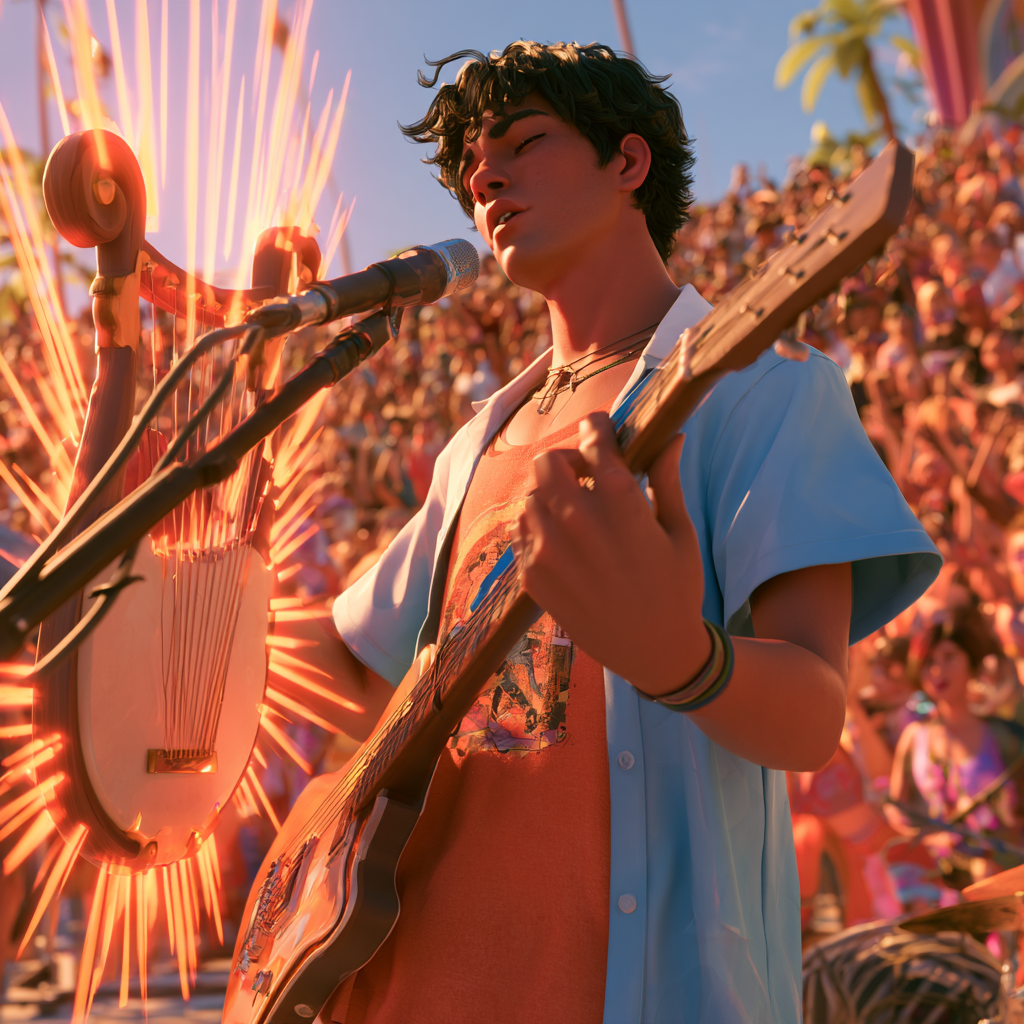
The cube doesn’t move me so much as redraw itself around me, and this time it redraws gold.
Not one shade of it. Dozens. Coin gold that’s gone dull and greenish at the edges, statue gold polished to mirror, the pale buttery gold of old jewelry that somebody wore every single day for forty years. It piles up the walls of the Griffin’s vault like snowdrifts that forgot how to melt. There’s no ceiling I can find. There’s a black altar down at the floor of the room and a set of scales beside it that would make a construction crane feel bad about itself, and the whole thing smells, according to nothing, since I can’t smell anything, of dry stone and hot metal.
Ser Cerulean Arlentis is climbing a slope of coins with a winged pony behind him.
He’s covered maybe forty meters of treasure since the tapestry, and the coins keep sliding out from under his boots, which means for every three steps he takes he loses one, which means he is basically running an escort mission with terrible physics. His cape drags a wake through the pile. It’s white, and it stays white, and I have stopped asking questions about that. The silver of his armor throws the gold light back in thin lines along his shoulders. His gauntlets are laced with gold at the knuckles, and when he braces a hand against the slope, the coins ring like somebody dropped a cash register down a stairwell.
Cielo takes the same slope by cheating. He opens those white wings and skims up the incline a hand’s width above the surface, hooves paddling at nothing, tail streaming out behind him. Pony-sized. Not a horse, definitely not the full mythological hardware. He lands at the crest first and looks back down at Cerulean with the specific smugness of a party member who unlocked flight two levels early.
“Show-off,” Cerulean pants, hauling himself up the last stretch.
Cielo snorts.
Then Cerulean stops moving, and the coins stop ringing, and in that flat quiet I hear the thing he heard.
A note.
Not a struck note. A settling one. Something down in the trove has shifted a fraction of a millimeter under its own weight and a string has answered.
He turns his head slowly. He does that thing where he tilts his ear toward a sound instead of his eyes toward the source, which honestly is a habit I only ever see in musicians and in bomb techs. Then he half-slides, half-runs down the far side of the coin drift with his cape snapping behind him, and he stops in front of a shallow bowl in the treasure where the light lands differently.
There it is. Wedged at an angle between a stack of bowls and the shin of a fallen statue.
A lyre.
Small. Smaller than I expected, honestly. It looks like something you’d carry to a picnic, not to a war. The soundbox is a tortoise shell, real one, the dome of it dark and glossy with those little polygon plates that fit together like a low-poly model that got very lucky. Two arms of curved horn rise out of it, blackish and grooved, and between them sits a crossbar of wood worn pale where fingers have gripped it. Seven strings, gut, thin as fishing line. One of them is fractionally slack. That’s the one that made the sound.
“Cielo.” Cerulean crouches, and his voice comes out hushed, the way you talk in a museum after the guard has walked past. “It’s an instrument.”
The pony extends his neck and blows warm air across the strings. They shiver, and one hums back at him, and Cielo yanks his head up with his ears flat, personally betrayed.
“It’s the only one.” Cerulean’s eyes travel the vault, hopping from pile to pile, checking. He’s right. I’ve had a full sweep of this room since we walked in and there is not one other thing in here that makes music on purpose. There are two hundred cups. There are swords, plates, coronets, a stack of bronze mirrors, a ship’s anchor for some reason. There’s exactly one lyre. “In a whole mountain of stuff, they only kept one. That has to mean something.”
He lifts it out.
He does it wrong at first. He picks it up under the soundbox like a lunch tray, then catches himself, resettles it against his chest with the crossbar up and the arms tilted away from his body. Left hand behind the strings. Right hand in front.
Because here’s the thing about Cerulean that most people who meet the armor never find out.
Before the cape, before the star, before any of this, he played the cello. Properly. Not the way rich kids play instruments where the instrument is really a photograph of the kid holding the instrument. He learned it for years under a teacher named Kutcher who used to stand in the wings and tell him he was going to nail it, and one night he sat down in front of an opera house full of people in gowns and played Mozart’s Fortieth all the way through without his hands shaking. I’ve watched that recording. His mother cried through the whole second movement and pretended it was her eyeliner.
So he’s holding a stringed instrument, and his body knows exactly what to do, and every single thing his body knows is wrong.
There’s no fingerboard. That’s the first thing that gets him. His left hand goes reaching for a neck that doesn’t exist and closes on air. There’s no bow, no scroll, no endpin to plant between his boots. The lyre isn’t a machine for shaping a note after you make it. The lyre gives you seven notes and that’s the entire menu. You either work with what’s on it or you don’t play.
“Okay,” he says. “Okay. New controls.”
He tunes it by ear, which is the flex he doesn’t even register as a flex, twisting the slack string at the crossbar and plucking, twisting and plucking, tipping his head until whatever’s in there lines up with whatever’s in his memory. Cielo has folded his legs and settled down onto a bed of coins to watch, wings loose, chin practically on the floor.
Then Cerulean plays.
It comes out sparse. He’s feeling for it, and the first few passes are just him walking up the seven and back down again, thumb on the low strings, fingers plucking across the high ones. But he’s got the ear, and about eight seconds in he finds a pattern he likes and starts turning it over, and it stops being a test and starts being a piece. Small and bright and a little sad in the middle where the tuning bends. Nothing like a cello. Cellos live down in your ribs. This thing lives somewhere behind your eyes.
The tortoise shell fills with orange light.
Not a spark or a flicker. The whole soundbox goes lit from the inside like a paper lantern, warm and steady, and the light spills up the horn arms and slides along the strings and pools in Cerulean’s gauntlets. His eyes catch it. He doesn’t stop playing.
And then I’m not the only one in this room getting a screening.
The vault dims at the edges, and the visions come up in the gold, projected on nothing, and I recognize the very first frame before it finishes resolving because I was there for it.
A school quadrangle. Morning heat, the flag still on its pole, three hundred kids in intramural jerseys packed in front of a stage that is essentially four risers and a prayer. A boy band called Kaleidoscope hits the boards to a scream that peels paint. Kai drops behind the keys. Rowan spins a stick and doesn’t drop it, which he later admits was luck. Apollo and Ezra plug in on either flank. And the kid at the center with the good hair and the microphone he doesn’t need, because he’s already got the whole quadrangle in his hand, is James.
Somebody in the crowd screams “Oppa!” loud enough to be heard over the drums, and I mouth it along, because I’ve watched this clip a lot.
The vision cuts.
A cave, gray and cold and lit blue-white by a board game that shouldn’t work. James sitting alone against the wall with his phone up, thumbing a message into a group chat from inside a mountain with no signal, and getting answers back with timestamps two hours out of sync. Ezra saying it’s magic. Kai saying it’s a glitch. Rowan saying the cave is haunted and they should all leave immediately, which, credit where it’s due, was the correct read.
Cut.
A bulletin board in a school hallway, senior high tracks pinned up in columns, and four boys standing around a fifth one who’s staring at the list too long. James saying maybe he should have taken a different strand. Rowan telling him it’s October and that ship has sailed. Ezra saying that Kai only joined them in the first place because he’d have been lonely anywhere else. The band sticks together, no matter what. That’s the whole argument. That’s the entire strategy meeting.
Cut.
A street outside the school gate, an ice cream cart, a girl named Caitlyn walking away fast with her shoulders shaking and James standing there with a red mark coming up on his cheek. Four boys stepping out from behind the cart where they had absolutely been watching the whole thing. Nobody says anything smart. Ezra says that was rough, bro. Apollo winces at the slap. They just sort of collect him and walk him home.
The gold brightens back up.
Cerulean’s hands haven’t stopped. He’s got his eyes half-closed and his chin down, and I can see him doing the math behind his face.
Friends, he thinks, and I catch it clean, the way I catch everything and can use none of it. That’s what he’s built out of.
Cielo has gone completely boneless in the coin pile. Ears forward. Tail flopped. This pony has never been happier.
Then the air over the lyre catches fire in letters.
They don’t burn. They just arrive, gold on nothing, two columns of them hanging in the space between Cerulean and the treasure slope, written in a stiff old English that reads like somebody translated it a very long time ago and never signed their name to it.
The left column:
It was not you who killed me.
Deadly fate and Leto’s son struck first;
of mortal men Euphorbos came before you.
You are third.
Take this into your heart and keep it there:
you will not walk this earth much longer.
Death already stands beside you,
and the hand of him whom Thetis bore is waiting.
Cerulean’s eyes track it line by line while his fingers keep moving, and he gets it before I have to think it at him. Patroklos. Book sixteen, dying in the dust with Hektor over him, spending his last breath on a prophecy instead of a plea. Fate. The part that’s already written down and doesn’t care what you wanted.
The right column:
My mother, silver-footed, tells me this:
that two fates carry me toward my death.
If I stay here and fight beneath these walls,
my homecoming is lost, my glory endless.
If I sail home to my fathers’ land, my glory dies,
and life runs long and quiet,
and death will not come quickly to my hand.
Achilles. Book nine, in his tent, laying his two futures side by side on the table like a save-file menu.
Two columns. Fate on the left. Glory on the right. And a kid in silver armor standing between them holding a musical instrument, which is either the most on-the-nose staging I have ever seen or the Griffin’s decorators have a sense of humor.
The last vision comes up while the letters are still hanging there, and this is the one that gets me.
Northgate Mall. Blue sky, security tape, a crowd pressing at the line. Seven figures walking in from the horizon, evenly spaced, none of them in step with any of the others. Rockstar in white and gray, hands in his pockets. Spartan in maroon, already rolling his shoulders. A little bee girl hovering at head height with a yellow ball trundling along under her. A crusader with a white cape. A magical girl checking her hair. A sea princess with a moon-bell scepter. A space captain in cobalt blue and gray, walking point.
Inside, an old man in a barong holds his wife against his side in a hostage line, and neither of them makes a sound.
I watched that day live. Every wing of it. I know which one of them takes a bullet before the hour is out. I know that this is the last time the number is seven.
Cerulean doesn’t know any of that. He just watches James land in the east wing and start throwing glowsticks, and he smiles.
He gets it, Cerulean thinks. He shows up for people. That’s the whole thing about him.
His hands come off the strings.
The orange light drains out of the shell. The letters go out mid-word. Cielo’s head comes up off the coins with a jolt and he makes a low, appalled noise, ears swiveling, hunting for where the music went.
“Sorry, Buddy.” Cerulean tucks the lyre under one arm and rubs the pony’s nose with his free gauntlet. “There’ll be more. Right now we’ve got a scale to break.”
They come down the treasure slope together and cross the floor to the altar.
The Griffin is waiting where he always is, front paws crossed, eagle head lowered, gold catching in the ruff of feathers along his throat. On the eastern dish behind him sit three things that have no business outweighing anything: a worn wooden paintbrush, a porcelain mirror, and a folded tapestry with a hearth in it.
“The lyre.” The old voice comes out amused. “You have a knack, little knight, for finding the one strange thing in a room full of splendid ones.”
“It’s the only music in here,” Cerulean says. “That makes it worth more than the rest.”
He raises it in both hands. The lyre lifts out of his grip, drifts over the altar, and settles onto the eastern dish beside the other three.
The chain groans. The whole eastern arm comes down in one long slow sweep, and the mountain of gold on the western dish rises to meet it, and the two dishes stop dead level with each other with a sound like a struck bell going off underwater.
“Cielo!” Cerulean grabs the pony’s neck with both arms. “Look at it! We’re even!”
“Congratulations,” the Griffin says, and lets it sit exactly long enough. “Our agreement, however, was that you tip the scales to the east. Not that you meet the gold halfway.”
Cerulean lets go of the pony. Straightens the front of his armor. Doesn’t lose the grin for even a second.
“We know,” he says. “That’s why Buddy and I are going to go find the fifth one.”
Cielo throws his head back and neighs so loud it rolls off the far wall, and the two of them turn and go straight back up the coin slope, and I stand in the room and watch them get smaller.
Four objects on the eastern dish now.
Only one of them still makes a sound, and only when somebody plays it.


Leave a Reply