Overview:
| Ser Cerulean Arlentis and his winged steed, Cielo, search for the fifth treasure within the Griffin’s vault. Their search leads them to a sword symbolizing Spartan’s courage in battle. The treasure hunt continues, and this time, the rider and his mount discover six busts of Greek scholars arranged around a scroll and quill at the center. The scroll is revealed to represent Captain McKinley’s intelligence and strategic mind. |
Sword_stops_before_sky.sav
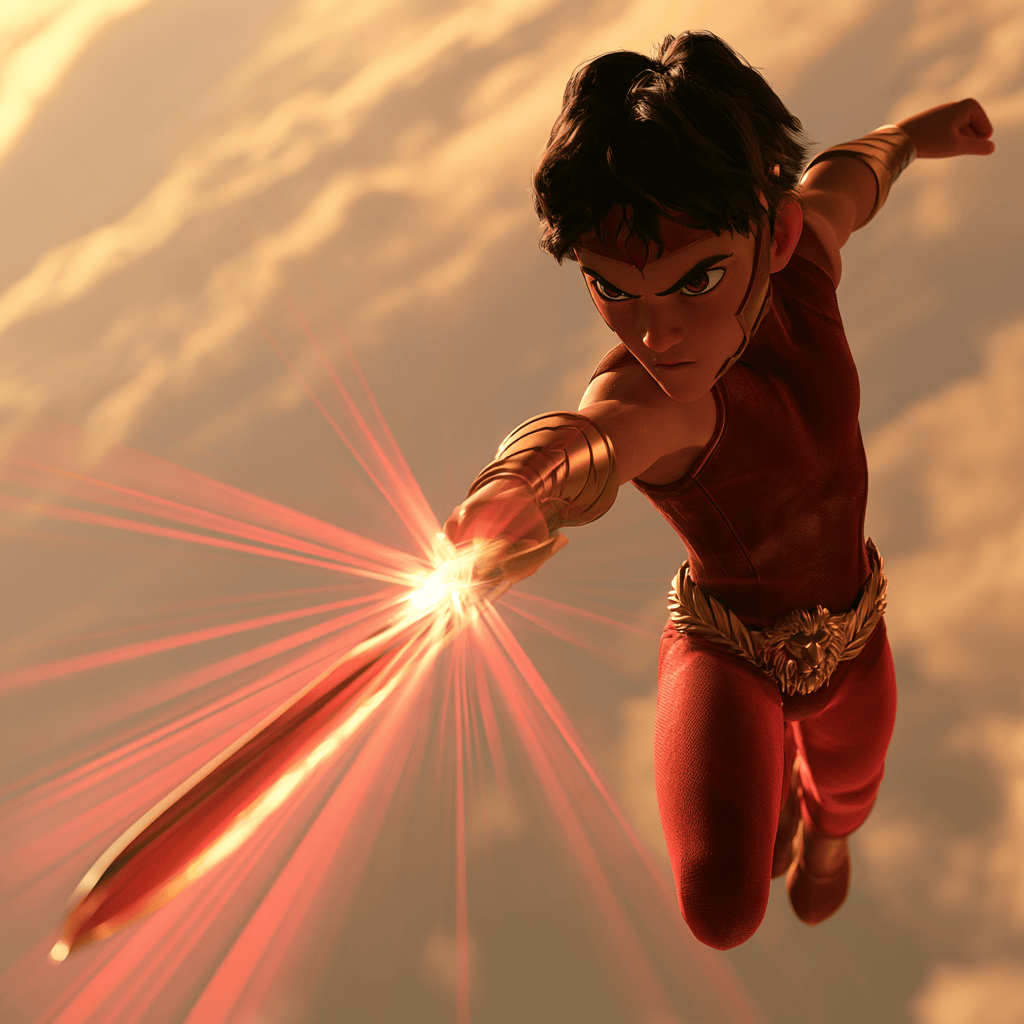
The vault does not have weather, but it has moods. Right now mine is the one where the gold stops looking like gold and starts looking like carpet.
Cerulean has been climbing for a while. He works a slope of coins the way you work a scree field in any open-world game with fall damage turned on, weight on the back foot, one hand out, testing before committing. Cielo does not bother with any of that. He hovers a body length above the slide, wings making a soft double-beat, and drifts along beside his rider like a drone on escort duty. Sometimes he lands just to be sociable, sinks to the fetlock, and lifts off again looking personally insulted.
Then Cerulean stops.
There is a sword lying across the crest of the mound. It is not planted in the pile, not sunk halfway, not lit from above by a conveniently placed shaft of destiny. It is just lying there on its side across the coins the way you’d set down a tool you meant to pick up again in a minute.
“A weapon,” Cerulean says. “Huh.”
Cielo neighs, low, one note, which in his language covers a wide range from agreed to I have no opinion but I support you.
Cerulean crouches. He does not grab it. He looks first, and I like him for that. The blade is bronze, short, leaf-shaped, wider two-thirds of the way down than it is at the guard. No jewels. No inscription running the fuller in a language nobody speaks. The grip has been wrapped in leather and the leather has worn thin in two places where somebody’s fingers sat, over and over, for years.
Every other object in this room has been the fanciest possible version of itself. Aphrodite’s mirror. A tapestry a museum would build a wing around. And now a sword that would not draw a second glance in a garrison.
He picks it up. The gold lacing on his silver gauntlet slides down the flat of the blade with a sound like a fingernail on a windowpane, and I get maybe half a second to think here we go before the room drops out.
I am not in his head. I want to be clear about that, because the sim gives me a lot and it does not give me that. What it gives me is the outside of him. His shoulders lock. His chin comes up a fraction. His eyes stay open and stop tracking, which is a specific and unnerving thing to watch on a face you know.
But the vault shows me the rest, because the vault wants an audience and I am the only one it’s got.
Stone. Not the golden walls, actual stone, damp and close and lit the wrong color. A corridor with no windows and one direction. There is a cord running along the floor, gold and taut, anchored somewhere far back the way they came.
Two figures at the mouth of a chamber. One in cobalt blue and gray, hard-segmented, helmet sealed, a map of light folded over his forearm. The other with no helmet at all, scarlet, moving like he already knows how the next thirty seconds go.
I know this corridor. Crete. The Labyrinth. I watched it live and I am watching it again with the sound gone.
The bull comes out of the dark and it is enormous. Spartan hits it first, because of course he does, and the vision does not soften it. He takes a horn across the ribs and goes into a wall hard enough that the wall keeps a copy of him. He gets up. That is the part the vision holds on. Not the hit. The getting up.
McKinley is doing something with his left gauntlet that is not working. He switches hands without commentary and keeps firing. They do not talk. They do not need to. Spartan drives it down, tears through its shoulder from above, and McKinley walks a blade of light through its neck in one clean pass while the thing is still deciding to fall.
Then the corridor folds up and it is sky.
Thrace. Cold, thin, cloud shredding past a mountain that has no business being that high. Spartan alone this time. The sword in his hand is the same shape as the one Cerulean is holding, which is the vault’s idea of subtlety.
The first Harpy comes in low off the rock and he meets it. And this is the part I did not expect the object to show, because it shows the work. Not the highlight reel. The footwork. The way he shortens his swing when he is inside its wingspan and lengthens it when he isn’t. Somebody taught him this. Somebody taught him this for years while everyone at his school was busy deciding he was the loud one.
He turns the sword into a spear and puts it through the thing, and the Harpy comes apart over the ridgeline.
There is a second one. I know there is a second one. I was there.
The vision stops.
It does not fade. It does not resolve into meaning with a gentle chord underneath. It ends the way a recording ends when the device it was recording on gets switched off, and I sit in my white cube nine hundred kilometers of nothing away from that mountain and feel something go tight under my sternum, because I know exactly why it stops. He dismissed the spear. He didn’t need it anymore. He had something older and worse in that shield and he used it, and the sword was already gone by then and never saw the rest.
An object can only tell you what it was awake for.
Cerulean doesn’t know that. Cerulean thinks it just ran out.
The blade goes scarlet in his hands. Not a glow that sits on the surface. A color that comes up through the bronze like heat coming up through a pan.
He stands there holding it, and his face does the thing. The one from Nemea, and the crater, and the belt, except turned down low, and he does not let it finish. His jaw works once.
“This is Spartan’s,” he says. Then, quieter, because he is talking to a pony and to himself and to nobody. “Michael’s.”
He tests the balance across two fingers, and it sits.
“Courage,” Cerulean says. “That’s what it weighs.”
Cielo comes down and puts his nose against Cerulean’s shoulder and leaves it there, and neither of them moves for a bit.
They go back to the altar.
The Griffin is where he always is. Four legs, folded wings, the tail flicking once at the end like a cat pretending to be asleep. Behind him the scales hang with four small things on one side and roughly a hill on the other.
“We’re ready,” Cerulean says. “This is our fifth.”
He raises his arm. The sword lifts off his palm, drifts across the gap, and settles beside the lyre.
The eastern dish drops.
It drops past the western one. Past level. The chains groan, the mountain of gold on the far side comes up, and Cielo goes straight vertical off the floor with a noise I would describe as a whinny only if I were being polite about it.
“We won!” Cerulean has both fists up. “Cielo, we did it, we actually did it, we beat the—”
“It is not yet time for celebration, my child.”
Cerulean’s arms stay up for one more second. Then they come down.
“What? Sir, I don’t. It’s tipped. Look at it, it’s tipped east.”
The Griffin stands.
Not up from lying down. Up onto two legs, the eagle half rising over the lion half, wings coming out just far enough to change the shape of the room. He has been talking to Cerulean at eye level this entire trial. He is not at eye level now.
“I must apologize.” His voice is exactly as warm as it has been all along, which is somehow the worst part. “Perhaps it is my age. These scales have seven levels. You have tipped them to the fifth. But this trial recognizes only complete victory, or utter loss. To win, the eastern dish must reach its lowest. The western must reach its highest.”
Silence in the vault.
“Oh,” Cerulean says. “So it’s zero-sum.”
Cielo’s ears go flat back and stay there. He looks at the Griffin, then at the scales, then at Cerulean, and his whole head sinks. I have seen that exact posture on a kid who found out on turn forty that the tutorial lied about the win condition.
Cerulean reaches over and scratches under the pony’s jaw.
“Hey. Buddy. Two levels.”
The ears do not move.
“Two,” Cerulean says again. “We’ve done five. Two is nothing.”
One ear comes up. Then the other. Cielo shakes himself out from nose to tail, coins skittering off his back down the slope, and lifts off already scanning the piles.
The Griffin watches them go. He does not lower himself back to four legs until they are well out of earshot, and when he does, he does it slowly, and he keeps looking at the scales.
I have been doing this a long time. That is not the face of an old man who forgot a rule.
Quill_draws_missing_squares.sav
They pick their way through a stretch of the vault where the hoard thins out, and the floor becomes actual floor again, dark polished stone with gold veins running through it like somebody spilled something expensive a long time ago and decided to leave it.
“Sixth treasure,” Cerulean says. “Eyes open. Stay sharp.”
Cielo widens his eyes. Both of them. All the way. He holds it for about four seconds, which on a pony face is deeply unsettling, and then he blinks and goes back to normal and pretends the whole thing didn’t happen.
Then the lamps ahead come up on their own, and there are the heads.
Six of them. Marble busts on marble stands, three down the left, three down the right, spaced like a receiving line. Between the two rows there is a gap wide enough for one person to stand in, and at the end of that gap sits a low podium.
Cerulean walks in and stops in the middle.
“Okay,” he says. “Okay, I know these.”
He points left, working down the row. “Aristotle. Socrates. And Plato, who, by the way, we have met. In Atlantis. He talked at me for about an hour and then froze mid-sentence.” A pause. “He was a student of Socrates. Aristotle was a student of his. So that’s the whole family tree standing right there.”
Cielo looks at the busts with the mild suspicion of an animal being introduced to strangers.
Cerulean turns right. “Heraclitus, the one who says you can’t step in the same river twice. Epicurus. And that’s Diogenes.” He grins. “The Cynic. Lived in a big clay jar. Owned a cup and threw it away when he saw a kid drinking from his hands.”
Cielo snorts.
“I know,” Cerulean says. “But it’s a good story.”
Here is the thing nobody in the room is saying, and I am not going to say it either, because the sim gives me a lot of time to notice things and no one to be smug at. Three on one side. Three on the other. One space in the middle where a person happens to be standing.
I file it. Moving on.
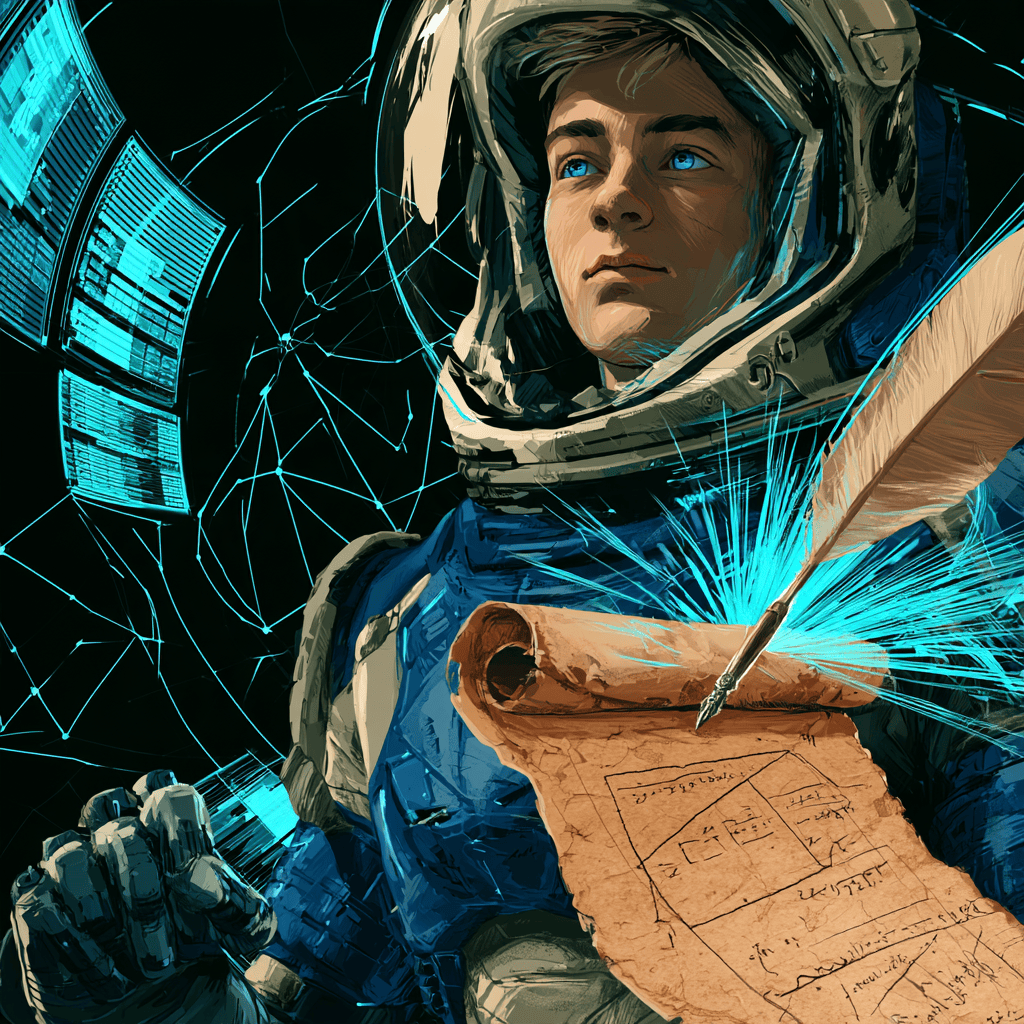
The podium holds a scroll, weighted flat at both ends, and a quill lying across the top of it. Bronze nib, feather gone gray at the edges. Cerulean crouches and reads without touching.
“It’s a diagram,” he says. “Geometry. And it’s not finished.”
He is right. Somebody drew a right triangle, careful and clean, and then drew one square hanging off the long side. The hypotenuse. Just the one. The two short sides of the triangle have nothing on them at all, and where the squares should be, the vellum is blank in a way that feels deliberate rather than lazy.
“Half a proof,” Cerulean says. “Somebody left it half done.”
He picks up the quill. Turns it over in his gold-laced gauntlet, checking the nib the way you check a stylus that has been sitting in a drawer since last summer. There is no ink pot on the podium. He notices that, decides it doesn’t matter, and sets the nib to the vellum anyway.
Ink comes. Dark and immediate.
He draws the first square off the shorter leg, hand steady, corners meeting properly. Then the second off the other leg, bigger. He sits back on his heels to check the shape, and the whole scroll goes cyan.
The color rolls out from the drawn lines and floods across the vellum and up the quill and into his hands, and Cerulean’s back straightens, and he is gone again.
I get the feed the way I always do. Secondhand and complete.
An island at night, or the tail end of night. Sand still holding heat. A figure in cobalt blue and gray, armor hard-segmented, moving with a woman in a white dress across a beach, and everything about his posture says I am walking beside you and also I am not walking beside you. Inside his helmet, numbers. Lines of them, running down the left of his vision, refreshing every half second. Blood traces. Movement modeling. A little box on his display with a prediction in it that keeps updating as she shifts her weight.
She turns. She stops being a woman.
And McKinley is already moving, because the box on his display told him where she’d be before she went, and the gauntlet comes up and puts a bolt exactly there.
Cut.
A mountain in Lycia, daylight, and something enormous and covered in rock plates trying very hard to kill three people at once. McKinley in the air. Jetpack, sword of light, shield on the other arm, doing lazy circles at a distance that looks cowardly right up until you understand what he is doing with the time. The display inside his helmet is drawing the thing’s shoulder over and over. Sampling it. Waiting.
Fourteen seconds of nothing.
Then he folds and drops and goes through the armor in one line.
Cut again, and this one is not a battlefield, and I honestly did not expect the scroll to have it.
A school covered court, blazing hot, hundreds of kids melting into plastic chairs. A boy in a pressed white uniform at a microphone that keeps popping. He is talking about garbage segregation. He is talking about it with his whole chest.
He tries a knock-knock joke.
It dies. Complete silence, the kind where you can hear a tricycle two streets over. He waits it out with his ears going red, and then somewhere in row eleven one kid laughs, honestly, all by himself, and the boy at the microphone lights up like the joke worked on everybody.
Cerulean comes back.
He is quiet for a second. Then he leans over the scroll and starts writing under the figures, and he says it out loud while he writes, the way you do when you want to hear whether it sounds right.
“The two squares on the short sides, added together, equal the square on the long side.”
Underneath he puts: a² + b² = c²
Then along the margin, smaller, in careful capitals: THEOREMA PYTHAGORICVM. He stops halfway through the last word, frowns, scratches out an ending and redoes it. Latin endings. He gets there.
“Books,” Cerulean says. “Numbers. And knowing where a monster’s going to be standing before it does.”
Cielo tilts his head.
“It’s Benjamin’s.” He rolls the scroll, and the quill lies down on top of it without being asked, and the whole bundle stays shut without a tie. “Obviously it’s Benjamin’s. Who else brings homework to a sword fight?”
He says it fondly. That is the part I would want somebody to record, if anybody were recording me.
They go back down the aisle between the philosophers. The lamps switch off behind them, one pair at a time, six heads returning to the dark in the order they were passed.
The Griffin is at the altar. Four legs again. Wings folded flat.
Cerulean holds up the scroll.
“The Pythagorean Theorem,” he says. “That’s six.”


Leave a Reply