Overview:
| For their mission, Benjamin and his brother Michael head to the national library. At the reception desk, the librarian asks for their library card, and Benjamin promptly presents his for entry. Once inside, Benjamin immediately pulls an encyclopedia from the shelves, much to Michael’s annoyance. As Benjamin leisurely reads at their table, Michael amuses himself by provoking the elderly spinster librarian. Without warning, the people inside the library begin disappearing one by one. Realizing they are being drawn into a dominion, the brothers soon find themselves fighting for survival as the library transforms into a twisting maze of shifting walls and closing shelves. Escaping to the other side, they emerge within a sprawling labyrinth. Benjamin quickly searches for information about the Greek monster known as the Minotaur. As they navigate the treacherous maze, Benjamin carefully keeps track of their coordinates while Michael spins his Lasso of Valor to leave a trail behind them. Eventually, the brothers come face-to-face with the Minotaur itself. Captain McKinley (Benjamin) and Spartan (Michael) engage the beast in battle, swapping combat ranges and coordinating their attacks until they finally slay the monstrous creature. Elsewhere, Echidna, Mother of Monsters, delights in Love Fey’s downfall to Medusa’s petrifying gaze, mocking the heroine’s vanity and pride. However, the Oracle of Delphi is quick to point out that, despite their constant animosity, the brothers ultimately overcame their differences and fought together as one. |
Library_before_the_storm.sav
The National Library of the Philippines isn’t subtle about what it is. The building announces itself with wide stone steps and a neoclassical facade that basically says take this seriously to anyone approaching from T.M. Kalaw Street. Columns. Arched windows. The quiet dignity of a place that has been holding the country’s written memory since before most of its visitors were born.
Michael squints at it like it personally offended him.
“This is it?” he asks.
Benjamin doesn’t look at him. His eyes are already moving across the entrance, cataloguing: the security post, the glass doors, the foot traffic. Standard recon. “Yes,” he says. “The national library.”
Michael’s arms drop to his sides. He shifts his weight to one hip and exhales through his nose in that particular way that means I have opinions and they are negative. “This monster better be worth it,” he mutters, “’cause books suck.”
From my sim room I watch the two of them side by side and think: these brothers share a last name and maybe fifteen percent of their personality. Benjamin has his hands loose at his sides, posture straight, the kind of guy who read the assignment before showing up. Michael is slouching slightly, jaw set, like he’s already negotiating with himself about the minimum effort required to get through this.
They walk up the steps together.
The security guard by the glass door nods them through without fanfare. Probably used to all kinds of visitors. He will never know he just waved in a superhero and a space captain.
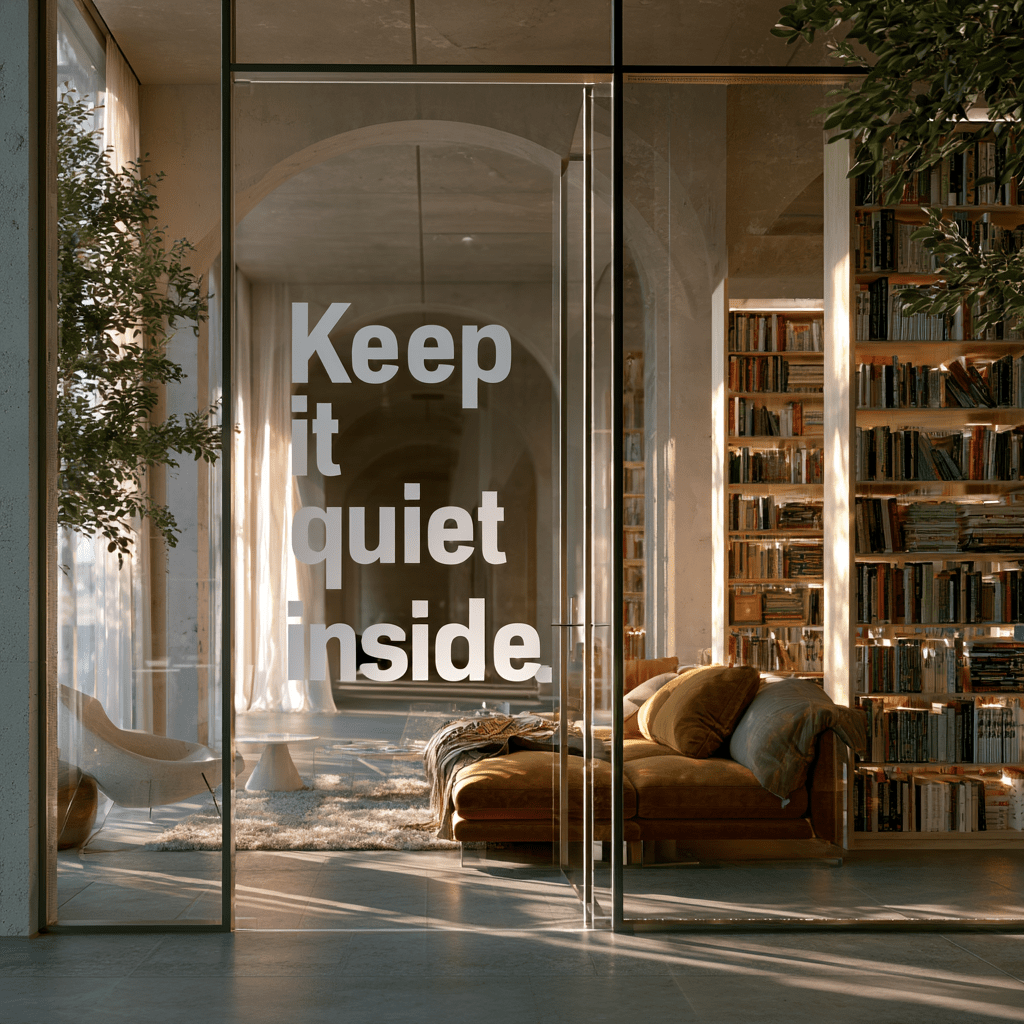
The door swings open. Printed on the glass in bold capital letters, black on white, is the sign: KEEP QUIET WHEN INSIDE.
Michael reads it.
His expression says: noted, and irrelevant.
They step through.
The door closes behind them and the library swallows both of them into its cool, book-scented quiet. Outside, Manila hums along. The columns don’t react. The stone steps stay exactly where they are. Nothing about the building hints at what’s waiting inside.
Libraries never do.
Research_before_rocket_science.sav
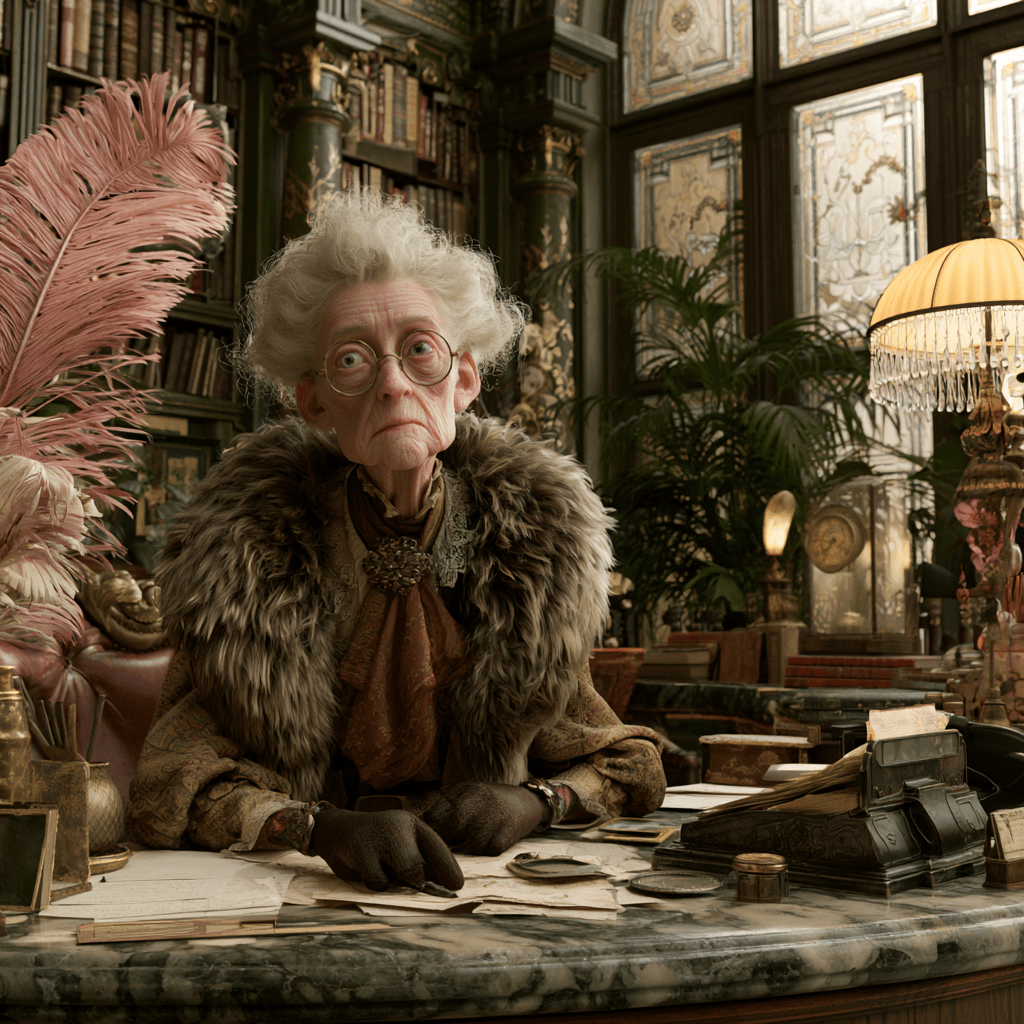
The reception desk sits just past the entrance, manned by a librarian who looks like she was hired when the building was new and has outlasted three generations of borrowers. Elderly. Thick glasses that magnify her eyes to an unsettling degree. Grey hair pinned back with the precision of someone who considers loose strands unprofessional. She looks up from her desk as the two of them approach, and her expression lands somewhere between stern and already tired of whatever is about to happen.
She looks at Benjamin.
“Do you have a borrower’s card, iho?”
“Yes, Ma’am.” Benjamin reaches into his jacket pocket without hesitation and produces a laminated card. He hands it over with both hands, slight bow of the head. Textbook courtesy. The librarian takes it, holds it up, examines it like she’s authenticating currency.
Whatever she finds there satisfies her. She hands it back.
“You may proceed. Both of you.” Her gaze flicks briefly to Michael, cataloguing him in about a second and a half, then returns to her desk.
Michael watches this whole transaction with his arms crossed and his head tilted.
“How did you even get a card?”
“You mean this?” Benjamin holds it up between two fingers. “I got it when we did science research for school.”
“You’re such a nerd, bro.”
Benjamin doesn’t reply. He pockets the card and starts walking.
I find this interesting. Not the card itself — the fact that Benjamin had it ready. No fumbling, no checking multiple pockets, no wait, let me find it. He knew exactly where it was. That kind of thing doesn’t happen by accident. That’s a person who organizes their life around the idea that preparation matters, and has been doing it long enough that it’s just automatic.
Michael follows his brother with his hands in his pockets, looking unbothered.
The librarian watches them go, then looks back down at her desk.
She has no idea she just cleared two Acolytes for entry.
Brothers_brains_brawn.sav
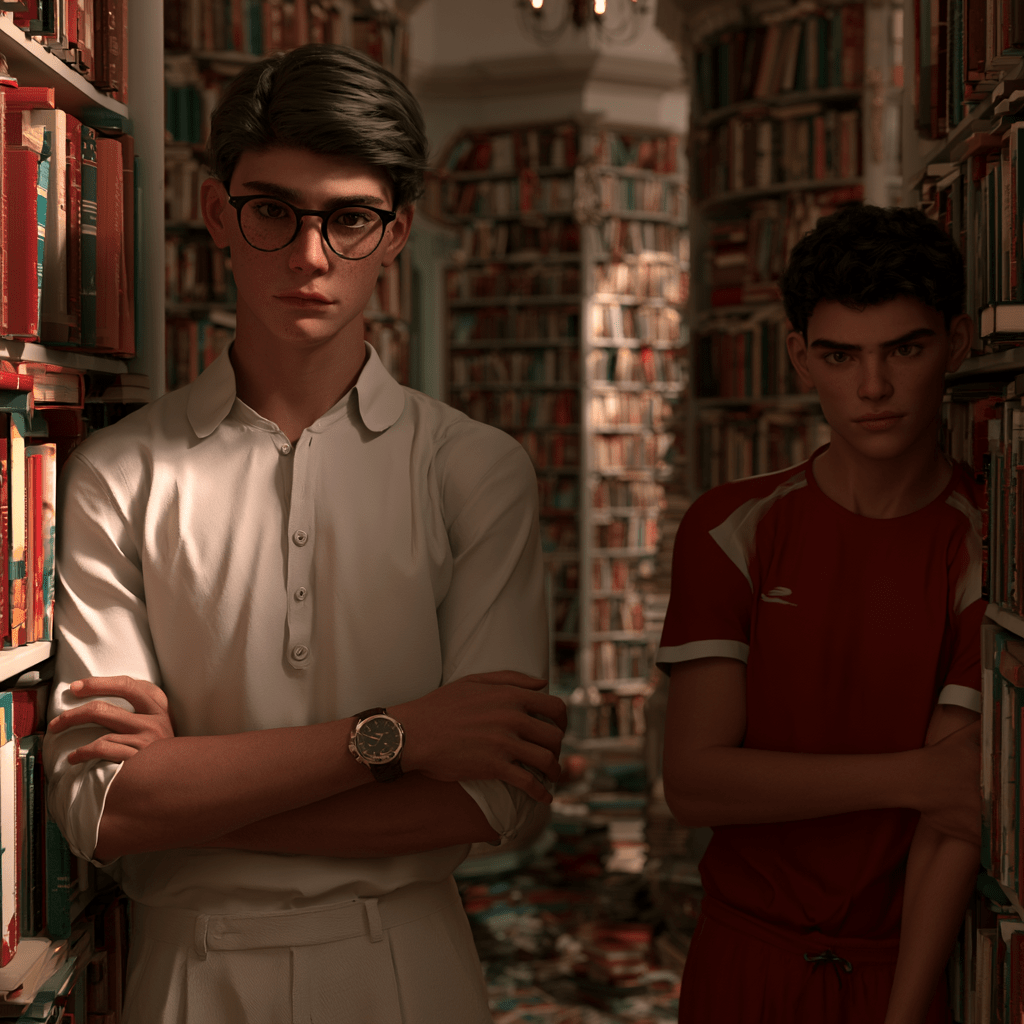
The reading floor opens up ahead of them — long rows of shelves stretching toward the far wall, the kind of library interior that makes a place feel bigger from the inside than the outside should allow. The shelves are tall. Not store-tall, but properly tall, the kind where the top row requires a ladder on wheels and nobody has touched those books since the previous decade. The air is cool and carries that specific smell: paper, dust, and something faintly wooden. Quiet presses down from everywhere.
Michael throws an arm over Benjamin’s shoulder without asking permission.
“You got mad at us for going out in the field,” he says, the grin already loaded before the punchline arrives, “but now you’re stuck with me on this mission.” He lets the pause do its work. “Ironic, huh?”
Benjamin doesn’t shrug the arm off. He keeps walking at the same pace, expression unchanged. “If I had a choice, I wouldn’t be stuck with you.”
“You’re lucky to be stuck with me,” Michael says, completely unbothered. He drops the arm and falls into step beside his brother, hands in his pockets now, posture loose. “Your brains might be good. But without my brawn, you’d be useless.”
Benjamin says nothing. He turns down the first row of shelves.
Here’s the thing about Michael that most people probably miss under the surface noise: he’s not wrong. He’s annoying about it, yes, and he delivers the observation with all the subtlety of a car alarm, but the tactical math he’s describing is accurate. Benjamin thinks in systems and contingencies. Michael hits things very hard. The combination has worked exactly once already in documented history, and they’re currently walking toward their second test.
The shelves close in around them on both sides. Benjamin slows his pace as he scans the spines. History. Natural sciences. Philippine literature. Reference. His eyes move with the systematic efficiency of someone who actually knows how libraries are organized, which is not a skill you develop by accident.
He stops.
Pulls a book from the shelf.
It’s an encyclopedia. A big one. The kind that suggests it covers everything and weighs roughly as much as a medium-sized dog.
“What are you doing?” Michael asks.
“Since we’re here to observe,” Benjamin says, flipping it open to somewhere in the middle with practiced ease, “we might be waiting a while. I might as well get some reading done.”
Michael stares at him.
“Oh my God.” He sounds genuinely offended. “You’re seriously going to read that boring thing?”
“Yep.” Benjamin flips another page. He’s not even looking at Michael. “Diving right in.”
There it is. The deliberate calm. Benjamin knows exactly what that encyclopedia is doing to his brother — he can read Michael the way Michael can read an opponent in a fight, and right now he’s applying that knowledge for personal entertainment purposes. The book isn’t just a book. It’s a tactic.
Michael glares at the encyclopedia with the specific hostility of someone who suspects he’s being messed with but can’t prove it.
I could tell him. I am right here. Technically present in every sense except the one that matters. But that’s not how this works, and it was never going to be.
The library is quiet. The two brothers stand between shelves that reach almost to the ceiling, one of them reading an encyclopedia, the other radiating impatience. The fluorescent lights hum softly overhead. Somewhere deeper in the building, something shifts.
Not anything visible yet. Just a feeling in the air.
Like the library is deciding what it wants to become.
Empty_library_loading.sav
They find a long table near the center of the room and claim it. Benjamin sets the encyclopedia down flat, opens it to a section somewhere in the middle, and settles in with the quiet focus of someone who genuinely enjoys this. His posture is straight. His eyes track the page steadily. He could be studying for an exam. He could be killing time. Either way, he looks like he’s done this before and expects to do it again.
Michael drops into the chair beside him, leans back until the front legs lift off the floor, and starts looking around the library the way a person looks around a dentist’s waiting room.
Twenty seconds of this is apparently his limit.
“Isn’t there a comic book or something here?” he says. Not quietly.
Benjamin’s eyes don’t leave the page. But one side of his jaw tightens.
The glare he gives Michael is brief and surgical.
“Young man.” The librarian’s voice cuts clean across the reading floor from her desk. “Keep your voice down.”
Michael straightens the chair legs back to the ground. He doesn’t look particularly sorry. He scans the shelves with renewed purpose, like maybe if he looks hard enough a manga section will materialize through sheer force of wanting. It doesn’t. The shelves offer back history, science, literature, and the kind of reference books that are alphabetized and never touched.
“Boring place,” he announces. “Total snoozefest.”
Louder this time.
“Didn’t you read the sign?” The librarian again, sharper now. “Observe silence!”
Michael grins. There it is — not malice, just Michael, who has apparently decided that provoking the librarian is now the most interesting activity available to him in this building. He glances around at the other occupants: a handful of students bent over their own tables, notebooks open, pens moving. Nobody looks up. A few of them flinch slightly at the noise.
Then Michael blinks.
One of the students at the far table is gone. He was there a second ago. Bag on the chair, notebook open, head down. Now the chair is empty. The notebook is gone. The bag is gone. No sound of movement, no scraping chair, nothing.
Michael watches the next table. Two students. He counts them. One. Then, between one breath and the next, there’s only one. Then none.
He watches this happen across the room with the slow, mounting realization of someone who has just noticed that a magic trick is being performed around him rather than for him.
Okay.
He turns back to face forward and clears his throat.
“You know why old spinsters are so cranky?” he says, loud enough to carry easily to the reception desk. “They’re just cat ladies with no excitement in their lives!”
He waits for the response.
Nothing.
He turns.
The reception desk is empty. The librarian’s chair is pushed in neatly. The desk lamp is still on, casting a yellow circle of light over an open logbook and a pen resting in the binding. No librarian. No sign of where she went.
“What the…”
He looks across the reading floor. Every table. Every chair. The room is completely, utterly empty. No shuffling. No breathing. No ambient sounds of anyone else existing in the same building. The fluorescent lights hum. The shelves stand. The air holds perfectly still.
Michael stands up from his chair.
“What is going on?”
He turns to Benjamin, who has not moved. Benjamin is still reading the encyclopedia. Page turned since the last time Michael checked, which means he’s actually processing it, which is not the point right now.
“Hey.” Michael nudges him. “Bookworm.”
Benjamin turns a page.
“Hey.” Nudge. Harder. “Listen up.”
“If you’re trying to mess with me,” Benjamin says, completely level, eyes on the page, “I’m not playing along.”
Michael grabs Benjamin’s head with both hands and physically redirects it to face the room.
Benjamin’s reaction is immediate: hands up, about to protest. Then the protest dies. His eyes track across the reading floor, from the empty tables to the empty chairs to the empty reception desk to the empty doorway, and the expression that crosses his face is not fear exactly but the specific look of someone doing rapid mental arithmetic on a problem they weren’t expecting.
He stands up. The encyclopedia stays open on the table, abandoned mid-entry.
“How is this possible.” It doesn’t come out as a question. His voice has dropped. “Where is everyone. The librarian. The students.”
“Weird, right?” Michael says.
He can hear that Michael is trying to sound casual about it and mostly failing. Michael’s hands have shifted — they’re no longer in his pockets, they’re loose at his sides. He’s already adjusting his weight without thinking about it, distributing it, putting himself in a position to move fast in any direction. The grin is gone.
Benjamin’s eyes move across the space one more time, systematic, checking angles and exits.
“This isn’t right.” He says it quietly, almost to himself. “People don’t just disappear.”
The library holds its silence.
Then something clicks in Benjamin’s expression. A piece falling into place. He goes still for half a second in that way he does when his brain catches up to a pattern and he doesn’t want to say it out loud yet because saying it out loud makes it real.
“Wait.”
Michael turns to look at him. “Wait what?”
“Could it be?”
“Could it be what?”
Benjamin looks at him. His voice comes out controlled, deliberate, each word placed with care. “We’re transitioning into the dominion.”
The word lands in the empty room.
The dominion. The monster’s realm. The warped overlay that Greek monsters apparently drag into the world when they decide to make a location their own — the way a normal forest stopped being a normal forest for Ruana and Allison, the way a balete tree became a portal, the way Athena’s temple materialized out of nowhere in the middle of Philippine geography. The dominion is the mechanism by which myth stops being myth and becomes something you can punch.
Which means somewhere in this building, a seven-foot bull-headed monster is waiting.
Michael’s expression does something interesting. The unease that had been creeping in across the last two minutes pulls back, and what replaces it is sharper, cleaner, and considerably more comfortable on his face. His shoulders drop slightly into their natural position. His weight settles.
“Get ready, Michael,” Benjamin says, low.
Michael cracks his knuckles.
There it is.
For most people, learning that a labyrinthine monster realm has just quietly assembled itself around them in a public library would represent a significant escalation of personal danger. For Michael, it appears to function primarily as confirmation that something worth doing is finally about to happen.
He is not most people.
The fluorescent lights flicker once, briefly, and the hum they produce shifts just slightly in pitch — lower, somehow, like a note that belongs to a different kind of room. The bookshelves on either side of them stand exactly where they were. But the space between them feels longer than it should. The far wall, which was clearly visible from the entrance, is less defined now. Edges softening. Geometry renegotiating.
The library is changing around them.
Benjamin closes the encyclopedia.
Labyrinth_Protocol_Initiated.sav
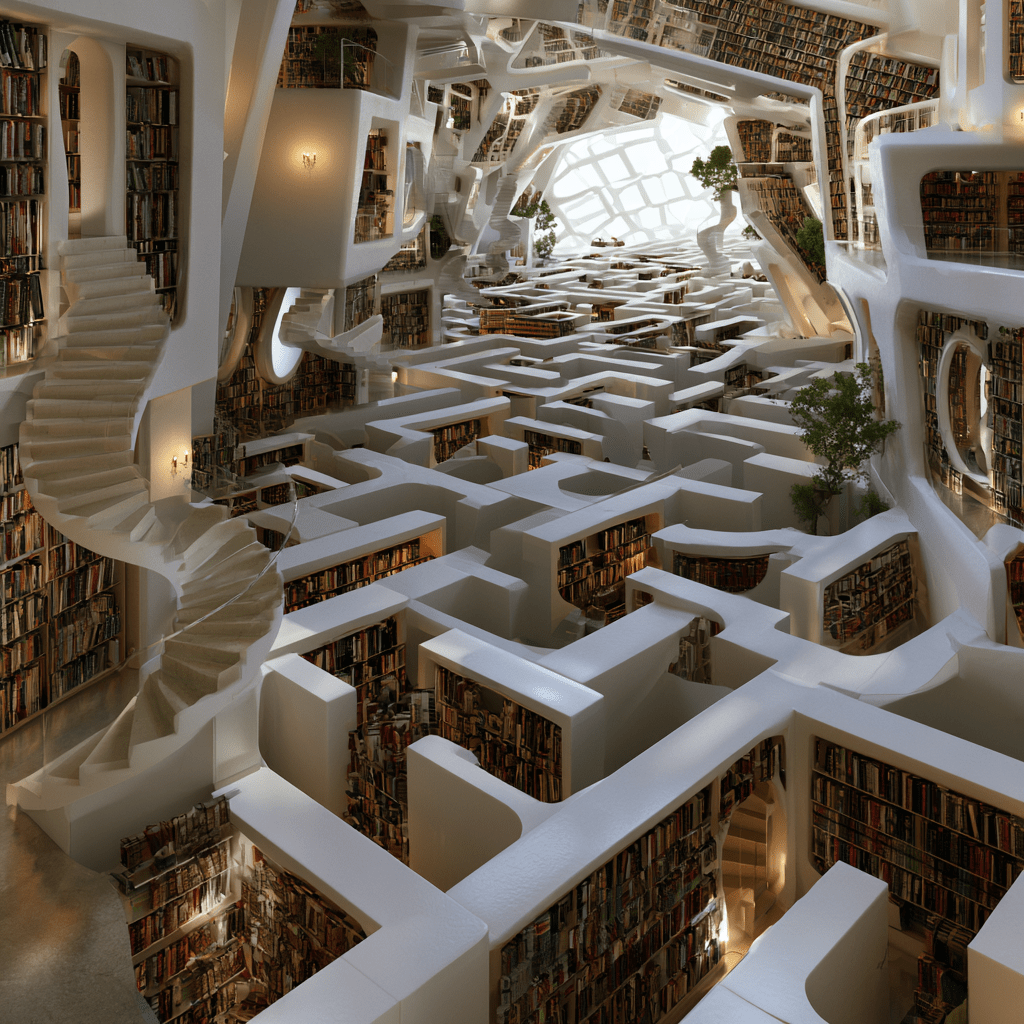
They move down the central aisle together, footsteps quiet on the linoleum floor. The long rows of tables stretch on either side of them, every chair empty, every surface clear. Whatever the dominion did to clear this place, it did it thoroughly. No abandoned bags, no stray notebooks, no half-drunk water bottles. Just absence, clean and total, the way a map looks before anything has been marked on it.
Benjamin walks slightly ahead, gaze forward, tracking the shelves as they pass. He moves like someone following a plan even when the plan is still being assembled. Michael keeps pace a step behind him, head on a swivel, taking in the room from multiple angles simultaneously. He’s quiet, which for Michael means something.
“We’re going to check around the bookshelves,” Benjamin says.
“Figures,” Michael replies.
They turn into the first row. Shelves on both sides, floor to ceiling, packed with reference volumes and bound periodicals and the kind of large-format books that suggest they were acquired for completeness rather than readability. Benjamin runs his eyes along them without breaking stride. Michael doesn’t look at the books at all. He’s watching the gaps between the rows, the shadows at the far ends of the aisles, the ceiling.
“There really aren’t any students left,” Benjamin says, more to himself than to Michael. “Not even back here.”
He’s right. The back section of the library is as empty as the front. No movement, no sound of pages turning, no ambient presence of other human beings anywhere in the building. The quiet has a specific quality to it, the kind that isn’t just the absence of noise but feels like something pressing in from the edges.
Above them, the fluorescent lights flicker.
Both brothers look up at the same time.
The flickering intensifies — not a gradual thing but a rapid, escalating strobe that throws the aisle into alternating sharp light and shadow. One of the tubes at the far end sparks. Then another, closer. The electrical pops punctuate the silence in short, bright bursts.
“Look!” Michael’s arm comes up, pointing left. “The wall’s closing in!”
Benjamin turns. The wall at the far end of the left shelves is moving. Not fast, not dramatic, but measurably, undeniably moving — the gap between the shelves and the exterior wall shrinking with the patient, mechanical certainty of a hydraulic press.
“And over there!” Michael points right. Same thing. The right wall, same motion, same pace.
The floor moves.
Not violently — no crack or split or sudden lurch, just a low, deep tremor that travels up through the soles of both their shoes and says something fundamental has changed about the ground they’re standing on. The vibration is constant and building.
The shelves begin to shift.
This is the part where the dominion stops being subtle. The rows of bookshelves — fixed, bolted, heavy with decades of accumulated volumes — begin sliding toward each other, the paths between them narrowing as the outer walls drive inward. Books shake loose from the upper shelves. One falls, then several, then an entire row tips and cascades, pages splayed, spines cracking against the floor. The aisle ahead of them is tighter than it was ten seconds ago. The one behind them is already gone.
The lights are still strobing. Sparks fall from two of the overhead tubes in short, bright showers that die before they reach the floor.
“Run, Michael!” Benjamin’s voice comes out sharp and clear over the noise. “We have to get out of here!”
Michael doesn’t need to be told twice.
He goes.
Full speed, immediate, no ramp-up, the way Michael does everything physical: committed entirely from the first step. He’s in the next aisle before Benjamin has fully started moving, weaving between the closing shelves with his arms pumping and his eyes reading the space ahead. A gap appears on the left, he takes it. Another narrows on the right before he reaches it, he adjusts, cuts back. The footwork is instinctive and fast and frankly impressive to watch.
Benjamin follows, moving with less natural athleticism but more deliberate economy. He doesn’t waste steps. His path through the narrowing rows is calculated — he’s reading the geometry of the collapsing space and choosing routes that buy him the most distance before the next obstruction. Books are everywhere underfoot now. He clears them without breaking stride, landing each foot with precision.
The sparking lights throw everything in strobed fragments. Half a second of bright clarity, half a second of near-dark, repeat.
A shelf section to the right collapses, the whole structure toppling inward, volumes cascading across the floor in a long sliding wave of paper and binding. The outer wall behind it is closer now, much closer, pushing the debris ahead of it. The path it cuts off forces both brothers to veer sharply left, then cut between two shelves that are close enough that Benjamin has to angle his shoulders to fit through.
From directly overhead — if you could see it from above, which the sim lets me do, the white cube warping to give me the aerial view — the shape of what’s happening is clear. The outer walls are driving everything toward the center, compressing the maze inward, and the two brothers are in the middle of it, running through what’s left of the navigable space as it collapses on both sides. The paths that exist now will be gone in thirty seconds.
Ahead of them, at the far end of the collapsing rows, a door.
The exit.
Michael sees it first. He doesn’t slow down to confirm it, doesn’t call back to Benjamin about it. He just runs at it. The gap between the last two shelves is barely a meter wide when he reaches it and still closing. He plants his right foot and drives off it hard, extending into a long, flat leap that carries him through the gap and past the threshold in one motion.
He clears it. Turns. Plants himself in the doorway, braced, looking back.
“Come on, Benjamin!” His voice is loud over the noise of the collapsing shelves. “Just a few more steps! You’re almost there!”
Benjamin is in the last row. The shelves on both sides of him are close enough that a sideways step would put him into the wood. Books are still falling. The floor shakes harder than before, the tremors coming faster. The exit is ahead of him and the space behind him is ceasing to exist.
He runs.
The last section of shelving begins to go. I can hear the wood cracking under the lateral pressure, the structural joints giving out. The sound is deep and percussive, the kind of thing that vibrates in your sternum.
Benjamin hits the gap at full stride and launches himself through.
He makes it.
The exit door is behind them both. The crash arrives a half-second later — the remaining shelves coming down in a chain reaction, wood and books and everything accumulated in that building over decades folding into each other, and then the ceiling dropping behind them in a single catastrophic impact that shakes the floor hard enough that both brothers have to catch their balance.
Then it stops.
The sound dies. The shaking stops. The sparking lights are gone.
Michael and Benjamin stand side by side and look at what used to be the exit. The doorway behind them is sealed. The collapse didn’t leave rubble — it left a wall, solid and ancient-looking, stone where there was wood, construction that belongs to a different century entirely. The fluorescent lights are gone. The linoleum floor is gone.
They’re standing at the entrance to a corridor.
Stone walls, roughly cut. Low ceiling with iron torch brackets, unlit but present. The passage extends ahead of them into dim, even shadow. The air smells of earth and moisture and something older than either of those things. It’s cooler than the library was. Not unpleasantly so, just noticeably.
There are no bookshelves. No tables. No librarian’s desk behind them. The National Library is, structurally speaking, no longer where it was.
The Labyrinth of Crete is.
I hold on the two of them for a moment. Benjamin is catching his breath, hands on his knees for exactly two seconds, then he straightens. He does a full rotation, taking in the corridor in all directions. His jacket is dusty along one shoulder where he clipped something on the way through. His expression is calm with a layer of alertness directly under the calm.
Michael is standing fully upright. He’s breathing hard but not distressed. His eyes are moving the way they always move when there’s a threat somewhere in the vicinity: forward, then sides, then up. He doesn’t look at the ceiling long. He looks back at the corridor ahead.
Somewhere in the stone passages in front of them, in the dark and the mist and the architecture of a myth that has waited a very long time for someone to walk back into it, something is waiting.
They both know exactly what.
Benjamin reaches for his left wristwatch and activates the holographic display. The cyan glow fills the corridor in a quiet wash of light.
Michael rolls his neck once, left then right.
The corridor waits.
Minotaur_intel_brief_now.sav
The other side is a room.
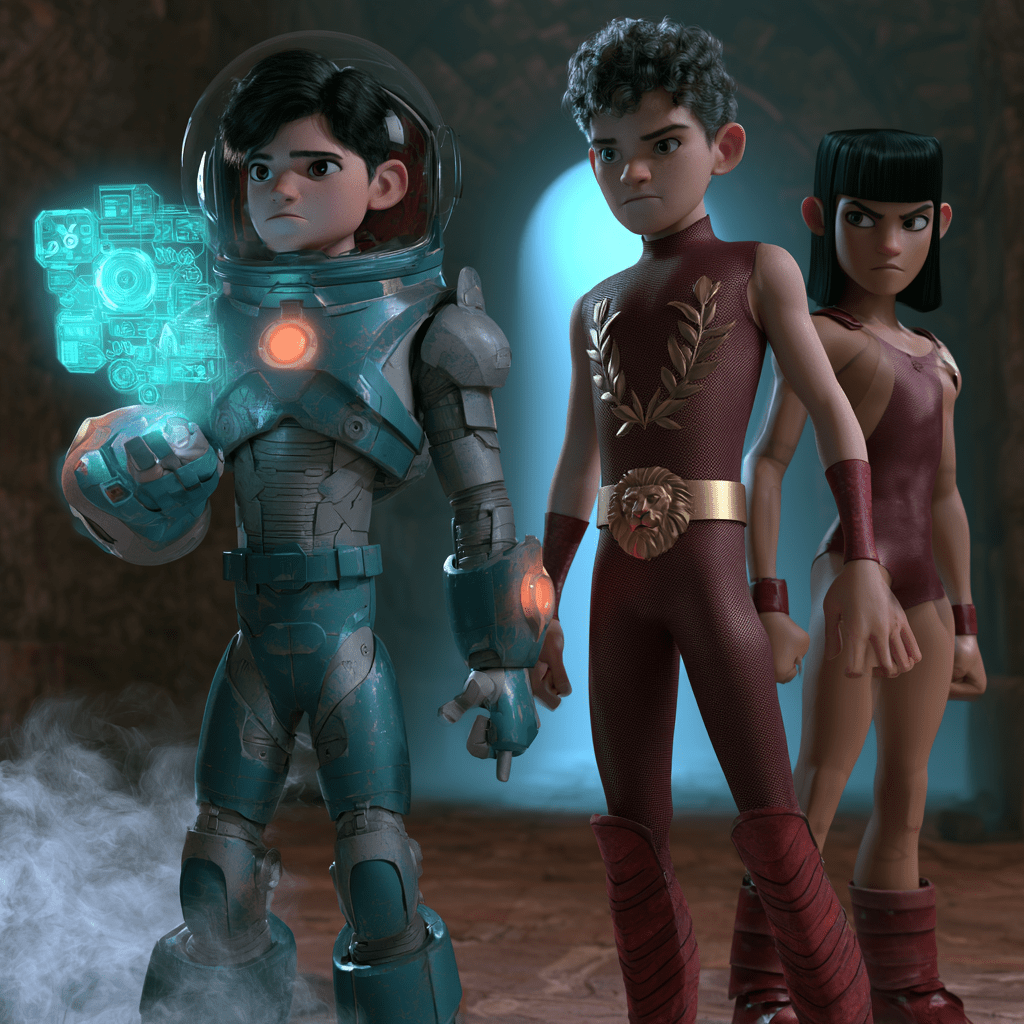
Not a corridor, not a passageway — a room, wide and low-ceilinged, with walls of rough-cut brick stacked unevenly like whoever built them was working fast and didn’t particularly care about aesthetics. The mortar between the bricks is old and uneven. The whole space carries the feeling of something constructed to contain rather than to welcome. A faint cyan glow comes from somewhere — no visible source, no torches, no fixtures, just a cool blue-green light bleeding from the corners and the seams between stones as if the air itself has been faintly irradiated. Mist covers the floor from wall to wall, ankle-deep and still, obscuring whatever the ground looks like underneath.
Michael turns a full slow circle, taking it in. His expression isn’t alarmed. It’s the look of someone recalibrating.
“It’s reality warping,” Benjamin says.
He’s already looking at his wristwatch. It’s a slim, precise thing — silver casing, cobalt blue detailing on the face, the kind of design that sits between functional and deliberate. He clicks the side button once. The small screen activates and throws a cyan hologram upward from the surface, hanging in the misty air above his wrist at eye level.
Then the nano-molecules arrive.
They come up through the mist from the floor, assembling in the air around him in a pattern that looks almost organic: floating pads materializing one by one at precise intervals, rising to shoulder height, positioning themselves around him in a loose ring. Each pad emits a thin cyan laser beam. The beams cross and intersect, projecting additional nano-molecules into the space between, and those molecules begin to structure themselves — layering, solidifying, building outward and inward simultaneously.
The transformation takes about twelve seconds from start to finish.
What was Benjamin Pangilinan — sixteen years old, cobalt blue wristwatch, dusty jacket from the run through the library — is now Captain McKinley. The suit is cobalt blue and gray titanium, full coverage from boots to collar, the kind of construction that suggests military-grade function packaged into something that still has a silhouette. The helmet materializes last, sealing over his features and replacing them with the visor’s cool, angled face. The cyan glow from the nano-molecule assembly settles, fades, and leaves him standing in the misty room as something considerably more substantial than what he was before.
Michael doesn’t watch with awe. He watches with the casual attention of someone who has seen this enough times that it’s become familiar. Then he activates his own transformation, and the scarlet takes over — the spandex suit assembles, and Spartan is standing where Michael was.
They leave the room through the only opening available: a narrow passage cut directly into the far wall.
What follows is several minutes I’m not going to dramatize in real time, because navigating a labyrinth turn by turn would be approximately as compelling to watch as a loading bar. They move through the passages — left, right, straight, right again — the mist thinning as they go deeper, the cyan glow from the walls persisting without explanation. The brick walls are consistent throughout. The ceiling stays low. The air is cool and dry and old. Neither of them speaks much. Captain McKinley tracks their position and direction with the focused attention of someone running a continuous internal map. Spartan walks slightly ahead of him, which tells me everything about how each of them thinks about unfamiliar spaces.
Eventually, the passage opens.
The room is larger than anything they’ve passed through — high-ceilinged, wide, with a floor cleared of mist. Stone carved with patterns that belong to a very old aesthetic: labyrinthine spirals, geometric repetition, the visual language of Minoan Crete rendered in whatever the dominion has decided stone looks like. The space feels like an arena that hasn’t been used in a long time and is about to be.
“I think we’re in a labyrinth,” Captain McKinley says. His voice carries the slight resonance of the helmet’s internal acoustics. “These endless hallways give it away.”
He pauses.
“And if that’s true, we know which monster we’re dealing with.” He looks at Spartan. “The Minotaur.”
Spartan’s posture shifts in a way that has nothing to do with apprehension. His chin comes up, his weight drops slightly into a readier stance, and the expression that comes across his face is the one I’ve catalogued from every fight he’s been in: genuine anticipation.
“The strong guy, huh.” Not a question. “This is going to be fun.”
Captain McKinley does not share this assessment, visibly. “We need to prepare. Knowledge is our best weapon here.”
He taps the space gauntlet. The hologram rises again, wider this time, and additional data pads assemble from the nano-molecules in the air — floating cyan screens, each projecting text and basic visual schematics. He navigates through them with practiced efficiency, pulling up what he needs.
“This is what I’ve gathered,” he begins. “The Minotaur. Half man, half bull. Born from a curse Poseidon placed on Queen Pasiphaë of Crete after King Minos refused to sacrifice a sacred bull. The sea god’s punishment was that the queen fell in love with the animal. The Minotaur was the result.”
Spartan’s expression is doing something complicated.
“King Minos had the architect Daedalus build the Labyrinth specifically to contain it,” Captain McKinley continues. “Near the palace of Knossos. Sealed it in and kept it. Then used it as a sacrificial site — every seven or nine years, Athens was required to send seven young men and seven young women into the labyrinth as tributes.”
“To be eaten,” Spartan says flatly.
“Yes.”
“So we’re basically the tributes now.”
Captain McKinley considers whether there’s a more reassuring way to frame this. Apparently there isn’t. “Yes.”
Spartan absorbs this. His expression remains entirely unbothered. I want to document that for the record: being told you are functionally in the position of a sacrifice to an ancient monster does not register on Michael Pangilinan’s face as a problem.
“Luckily,” Captain McKinley says, “this is a labyrinth, not a maze.”
“Is there a difference?”
“A significant one. A maze has multiple branching paths and dead ends — you can get lost in it. A labyrinth has one single continuous path. No forks. No dead ends. One route in, one route out.” He pulls up a schematic: a simple spiral with a single unbroken line tracing from the entrance to the center. “We stay on the path, we reach the Minotaur. We defeat it, the exit back to the library should return to normal. The dominion collapses when the monster does.”
“Should,” Spartan says, catching the word.
“Should,” Captain McKinley confirms. He closes two of the floating data pads. “Which is why we’re also using your Lasso of Valor.”
Spartan looks at him. “What?”
“As a contingency. You trace our path through the labyrinth with the lasso — anchor it at this room and let it run behind us as we move. If the exit doesn’t normalize after we win, the lasso marks the route back.”
Spartan is quiet for a moment.
“So we have to retrace our steps,” he says. “From wherever we fight it, all the way back to this room.”
“Exactly.”
Spartan exhales through his nose in a long, slow breath. It’s almost the same sound he made in the library when Benjamin pulled out the encyclopedia, which suggests Benjamin produces this particular response in him fairly regularly across multiple contexts.
“You should’ve told me that earlier.”
Captain McKinley looks at him steadily. “I’m telling you now.”
“Before we walked through half the labyrinth, I mean.”
“The lasso works regardless of distance. It’s fine.”
“That’s not the point.”
“What is the point?”
Spartan opens his mouth, then closes it. He reaches back and unsheathes the Lasso of Valor from where it rests at his belt — golden cord, dense and weighted, coiled into a compact disc. He holds it for a moment, looking at it with the expression of someone doing a mental calculation about how much ground they’ve already covered and how much more there probably is.
Then he anchors one end to a protruding stone at the edge of the room and clips the rest to his side so it will uncoil freely as they walk.
He looks at Captain McKinley.
“For the record,” Spartan says, “I’m only doing this because you’re right.”
“I know,” Captain McKinley says.
They face the passage ahead.
The room behind them holds the anchored end of the golden lasso, the mist reassembling slowly along the floor, the carved spirals on the walls describing in their ancient geometry exactly the shape of what the two of them are about to walk into. The Minotaur is in here somewhere. In the myth it took Theseus, Ariadne’s thread, and a sword to resolve. In this version, the thread is golden and Ariadne’s role is being filled by a guy who just complained about it.
Close enough.
The passage accepts them. The mist closes behind their feet with each step. The cyan glow keeps pace with them along the walls, steady and sourceless, and the lasso uncoils quietly in Spartan’s wake, leaving its golden line across the stone floor of the Labyrinth of Crete.
Spartan_versus_the_bull.sav
The space gauntlet projects the holographic map in a small, precise display above McKinley’s left wrist as they walk — a cyan wireframe of the labyrinth rendered in real time, their position marked as a single moving point. He checks it at intervals, never stopping, never slowing. The route has a logic to it once you accept that the labyrinth was designed with only one path: there are no choices to make, only commitment. You follow the corridor. You go where the single path takes you. You arrive at the center eventually because that’s the only place to arrive.
Spartan is less philosophical about it.
He’s been spinning the Lasso of Valor since the first hallway, uncoiling it behind them in a continuous golden thread that marks the floor as they go. The motion is automatic by now, the loop of his wrist mechanical and unhurried. But his face tells a different story: jaw set, eyes moving constantly from floor to ceiling to walls, the particular expression of someone who operates at a higher RPM than the current situation is demanding and cannot do much about it. He’s not exactly bored. He’s waiting, and waiting is its own specific kind of uncomfortable for Michael.
They pass through halls that are wider, then narrower, then wide again. Rooms that open briefly and then funnel back into passages. The carved walls maintain their consistency throughout — the spiral patterns, the geometric repetition, the aesthetic of something built to a very specific and very ancient design specification. The mist follows them at floor level, thinner in some sections, thicker in others, but always present. The cyan glow from the walls keeps its constant, sourceless light.
Then the passage ends at a gate.
It’s large. Taller than anything else in the labyrinth, framed by stone columns carved with the same spiral motifs, the gate itself constructed from what looks like aged bronze worked into interlocking geometric panels. The metalwork is dense and deliberate. Whatever is on the other side, this gate was built to announce it.
Captain McKinley looks at it for a moment.
“This must be the Minotaur’s chamber.”
Spartan’s whole posture changes in about half a second. The coil of lasso goes still in his hand. He straightens, weight shifting forward onto the balls of his feet, chin coming up. The waiting is over.
“Finally.” He says it quietly, which for Spartan is more significant than saying it loudly would be. “It’s action time.” He looks at the gate, then at McKinley. “Let’s do this.”
McKinley puts a hand to the gate and pushes.
The bronze panels swing inward without resistance, as if they’ve been waiting for exactly this.
The chamber on the other side is the largest space they’ve encountered in the labyrinth — high-ceilinged, wide, the floor clear of mist for the first time. The carved walls curve here, following a circular geometry that draws the eye to the center of the room. Stone columns ring the perimeter. The cyan glow is brighter here, diffused through the air itself. It should make the space feel open. It doesn’t. It feels watched.
They step inside.
For several seconds, nothing happens.
Spartan scans left, right, forward. McKinley holds the space gauntlet display active, tracking. The chamber appears empty. The columns stand. The walls curve. The air is still.
Then the floor trembles.
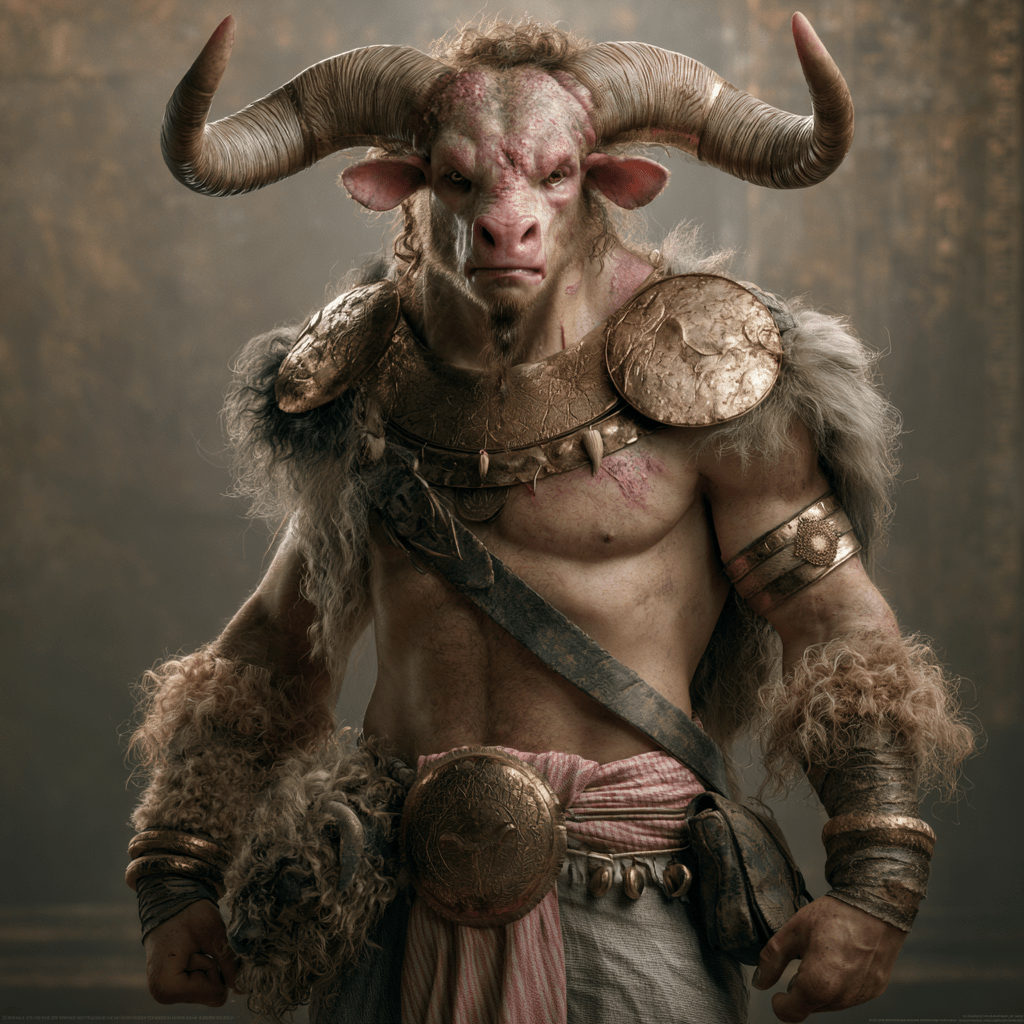
Something at the far end of the chamber moves in the shadows. Big. Heavy. The footfall that follows is deep enough to feel through the stone underfoot rather than just hear. And then the Minotaur steps into the light, and everything about the encounter recalibrates.
Seven feet is the documented figure. Seven feet of humanoid frame built thick through the chest and shoulders, tapering into legs that carry the mass without apparent effort. The lower body is human in proportion but scaled wrong — too dense, too powerful. The upper torso is where the human architecture ends. Above the broad, muscled neck: the head of a bull. Black horns curving outward and forward, each one long enough to be a serious tactical concern. Eyes that catch the cyan light and throw it back in two flat, dark gleams. The body is covered in short dark fur across the shoulders and upper chest, fading into the weathered appearance of something that has been in this labyrinth for a very long time.
It opens its mouth and roars.
The sound fills the chamber completely. It’s not just loud — it’s the kind of noise that has weight, that moves air, that makes the decision for your body about whether your legs take a step back before your brain has any input on the matter.
Spartan takes a step forward.
He goes in first. This is not discussed or assigned — it’s just the order of things when Michael is in range of something that needs hitting. He closes the distance fast, comes in low, and connects with his first punch before the Minotaur has finished its opening roar. The impact is solid. The Minotaur’s head snaps to one side.
Then it swings back and hits Spartan with a closed fist that sends him skidding across the chamber floor on one knee.
He’s up before the slide fully stops.
The exchange that follows is fast and loud and punishing in both directions. Spartan trades punches and kicks with the Minotaur at close range, reading the monster’s rhythm mid-fight, taking hits that would end most encounters and returning them with compound interest. The Minotaur is strong — stronger than anything that size should be, the kind of strength that belongs to something that has been sealed in a stone maze for centuries with nothing to do but exist and grow more dangerous — but Spartan doesn’t go down. He absorbs, resets, and comes back each time from a slightly different angle.
While that’s happening, McKinley activates the nano-molecule assembly from his suit.
The gauntlets over his hands — cobalt blue and gray, gravity-assisted, the knuckles weighted with the kind of engineering that multiplies force on impact. He raises the right one, lines up, and fires a burst of cyan laser from his laser blaster. The Minotaur twists away from the blast with speed that has no business existing in something that large. Second burst: dodged. Third: clipped the shoulder, minor effect.
The Minotaur adjusts. It’s been in fights before.
McKinley changes approach. He comes in close, and the gauntlets do what they were built to do — the gravity enhancement converts his bodyweight into something the Minotaur actually has to account for. He drives a combination into the monster’s ribs, then takes an elbow across his left shoulder that compromises the gauntlet housing on that side.
Simultaneously, Spartan goes airborne.
He clears the Minotaur’s head by about two meters, hangs at the top of his jump, and fires his heat vision downward in a sustained beam of scarlet light. The first shot tracks across the Minotaur’s right shoulder. The second catches its back. The monster staggers forward, the bellowing taking on a different register — pain in it now, genuine pain, the sound of something discovering that it can be hurt.
Spartan reads this.
He and McKinley don’t talk. They’ve been in proximity long enough that the communication happens faster than words. McKinley pulls back from close range. Spartan is already moving.
He rises to the apex of his jump, clasps both fists together above his head, and drives into a full rotation — body coiling into a high-speed spin, the momentum building and concentrating, the whole thing acquiring the geometry of something that was designed specifically to go through other things. He drops toward the Minotaur at speed and hits it square in the torso with both fists at the center of the spin.
The impact punches clean through.
The Minotaur stands with a gaping wound through its abdomen and doesn’t immediately fall, because apparently that’s where we are now, and I note for the record that the sim room around me has gone very quiet.
McKinley moves.
He brings both gauntlets together, the nano-molecule housing of each unit connecting and reconfiguring as they merge — the combined form projecting a long cyan blade from the joined housing, straight and bright and shaped like a longsword. He gets a running start, leaves the ground in a single clean leap, and brings the blade across in one stroke.
The Minotaur’s head leaves its shoulders.
The chamber goes still.
The Minotaur stands for a moment that seems longer than it is — headless, torso holed, the body’s last instructions running out. Then it drops to its knees. Then it falls forward, full weight, and the impact against the stone floor is the last sound the labyrinth makes for several seconds.
The body begins to pale. The color drains from the fur, from the skin, from the stone floor where it lies, and then it starts to come apart — dissolving outward from the wound sites, piece by piece, fading into the cyan glow that fills the chamber from everywhere and nowhere. Within thirty seconds, nothing remains. Not even the outline of where it fell.
The chamber is empty.
McKinley lands. He straightens slowly, breathing controlled, and looks at where the Minotaur was.
“We really did it,” he says.
Spartan is already grinning. It’s the full one, the unguarded version that doesn’t show up often. “Yeah, we won.” He turns to survey the chamber with the satisfaction of someone reviewing a completed level. “That monster may have been a Goliath, but we beat it to a pulp.”
McKinley is quiet for a moment. Something in his posture is slightly off. He looks at his left gauntlet, then tries to activate the space gauntlet display.
The holographic map flickers. Glitches once. Goes dark.
“Bad news,” he says. He holds up the left gauntlet — the housing is cracked along the side, the damage from that elbow clearly worse than it looked mid-fight. “My left gauntlet took too much damage. The nano-molecule link is broken. I can’t project the map or coordinates.”
Spartan stares at him. “How are we supposed to get back now?”
McKinley turns and looks at the floor behind them.
The golden cord of the Lasso of Valor runs from Spartan’s belt across the chamber floor and disappears through the gate they entered from, tracing the entire path back through the labyrinth to the starting room. Every turn they took, every hallway they walked, every junction — marked in a continuous unbroken line, exactly as planned.
Spartan follows McKinley’s gaze.
“Oh,” he says. “Right.”
He looks at the lasso. Then at McKinley. His expression runs through several quick calculations.
“I painstakingly traced that entire path,” he says, arriving at the obvious realization with slightly more ceremony than strictly necessary.
“You did,” McKinley agrees.
“So we just follow it back.”
“Exactly.”
Spartan is quiet for a beat. He looks at McKinley with an expression that is working hard to stay neutral. “Your smarts aren’t so bad after all, Brother.”
“Your strength was useful,” McKinley says, evenly and without elaboration.
Spartan extends a fist.
McKinley looks at it. Then he brings his own fist up and connects with it — not quite the smooth reciprocation, slightly mistimed, the kind of fist bump that happens between two people who don’t normally fist bump and are both aware of this. It lands anyway. It counts.
They walk back through the gate. It closes behind them the moment they pass through, the bronze panels swinging shut with a sound like a vault sealing. The golden lasso runs ahead of them on the floor, steady and bright, and they follow it into the passage.
The labyrinth, having done what it was designed to do and lost the thing it was designed to hold, has nothing left to say.
Echidna_counts_the_fallen.sav
The sim doesn’t want to be here.
That’s not a technical observation — the white cube renders the cave with the same fidelity it renders everything else, every stone and tendril and curl of steam resolved to full clarity. But there’s something about Echidna’s cave that makes the space feel hostile to observation, like a room that knows it’s being watched and resents it. The walls are rough volcanic rock, slick with moisture, draped in long curtains of vine that have been here long enough to have turned dark and fibrous. Moss covers every horizontal surface. The air, if I could breathe it, would smell of earth and deep water and something older than both. The cave is vast — the ceiling disappears into shadow above, the walls curve away into alcoves and passages that lead somewhere I can’t see and don’t particularly want to.
At the center of the floor, a chasm runs in a rough irregular line, maybe three meters across, its edges cracked and jagged. From below: the sound of churning rock, the heat of something geological and violent, and plumes of steam rising in slow continuous columns through the gaps. The steam doesn’t disperse the way it should. It rises, flattens, and spreads into a hovering layer at mid-height that catches light from the magma below and glows faintly amber. Within that layer, shapes move. Images form and dissolve and reform.
A viewing window. Built by the earth itself, or something that learned to use the earth.
Against the far wall, the Oracle of Delphi is pinned.
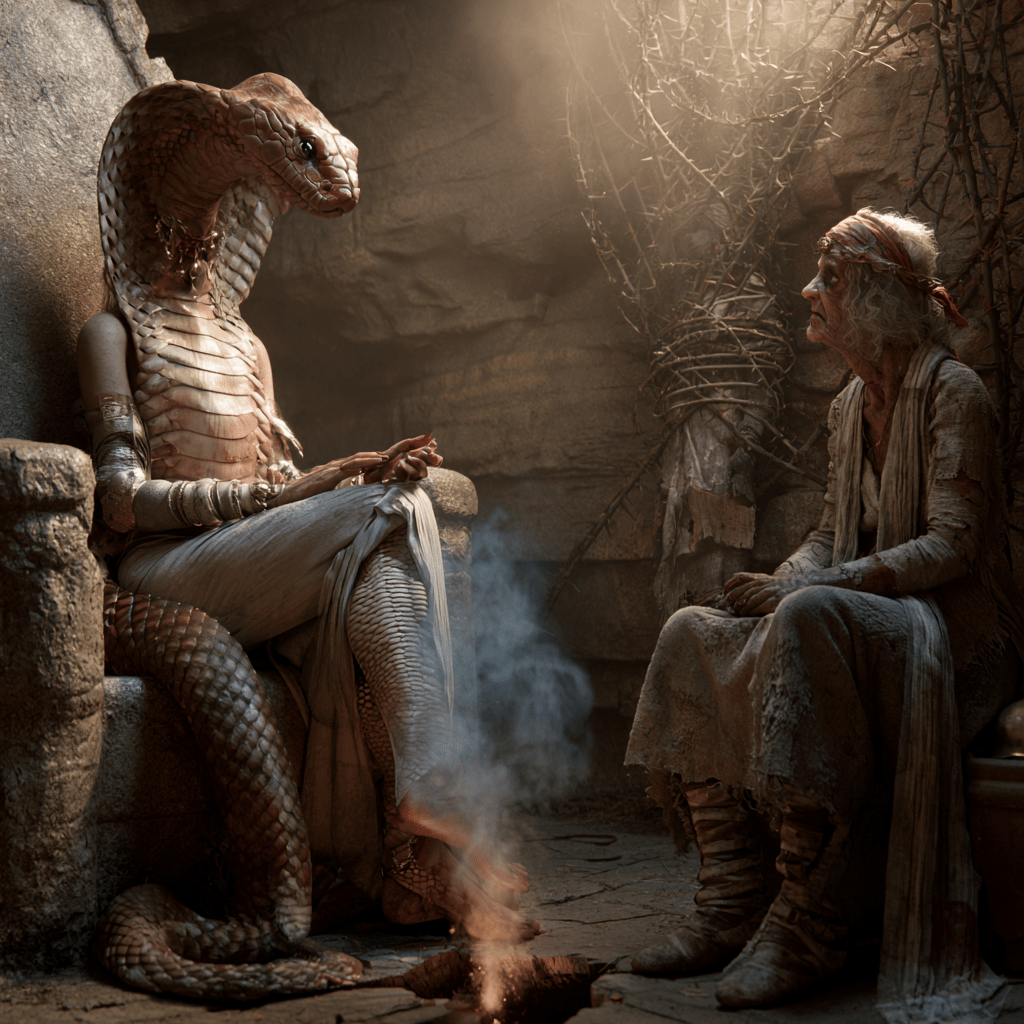
She’s ancient in the way that defies specific measurement — centuries is probably an underestimate, the way saying a star is “far” is technically accurate but misses the point. Her robes are white, or were white, now grey with the cave’s damp. Her arms are extended at her sides, her back against the stone, held in place by dark wooden thorns and tendrils that have grown through and around her with the patient thoroughness of something that had all the time it needed. She doesn’t struggle. Her head is up. Her eyes are open. Whatever she is, captivity hasn’t taken her composure.
And on the throne — if you can call a crude formation of stacked stone a throne, which Echidna apparently can — sits the Mother of Monsters herself.
The lower half is serpent: scaled, thick, coiled in loose rings across the base of the throne and the floor around it, the tail extending back into shadow. The upper half is a woman, her skin green and cool in the amber light, the head of a king cobra. She’s watching the steam window with the focused attention of someone reading a very satisfying report. Her hands rest on the arms of the stone throne. Her posture is unhurried. She has the bearing of someone who has been doing this for a long time and expects to keep doing it for considerably longer.
The steam shows two images simultaneously, like split-screen.
On one side: the ruins of Athena’s temple. A stone figure frozen mid-gesture, arms at her sides, face upturned. Love Fey, calcified from pupils outward, preserved in her moment of premature victory. On the other side: the Labyrinth of Crete, empty now, the Minotaur’s chamber cleared, two figures following a golden thread back through the passages.
Echidna watches both. Her expression doesn’t change between them.
“Pride truly precedes the fall.”
Her voice carries the specific quality of something that hasn’t needed to raise itself in a very long time. Rasping, controlled, each word placed with deliberate weight. “The magical girl — so vain of her beauty, so proud of her powers.” Her eyes stay on Love Fey’s stone form. “She obliterated the great Medusa. Obliterated her. And yet.” The corner of her mouth lifts. “Irony has a cruel sense of humor. That Love Fey is now stone herself.” She settles back against the throne. “Another Acolyte has fallen. And it’s only the Second Day.”
The Oracle doesn’t respond immediately. When she speaks, her voice is quieter but steadier — the voice of someone choosing words rather than spending them.
“It wasn’t all vice.”
Echidna turns her head slightly but doesn’t look at her.
“Brothers Spartan and Captain McKinley,” the Oracle continues. Her eyes are on the steam window, on the two figures following the golden lasso back through the labyrinthine passages. “Oil and water. A contrast that did not blend. One, an athlete wielding pole and ball. The other, a scholar scribing with quill and scroll.” She pauses. “But the sword is as sharp as the quill. And together, their strength felled the mighty Minotaur.”
Echidna is quiet for a moment.
Then: “Hope all you want, Seer.”
She says it without heat. That’s what makes it land harder than contempt would — it’s indifferent, the tone of someone correcting a small factual error rather than arguing. “You’re still firmly in my grasp.” She turns to look at the Oracle fully now, the serpent coils shifting with a dry, slow sound against the stone floor. “The guard dogs of Hades are no simple prey.” Her gaze moves back to the steam window, which has shifted — the Labyrinth image dissolving, replaced by something else. Geography. Ancient coastline. The suggestion of columns and marble and a sky that belongs to a different part of the world. “The Keeper of the Star and the Acolyte who wields music have now crossed into the land where our civilization was born.”
She watches the image settle.
“We shall see how long they last.”
The Oracle says nothing more. She closes her eyes. Whether in defeat or concentration or something else entirely, I can’t tell from here, and I’m not sure I’m supposed to.
I pull back slightly in the sim and take in the full chamber.
I’ve been cataloguing Echidna for a while now, across multiple encounters filtered through the steam and the secondary reports and the aftermath of whatever she sends above. What I keep arriving at is this: she’s patient in a way that most threats aren’t. Echidna herself operates on a longer timeline. She’s not watching the steam window with urgency. She’s watching it the way a person watches a game they already know the outcome of, checking to see if the details match the prediction.
That’s the part that’s hardest to sit with.
The steam shifts again. New images assembling from the heat — the Harpies, the Chimera, configurations of threat I recognize from myth and have been watching materialize into tactical reality one by one across seven days. The second wave isn’t over. The third will follow. Whatever Echidna has arranged, it goes deeper than any single monster, and she is in no hurry.
At the far edge of the chamber, where the cave wall curves into its deepest shadow, Typhon’s tomb stands.
It’s not a coffin, not a sarcophagus — it’s a structure in the wall itself, the stone sealed and marked with symbols that predate every writing system I have any reference for. The proportions are wrong for anything human-scaled. Whatever is in there is large. Whatever is in there is not moving. The tomb doesn’t make sound or light or any observable effect on the cave around it.
But it is there. It is present in the room. And Echidna’s throne faces toward it as naturally as it faces toward the steam window, as if both things are equally worth watching.
I hold the image for a moment longer than I need to.
Above this cave, seven children are fighting mythological monsters across multiple locations in the Philippines, with a body count on the Acolyte side that is currently one. Below this cave, boiling rock churns through geological time. And in between, a serpent woman sits on a stone throne, watching her plans progress through steam, unbothered.
The sim holds the scene in full resolution, every moss-covered stone, every dark tendril across the Oracle’s arms, every amber flicker from the chasm below.
I’m right here.
I can’t do anything about any of it.


Leave a Reply